BioMap has completed a $100 million Series A round of financing, advancing toward superintelligence in the life science sector with its self-evolving microcosm model | Xinglian Portfolio Update
Recently, BioGeometry, an AI Native biopharmaceutical company, announced the completion of its Series A+ financing. To date, the company's total Series A financing has exceeded 100 million US dollars. This round of financing was led by China Life Capital, with additional investment from existing shareholder Shanghai Biomedical Industry Fund. Multiple institutions including China Development Venture Capital, Reliance Investment, Guofang Venture Capital and leading biomedical industrial parties participated in the follow-on investment, while existing shareholder Dacheng Wealth Capital continued to increase its stake. Index Capital continued to act as the exclusive financial advisor. The proceeds from this round of financing will be primarily used for the continuous iteration of the two micro-world models at the molecular and cellular levels, namely GeoFlow (molecular level) and GeoCell (cellular level), the expansion of high-throughput automated laboratories, and the commercialization of self-developed drug pipelines.
Connecting Molecules and Cells: Building a Multi-Scale Micro-World Model
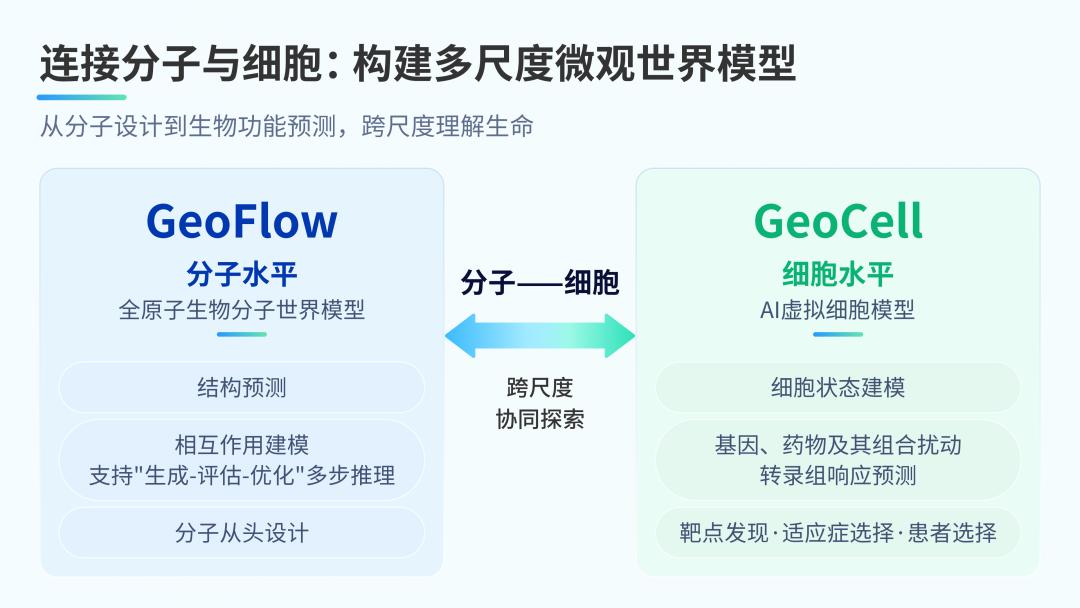
Schematic diagram of the cross-scale model concept of GeoFlow and GeoCell
The key to life science R&D lies in understanding the connections between different scales: how the structure and interactions of molecules affect cell functions, and how cells' responses to interventions in turn help explain the mechanism of action of molecules. Focusing on this issue, BioGeometry has built a micro-world model system that connects "molecules to cells". Among them, GeoFlow is an all-atom biomolecular world model at the molecular level, which continuously integrates capabilities of structure prediction, de novo design and multi-step reasoning; GeoCell, oriented at the cellular level, models cell states and their responses under different perturbations. The two jointly support cross-scale exploration from molecular design to biological function prediction.
GeoFlow: From Structure Prediction and Molecular Design to Complex Molecular Systems
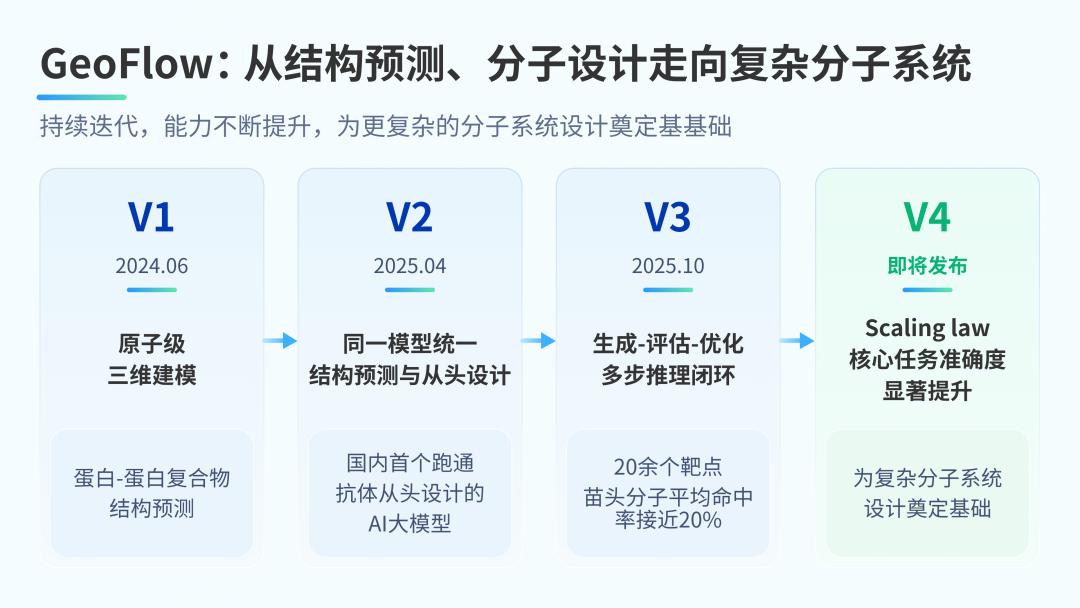
Schematic diagram of the evolution of GeoFlow V1 to V4 models
GeoFlow has completed three generational leaps in two years:
V1 (2024.06) Directly describes the three-dimensional space at the atomic level, and its protein-protein complex structure prediction reaches the same level as AlphaFold 3;
V2 (2025.04) For the first time globally, it unifies structure prediction and de novo design into the same model, becoming the first domestic AI large model that successfully runs antibody de novo design, breaking the monopoly of overseas closed-source models;
V3 (2025.10) It introduces a multi-step reasoning closed loop of "Generation-Evaluation-Optimization" for the first time, which evolves autonomously by imitating the antibody affinity maturation process. The average hit rate of hit molecules on more than 20 targets is close to 20%, nearly 100 times higher than the previous generation of AI methods, and the discovery cycle of lead molecules is shortened to within three weeks.
The upcoming GeoFlow V4 follows the Scaling Law, expanding synchronously in both dimensions of model parameters and training data. The accuracy of core tasks such as structure prediction, interaction modeling and de novo design is significantly improved compared with V3, laying a foundation for more complex molecular system design.
GeoCell: From Molecular Design to Disease Biology
Molecular design is only the starting point. The success of a drug depends on whether the target truly drives the disease and in which patients it works — the answer does not lie in molecules, but in the biological mechanism of the disease. GeoCell, an AI virtual cell model independently developed by BioGeometry, uses generative AI to model the transcriptomic responses of cells under perturbations of genes, drugs and their combinations. It can predict changes in cell states under unseen perturbation conditions, and reconstruct the causal chain of disease occurrence and intervention response at the computational level.
Therefore, GeoCell runs through the three most experience-dependent links in R&D: target discovery — identifying targets that truly drive disease phenotypes; indication selection — determining the diseases where the molecule is most likely to be effective; patient selection — predicting which populations will respond to interventions.
GeoFlow answers "what molecule to design", and GeoCell answers "which target to hit, which disease to treat, and which people to treat". The two together constitute BioGeometry's "molecule-cell" micro-world model. With the continuous accumulation of data and verification results, the understanding of disease biology is deepening.
RSI Dry-Wet Closed Loop: Recursive Autonomous Evolution of Micro-World Models
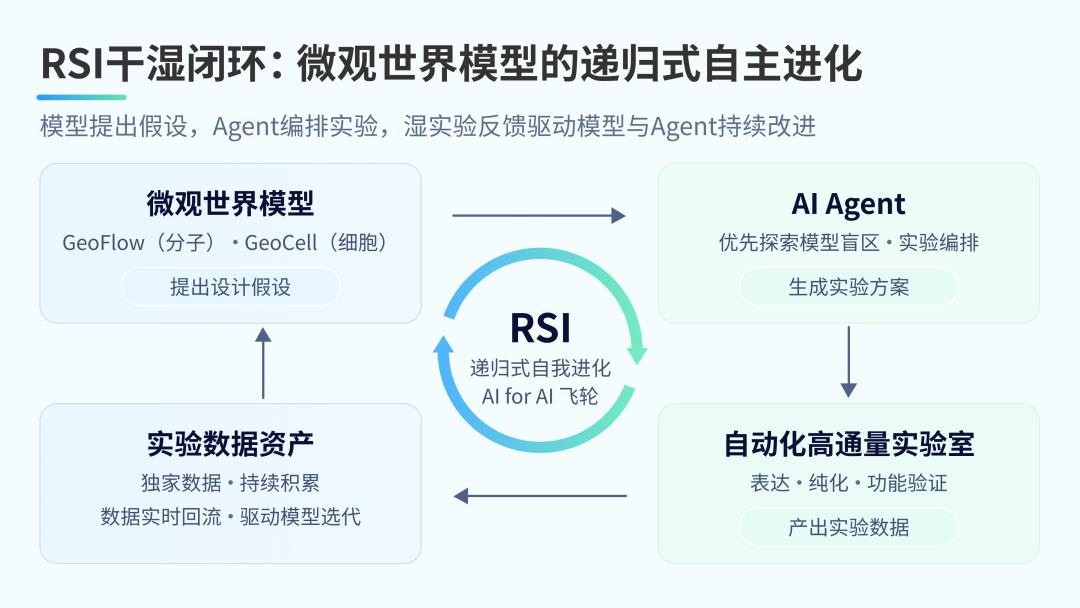
Schematic diagram of the concept of RSI Design-Experiment-Learning closed loop
AI is evolving from "human trains AI" to "AI trains AI" (AI for AI), and recursive self-improvement (RSI) is regarded as the core path leading to superintelligence. BioGeometry brings this paradigm into life science, and every "self-improvement" is verified by real wet experiments.
BioGeometry uses AI Agent to connect the model with the automated laboratory to form the RSI dry-wet experimental system: the model puts forward design hypotheses, the AI Agent automatically generates experimental schemes and arranges processes, the high-throughput platform completes expression, purification and functional verification, and data flows back in real time for model iteration — the "Design-Experiment-Learning" cycle repeats.
AI Agent prioritizes exploring hypotheses that can best expose the model's blind spots. The model corrects deviations and improves design capabilities from real feedback. The model "gets smarter the more it is used", and the Agent "gets more capable the more it operates", forming an AI for AI flywheel in the biological field, and continuously accumulating exclusive experimental data that cannot be replicated by others.
The proceeds from this round of financing will be used to build an automated high-throughput laboratory, with higher throughput and shorter feedback cycles to make the RSI flywheel run faster.
Dual-Driven by Biomedicine and Synthetic Biology to Realize Platform Value Transformation
BioGeometry has reserved dozens of self-developed drug and synthetic biology product pipelines.
In terms of biomedicine, multiple bispecific antibody pipelines will enter the IND stage in 2027.
In terms of synthetic biology, more than 5 product pipelines including α-ketoglutarate (AKG) and natural borneol have completed pilot tests.
Among them, natural borneol has achieved biosynthesis for the first time in the world, with the cost reduced by 80% compared with plant extraction — it is about to be mass-produced on a large scale, and will generate large-scale revenue in 2027.
Models promote pipelines, and pipelines feed back models — with the continuous iteration of GeoFlow and GeoCell, the continuous deepening of the RSI closed loop, and the accelerated advancement of self-developed pipelines, BioGeometry is moving towards the inflection point where technology and commercialization intersect.
This round of financing will accelerate this process, continuously enhance the system's ability to raise questions, verify hypotheses and make autonomous improvements, and move towards superintelligence in life sciences.
Investor Insights
China Life Capital stated: We are very pleased to lead the Series A+ financing of BioGeometry. Scientific Intelligence (AI4S) is the core engine driving the transformation of scientific research paradigms and fostering new quality productive forces, and is becoming the frontier focus of global technological competition. This leading investment in BioGeometry is a strategic move for China Life Capital to anchor the opportunity of AI4S to systematically reconstruct the global life science R&D paradigm, and it is also a practical measure to promote artificial intelligence to take root in high-value scenarios and foster new quality productive forces. As a benchmark company of China's AI Native biotechnology industry, BioGeometry builds differentiated barriers with dual-scale micro-world models of molecules and cells and the Recursive Self-Improvement (RSI) of the dry-wet experimental closed loop, and its industrial cooperation and self-developed pipelines are accelerating to realize value. China Life Capital will give full play to the synergistic advantages of industry and capital, work hand in hand with the enterprise to promote the deep integration of AI and life sciences, and inject new momentum into the intelligent upgrading of China's biomedical industry.
Guo Qiushan, Partner of Shanghai Biomedical Fund, stated: From the joint lead investment in the first round to the continuous additional investment in this round, our judgment on BioGeometry has always been consistent, and has been continuously verified by the test of time. Today, the company has extended its model capabilities from molecules to cells: GeoFlow characterizes molecular interactions with all-atom precision, unifying structure prediction, de novo design and multi-step reasoning; GeoCell models cellular transcriptomic responses under perturbations, enabling capabilities to move from "designing molecules" to "understanding diseases" — running through target discovery, indication selection and patient stratification. Coupled with the RSI dry-wet closed loop that allows the model to self-evolve in real experiments, the technical barriers continue to deepen with the accumulation of data; multiple bispecific antibody pipelines are accelerating towards IND. This additional investment is not only full trust in the team's execution ability, but also firm optimism about the long-term value of this path. We look forward to BioGeometry, relying on its rapidly iterating, self-controllable GeoFlow algorithm base, fully advancing the clinical development of self-developed pipelines and global cooperation.