Zhang Yiming has once again become the richest man, while Liang Wenfeng surges to the 7th spot with a fortune of 280 billion yuan.
Zhang Yiming has become the richest man in China again.
On October 27, the 2026 Hurun China Rich List was officially released. 43-year-old Zhang Yiming, founder of ByteDance, reclaimed the top spot with a fortune of 670 billion yuan, also setting a new record for the wealth of China's richest person.
Zhong Shanshan, founder of Nongfu Spring who ranked first last year, dropped to second place this year with 410 billion yuan. Zeng Yuqun of CATL ranked third with 385 billion yuan, and Ma Huateng ranked fourth with 346 billion yuan.
However, there is another very eye-catching figure this year: Liang Wenfeng, founder of DeepSeek.
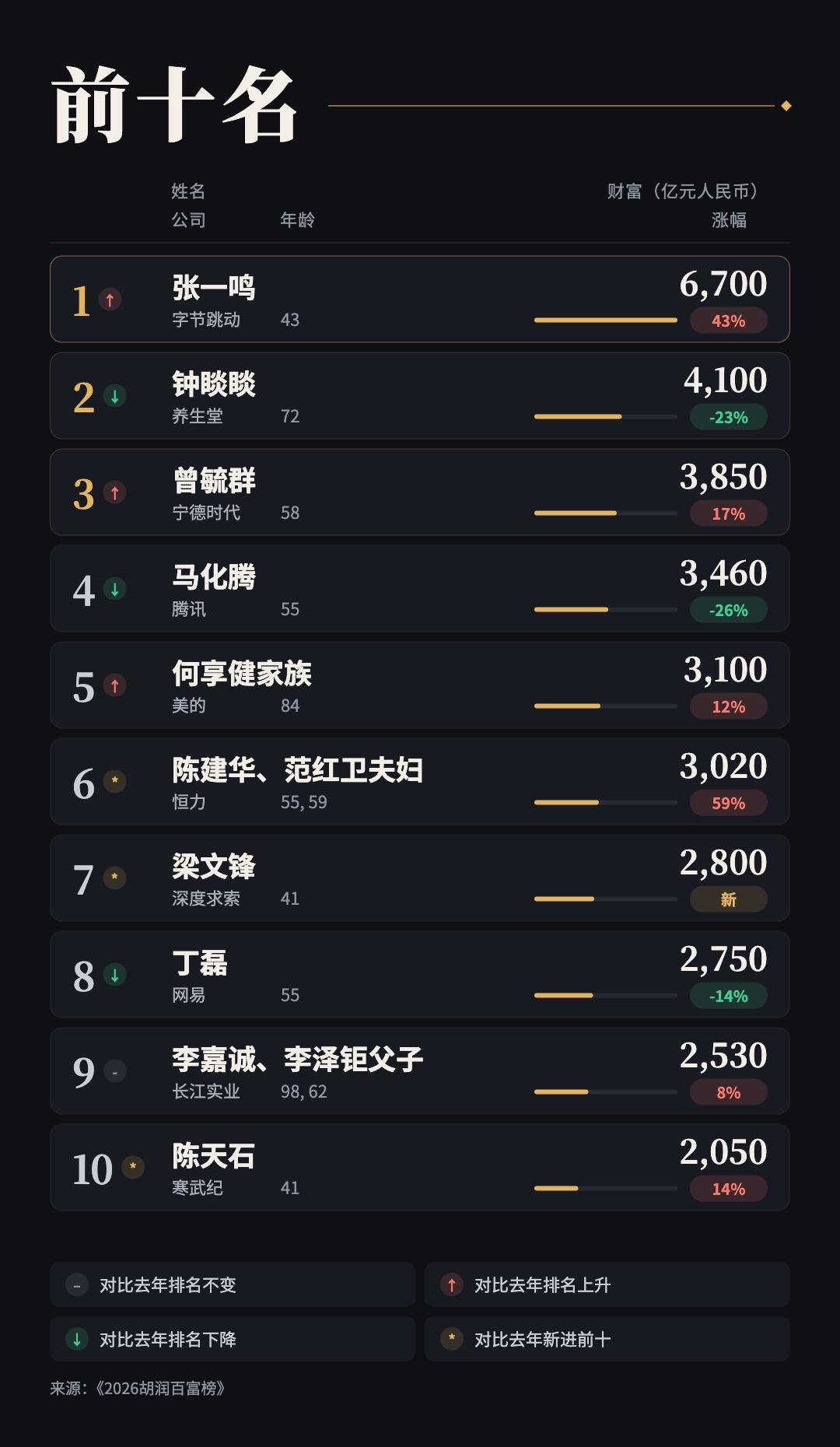
41-year-old Liang Wenfeng, making his debut on the Hurun China Rich List, directly soared to 7th nationwide with a fortune of 2800 billion yuan.
This figure is quite staggering.
It is worth noting that DeepSeek only truly rose to global fame in 2025. Today, Liang Wenfeng's wealth has surpassed many veteran internet tycoons including Ding Lei.
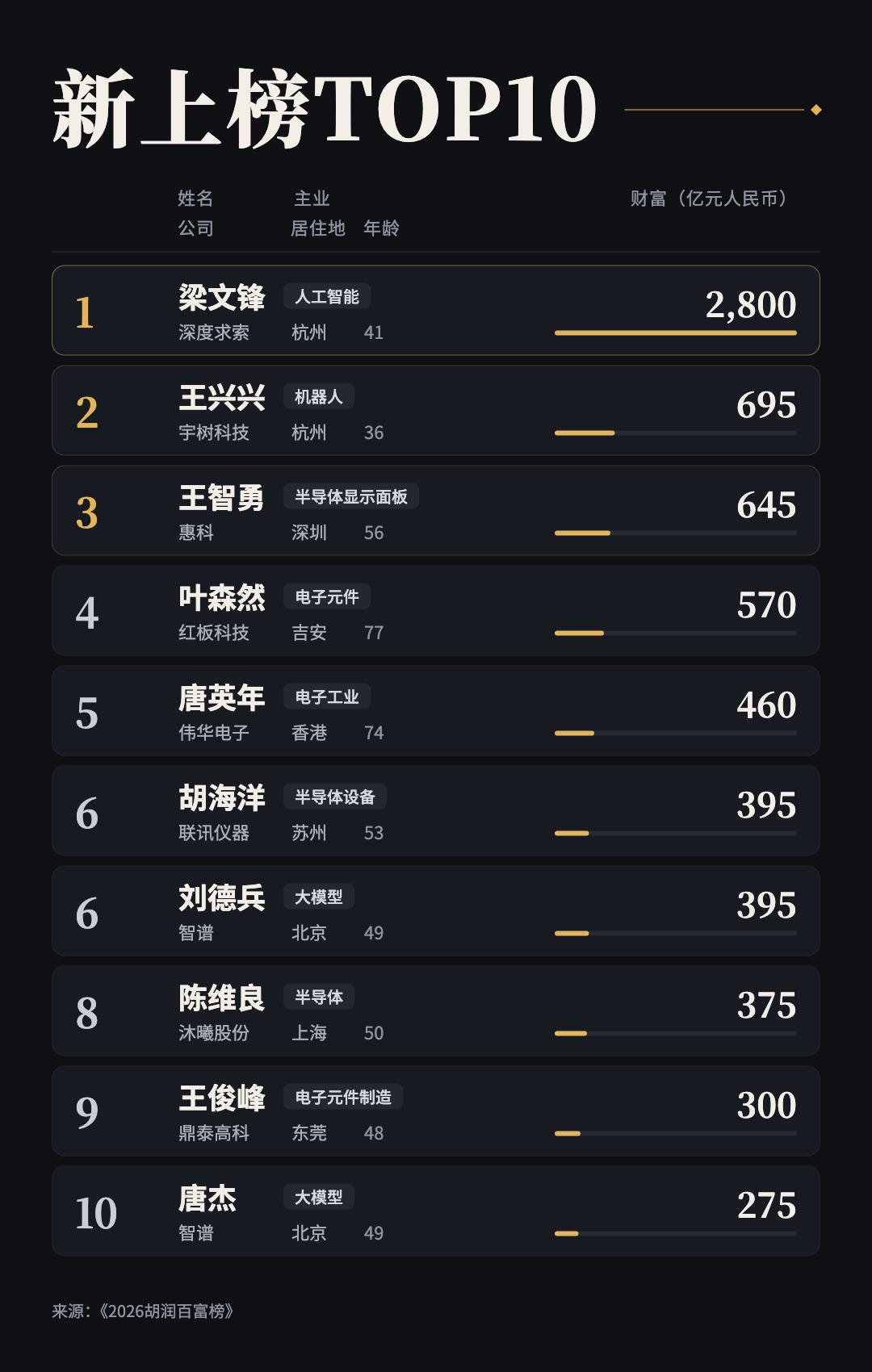
Chen Tianshi, founder of Cambricon who is also 41 years old, broke into the top 10 nationwide with 205 billion yuan. 36-year-old Wang Xingxing from Unitree Robotics made his first appearance on the list, with a fortune of 69.5 billion yuan.
One works on large AI models, one on AI chips, and the other on humanoid robots.
In recent years, many star entrepreneurs have emerged in the AI circle, and now the Chinese rich list is also being dominated by them.
Seeing this list, I suddenly thought of a question: Over the past few years, how many people have taken the position of China's richest man? In another five or ten years, who will be sitting in that position?
01 From Jack Ma to Zhang Yiming, the position of China's richest man has gone through a full rotation
Let's turn back the clock to 2018.
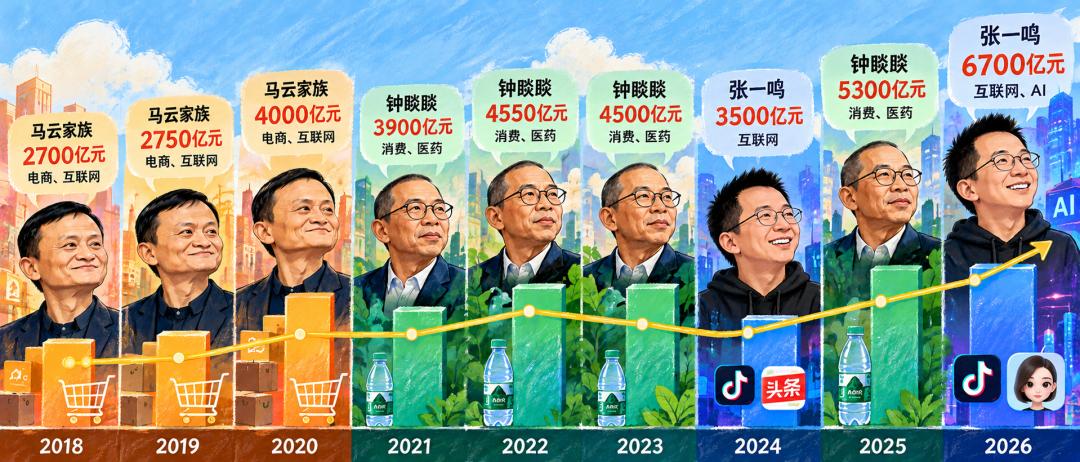
That year, Jack Ma topped the Hurun China Rich List with a fortune of 270 billion yuan. In 2019, he retained his title as the richest man with 275 billion yuan. By 2020, Jack Ma's net worth had risen to 4000 billion yuan, securing his position as China's richest man for three consecutive years.
At that time, Alibaba was at the peak of its prosperity.
Taobao, Tmall and Alipay had almost penetrated into everyone's daily life, while Alibaba Cloud was also developing rapidly. Entrepreneurs in the internet industry loved to study the business models of Alibaba and Tencent the most.
Jack Ma and Ma Huateng had long been the two most high-profile figures on the Chinese rich list.
But in 2021, the richest man changed.
Zhong Shanshan, founder of Nongfu Spring, became China's richest man with a net worth of 390 billion yuan, and continued to top the list in the following two years.
At that time, many people found it very interesting: those who worked in the internet and high-tech industries were eventually overtaken by someone selling mineral water.
A bottle of mineral water seems to have little technical content, but the decades of accumulated brand, channels and supply chain of Nongfu Spring have given this business amazing commercial value.
Especially in the era when internet companies were burning money to grab users, the water-selling business appeared particularly stable.
However, Zhong Shanshan's position as the richest man did not last forever.
In 2024, 41-year-old Zhang Yiming topped the list for the first time with 350 billion yuan, becoming the first self-made post-80s richest man in China on the Hurun China Rich List.
From Toutiao to Douyin, and then to TikTok, Zhang Yiming spent more than ten years building ByteDance into a globally renowned technology company.
But Zhang Yiming's reign as the richest man only lasted one year.
In 2025, Zhong Shanshan topped the list for the fourth time with 530 billion yuan, and Zhang Yiming dropped to second place with 470 billion yuan.
This year, Zhang Yiming overtook him again.
Moreover, this growth is extremely strong, with his wealth increasing by 2000 billion yuan in one year, directly reaching 670 billion yuan.
Let's briefly sort out China's richest men in the last nine years:
From 2018 to 2020, Jack Ma topped the list for three consecutive years; from 2021 to 2023, Zhong Shanshan held the top spot for three years; in 2024, Zhang Yiming topped the list for the first time; in 2025, Zhong Shanshan reclaimed the first place; in 2026, Zhang Yiming topped the list again.
Jack Ma, Zhong Shanshan and Zhang Yiming have created huge wealth relying on e-commerce, consumer goods and internet platforms respectively.
And behind Zhang Yiming's ability to become the richest man again this year, there is an extra driving force: AI.
02 The speed of wealth creation by AI is getting more and more astonishing
Zhang Yiming's 670 billion yuan is of course not earned by Doubao.
ByteDance already has mature businesses such as Douyin and TikTok, and its business models including advertising, e-commerce and live streaming are already quite mature. Even without AI, ByteDance is a very valuable technology company.
But the emergence of AI has indeed made the capital market re-evaluate ByteDance.
In the past two years, ByteDance has invested a lot of capital and resources in AI. Doubao has become one of the most popular AI applications in China, and Volcano Engine is also providing models, computing power and related services to enterprises and developers.
ByteDance has users, traffic and commercialization capabilities, and now it occupies a very advantageous position in the AI field.
Hurun Research Institute explicitly mentioned that the progress of AI business has further boosted ByteDance's valuation, and the company's current valuation has reached 3.3 trillion yuan.
In 2024, Zhang Yiming's net worth was 350 billion yuan. Two years later, this figure has become 670 billion yuan.
Of course, net worth is not equal to cash, and ByteDance's company valuation is not equal to actual profit. But the price the capital market is willing to offer has reflected the outside world's expectations for ByteDance's future.
Then let's look at Liang Wenfeng.
If Zhang Yiming has a commercial empire accumulated for more than ten years, then the speed at which DeepSeek has risen in the public eye is a bit exaggerated.
In early 2025, DeepSeek quickly became popular with its excellent model capabilities and open-source strategy, and became the focus of discussion in the global AI industry.
At that time, many people were busy studying DeepSeek's technological breakthroughs, its model cost, open-source strategy, and its impact on companies such as OpenAI.
More than a year later, Liang Wenfeng has broken into the top 10 of the Chinese rich list with a net worth of 2800 billion yuan.
It is worth noting that Jack Ma's wealth when he topped the list in 2018 was only 270 billion yuan. Of course, wealth valuations from different years cannot be simply equated, but this comparison is still very impactful.
DeepSeek did not initially follow the familiar route of domestic internet companies. It did not buy traffic on a massive scale, nor did it rely on live streaming, e-commerce or advertising to make money, but quickly gained popularity relying on large model technology.
According to Hurun Research Institute, an important reason why Liang Wenfeng was not included in the list last year was that he had previously proposed "no commercialization"; and this year DeepSeek's valuation has rapidly climbed to more than 50 billion US dollars.
For an AI company that has not yet formed a mature commercial system like ByteDance, the founder's wealth valuation has reached 2800 billion yuan.
This of course also raises a question: How much money can DeepSeek make in the future to support such a valuation?
After all, leading model technology does not guarantee commercial success. Domestic companies including ByteDance, Alibaba and Tencent, as well as overseas companies such as OpenAI and Anthropic, are all investing huge sums of money to participate in model competition.
But Liang Wenfeng's emergence has already shown people the amazing wealth creation ability of the AI industry.
Moreover, Liang Wenfeng is not the only one this year.
Chen Tianshi, founder of Cambricon, has a fortune of 205 billion yuan, ranking 10th nationwide.
Liu Debing and Tang Jie of Zhipu AI made their debut on the list with 39.5 billion yuan and 27.5 billion yuan respectively. Yan Junjie, founder of MiniMax, also made his debut on the list with 22.5 billion yuan.
Large models, AI chips, robots, these once relatively niche technology entrepreneurship tracks are now giving rise to entrepreneurs with fortunes of tens of billions or even hundreds of billions of yuan.
AI has not yet made big money for all companies, but it has already allowed many founders to enter the rich list first.
03 Who will be the next richest man in China?
Zhang Yiming currently leads Zhong Shanshan, the second place, by 2600 billion yuan with 670 billion yuan, and his advantage in the short term is quite obvious.
ByteDance's old businesses are still continuously generating revenue, and AI businesses such as Doubao and Volcano Engine also have room for continued growth. If ByteDance's AI business develops smoothly in the future, Zhang Yiming's wealth may still rise.
But when we extend the timeline to five or ten years, the competition is hard to predict.
I think several tech entrepreneurs are worthy of attention.
First of all, Liang Wenfeng.
He is 41 years old this year, with a fortune of 2800 billion yuan, and has already entered the top 10 nationwide.
DeepSeek's technical strength has been widely recognized. Whether it can convert its model advantages into continuous and stable commercial revenue in the next step will largely determine its future value.
If DeepSeek can continue to maintain its competitiveness in the global large model market and gradually build a mature business model, Liang Wenfeng's wealth may continue to grow.
However, the current gap of 3900 billion yuan between him and Zhang Yiming is not easy to close.
Moreover, there is a very troublesome problem in the AI large model field: technology iteration is extremely fast.
A leading model today may be overtaken by competitors in a few months. No one is fully sure how long a company can stay ahead.
Secondly, Chen Tianshi from Cambricon.
Chen Tianshi's wealth has reached 205 billion yuan this year, ranking 10th nationwide.
No matter how powerful the AI large model is, it has to run on chips and computing power.
As more and more domestic AI models emerge and reasoning demand continues to grow, domestic AI chip manufacturers have ushered in a rare development opportunity.
Compared with AI applications, the chip industry has higher technical barriers, longer R&D cycles, and more complex competition. But once technical advantages and customer scale are formed, the commercial value can be quite astonishing.
I would not be surprised at all if China's next richest man comes from the AI chip industry.
Then there is Wang Xingxing from Unitree Robotics.
Wang Xingxing is 36 years old this year, making his debut on the Hurun China Rich List with 69.5 billion yuan.
Compared with Zhang Yiming and Liang Wenfeng, his current wealth is still far behind.
But from the perspective of long-term industrial opportunities, I have always thought that the robotics industry is worthy of attention.
Many of the robots we see now are still performing dancing, somersaults, running, or performing specific tasks in factories.
If one day humanoid robots can widely enter factories, shopping malls and homes to undertake a large number of repetitive labor, that will be a huge market.
Of course, there is still a long way to go for robots to move from demonstration to real large-scale commercial applications. Cost, stability, general capabilities, and how much work they can actually do for humans are all problems that must be solved.
It is still hard to judge whether Wang Xingxing can become China's richest man. But he is only 36 years old this year, and he still has a very long entrepreneurial time ahead.
In addition, there are young entrepreneurs such as Yang Zhilin from Moonshot AI.
33-year-old Yang Zhilin is already the number one self-made entrepreneur under 35 on the Hurun China Rich List.
The founders of companies such as Zhipu AI and MiniMax are also entering the wealth list.
The current scale of these companies is still far behind ByteDance. There is still great uncertainty about who can stand out and who can make sustainable profits in the future.
But this kind of situation often happens in the technology industry: a startup that was not very well-known seizes the opportunity of a technological revolution and becomes an industry giant a few years later.
A few years ago, how many people would have thought that Liang Wenfeng of DeepSeek could break into the top 10 nationwide with a fortune of 2800 billion yuan?
Of course, when predicting the next richest man, we cannot only focus on AI.
Zeng Yuqun of CATL currently has a fortune of 385 billion yuan, and the market of new energy and energy storage industry is still huge. Ma Huateng of Tencent also has a mature business system. If AI brings new growth opportunities to Tencent in the future, the wealth ranking may also continue to change.
The AI industry is very hot now, but there is no rule that the next richest man can only come from the AI circle.
04 The Chinese rich list is being rewritten by AI
There is another data on this year's Hurun China Rich List that I think is very representative.
In 2026, among the listed entrepreneurs, the proportion of those involved in the AI field and taking AI as the leading direction has reached 10.4%.
According to Hurun's statistical standards, before 2019, there were no listed entrepreneurs on the list whose main business was AI.
In just a few years, more than 160 entrepreneurs from the AI field have appeared on the list.
This change is very interesting.
The internet entrepreneurship stories we were familiar with in the past usually required accumulating a large number of users first, and then making money through advertising, e-commerce, games and other businesses.
Now, an AI startup, even if it does not yet have a huge scale of consumer-level users, can obtain a very high market valuation as long as it makes breakthroughs in key technologies such as models, chips and computing power.
Of course, high valuation does