The Chinese version of Muse is here! Ant Lingguang 2.0 leads the Personal Agent track.
Double 11 is coming. For seasoned shoppers, there is often a long list of preparations before placing orders.
They first make a shopping list, compare prices across platforms, calculate coupons and full-reduction discounts, and then set alarms for paying the final balance. Even after finishing the purchase with great effort, they may find the price drops again a few days later, so they have to check the price protection rules, locate the corresponding order, and apply for a price difference refund.
Abundant commodities and developed internet services have facilitated people's lives, but also trapped users in dazzling screening and operation processes. Is there a solution to this in the AI era?
In September this year, Meta launched Muse, which reached 5 million downloads just three weeks after its release. This type of Personal Agent demonstrates a new possibility: users state their goals, the AI continues to work after the conversation ends, and contacts users only when there are changes or confirmation is required.
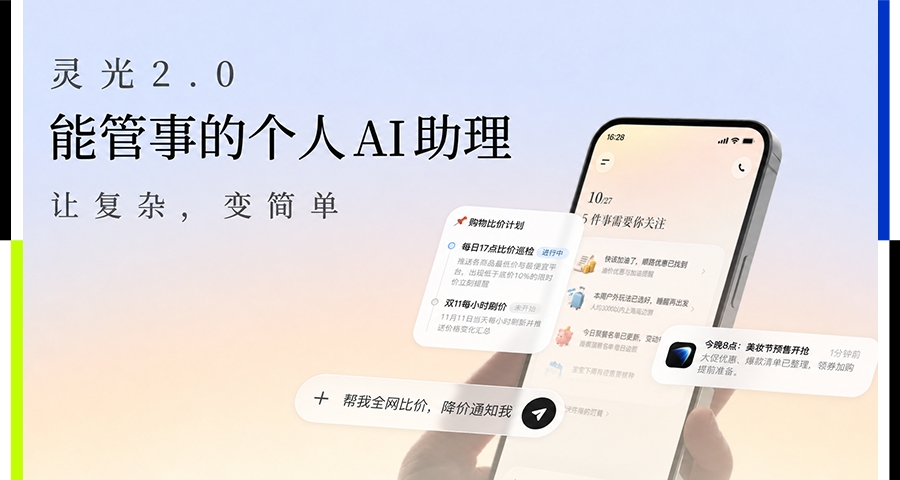
On October 27, Ant Group released Lingguang 2.0, positioned as a "personal AI assistant that manages affairs", taking the lead among major domestic tech companies to roll out their Personal Agent product. What it intends to take over are exactly those matters that require constant attention: remembering users' instructions, keeping track of changes continuously, reminding users in time at key nodes, and helping users push things forward step by step.
Why are Personal Agents emerging in a concentrated manner at this time?
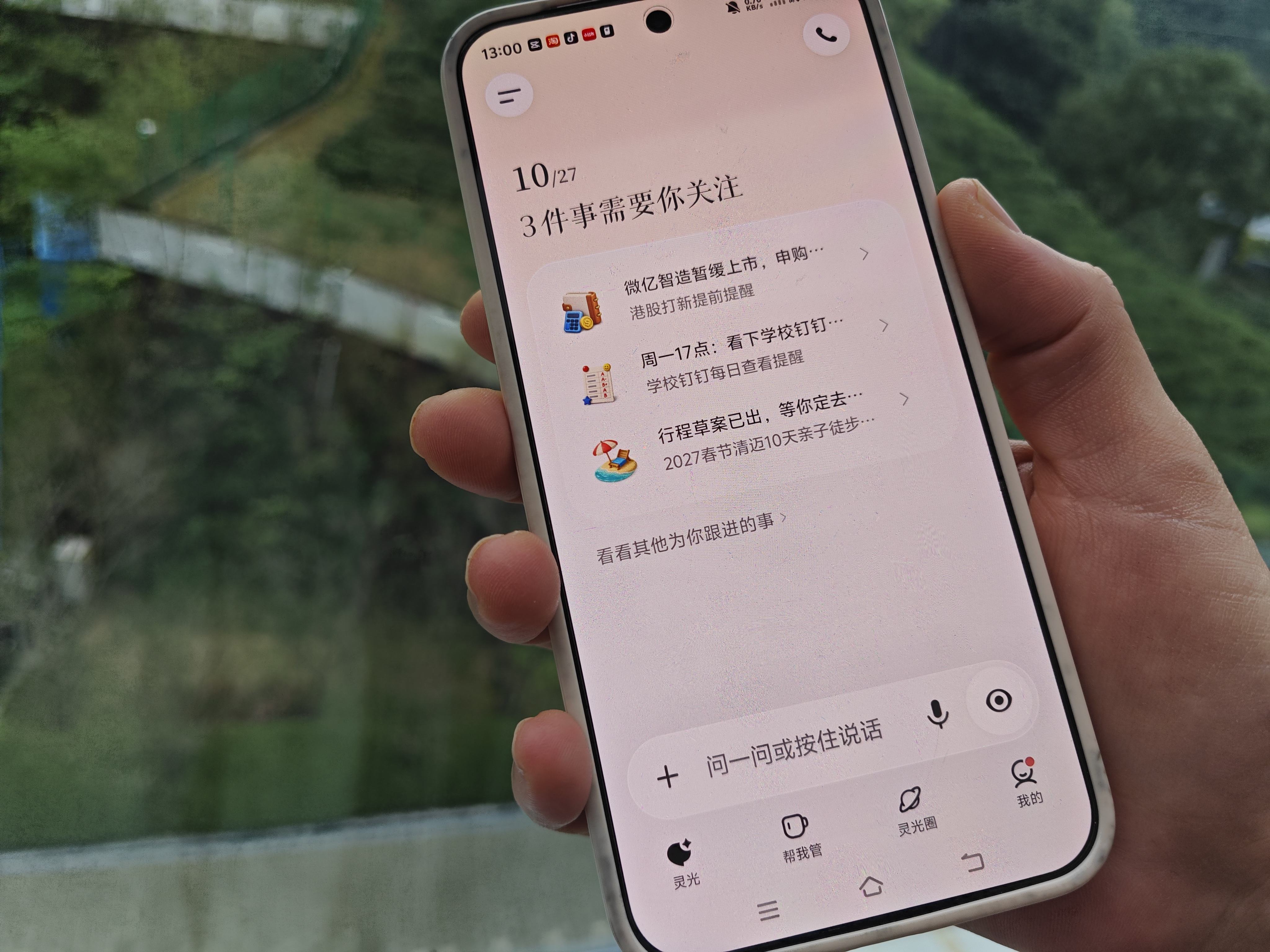
Different Solutions for Personal Agent From Muse to Lingguang
From Muse to Lingguang, Personal Agent is exploring a new type of user relationship: users assign a task, and the AI keeps it in mind all the time on their behalf.
The emergence of this change is based on technical foundations. As the model's ability to execute long tasks improves, AI has been able to continue working after users leave the conversation. At the same time, the capabilities of long-term memory, cloud operation, task scheduling, browser operation and tool connection are gradually maturing, enabling AI to remember goals, pay attention to changes, and take actions at different time nodes. Personal life and affair management has thus become a new test field.
Compared with office and programming Agents that are mainly oriented to knowledge workers or programmers, Personal Agent touches on broader user needs: shopping price comparison, air ticket and hotel price tracking, bill and automatic renewal management, family travel arrangement, information sorting for class groups and work groups, and even pet care, vehicle annual inspection and vaccine reminders.
These trivial life matters have one thing in common: the matters themselves are not necessarily complicated, but they need to be remembered for a long time, and the relevant information will keep changing. What users need is someone to keep an eye on things continuously for them, remind them in time when changes occur, and push things forward when processing is needed.
When AI can search, compare and follow up continuously around user goals, users' choice will shift from "which App to open for services" to "which AI to assign the task to". The competition between platforms and merchants will also change accordingly: whether the service can be discovered and invoked by the Agent, and complete transactions and performance. Therefore, Personal Agent has the opportunity to become a new service entry and become the focus of layout for global tech giants.
However, Muse and Lingguang have chosen different entry points for taking over these daily affairs:
Muse puts more emphasis on autonomous execution around goals. In its officially introduced scenarios, AI can process web pages, emails and online services, help users send emails, book trips, fill in forms, and continue to promote long-term goals after users close the application. When sensitive actions such as sending emails or making purchases are involved, Muse will request user approval.
This path is related to the overseas internet service environment. Overseas, email is the information hub for people to manage daily affairs, carrying information such as orders, bills, appointments and itineraries; websites and online platforms are important entrances for obtaining services and completing transactions. Through browsers and connectors, Agents can obtain this information, access relevant services, and continuously promote tasks.
Lingguang 2.0 represents another path. It does not position itself as "doing everything for users", but focuses on "managing affairs": starting from the daily needs of Chinese users in consumption, travel, family and work, it allows AI to remember things, follow up continuously, and connect to services familiar to users such as Alipay, DingTalk and Feishu, to take long-term charge of those matters that require repeated attention.
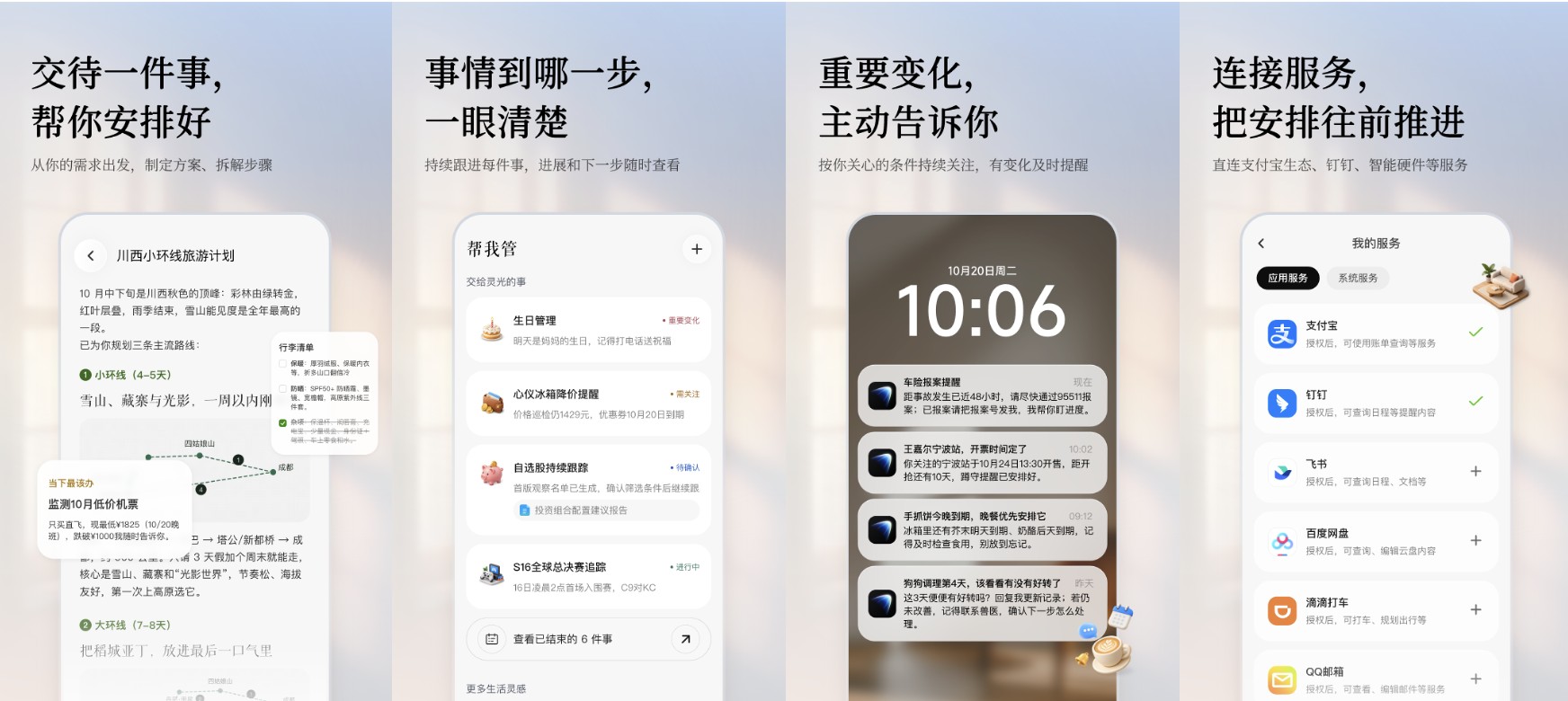
The path of Lingguang can be understood from three aspects.
From the perspective of digital service environment, Chinese users' consumption, travel, work and family affairs are often distributed in different Apps, mini-programs and platforms. Cross-platform information still needs to be sorted out by users themselves, and long-term items still need to be kept in mind by users themselves. The opportunity for Personal Agent lies in taking over these continuous and worrisome tasks.
From the perspective of service connection path, Lingguang 2.0 relies on Alipay's service ecosystem and Ant Group's payment and trust foundation, and accesses services such as DingTalk, Feishu, email and Mijia through tool connections. This gives it the opportunity to connect scattered information and services around one user's affair, and link up subsequent sorting, reminders and follow-ups.
From the perspective of product experience, many domestic services are already convenient enough. What is more worth looking forward to is extending the convenience of a single operation to the peace of mind of the whole matter. "Handling an affair" is more like a one-time task: the user gives an instruction, and the AI completes the action; "managing an affair" means that after the task is completed, the AI still remembers the matter, keeps an eye on changes continuously, reminds the user when needed, and pushes forward to the next step.
Lingguang 2.0: From One-time Task Execution to Continuous Affair Management
Turning the convenience of a single operation into the peace of mind of long-term entrustment is exactly the main line of Lingguang's iteration. The capability improvement of Lingguang 2.0 can be summarized into four items: good memory, task promotion, continuous follow-up, and flexible adjustment. The value of these capabilities needs to be understood in specific daily life scenarios.
The first point is to remember things clearly. For example, when arranging a family trip, the user tells the AI "travel with the elderly, do not take an early morning flight, and the hotel is close to the subway", and these conditions must run through the subsequent arrangements. When talking about air tickets and hotels a few days later, Lingguang can still continue to promote the work according to the previous requirements, without the user having to explain everything from scratch every time.
The second point is to keep tracking changes continuously. For example, there is a refrigerator in the shopping list, and the user tells the AI "remind me when the price drops below 2000 yuan", then there is no need to open the App to check the price every day. Lingguang follows up continuously and reminds the user when the conditions are met. Even if the user puts down the mobile phone, the matter will not be neglected.
The third point is to convert changes into actionable items. For example, if the teacher sends a long spring outing notice in the class group, Lingguang can extract several clear to-dos: "Submit the reply slip before Wednesday, bring a water bottle and raincoat on Friday." Users do not need to repeatedly look through chat records to know what to do next and when to do it.
When encountering new situations, it is also necessary to adjust the arrangement according to the existing goals. For example, if you plan to travel with your family on the weekend and the weather forecast suddenly says it will rain, you need to consider replacing outdoor activities with indoor projects and rearrange the travel time. Lingguang can help sort out the adjustment plan, and decisions involving cancellation, ticket change and other operations are confirmed by the user. Continuous affair management also includes helping users figure out the next step when plans cannot keep up with changes.
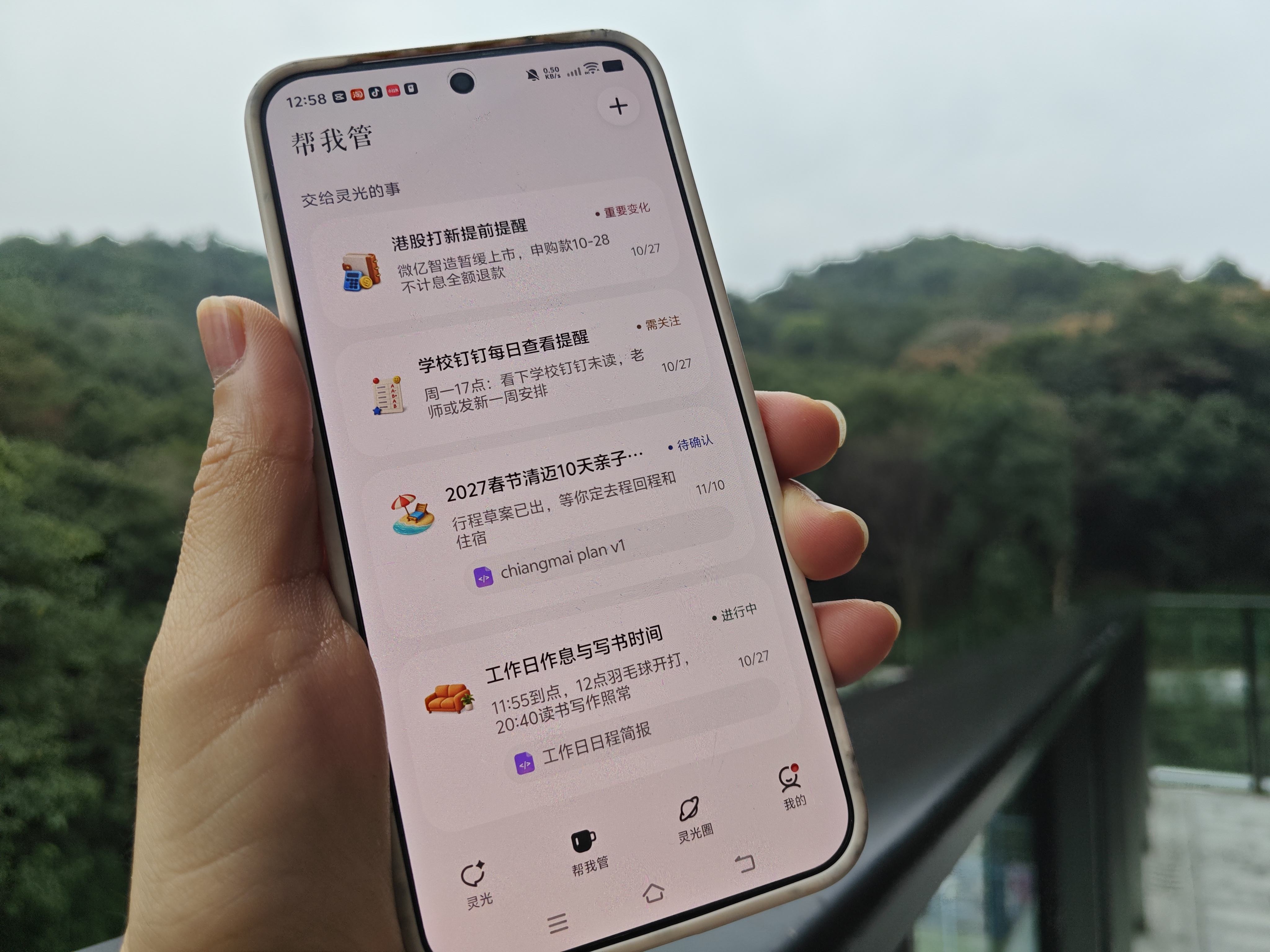
This is exactly the "Chinese solution" for Personal Agent provided by Lingguang 2.0: it does not package itself as an "all-round affair handling assistant", but starts with memory, sorting, monitoring, reminding and follow-up, connects the technical capability of continuous affair management with China's mature digital service ecosystem, and adds a more continuous layer of care to the familiar life services of users.
From popularizing mobile payment and promoting the digitalization of people's livelihood services, to exploring AI that helps people manage affairs, Ant Group has followed the same path: applying the most cutting-edge technology to the most daily life scenarios.
Ant Group Increases Investment in Personal AI to Vitalize the Service Ecosystem
To become a new service entry, Personal Agent needs to cross two thresholds in addition to model capabilities.
The first one is the service threshold. To manage affairs, the Agent needs to access the Apps and services that users use daily, but domestic high-frequency applications generally set access barriers for Agents. What can be accessed and to what extent the affairs can be processed depends on the service openness and authorization rules.
The other one is the trust threshold. When AI starts to read bills, follow up affairs for a long time, and even participate in payment, users need to be clear about what it can see, what it can do, which operations need confirmation, and how to trace problems when they occur. Whether users are willing to entrust their affairs to AI needs to be gradually established through clear permissions and reliable execution.
Ant Group's accumulation in these two aspects provides a foundation for the exploration of Lingguang 2.0. Relying on Alipay's service ecosystem, Lingguang can connect to services such as bills, memberships and travel, and access applications such as DingTalk, Feishu, email and Mijia through tool connections; Ant Group's 22 years of accumulation in payment security, identity authentication and authorization management provides support for AI to handle affairs within the scope of user authorization.
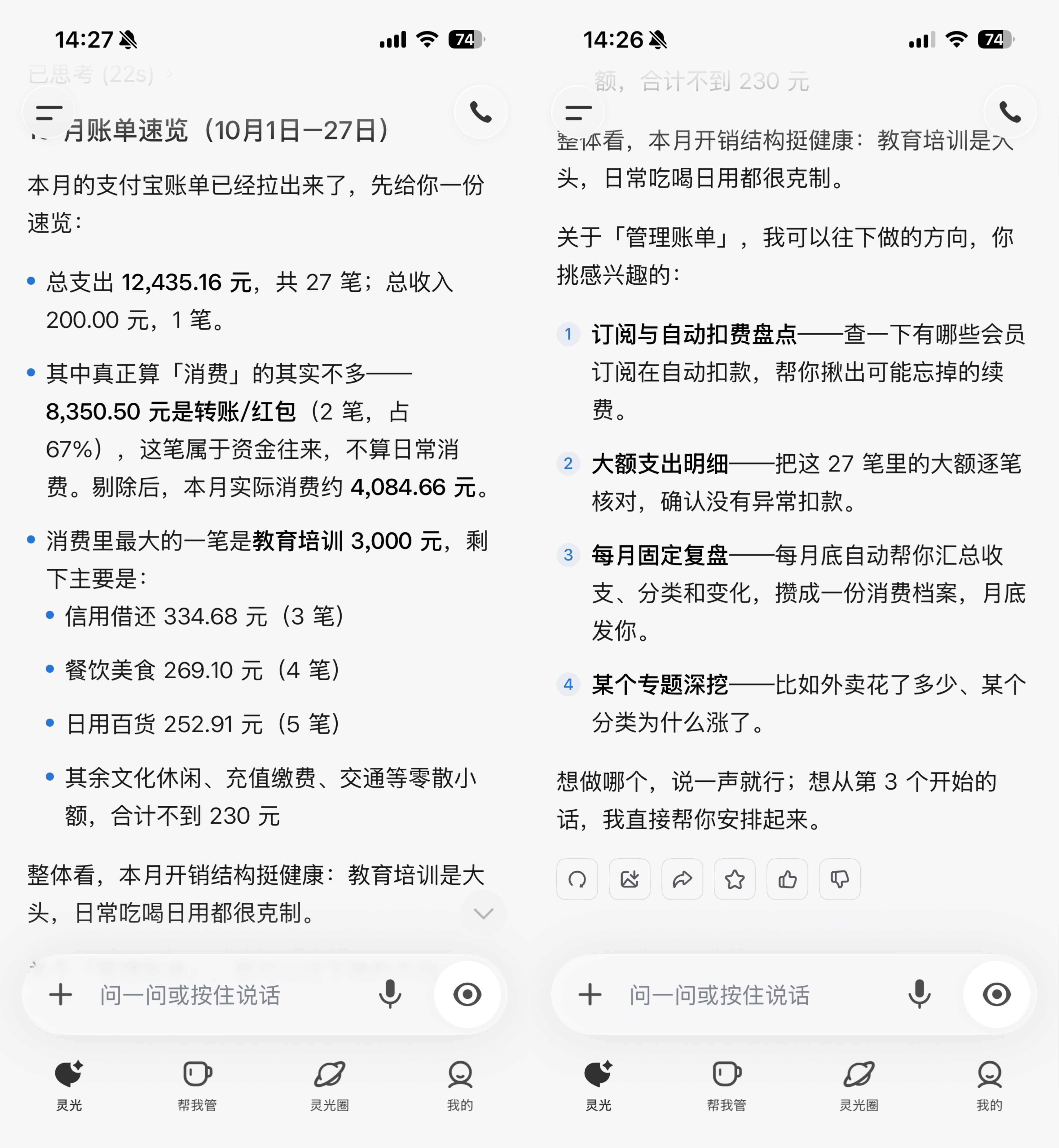
This is also the significance of Lingguang 2.0 as a technical exploration window: it not only verifies capabilities such as long-term memory, task scheduling and tool connection, but also observes which affairs users are willing to entrust to AI and to what extent. Only when the technology can run continuously and users are willing to entrust their affairs continuously, can personal agents truly enter daily life.
Lingguang is an important step for Ant Group to increase its investment in Personal AI, but what is more noteworthy behind it is Ant Group's systematic layout from payment infrastructure to AI application ecosystem in recent years.
At the AI payment level, Alipay has launched full-stack products such as AI Pay, AI Collection, AI Wallet and Token Pay to support agents to complete transactions. In May this year, Alipay disclosed that AI payment has supported 95% of general agent frameworks, and a total of 300 million agent payment transactions have been completed. Among them, AI Wallet supports users to manage agent tasks before and during payment, and check bills after payment, allowing users to grasp the whole process of AI spending money on their behalf.
At the AI application level, Ant Group explores Personal AI in different scenarios through Afu, Abao and Lingguang. Afu focuses on health consultation and health management, Abao relies on Alipay to connect daily services such as consumption, travel and affair handling, while Lingguang focuses more on cutting-edge product and technology exploration, trying to take over long-term affairs that require continuous attention and follow-up.
It is worth mentioning that there is still room for further collaboration between Lingguang and Abao. The product form and technical capabilities explored by Lingguang in advance are expected to be applied to Abao after verification, reaching more users with the help of Alipay's high-frequency scenarios and service ecosystem, so that cutting-edge exploration can gradually move towards mass application.
In addition, Ant Group is also extending AI capabilities to industry scenarios. For example, Ant Digital Technology has built a "Super Agent Factory" to help industry partners develop and apply agents through platforms such as Agentar.
In short, only when AI payment, AI application and the ecosystem operate in better coordination can Lingguang manage affairs better; and the continuous evolution of Personal AI represented by Lingguang is also expected to further activate Ant Group's digital service ecosystem accumulated over many years, generate new service demands, and open up greater imagination space.
Perhaps next Double 11, people can go to bed earlier, while AI continues to track prices; when the class group has 99+ unread messages, users do not have to find out "you need to bring an empty cardboard box tomorrow" right before going to bed.
For users, the value of Personal AI is perhaps less last-minute panic. Those "don't forget" reminders that always linger in your mind can be gradually handed over to AI. Lingguang will keep the affairs in mind for you, services will appear when you need them, and life can be less hectic.
For Ant Group, the new entry in the AI era may be hidden in countless trivial things that bring peace of mind to users.