Why has this global automotive parts giant ventured into the robotics sector outside its core business?
Enterprises in the automotive industry chain stepping into the robotics sector is emerging as a new industry trend.
On the one hand, the price war between complete vehicles and auto parts continues, putting corporate profits under pressure, and enterprises need to explore new business directions. On the other hand, the robotics industry represented by humanoid robots is regarded by many practitioners and institutions as the main growth line for the next stage. A widely circulated view in the industry holds that the first half of embodied intelligence is autonomous driving, and the second half is humanoid robots.
Against this judgment, dozens of automakers including XPeng, Chery, BAIC, NIO, BYD and others have successively made layouts in the robotics sector.
Ningbo's leading auto parts giant Joyson Electronics has also joined the competition. Joyson Electronics started its business with automotive functional parts in the early stage. Later, through integrating high-quality assets including Germany's Preh, Qunying, TechniSat, the US-based KSS, and Japan's Takata, it entered the automotive electronics and automotive safety sectors, carried out secondary innovation combined with the Chinese market, and grew into one of the world's top 30 automotive parts enterprises. At present, the company has factories in more than 20 countries around the world, with revenue exceeding 60 billion yuan in 2025, of which over 70% comes from overseas markets.
In 2025, Joyson Electronics adjusted its business direction to the two-wheel drive of "Automotive + Robotics", and started to layout humanoid robots, positioning itself as a Tier 1 supplier in the robotics sector. Its product planning focuses on three major areas: "big and small brain + limbs + energy", including key components such as AI head assembly, energy management system, big and small brain domain controllers, electronic skin and dexterous hands, and mecha. The electronic skin, namely the flexible tactile sensor, is mainly developed and manufactured by Joyson Qunying, a joint venture between Joyson Electronics and Xiangshan Co., Ltd.
Dr. Kang Yuran, head of the electronic skin business of Joyson Qunying, told 36Kr that the robotics business ranks first in the group's current strategic plan, and is a clear second growth curve.
Through Joyson, we can not only see how the accumulation and precipitation of automakers can be reused in humanoid robots, but also see the gaps between the automotive and robotics sectors that cannot be directly transferred in place.
1. Betting on the second half of embodied intelligence
Founded in 2004, Joyson Electronics focused on automotive functional parts at the beginning of its establishment. In 2011, the company acquired Preh, a time-honored German automotive electronics company, with its revenue exceeding 10 billion yuan, thus kicking off more than ten years of international mergers and acquisitions afterwards.
In December 2014, Joyson Electronics acquired German high-end interior parts company Qunying for more than 90 million euros, and later integrated it with the original Joyson functional parts business into the brand new Joyson Qunying. Joyson Qunying is good at cockpit air management systems and smart surface technologies, and has certain accumulation in real wood, real aluminum, carbon fiber, new materials and related processes, and has long served international automakers including Mercedes-Benz, BMW, Audi, Volkswagen, General Motors and Lamborghini.
From 2016 to 2018, Joyson successively acquired the automotive business of German TechniSat, US automotive safety supplier KSS, and high-quality assets of Japan's Takata. The company has rapidly grown into the world's second largest automotive safety supplier and the fourth largest smart cockpit domain control system supplier, with its products covering almost all mainstream automakers around the world since then.
In 2025, Joyson has more than 40,000 employees in over 20 countries around the world, and its products serve more than 100 automotive brands globally. It achieved revenue of about 61.2 billion yuan in that year, of which overseas revenue reached 44.446 billion yuan, accounting for 72.64%.
In the past few years, automotive price competition has spread from the mass market to the mid-to-high-end market, and vehicle and parts enterprises have generally fallen into the dilemma of "revenue growth without profit growth", making exploring the second growth curve a common topic for the whole industry. As Li Xiang, founder of Li Auto, said in May this year, "The first half of embodied intelligence is autonomous driving, and the second half is humanoid robots."
According to statistics from The Robot Report, as of August 2026, more than 15 vehicle manufacturers have entered the humanoid robot track. In addition to the dense entry of vehicle manufacturers, upstream parts suppliers are also shifting to the robotics sector accordingly. The Joyson system is also one of this batch of follow-up parts enterprises.
At present, Joyson has launched cooperation with leading domestic robot manufacturers. On the one hand, Joyson provides OEM services for a wheeled chassis dual-arm robot from Agibot, with the manufacturing, assembly and testing of the head, dual arms and chassis all completed by Joyson. On the other hand, it carries out embodied data collection business. After the complete machine leaves the factory, it will be deployed in multiple real scenarios built inside Joyson to carry out real-scenario training, collect robot operation data, and use it for the training of physical AI models.
2. Becoming a Tier 1 supplier in the robotics sector
According to Kang Yuran, Joyson continues the Tier 1 supplier positioning it has in the automotive industry for its robotics business. In other words, Joyson does not manufacture robot bodies, nor does it produce a single product, but covers key components of robots from head to toe, including AI head assembly, energy management systems, big and small brain controllers, dexterous hands and electronic skin.
Take the electronic skin of Joyson Qunying as an example. Electronic skin is the "tactile organ" of robots, a layer of flexible electronic film similar to artificial skin, which is attached to the surface of robots and can perceive tactile signals such as pressure, sliding, vibration and temperature.
On the technical route of electronic skin, Joyson Qunying adopts multi-line parallelism, taking piezoresistive as the foundation and multi-modal as the feature. According to Kang Yuran, the piezoresistive route is taken as the foundation because it has the highest maturity, is suitable for high-density integration and large-scale mass production, also has cost advantages, and senses through the resistance change after being pressed, without being interfered by strong magnetic environments.
At present, the first-generation electronic skin is based on the piezoresistive principle, and has been developed and launched with robot fingertip tactile sensors, gripper tactile sensors and full-hand tactile perception solutions for dexterous hands. The second generation will develop capacitive large-area electronic skin. According to Kang Yuran, the capacitive route senses through the capacitance change after being pressed, which has higher sensitivity and can also realize proximity perception, suitable for being laid on the surface of the fuselage with a larger area.
In addition, Joyson Qunying, in cooperation with institutions such as Ningbo Institute of Materials Technology and Engineering of the Chinese Academy of Sciences, Ningbo East Institute of Technology, and Beihang University, relying on the Zhejiang Provincial Key R&D Technology Vanguard Project, is simultaneously promoting the R&D of new flexible electromagnetic electronic skin. This type of solution senses through magnetic field changes and is suitable for scenarios that are not sensitive to magnetic fields.
At present, the electronic skin product has been adapted to Joyson's self-developed dexterous hands and industrial grippers. The philosophy of Joyson Qunying is to get through all technical links and complete verification on its own production lines first, and then supply products to external customers, helping customers find problems in advance, and later promote the products to the production lines of customers such as automakers.
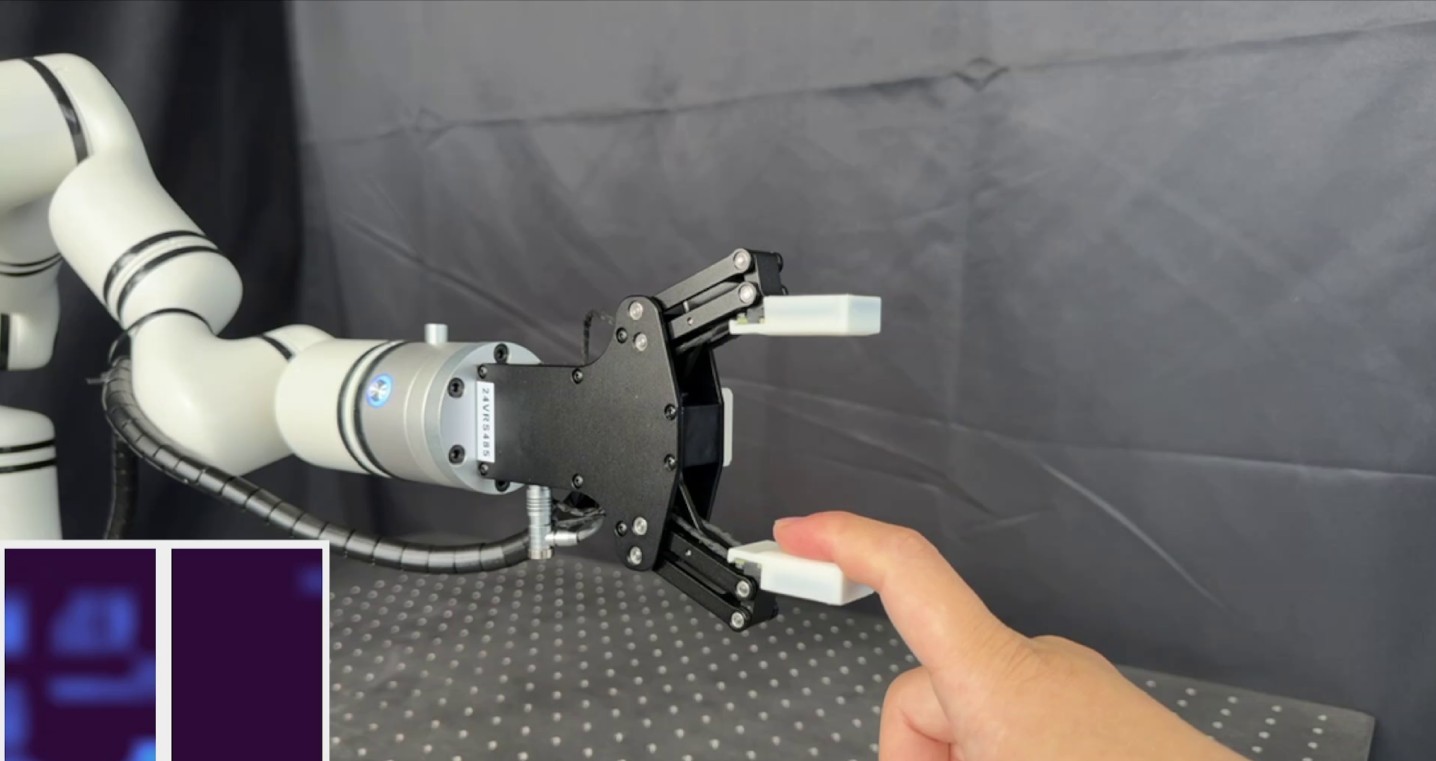
The electronic skin of Joyson Qunying is mounted on the fingertip of the robot gripper
"This is also a major advantage of Joyson Qunying in manufacturing key robot components." Kang Yuran introduced that which several modules are needed in a certain scenario and what level the pressure accuracy should reach all depend on the feedback from real demands in the production line. The more deployments and applications there are, the more data collected, the more the product can iterate continuously based on real scenarios, improve reliability and reduce costs. The lower the cost, the more orders it will bring, forming a positive cycle.
Kang Yuran said that Joyson Qunying's advantages in robotics business lie in its engineering capability, scenario data and customer resources. In terms of engineering, Joyson Qunying has decades of production line construction experience, which can turn prototypes into products for stable mass delivery. In terms of scenario data, as a manufacturing enterprise, Joyson Qunying's own production lines provide a large number of typical working conditions, where robots and electronic skin can be directly deployed to verify and iterate in real environments.
In terms of customer resources, Joyson Qunying has a large number of factories and production lines, which are exactly the future buyers of robots. At the same time, Joyson also supplies key components to robotics companies. It undertakes OEM production, deploys and uses robots on the one hand, and develops, produces and sells key robot components on the other hand, forming a two-way cycle. This mutually customer-oriented relationship is very close.
But he also admitted that at the current stage, commercialization is a common challenge for the entire humanoid robot industry, even for automakers with rich manufacturing experience.
Kang Yuran summarized the current challenges faced by Joyson Qunying's robotics business into two levels: one is the balance between customer demands and R&D costs; the other is the acquisition of large-scale customers. "Large-scale customers with real demands are still in the forming process. Customers who are willing to pay want overall solutions that can be directly implemented and operate stably for a long time, rather than samples. This requires the software and hardware systems to operate continuously for one to two years under maintenance-free conditions, and the overall cost should be controlled within the acceptable range of enterprises and production lines."
For the globalization of the robotics business, Joyson Qunying plans to start from Joyson's own overseas factories. After completing robot deployment and verification on its own production lines, it will gradually promote the products to overseas manufacturing customers. There is a large stock market overseas, which will be the blue ocean for the robotics business on the premise of complying with international policies. In the future, Joyson's target customers will still be mainly automotive customers, and the company's existing automotive customers are also potential robot customers.