Growing tenfold in three years, Japan's extramarital affair social sector is ushering in explosive rapid growth driven by AI.
Mrs. Watanabe, a distinctively Japanese economic term, is likely to fade away in the 21st century, as the family unit that carries its concept is gradually collapsing.

Over the past three years, thanks to the rapid advancement of AI technology, the number of active users of extramarital affair social apps in Japan has increased by nearly 10 times, and its penetration rate among the young 30-40 age group has reached 5%.
Japan's marriage system is undergoing an unprecedented impact.
Some sociologists point out that the "free love + monogamy" marriage system established in the 20th century, whose historical function is to package sex, emotion, economic cooperation, child rearing and elderly care into a lifelong contract. This packaged solution is highly efficient under specific historical conditions (women's economic dependence, short life expectancy, low social mobility).
However, with the advent of the era of economic globalization, the labor force participation rate of women has risen, and marriage is no longer the only channel for women to obtain economic security; the sex industry has been legalized or semi-legalized in many countries, decoupling sex from reproduction and marriage; AI technology has greatly improved the matching accuracy and concealment of extramarital affair social interactions; and the DINK lifestyle and low fertility rate have long decoupled reproduction from marriage.
The marriage system has not been abolished, but it has been "de-bundled" in terms of functions. When sex, emotion, economy and child rearing can be obtained separately, marriage has changed from a "container that meets all needs" to "an optional choice that no longer needs to satisfy all demands". The rise of Japan's extramarital affair app market is exactly the commercial manifestation of this "de-bundling" process: it does not attack marriage, it only undertakes the part of demands that the marriage container is no longer willing or able to take on.
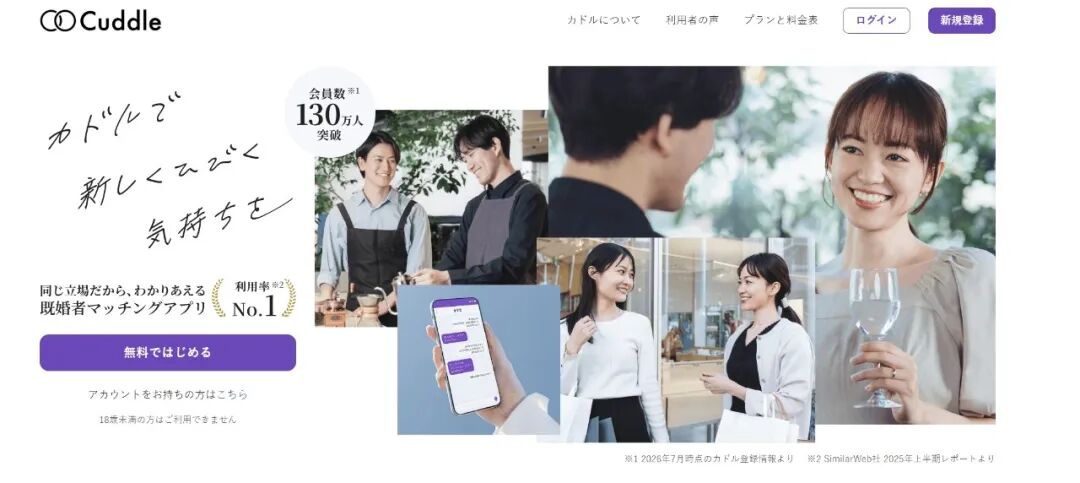
(Cuddle Official Website)
The surging growth trend of extramarital affair social platforms in Japan
If you travel to Japan recently and pass by Shibuya or Shinjuku, you will most likely see dating app ads marked "exclusive for married people" on outdoor billboards.
This was an unimaginable scene just a few years ago.
Nowadays, the three platforms Cuddle, Healmate and Married Club form the "top three giants" in this track, and the three are competing fiercely. Among them, Cuddle, which promotes the AI narrative the most prominently, is exactly the epitome of this round of growth.
Cuddle was launched in February 2022, and introduced the AI matching system in 2024, entering a period of rapid growth ever since. It is reported that the number of Cuddle members reached 400,000 in September 2024, exceeded 700,000 in July 2025, adding 300,000 new users in 10 months with nearly 1000 new daily registrations; by December 2025, the official cumulative number of members exceeded 1 million, and third-party estimates in 2026 have reached about 1.3 million.
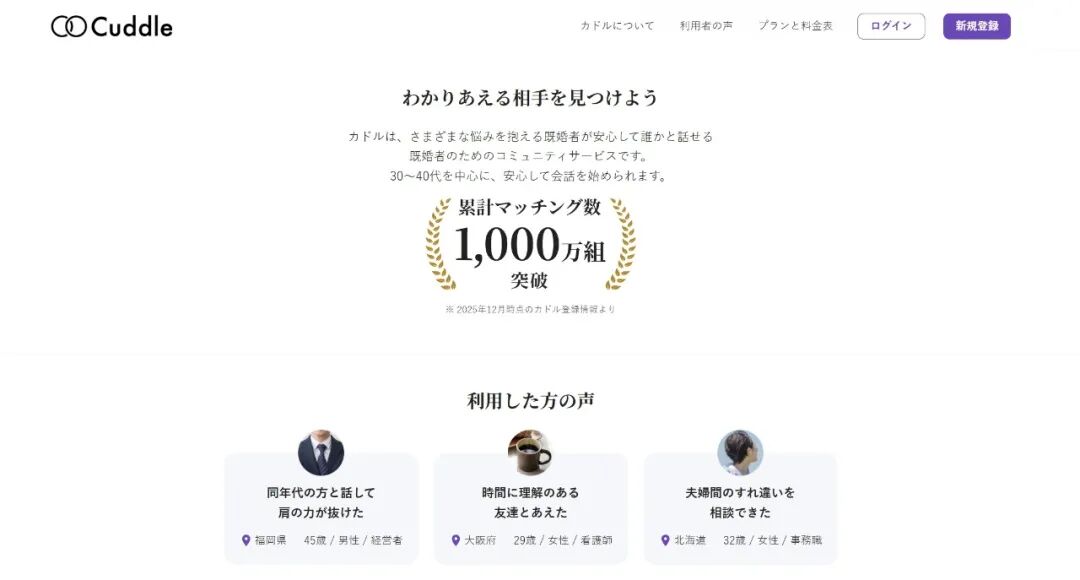
Cuddle publicly claims that its AI system facilitates one match every 4 seconds on average, and high efficiency is the main driving force for this round of growth.
At present, the nominal cumulative number of accounts of the top three giants can reach up to about 2.8 million, accounting for 4.4% of Japan's 64 million married population.
Different from the previous generation of stranger social products that used a large number of bots to induce male users to pay, the extramarital affair apps represented by Cuddle focus on authenticity, that is, "feasible matching" targeting real users. The platform will strictly verify the authenticity of user identities. Cuddle says its AI anti-fraud system can identify scammers, marketing accounts and accounts with "abnormal purposes" in real time, and plans to introduce Japan's My Number Card for identity verification to ensure a pure circle for all married users.
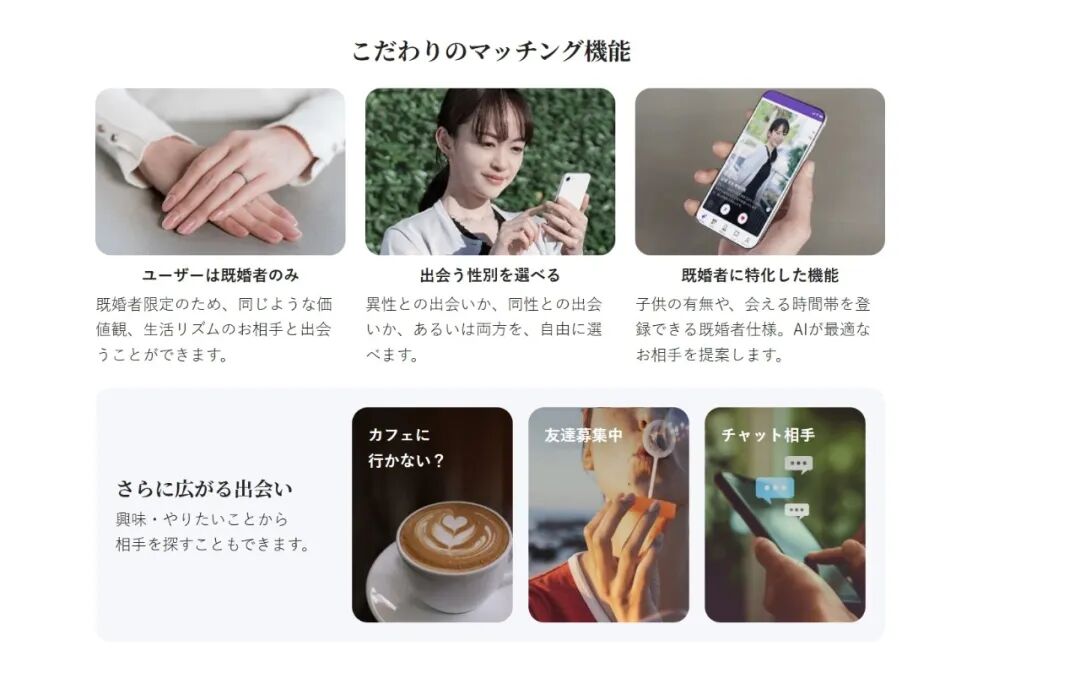
What AI focuses on solving in this scenario is the high efficiency of "feasible matching". Before AI technology matured, extramarital affair matching was an algorithm engineering with high cost: a full-time housewife may only be free on weekdays during the day after her children go to school, and an office worker may only have one or two hours of free time during lunch break or before getting off work. How to complete the complex matching of suitable candidates within this limited time window was an impossible project in the past.
Cuddle uses AI to let users register whether they have children and the time period convenient for meeting, combines behavioral data such as login frequency and reply interval, and even identity ID to predict when two people will be in available state at the same time. It can even understand colloquial descriptions such as "I am free during the days when my husband is on a business trip" through natural language processing. In terms of technical stack, Cuddle claims to use LSTM and Transformer to learn user activity patterns, use NLP to analyze chat emotional tendency, use graph neural network to analyze relationship structure, and then use reinforcement learning to optimize matching strategies. The whole chain of "testing - negotiating - making excuses" in the traditional way is compressed into one push, making matching accurate and efficient.
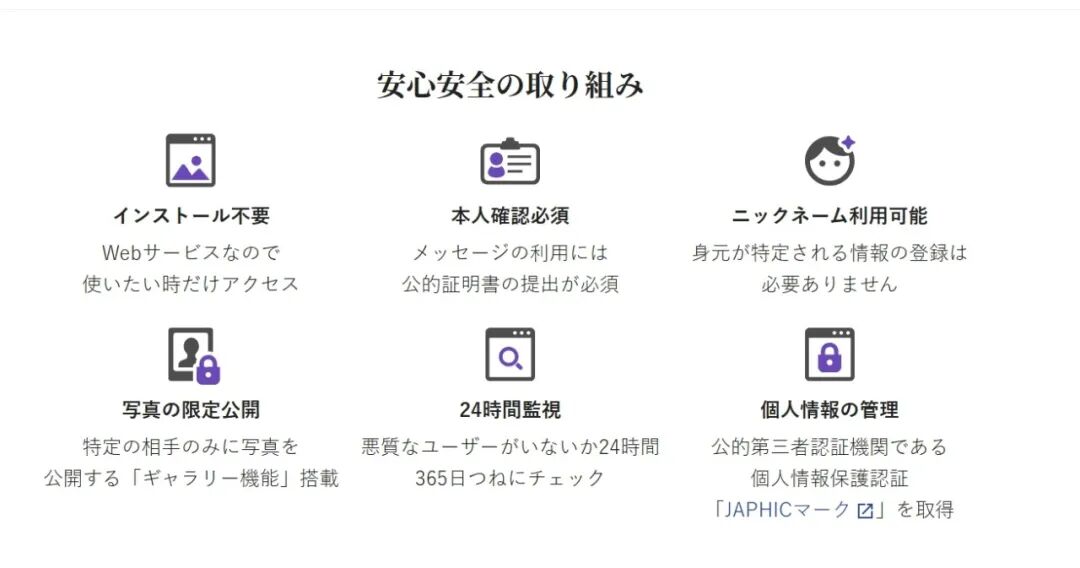
(Security is the foundation of survival for every extramarital affair app)
If Cuddle is an AI-driven efficiency-oriented platform, then Healmate takes "second partner" and spiritual communication as its core narrative, which is more inclined to search and community operation, while Married Club retains the bulletin-board-style mode for users to take the initiative to find targets. AI acts as a growth engine for Cuddle, and for the other two platforms, it is more used for back-end risk control and auxiliary functions.
The three platforms share one common premise: married people need a low-friction matching space that will not be seen by their spouses.
When we talk about extramarital affairs, we are talking about far more than sex
As a country where the sex industry is semi-legalized, Japan has seen the commercialization of sex become common as early as the past 100 years. Whether it is bubble bath and "papa katsu" for male consumers, or host clubs for female consumers, purchasing sexual services is as simple as buying a bottle of mineral water in a convenience store.

Then why are there still people willing to pay, spend time, and take the risk of being exposed on a platform with uncertain results, to pursue an opportunity that may not even lead to sexual relations?
Because what the sex industry sells is deterministic release, while what extramarital affair apps sell is the experience of being actively chosen by another subject who also has desires. The former is a transaction: I pay, the other party provides services, and the relationship ends as soon as the transaction is completed. The latter retains the complete emotional sequence of pursuing, testing, waiting for replies, being rejected or accepted. A Japanese man who has long patronized "papa katsu" once described that it "after all, is a money-mediated relationship, and you will feel empty somewhere unconsciously"; after switching to the married people app, he felt "the satisfaction of recalling the love when he was young". Certainty can be bought with money, but the uncertainty of "being chosen" is exactly what the sex industry cannot deliver structurally.
Going deeper, this platform provides a subtraction of social identities. In daily life, a person is a husband, father, lawyer, high-income earner, and service provider at the same time, with layers of identity labels stacked on top of each other. In an anonymous married people matching space where photos can be blurred, these labels are temporarily stripped away, leaving only "a person willing to listen" and "a person who can still be desired". A 43-year-old female user described in an interview that she looked for extramarital relationships through the platform, and the photo blurring function made her feel "the risk of being identified is relatively small"; she meets her extramarital partner once a month, and because she no longer has expectations for her husband, the relationship between the couple has become better instead. The core of this experience is not that you "buy" something outside of marriage, but that you reconfirm in another person's eyes that you are still a vivid individual worthy of being seen.

This demand structure also explains the change in user age. The core users of Cuddle are married people in their 30s and 40s, more than 60% of whom have children. But the middle-aged and elderly groups are entering this market. A survey by MMD Research Institute shows that 19.3% of people in their 50s have used matching apps. For people over 50 whose children are independent, who are approaching retirement or have experienced the relationship loosening of "sotsukon (graduation marriage)", the sexual and emotional functions of marriage may have long existed in name only, and the demand to "be seen" will not disappear with age.
Cuddle even said that the company is currently investigating the same-sex crowd market, and does not rule out launching products for this group.

Changes in human society: officially stepping from the construction era to the deconstruction era
If the 20th century is an era of construction, then the 21st century is an era of deconstruction.
At the beginning of the 20th century, human society overthrew the decadent feudal hierarchy, established free love and a new marriage system, and popularized free work and universal suffrage.
In the social cell theory, the family is regarded as the smallest cell of society, and marriage is the metabolism of new cells. The marriage system of the 20th century is essentially a packaged container: sex, emotion, economic cooperation, child rearing, and elderly care are bundled in a lifelong contract. In the past half century, every function of this container has been decoupled one by one:
(1) The labor force participation rate of women has risen, and marriage is no longer the only channel for women to obtain economic security;
(2) The sex industry has been legalized or semi-legalized in many countries, decoupling sex from reproduction and marriage;
(3) AI technology has greatly improved the matching accuracy and concealment of extramarital affair social interactions;
(4) The DINK lifestyle and low fertility rate have long decoupled reproduction from marriage.

(Host club posters on the streets of Japan)
Japanese sociologists have observed that since the 21st century, "the inherent functions of marriage are being provided separately", and the emergence of forms such as cohabitation divorce, friendship marriage, and second partner points to the same direction: marriage is changing from a "default container" to "one of the optional items".
Business plays a dual role in this process. As a pressure release valve, it may delay the breakdown of marriage: some users clearly stated that after finding a "second partner", they no longer make demands on their husbands, and the relationship between the couple has become more harmonious. If this model is valid on a larger scale, the social function of such platforms is not to disintegrate marriage, but to allow marriage to continue to exist even when it cannot meet all needs.
But as an accelerator, it is changing people's expectation structure for marriage: when emotional and sexual supplements can be subscribed from the outside at any time, marriage shrinks from an "emotional community" to a "life cooperation framework", and people's expectation for meeting these needs within marriage will decline. What is really disturbing is not that "desire is commercialized", but that business has begun to systematically undertake the relational functions that were originally guaranteed by "commitment" and "exclusivity".
The future social structure is more likely to move towards hierarchical relationships. The marriage layer retains the functions of law, economy, child rearing and elderly care, but the exclusive expectation for emotion and sex continues to weaken, and it is more and more like a life cooperation contract. The emotional layer is undertaken by commercial platforms, which is subscribable, exitable, low-commitment and high-privacy. The sexual layer has long been highly commercialized and separated from emotion in legalized societies, and extramarital affair apps repackage sex and emotion into an intermediate zone of "project-based, renewable, low exposure risk". Each layer solves a specific problem, and no layer tries to solve all