NeoLab's first business model: reselling GPUs
Neolab, which fails to train usable models, has started reselling GPUs.
Neolab, an emerging AI lab, is the most popular VC project at the moment — referring to those AI startups founded by star researchers that secure huge financing first and then invest in model R&D.
Born with a glowing reputation, they ostensibly are all engaged in cutting-edge technology, but...
Recently, an "outrageous" business model has begun to surface, and even Elon Musk has come to watch the buzz:
Those Neolabs that have locked in a large amount of computing power in advance with huge financing can make a huge profit by reselling GPUs even if they fail to train a good model.

In response to this business opportunity, the founder of Modal, a unicorn in AI cloud computing, said:
Next year, we may see a large number of Neolabs transform into Neocloud (AI computing power cloud service providers).
Netizens have already mapped out a clear path for these Neolabs: the best scenario is to achieve technological breakthroughs and become the next OpenAI; the second-best is to transform into vertical enterprise Agents to survive in the niche market; the worst case is that the model training fails, but they can still sublease GPUs to distribute dividends to shareholders as a bottom line guarantee.
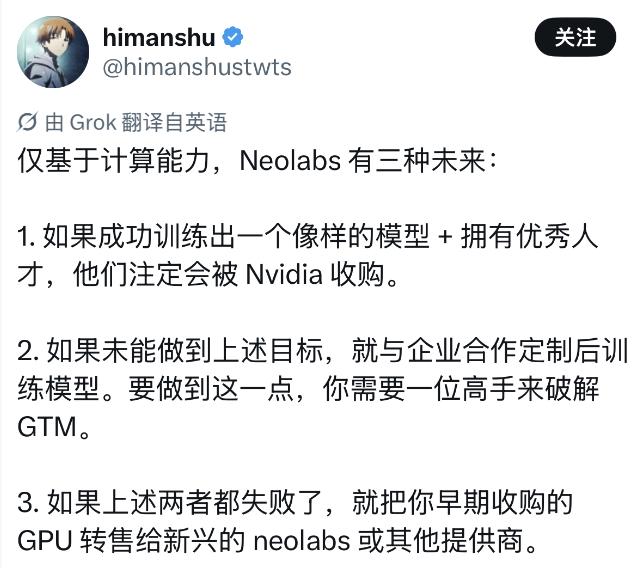
This is a perfect demonstration of mastering cycle and risk hedging.
Computing Power Scalpers Are Coming
For large model startups, computing power is the largest sunk cost, which often accounts for more than half or even 70% of the total expenditure of a Neolab.
To prevent sudden supply interruption of the cluster in the middle of the training process, after most labs complete the seed round or Series A financing, the first thing they do is sign 1-3 years of guaranteed lease contracts with cloud vendors or large data centers.
On the other hand, affected by various factors, the spot computing power market is currently continuously tight.
The market rent of H200 has once risen by about 160%, the new computing power dark horse B200 has increased by 120%, and even the spot price of H100 has maintained a premium of around 35%.
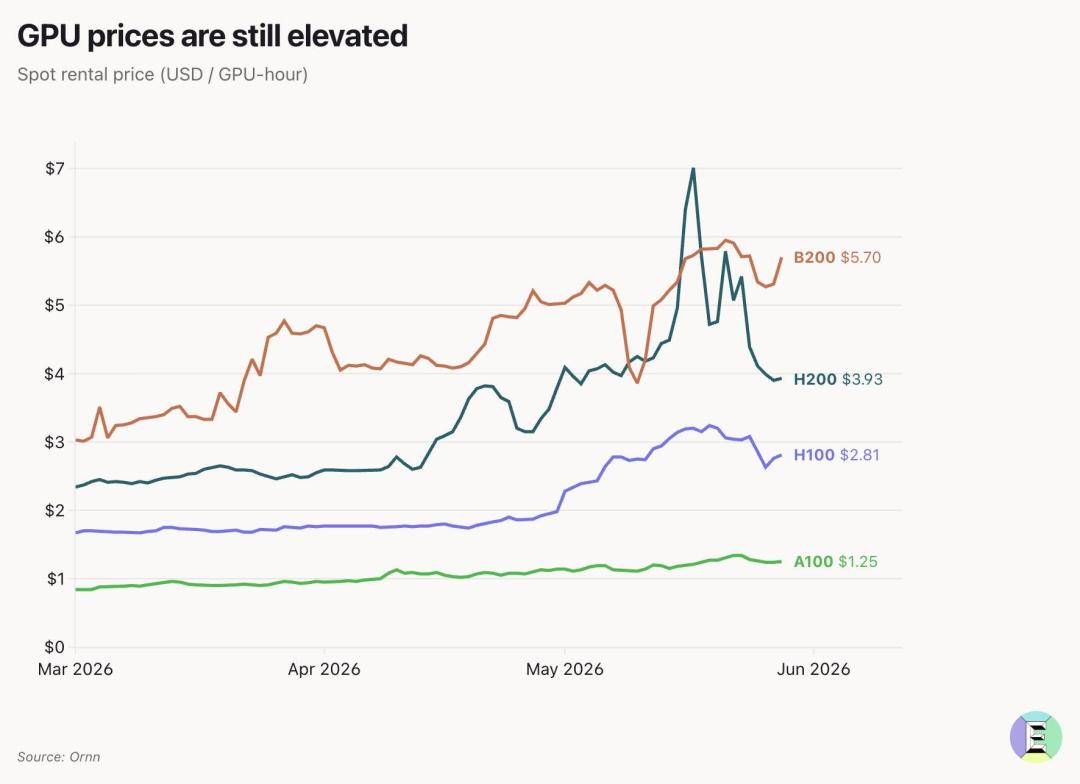
Therefore, in the face of huge price differences between buying and selling, many labs that are blocked in scientific research and cannot produce usable models have begun to act as computing power scalpers.
Apart from launching advanced models to sell tokens, they have found three other ways to make money.
The first is to directly transfer the long-term computing power lease to brokers at a premium to earn risk-free spread;
The second is to list and sell spot GPU instances, split idle nodes, and sell short-term computing power to small teams that are in urgent need of computing power on a daily or weekly basis;
The third is to wrap and run open-source models for inference, simply give up pre-training, directly mount the chips to mainstream open-source large models, and provide API services charged by tokens.
In short, they can make profits anyway, which is a perfect win.
Faced with the temptation of such monetization of computing power, an associate professor from Carnegie Mellon University also confessed on X

:
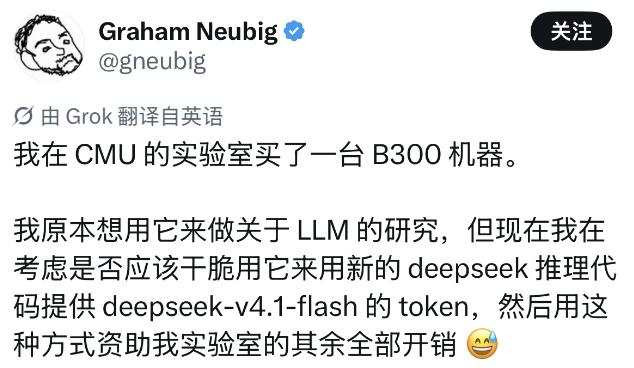
AI Genius Entrepreneurship, Silicon Valley VCs Start to Do the Math
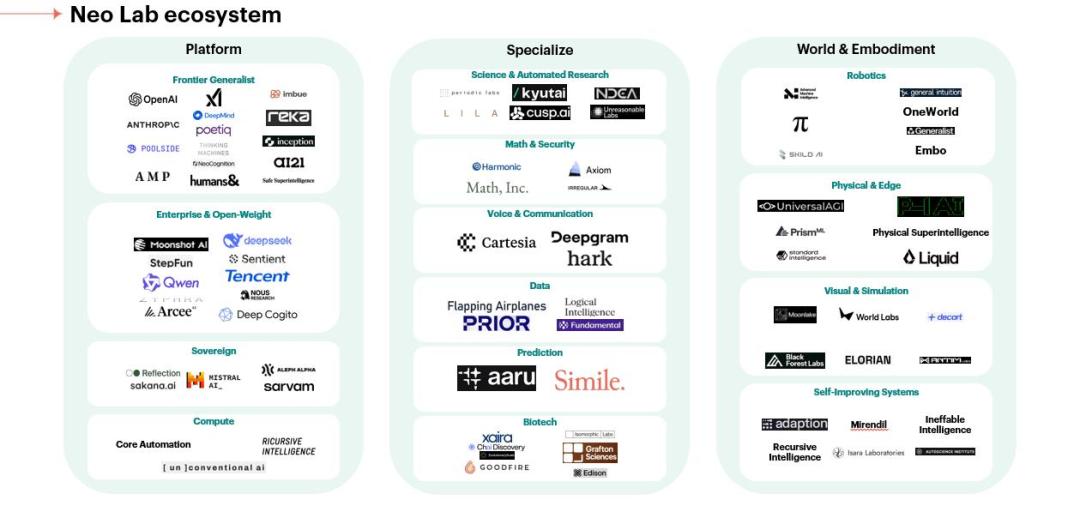
As the most cash-absorbing species in the VC industry in the past two years, Neolabs all follow a unified playbook.
They are usually founded by star chief scientists from top giants such as OpenAI, DeepMind, and Meta. They never engage in cumbersome application layer development, and directly claim to tackle AGI after launching. With extremely high talent density, they can easily secure hundreds of millions of dollars in financing even at the PPT stage.
However, according to the latest report disclosed by Dealroom, the authoritative European venture capital data institution, the 29 most typical AI Neolabs in the world have raised a total of 23 billion US dollars (equivalent to 166 billion RMB) so far, and less than 35% of them have truly launched commercial products for external sales.
In other words, at least 19 labs are either still in the closed research stage, or have only released technical white papers or demos.
△
A typical example is Safe Superintelligence (SSI), co-founded by Ilya Sutskever, former chief scientist of OpenAI.
With the unparalleled technical reputation of the founding team, SSI was valued at 32 billion US dollars when it was less than a year old and had a team of less than dozens of people. This speed was almost unimaginable before 2023.
However, SSI stated from the very beginning of its establishment that before realizing "Safe Superintelligence (SSI)", the team will never develop any commercial products for consumers or enterprises.
Such ambition is undoubtedly noble.
But a Silicon Valley VC did the math: today, a complete training cycle of a basic foundation model burns at least 10 million US dollars in computing power costs.
If the company wants to earn this money back slowly by providing APIs and selling tokens later, it must successfully sell a total of 10 trillion-level effective token calls to the market after deducting electricity fees, broadband fees and depreciation.
Moreover, under the current background that top giants are almost dumping open-source models at subsidized or even free prices, it is not very realistic for labs without supporting enterprise workflows and exclusive data to recover costs by selling APIs.
According to a report by Business Insider, Matt Murphy, a Silicon Valley veteran who participated in Google's early investment and led Menlo's investment in Anthropic, believes that Neolab is one of the most overhyped investment sectors at the moment.
He said that Google's early success was like "throwing a match into a bonfire", while some Neolabs today are trying to "use a pile of bonfires to light a single match".
In his view, injecting tens of billions of dollars at one time into early cutting-edge labs artificially raises the threshold for their commercial success.
One More Thing
Elon Musk also came to comment on this wave of Neolab's reselling computing power operations.

His point is that buying so many GPUs is useless, because what is causing the current computing power shortage is not the lack of GPUs, but the lack of electricity.
According to the latest research from Goldman Sachs, global data center power demand is expected to grow by 170% from 2025 to 2030, but grid construction, approval and infrastructure expansion are far from keeping up.
As of October this year, 86 data center projects around the world have been canceled or severely delayed.
Musk also predicted yesterday that the Neocloud industry will face a wave of large-scale consolidation and closures.
The road of transformation for Neolabs is probably far from easy...
This article is from the WeChat official account "QbitAI", author: Focus on cutting-edge technology, published with authorization from 36Kr.