Spend today's money to get yesterday's experience, what exactly is wrong with old hotels?
When the criteria for "good" have been rewritten, do old supplies still stand a chance?
This dilemma is particularly prominent in the hotel industry.
Changes have taken place from the moment people start booking hotels. Searching for "when was this hotel opened" before placing an order is becoming muscle memory for many people — they will check the opening year, renovation time, and bad reviews from the past three months one by one. They have gone through multiple rounds of inspection before making decisions, and consumers' complaints are the most intuitive proof [1].
@HiddenDeer, a Xiaohongshu user who was on vacation in Sanya during the long holiday, shared her frustrating experience: an old resort hotel that had been open for many years either had no laundry room, or charged extremely high fees for laundry services. A family of four spent their days on vacation and had to wash clothes by hand at night, which made them feel like "maids in the imperial laundry bureau".
Quite a few people have the same feeling, and even long-term guests have come up with tips — after staying at an old hotel for several consecutive days, you can arrange a one-night stay at a chain hotel specifically to wash the accumulated dirty clothes.
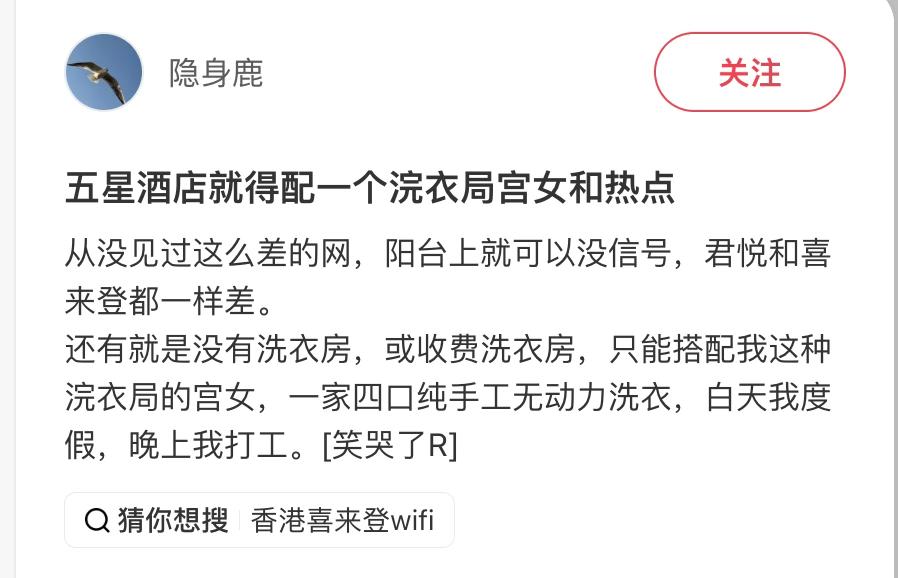
Comments from Xiaohongshu users
Laundry is only one of the many dissatisfactions —
The goose down pillows commonly used in old hotels lack support, and people who are used to latex pillows at home will wake up with sore necks after sleeping on them;
Although the carpets in corridors and rooms can reduce noise, they also accumulate dirt and grime;
Many hotels do not even have intelligent in-room control systems. For travelers who are used to whole-house intelligence, it is simply "spending today's money to buy yesterday's experience".
Consumers have not suddenly become picky. From the perspective of Daofa, what has really changed in the accommodation sector is the weight of the word "old": in the past, it represented seniority and trust, but today it may mean risks that require additional verification. Because the criteria for being good have changed, "old" itself is not a sin. The real problem is being disconnected from current demands and stopping updates.
The new generation of hotels has reshaped travelers' experience expectations. Intelligent in-room control, bedding that guarantees deep rest, restrained non-intrusive services, and self-service laundry have even become standard configurations for budget hotels. When consumers look back at those old hotels that have not been updated for a long time, what they feel is not only outdated facilities, but also that their product logic still stays in the last era.
Under the new coordinate system, consumers are voting with their feet. The so-called "seven-star" Huzhou Moon Hotel officially removed its brand label on October 1, 2026, terminating its brand trusteeship cooperation with top hotel groups. Landmark hotels engraved in the city's memory, such as Shenzhen Huaqiang North St. Regis Hotel, Chengdu Galaxy Dynasty Hotel, Chongqing Yudu Hotel, and Guangzhou Yuexiu Hotel, have successively introduced chain brands such as All Seasons, Orange, Moxy, and Hilton Curio to take over operations [2].
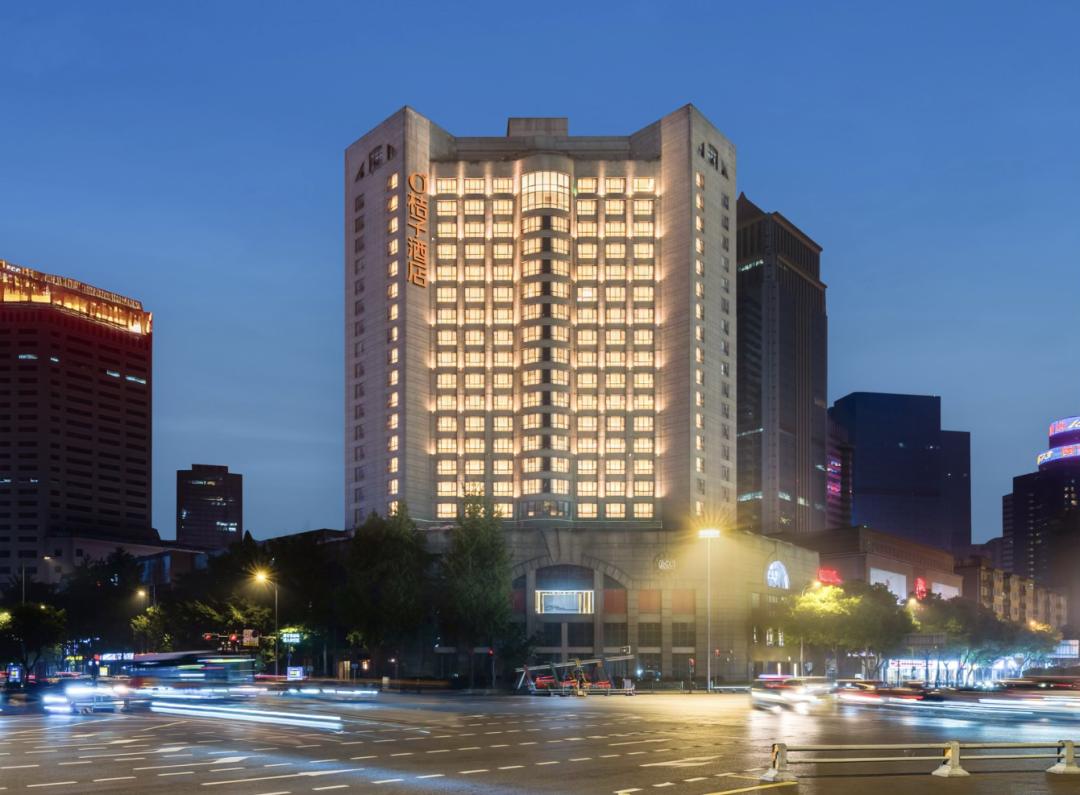
Orange Hotel Chengdu Chunxi Road Tianfu Square (formerly Chengdu Galaxy Dynasty Hotel)
However, this cannot be simply interpreted as a "war between new hotels and old hotels". It is more like the creative destruction mentioned by Joseph Schumpeter — in the stock era, the value system that has supported the hotel industry for decades is being subverted. Old supplies are being cleared out at an accelerated pace, and new paradigms are emerging, spurring new consumer demands and market space.
Consumers no longer pay for "long-standing seniority"
The reason why this creative destruction can happen is that the consumer group standing on the stage has completely changed.
The "physically conscious generation" has formally stepped onto the main stage. They do not correspond to a specific age or income label, but a broad and rapidly expanding consumer group. Anyone who values personal experience and requires an extremely efficient balance between quality and price can be included in this group.
They no longer blindly pay for the aura of "long-standing seniority", nor do they pay high premiums for "social face" such as prestigious signs and grand lobbies. Instead, they attach great importance to affordable high quality and "zero-friction" seamless experience.
The shift in consumer preferences did not happen by accident, and there are two layers of driving forces behind it.
First, the consumer mindset has changed.
After experiencing the fluctuations of the macroeconomic environment, the public's mindset has shifted from the past "expecting asset appreciation and pursuing class ascent" to "protecting disposable income and pursuing life certainty", and rational consumption has returned to the mainstream. But this does not mean that consumers have given up the pursuit of quality. On the contrary, they hope that every expense can bring stable and perceptible quality.
Under the dual high pressure of work and life, consumers' psychological tolerance has dropped to the minimum.
Stuck processes, aging hardware, and inefficient services will continuously consume precious energy and hard-won good moods. For consumers who are physically and mentally exhausted, zero friction is a rigid demand, and the seamless, smooth and efficient "unnoticeable" experience has become a core variable affecting consumption decisions.
Second, social media has completely broken information asymmetry, making "old and outdated" impossible to hide.
Before the popularization of Xiaohongshu, review platforms and short video platforms, old hotels held the right of speech, and the real problems behind aging hardware were difficult to be seen. Today, problems that were easy to cover up in the past, such as outdated facilities, absent services, and perfunctory details, will be exposed by ordinary users on major platforms for consumers to inspect and judge.
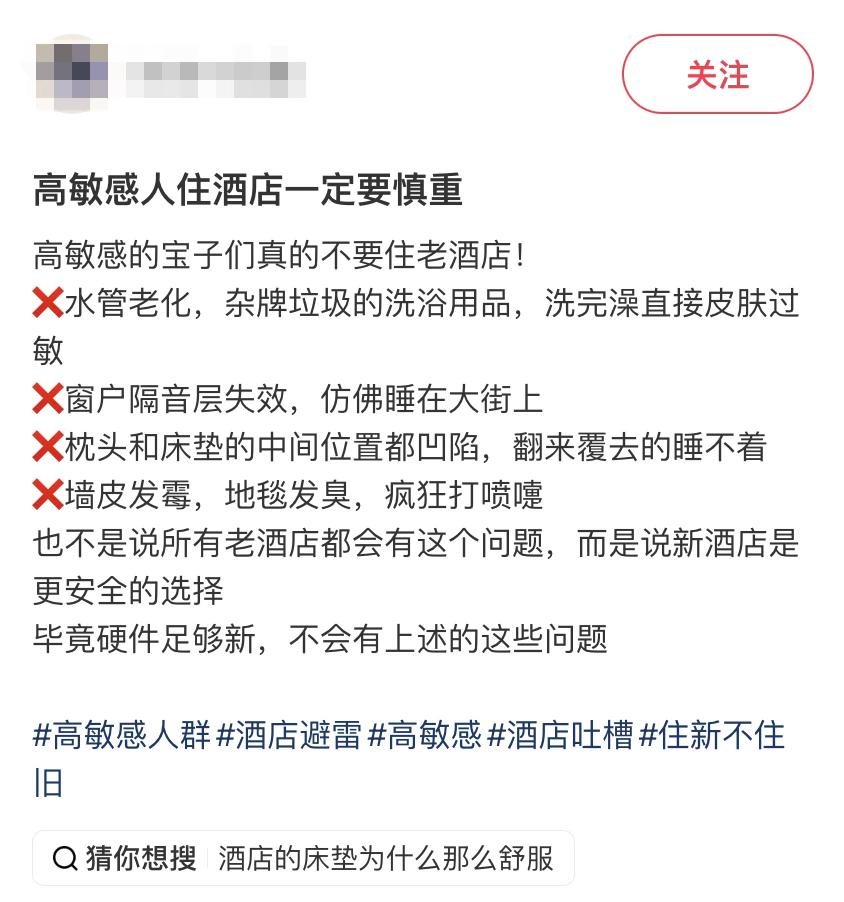
Comments from Xiaohongshu users
When individual real experiences become publicly accessible references across the entire network, the era of "easy profits" relying only on brand aura and location has come to an end.
What old hotels really lost is not their age
Changes in consumer groups and consumer mindsets have opened a window for transformation. Facing the same window period, some hotels choose to embrace changes, while others stick to old habits out of inertia.
The gap is first reflected in the distribution of experience resources.
Every hotel has to calculate its economic accounts, and there are upper limits for capital, space and operating costs. The essence of experience design is to make trade-offs under the constraints of limited resources: which links are worthy of key investment, and which configurations will only occupy resources inefficiently.
When old star-rated hotels were designed in the past, they focused their peak resources on "face scenes": lobbies with a height of more than ten meters, executive lounges, constant temperature swimming pools, etc. These facilities have extremely low usage rates, but the costs are passed on to guests through premiums.
The old batch of economy and mid-range chain hotels fell into another kind of misalignment: they once led the trend with advanced "peak design" back then, but these peaks stayed in the era of opening and never evolved again. More than ten years later, these once leading functions may have become basic configurations today, or even no longer meet demands.
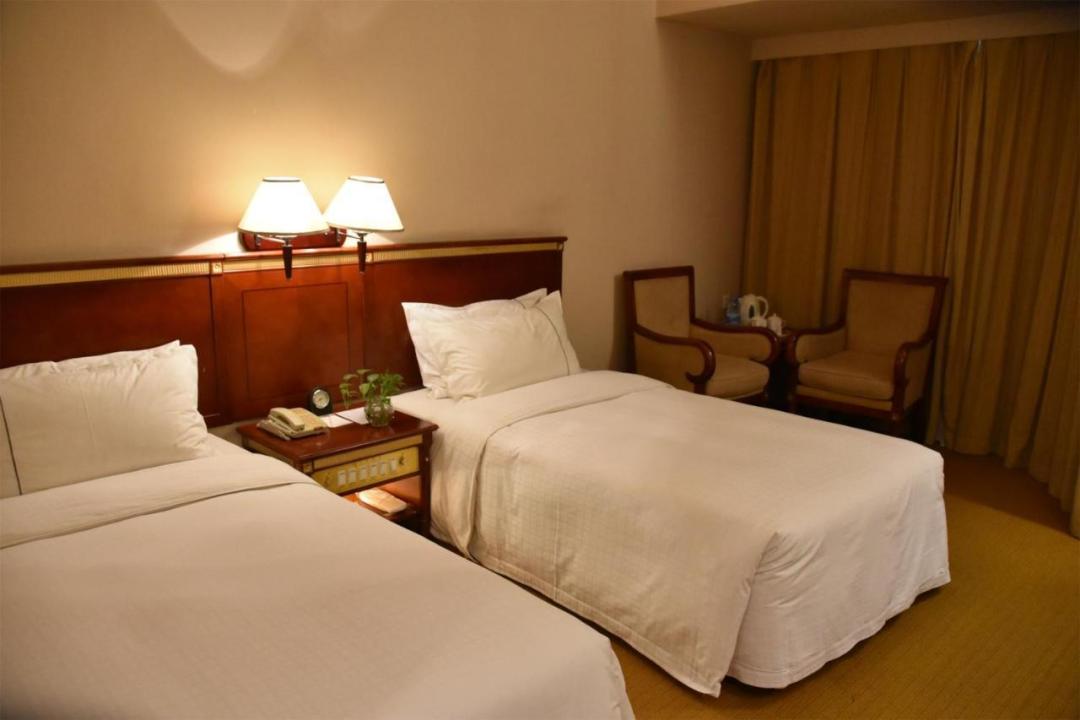
Hotel with outdated facilities
One is outdated extravagance, the other is outdated leadership, but they both lead to the same result: the peaks they built deviate from the real physical experience needs of current consumers.
The new generation of hotels targets this supply-demand mismatch and arranges experience peaks in the mid-stay scenarios. Relying on mature supply chains and digital capabilities, configurations such as intelligent in-room control, self-service, and self-service laundry have been implemented on a large scale in mid-range and even mass brands. They shift the focus of resources to high-frequency touchpoints such as sleep, bathing, laundry, and check-in procedures, and redefine the "good" standard of accommodation with a low-friction, unobstructed and smooth experience.
On the surface, it is only a difference in the idea of resource allocation. In fact, the real divergence between old hotels and new generation hotels lies in whether they take continuous evolution as the premise of operation.
The success of old hotels in the past was due to their accurate response to the needs of the previous generation of consumers, but consumers' needs never stay the same. If they cling to the past success path, their once advantages will become heavy burdens.
A more hidden gap is hidden in the decision-making cost before check-in. The experience of old hotels is a blind box: under the same brand sign, different opening years and different owners lead to huge differences in maintenance investment. Guests pay similar premiums, but can only get whatever experience they randomly get.
New generation hotel products strive to reduce uncertainty. Even in different cities, the layout of guest rooms, the softness and hardness of bedding, the operation logic of intelligent in-room control, the location of free laundry and drying rooms, and even a bowl of noodles for breakfast maintain highly consistent quality standards.
This extremely strong certainty is very friendly to consumers' prefrontal cortex — you don't have to work hard to do research, and you can get a stable and predictable experience by placing an order with your eyes closed. At the same time, it also puts more direct pressure on economy and mid-range hotels with aging facilities, outdated aesthetics and lack of renovation: even if they occupy a good location, if their product strength cannot keep up, the location can only bring the first attempt, not necessarily repurchases.
Clearing out and rebirth are happening at the same time
From a larger historical background, the de-branding and rebranding of old hotels are not only determined by consumer experience, but the result of the combined effect of multiple factors such as demand changes, real estate cycles, and property conditions. Differentiation is emerging on the supply side: uncompetitive products are accelerating their exit, and properties with renovation value are re-entering the market.
One type is in the period of real estate prosperity, where hotels are the "supporting facilities" of residential or commercial complexes. Owners make money from real estate appreciation rather than hotel operation. These hotels were not designed according to the optimal operation standards from the beginning, which sowed the seeds of supply-demand mismatch. When the real estate dividend fades, these properties must rely on their own operation to generate profits, and the previously covered supply-demand mismatch will be exposed.
Another type of hotels once won the market with their products, but lacked continuous renovation and version upgrades in long-term operation. The superposition of aging facilities, backward functions and rising maintenance costs eventually weakened their profitability.
The speed of stock clearing is faster and more intense than imagined.
According to industry data, the proportion of existing branded hotels that have been open for more than 5 years across the country has reached as high as 69.3% [3]. In 2025 alone, 1054 hotels were de-branded, and more than 3600 mid-range and above hotels were closed [4]. These numbers do not mean that every exit can be attributed to "old and outdated", but it is enough to show that product renewal and asset disposal of existing hotels have become problems that the industry must face.
At the same time, in the downward cycle of real estate, a number of properties with good locations, modifiable structures and more flexible lease terms have been released to the market, and good products can complete expansion and upgrading at more controllable costs. New possibilities have also emerged in core locations that were difficult to enter in the past.
The development focus of major hotel groups has also begun to shift to existing property rebranding and renovation.
It is understood that local hotel group Huazhu Group has successively signed agreements with the SASAC of Guangzhou and Chengdu to carry out all-round strategic cooperation in fields such as revitalizing existing assets; Jin Jiang Group has also carried out strategic cooperation with the Department of Culture and Tourism of Guangdong Province, Lu'an Urban Investment and other parties in the past two years to launch existing property renovation projects.
Therefore, old hotels do not only have two options of "defending" or "retreating". A more realistic path is: properties with suitable conditions and feasible renovation budgets can remake products through renovation or rebranding; those with limited structures and unfeasible input-output ratios may be cleared out.
Daofa believes that location and brand accumulation are still assets of old hotels, but they can only provide a starting point and cannot replace the product itself. Consumers are still willing to pay for quality, but they no longer accept premiums where "price does not match experience", and the supply side needs to re-answer consumers' question of "whether it is worth it".
This phenomenon is not limited to the hotel industry. The iteration of new energy vehicles over traditional fuel vehicles is a typical sample.
Traditional fuel vehicle giants have rich technology, channels and brand accumulation, but path dependence has led to their slow transformation in electrification and intelligence, and they gave up progress in their old success. When a large number of new energy vehicles enter the market, the price system and consumer minds are rewritten at the same time, and old players soon feel the pressure of survival — price cuts, production cuts, factory closures and reorganizations follow one after another.
Back to the question at the beginning: do old hotels still have a chance? The answer is yes, but you can't keep it by just "defending". Old hotels that can embrace changes can turn their seniority into trust; products that stay in the past may be eliminated by new experience standards even if they are located in prime locations.
Was the last hotel you stayed in exceeding expectations and making you want to repurchase, or did you step on a mine and add it to the blacklist? Welcome to talk about your real stay experience in the comment section.
References
[1] Travel Daily, Young people start to check the age of hotels when staying in hotels
[2] Space Exploration, Why are old landmark hotels gathering to "rebrand" and embrace chain brands?
[3] Maitour, 2026 Hotel Brand Development Report
[4] Houhai Data Platform, Insight Report on Brand Changes in China's Hotel Market
This article is from the WeChat official account "Daofa Research Institute" (ID: DigipontClub), written by Daofa Research, and authorized by 36Kr to be released.