When AI is more adept at speaking than humans, Agora is paving an invisible road.
In the AI era, you must have encountered such moments: after you finish speaking to a voice assistant, the indicator light spins for two seconds before it slowly starts to respond; when you want to correct your words halfway, it acts as if it did not hear you and insists on finishing its previous utterance; even when your tone is already impatient, it still reads the script in the same gentle tone.
After learning to "speak", AI seems to hit an invisible wall. This wall has nothing to do with intelligence, its name is "real-time". As a result, the competition focus of global AI manufacturers has shifted from "generating more anthropomorphic voices" to "participating in ongoing real-time interactions".
2026 is also widely regarded as a key year for Voice Agent to move from pilot deployment to large-scale implementation. When everyone is making AI "speak", who will solve the last-mile problem of "speaking naturally, listening clearly, and responding smoothly"?
1. The second half of "real-time interactive" AI
Arrange the key nodes of the past two and a half years in a line, the pace is so fast that it feels almost unreal.
In May 2024, GPT-4o used native multimodality to turn real-time voice dialogue into reality; in October of the same year, OpenAI released the Realtime API, and officially moved it from demonstration to production environment last August.
The real acceleration happened this year: in May and July, GPT-Realtime-2 and 2.1 integrated real-time reasoning, tool calling and streaming transcription into voice models; on September 15, Gemini 3.8 Live enabled "dialogue" and "deep thinking" to run in parallel, completing tasks while communicating; on October 15, the combination of GPT-Live and Decisions realized the scenario that "the user is still speaking, and the Agent has already taken action".
The signals on the commercial side are more direct. Sierra, an enterprise-level voice Agent company, completed a $950 million financing in May this year, with a post-investment valuation of $15.8 billion. More importantly, this company founded only three years ago disclosed that its ARR (Annual Recurring Revenue) has exceeded $150 million, and the billing method has changed from the traditional "pay per message volume" to "pay by the number of problems solved".
Capital often senses trends earlier than technology. Data from Grand View Research shows that the global AI voice agent market was about $2.54 billion in 2025, will increase to $35.2 billion in 2033, with a compound annual growth rate of 39% from 2026 to 2033; in the first quarter of this year alone, the financing amount of AI voice startups reached about $7 billion, which was less than $1 billion in the same period last year. A sevenfold difference within one year.
In the startup ecosystem, Thinking Machines Lab, founded by OpenAI CTO Mira, released the Interaction interactive model, leading the paradigm shift from end-to-end single model to the "fast-slow brain" architecture; the Griffin model launched by overseas company Tavus made 48% of users mistake it for a real human in real-person tests; startup Instinct realized a Zero-UI personal assistant through SMS and phone calls.
At the same time, the brutal reshuffle of the industry is also underway. Chapter AI filed for bankruptcy protection, and the Chinese government has also released the world's first national-level regulatory rule for AI emotional companionship and anthropomorphic interaction services.
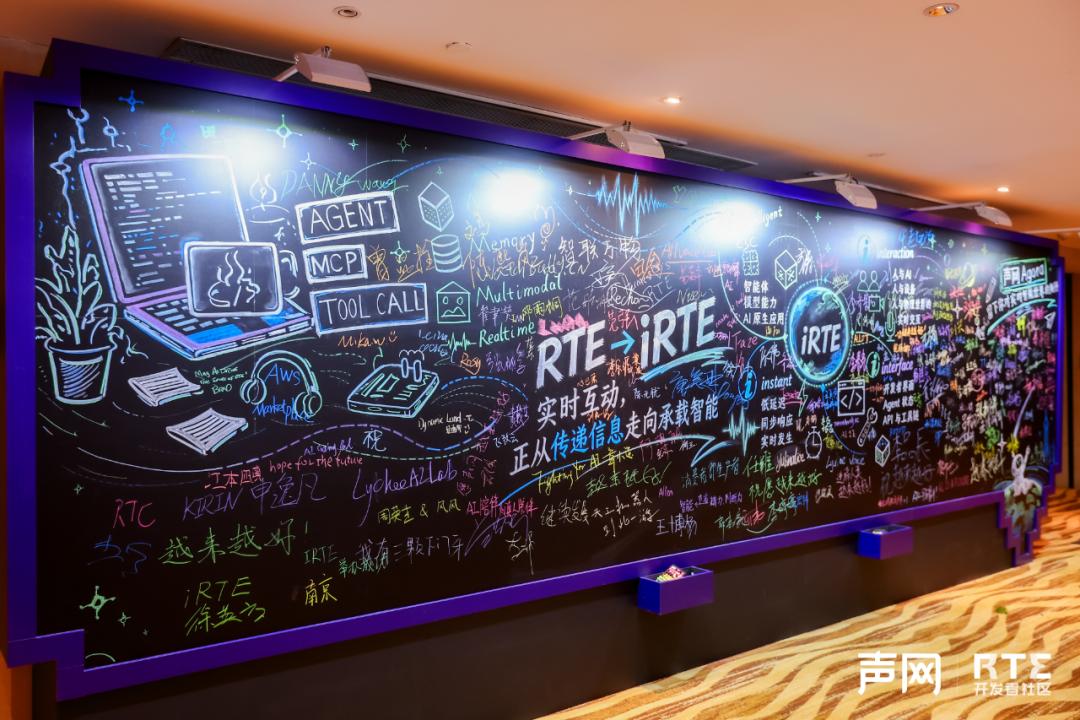
It is at this node where technological explosion and business reshaping are intertwined that the RTE Conference, which has been held for 12 consecutive sessions, is officially upgraded to iRTE. The added "i" accurately announces the intergenerational leap of real-time interaction from information transmission to intelligence carrying.
2. The weight of a single "i"
In 2015, the first Real-time Internet Conference was named RTC. At that time, there were almost no dedicated real-time audio and video services in China, and a group of developers with obsession for technology brought WebRTC to China. From 2016 to 2019, with the rise of the mobile Internet, real-time audio and video expanded from co-hosting in live streaming rooms to social, education, and meeting scenarios; in 2020, RTC was upgraded to RTE, and "real-time" extended from a single technology to a whole range of scenarios. This year, an "i" is added before RTE, making it iRTE — Real-time Intelligence.
The "i" interprets two extensions of the RTE boundary: the interaction objects expand from person-to-person to person-to-Agent; the interaction content evolves from information transmission to intelligence carrying.
The easiest way to judge whether a conference is a vane of the industry is to look at its speaker list.
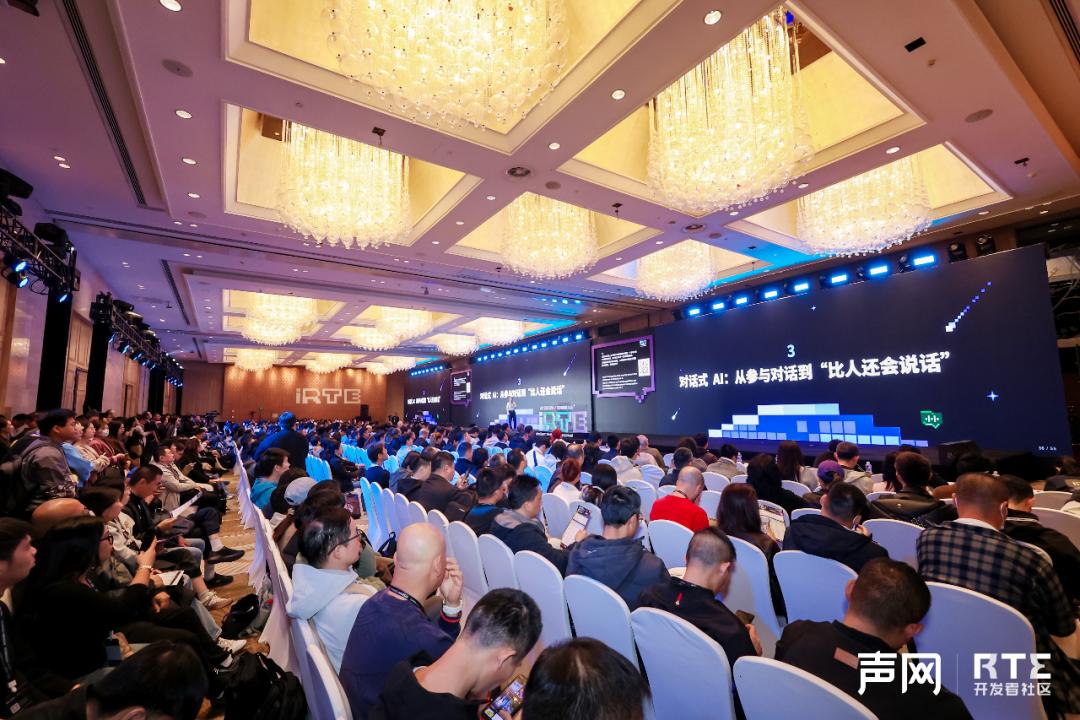
This conference has set up more than 15 forums and over 100 in-depth speeches. At the model layer, leading domestic large model companies including Kimi, MiniMax, StepFun, MiniMax, FaceMind, Mosi AI and SsTech will gather at the scene; at the scenario layer, Meituan, Alibaba ATH, Rokid, Soul, HOLLA, EF Education First and Papaya will bring landing practices in customer service, hardware, social networking and education; at the infrastructure layer, Agora, Beken Integrated, Rockchip and other enterprises will present chips, end-side capabilities and real-time network technologies on the stage.
In terms of in-depth technology, the "Conversational AI Technology Special Session" is co-produced by Professor Xie Lei from Northwestern Polytechnical University and Wu Bo, head of Agora's multimodal business, directly targeting the core of "interaction is intelligence". The agenda of the conference is highly focused on three industrial pain points:
The first is how models evolve from "being able to speak" to "being able to interact". Yang Xuerui from StepFun will discuss the next-generation interaction model, Wang Xinsheng from Soul will bring Loxi-Speech, a speech synthesis model "born for real-time interaction", and Professor Li Ming from the Chinese University of Hong Kong, Shenzhen will share the target voice extraction technology in complex multi-person scenarios.
The second is how agents evolve from "being able to converse" to "being able to get things done". At the enterprise-level customer service agent special session, Huang Zhe, product manager of Agora Call Agent, analyzes the cost and conversion rate, Xu Jun, senior technical expert from Meituan, disassembles the B-end challenges, Shi Xinhua, senior architect from Alibaba ATH, talks about the self-evolution of intelligent customer service Agents. The roundtable forum directly takes "AI Agents on duty" as the theme to discuss business closed loops.
The last is how hardware evolves from Demo to commercial growth. In the intelligent hardware special session, Shi Yunlei from Petkit shares how to integrate AI into pet products, Jiang Chengyuan from Uniview discusses the path of visual capability entering households, and Wang Lijun from Jellop raises the question of which AI hardware products in the overseas crowdfunding market are truly worth consumers' money.
Three questions — can it interact, can it deliver results, can it be sold — correspond to the three layers of the entire industrial chain from top to bottom. A conference that addresses these three pain points deserves the title of "industry vane".
During two high-weight roundtable forums, industry consensus has been further consolidated.
The "Personal Agent" roundtable hosted by Tony Wang, co-founder of Agora, points out that the value of AI products is shifting from competing for users' attention to helping users complete tasks; Jian Hua believes that future entry points will not necessarily be monopolized by a single device; Eugene Wei emphasizes that "context is king", and personal agents must understand users' social relationships and long-term memories.
The "Driven by Conversational AI" roundtable hosted by Cui Bo, Chief Business Officer of Agora, focuses on implementation. Chen Wei, founder of Oblique Intelligence, Cai Guoxiang, co-founder of Rokid, Geng Xianglei, founder of Guanke Technology, and Wu Kan, CEO of Titan Qiming, discuss real business challenges such as latency, interruption, anthropomorphism and large-scale reach in scenarios including embodied intelligence, AI wearables, voice seats and AI recruitment respectively.
3. Build the bridge named "real-time"
If model companies are responsible for the "brain", someone has to be responsible for the "nervous system". Agora has played this role for 12 years.
Few people in the domestic public noticed that when OpenAI released the world's first end-to-end multimodal API Realtime API in October 2024, Agora, the overseas entity of Shengwang, was its partner. This is not a random choice of side, but a natural realization of 12 years of technology accumulation in the new cycle.
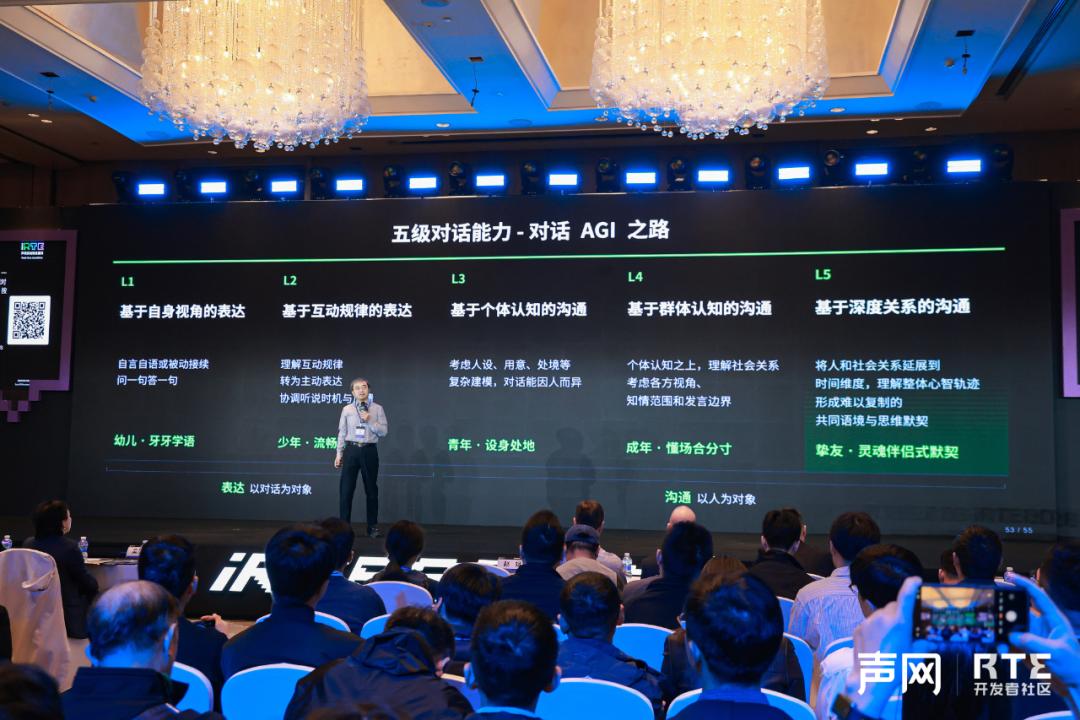
Zhao Bin, founder and CEO of Agora, judges that conversational AI is driving RTE to evolve from "normal dialogue" to "vivid and expressive interaction". This phrase is not only a technical indicator, but also a product philosophy. It confirms one fact: when people talk to each other, they never just exchange information.
To quantify this evolution, Zhao Bin also proposed a "five-level dialogue capability framework": from L1 passive expression based on self-perspective, to L2 active coherence based on interaction rules, to L3 personalized adaptation based on individual cognition, then to L4 complex multi-person communication based on group cognition, and finally to L5 tacit understanding of thinking based on deep relationships. This five-level framework provides a clear scale for the industry to move from "understanding the present" to "understanding a person".
This product line did not start this year. From the world's first AIGC RTC SDK supporting AI voice in October 2023, to supporting OpenAI's Realtime API in October 2024, to the conversational AI engine in March 2025, engine 2.0 and Studio in October 2025, until the Call Agent and real-time AI development toolkit in October this year. In three years, it has achieved hundreds of millions of call volumes, and its customer list includes not only model companies such as MiniMax, SenseTime and Zhipu AI, but also AI toy Fu Zai from Robo Intelligence, AI customer service for Meituan Keeta and Full Truck Alliance freight business.
Agora's choice on the model side is more worth mentioning: it does not bet on a single path, but combines three paths into a hybrid system — the Agora Conversational Model. The perception system is responsible for VAD, echo cancellation, streaming ASR, sound event understanding and speaker separation; the full-duplex dialogue response system is responsible for streaming reasoning, tool calling, long-term memory and large/small brain division of labor; the expression model uses Context TTS to restore semantics to proper tones.
The advantage of the three-in-one architecture is that it can be easily connected to business systems and withstand complex Agent workflows, at the cost of higher model coordination and engineering complexity. However, under mutual promotion, it can achieve continuous listening interaction perception, timely response intent judgment, and correct action semantic application, so that models, interaction and real-time network can collaborate, making the system "better at communicating".
Based on this path, Agora has launched a conversational AI engine with full-duplex interaction as the core, realizing end-to-end response latency at the 50ms level, and extreme interruption response at 340ms; it has also released the R1 series, R1-4G, R2 and other conversational AI development kits, as well as the Agora Agents SDK, Skills, CLI tools and other product matrices for developers.
The foundation of all this is the intelligent routing of Agora SD-RTN across more than 300 data centers around the world. Its Web SDK can support a peak bandwidth of 700Gbps under complex weak network conditions, with a maximum of 230,000 concurrent users in a single channel, compressing the RTT for joining a channel from 7 units to 2 units. In the MrBeast Super Bowl live broadcast case, Agora provided exclusive technical support for the extreme test of 582,000 peak concurrent users in a single channel and a peak bandwidth of 2.76Tbps. Under the condition of covering 213 countries and regions and running continuously for 72 hours, the first-screen streaming delay was less than 1 second.
Looking into the future, the shipment volume of AI glasses is expected to exceed 10 million units in 2026, Salesforce is fully transforming to Agent-driven, and WebRTC is also evolving from a browser capability to a basic technology stack for interaction between AI and humans. It is foreseeable that the industrial division of labor is becoming clear: the "brain" can be updated every month, but the "nervous system" cannot be disconnected for even one second. When the industry shifts from "whose model is smarter" to "whose experience is more natural", the competition is no longer about ranking lists, but about the unglamorous, long-cycle foundation capabilities that must be accumulated over time.
The Voice Agent competition has just started, but the ranking battle for infrastructure has already begun. When Agent becomes a new participant in the real-time interactive network, iRTE2026 not only marks the direction of the industry's next stage, but also witnesses another self-rewrite of this infrastructure company.