After two years of frantically embracing AI, enterprises suddenly hit the brakes.
Shen Translation Bureau is a translation and compilation team under 36Kr, focusing on technology, business, workplace, life and other fields, and dedicated to introducing new technologies, new perspectives and new trends from abroad.
Editor's Note: In the past, when enterprises talked about AI, they only discussed how to put AI into use faster. Now the trend has changed: Meta has rolled back its layoff plan, Microsoft restricts internal use of AI, and frontline employees at Walmart are forced by the system to take shortcuts. The saved time has not disappeared, it has just become the time to clean up the mess. This article comes from a translated content.
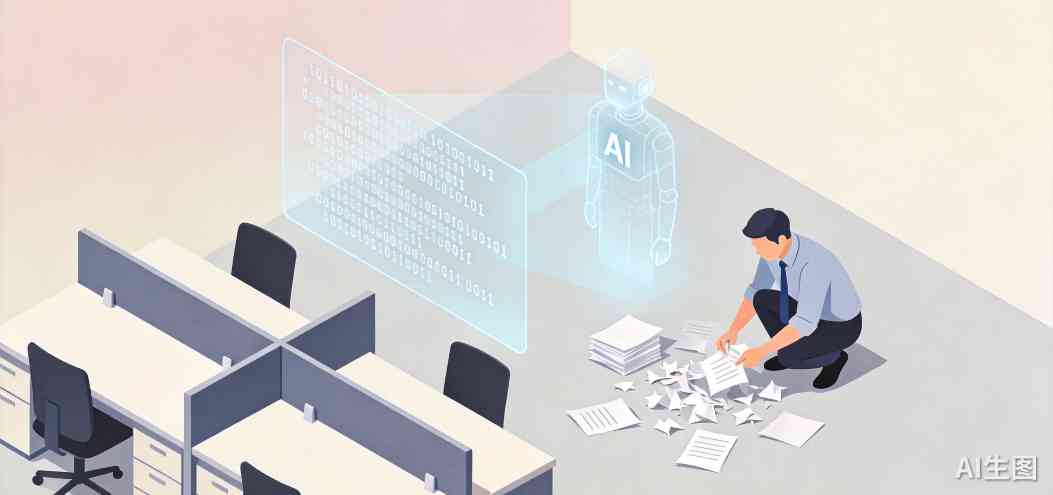
AI was rolled out too fast, forcing employees to clean up piles of errors and low-quality outputs
Employers around the world are now clearing up the mess left by their hasty AI deployment in the early stage.
According to Reuters, Meta originally planned to carry out large-scale layoffs and replace positions with AI agents, but this plan has now been scaled back, as the company found that employees are spending more and more time patching technical and security vulnerabilities. Posts from employees on LinkedIn also show that after the "efficiency" reform in 2023 that cut a large number of staff (with middle managers being the first to be affected), Meta has started to expand management positions again.
AI has been widely deployed inside Microsoft. Ryan Roslansky, Executive Vice President, recently publicly complained that his daily work is full of "watered-down content" generated by AI. He said that a colleague sent him a document that was "obviously written by AI", he used his own AI to generate a summary, and after reading it, he had no new ideas about the solution at all. He reminded his followers to be careful of falling into this "vicious cycle", where reading is done by AI and writing is done by AI, and everything ends up looking the same in the end.
Meanwhile, according to Business Insider, employees in Walmart's stores and warehouses are troubled by AI tools. These tools are in charge of task assignment, scheduling and performance assessment, bringing unreasonable expectations, errors and false reports along with them.
Right now employers have to digest the flood of errors and low-quality outputs, which takes up all employees' time, raises privacy and security risks, and pushes up costs. As a result, some companies that acted hastily and aggressively on AI in the past have begun to hit the brakes: restrictions are now set in places that used to encourage trials, experienced employees are called back, and training efforts are also being increased.
"On the AI front, executives generally feel like they are building the car while driving it, which is a problem in itself," said Johnny C Taylor Jr, President and CEO of the Society for Human Resource Management (SHRM). "If we could turn back time... we would introduce it in a more thoughtful and slower way."
Although global enterprises have invested tens of billions of dollars in AI over the past few years, the real returns have not yet appeared. A working paper from the Federal Reserve Bank of Atlanta shows that 90% of executives said their company's investment in AI has not yet been translated into productivity gains. A survey released by Ernst & Young last month also shows that among enterprises with annual revenue of at least 1 billion US dollars, 36% of AI executives reported AI accidents that caused consequences such as data loss, financial losses, brand damage or operational disruption.
According to Reuters, the proliferation of new tools and their astonishing usage are eroding corporate profits, and companies from Microsoft to McKinsey are restricting employees' use of them. Companies such as Palantir, Booz Allen Hamilton and NVIDIA have also set restrictions on employee usage due to growing concerns that their own data is not safe when stored at AI companies.
Microsoft and Walmart declined to comment. Meta, Palantir, NVIDIA and Booz Allen Hamilton did not respond to requests for comment.
"At the beginning, we treated AI as an ordinary technology promotion, which was nothing more than deploying tools, providing training and promoting usage," Kathleen Hogan, Chief Strategy and Transformation Officer of Microsoft, wrote in a recent blog post about the company's AI implementation journey. "Later we realized that being usable and in use does not mean real transformation."
Professional knowledge gaps and errors
AI remains a mixed blessing for both managers and employees. A survey released by Indeed in July this year shows that more than half of the employees said they "did not get the AI training they needed", while most managers admitted that their subordinates are more proficient in AI than themselves. Only 45% of managers feel that they are "capable of leading these AI natives well".
Zack Mabel, research director of the Center on Education and the Workforce at Georgetown University, said many employees feel that they are "asked to use these tools, but no one tells them exactly how to use them". He added that managers are caught in the middle, having to meet the requirements of "promoting implementation, delivering benefits, and making no compromise on quality" at the same time.
Taylor said that to make up for these widely recognized shortcomings, enterprises are shifting from providing one-off online courses for a large number of employees to "continuous, position-specific customized training".
Hogan wrote in the blog post that Microsoft found that "adding an agent to a broken process still results in a broken process", and "speeding up a single step alone will only make the next step have a longer queue". The company also found that investing in employee training does improve productivity, especially when junior engineers are paired with senior staff.
Jessica Reif, assistant professor of management at the Wharton School of the University of Pennsylvania, explained that one of the obstacles preventing AI from bringing greater returns for a long time is that it always outputs things that "look plausible", but hide hidden defects or errors that are not easy to detect.
Reif said that in this way, errors are more likely to pass down the workflow all the way instead of being corrected on the spot, and small problems will thus snowball into big ones.
At the same time, AI still has limited ability to evaluate human employees, which creates tension inside some companies. According to Business Insider, ordinary store employees at Walmart are complaining more and more about the unstable, error-prone AI tools.
The systems described by employees set unreasonable standards for human employees on the one hand, and create a lot of inefficiency and errors on the other hand, such as planning inexplicable routes for employees in charge of order picking that make it harder to complete orders quickly, popping up batches of useless safety alerts, and generating unrealistic schedules that force store employees to take shortcuts and cut corners to meet progress targets.
"These robots assume that employees can do everything perfectly every time," a manager told Business Insider. "We won't set such impossible standards for people."
Walmart declined to comment.
Rising Risks
Neil Elan, a lawyer at the law firm Stubbs Alderton & Markiles, said he has noticed that the "gap is growing" between the way clients think their employees are using AI and the way employees actually use it, which leads to troubles in confidentiality, intellectual property, efficiency and employee integrity. Once the fact that employees use ChatGPT is brought to light, it will also give enterprises a big headache.
Translator: Xiao Chuan