The AI employee bubble has burst, Meta has urgently called off its layoff plans, and Mark Zuckerberg says: Humans are still more useful.
What happened to the promise of replacing employees with AI at work?
How come the headcounts are all increased, but AI hasn't taken over at all...
Previously, Meta's second round of layoffs originally scheduled for November was suspended because AI failed to deliver the expected work performance.
Zuck: It's all a lie. There is no such easy-to-use AI employee at all. (Crying)

Meanwhile, Microsoft also noted in its review that its own business has not improved with the large-scale promotion of AI.
After several months of accelerated advancement, major tech companies have begun to recalculate the efficiency of AI...
Meta Calls Off Its Second Round of Layoffs
To see how confident Zuckerberg is in AI employees, just look at Meta's restructuring plan.
Back in January this year, when Mark Zuckerberg met with senior executives in Hawaii, they discussed a plan called Project OT.
OT is the abbreviation of Organization Transformation.
According to the vision at that time, Meta's organizational structure in the future would be redesigned around AI.
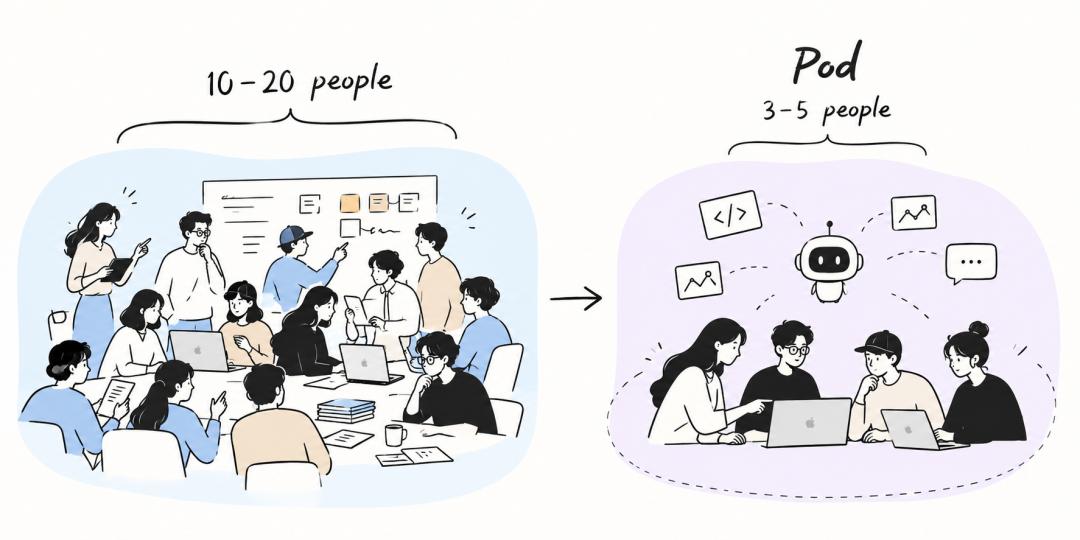
In the past, a product development team needed 10 to 20 people, with engineers, product managers, and designers each performing their own duties.
What about in the future?
3 to 5 people would be enough.
△
The new team is called Pod, a common small-team combat model in Silicon Valley.
There are no such titles as engineer, designer or product manager here, everyone is uniformly called Builder.
According to this plan, the layoff scale for some teams is expected to reach 60%.
This set of plans includes multiple measures such as layoffs, internal transfers, and cancellation of vacant positions.
To get AI to take over as soon as possible, Meta planned to let AI first learn the way human employees operate computers.
That is, distill the work patterns of employees.
In April this year, Meta required employees to install tracking software on their devices to record keyboard inputs and mouse clicks — these operation records would be used to train AI Agents, so that they can imitate the way humans use computers.
A large number of dissatisfied voices soon appeared on Meta's internal forum, and employees spammed elephant images under posts from senior executives, satirizing the management for avoiding the "elephant in the room" of layoffs.
After that, according to Meta's internal semi-annual survey, employees' positive sentiment rating dropped from 74% to 55%.
But now it seems that the result is a total slap in the face.
Meta CTO pointed out that after the large-scale adoption of AI, the amount of code changes in internal software platforms and infrastructure increased by 220% year on year.
But the amount of changes that finally brought user-visible new features or feature upgrades only increased by 36% year on year.
That doesn't sound so bad? But you have to know that at the same time, Meta's major technical and safety incidents increased by 40% year on year, and the time employees spent on troubleshooting increased by 70%.

Engineers: I don't want to take a part-time job as AI after-sales support.
Given all these situations, Meta has stopped planning the second round of restructuring that was originally scheduled for November.
Zuckerberg also admitted at an internal employee meeting that there was a misjudgment in the timing of organizational adjustment, and Agent technology has not advanced as rapidly as previously expected.
At the same time, Meta also suspended the mouse tracking project; drastically reduced its investment in Claude; allowed some employees who were transferred to the AI engineering team to return to their original positions.
Moreover, to appease the remaining employees, the company began to improve office snacks, and increase budgets for business trips and social activities...
Microsoft Admits Business Performance Has Not Improved After Using AI
On the other side, Microsoft is also troubled by the massive introduction of AI.
Ryan Roslansky, CEO of LinkedIn and Executive Vice President of Microsoft, is complaining:
He once received a document sent by a colleague, and when he opened it, he could tell at a glance that it was AI-generated.
So he sent this AI-generated document to his own AI for summarization.
As a result, back and forth, zero new ideas were generated.
This is simply a Doom Loop.
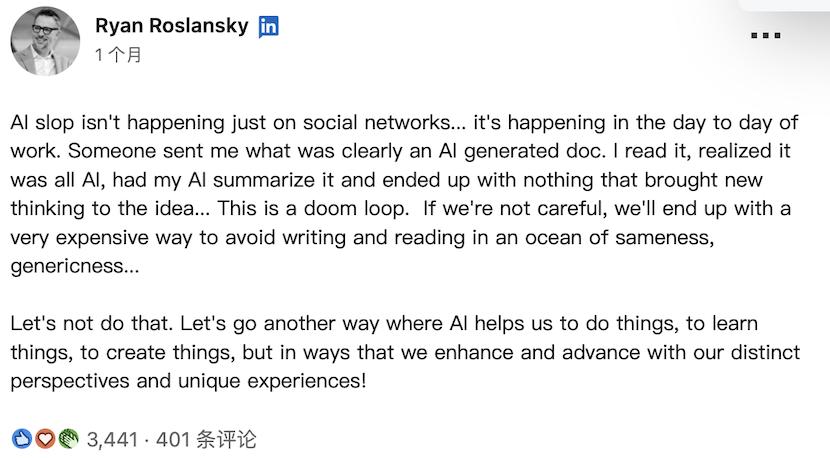
Roslansky worries that if things go on like this, companies will spend more money, but in the end they only find a way to avoid writing and reading carefully.
Such issues are not just about employees' usage habits.
In September, Microsoft published a review article sharing its experience in promoting AI transformation internally.
Microsoft's Chief Strategy and Transformation Officer admitted in the article that the team initially followed the traditional way of promoting software: deploy tools, train employees, and then push everyone to use them.
Microsoft is very familiar with this method, and has provided AI tools to more than 200,000 people so far.
Logically speaking, with such a large promotion scale, all they had to do next was to sit back and wait for productivity to skyrocket.
However, in the practice of the early sales team, AI usage quickly entered a plateau period, and the expected business performance did not appear.
Microsoft also found that directly inserting Agents into the original workflow will only cause problems to appear in the next process of the Agent.
In this way, Microsoft began to carefully calculate the usage process and expenses of internal AI tools.
Microsoft executives previously estimated that the company's annual internal expenditure on using Anthropic's technology could reach at least 1 billion US dollars.
Later, this internal expenditure estimate was lowered by more than one third.
Microsoft began to encourage employees to use its own GitHub Copilot and other tools more, and required all departments to manage their Token budgets.
Previously, some employees in Microsoft's Cloud and AI division had a monthly AI model usage budget as high as 100,000 US dollars per person.
Now, this limit has been reduced to about 10,000 US dollars...
One More Thing
It's not just Meta and Microsoft.
More and more companies are beginning to find that the faster AI is deployed, the faster problems arise.
In September, EY released an AI risk survey targeting large listed companies in the United States.
The survey respondents were 202 senior AI decision-makers, whose companies all have annual revenues of at least 1 billion US dollars.
Among them, 36% of the respondents said that their organizations have experienced AI accidents or failures that caused substantial negative impacts.
Including data loss, financial loss, operational disruption, brand reputation damage and other situations.
Taylor, CEO of the Society for Human Resource Management, said:
Companies are now like driving a truck on the road while still building the truck.
Taylor lamented that if they could start all over again, many companies would probably choose a more prudent and slower AI deployment approach.
It's a pity that...
It's easy to invite the god, but hard to send him away.
This article is from WeChat official account QbitAI, author: Cheng Qian, published with authorization from 36Kr.