Today, AI product managers, please focus on developing APPs rather than mini-programs.
Recently several friends asked me how to launch a mini-program after its development is completed, which involves various business licenses, subject entities, review processes and other related matters. This leads to the situation that while mini-program development is very simple in the AI era, its actual promotion and user adoption still remain a very troublesome process with high thresholds.
Now after the launch of ChatGPT Astra, I believe AI product managers should no longer develop mini-programs, and try their best to implement all features through local offline solutions instead.
All AI product managers should develop local offline apps, with iOS as the top priority, followed by HarmonyOS, and Android as the last choice. If the target users are overseas, the priority order should be iOS, Android, and HarmonyOS.
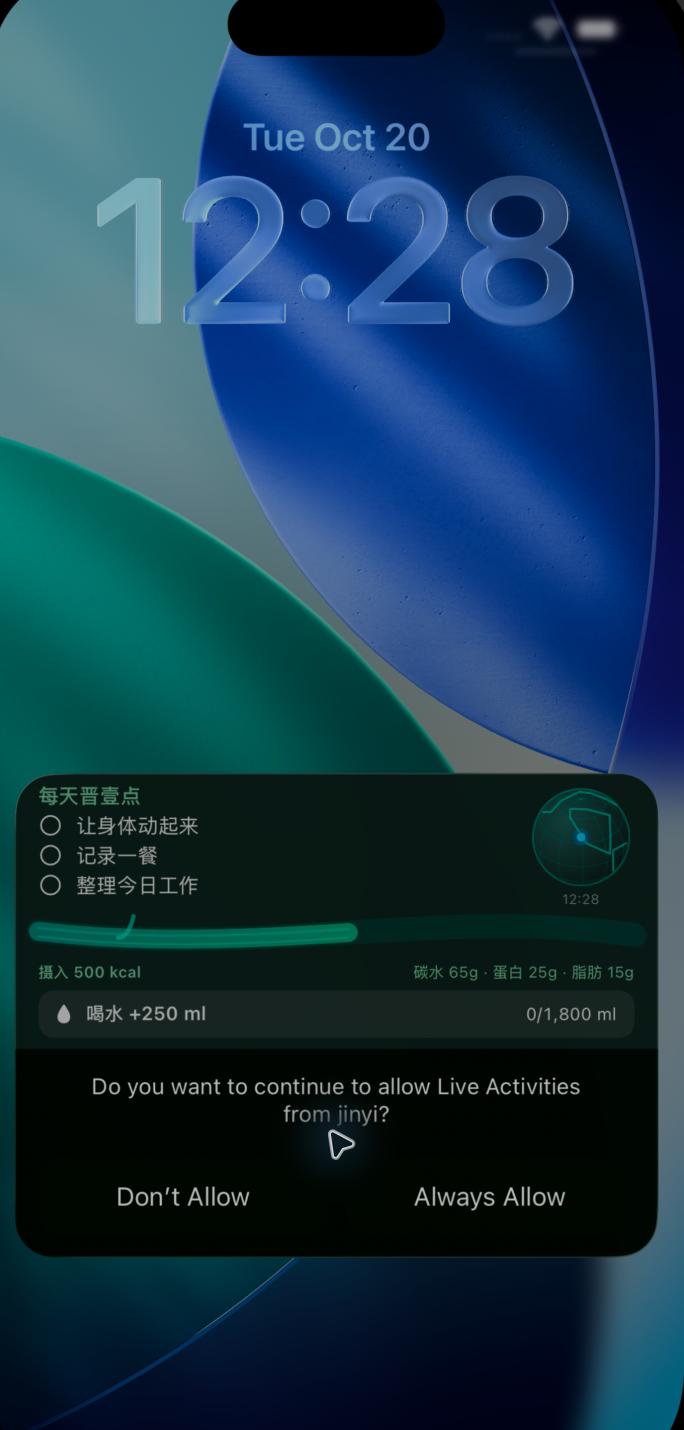
Apart from the review mechanism, the biggest problem with WeChat mini-programs is that it is difficult to achieve rich experience. If you want to develop some local featured functions, such as integrating relevant native system capabilities, or even solving performance issues, all these will become bottlenecks of WeChat mini-programs. For example, the iOS component card we are developing now can never obtain such permissions on mini-program platforms.
For example, the following is the desktop widget of jinyiAPP, which displays daily progress tasks.
Product managers working on mini-programs will never get the first user interaction on mobile phones, because there is an intermediate platform, WeChat. All relevant data and content security are monitored by third-party platforms. It should be noted that the AppStore review and WeChat review are two completely different mechanisms from separate platforms.
Nowadays mini-programs are increasingly more suitable for developing small games
Compared with developing software, small games are more suitable for the WeChat ecosystem, as users tend to play games when they are tired. But most of these games require network connection, so offline games work better if developed as a local client. For example, there are many small games developed via Claude online, which used to be regarded as high-quality 3D masterpieces, but now they can be completed within a few hours of token consumption plus debugging with Unity and Blender.
Mini-programs have instead become the biggest obstacle in the current AI era. First, they cannot be installed offline; second, they require mandatory review, which prevents the productivity of AI applications from being fully unleashed.
Finally, many people are used to acquiring customers through WeChat. Especially since almost every user in China uses WeChat, they take it for granted that mini-programs are the best channel. In fact, distribution on the App Store and downloads from Android app markets are also very good traffic entrances.
Many domestic product managers are limited by the mini-program mindset. After all, apps like ChatGPT gained over 100 million users in a very short period of time. These products are directly downloaded from the App Store, with their own independent account system, instead of relying on WeChat or other large platforms to launch a mini-program.
In the AI era, offline applications are seeing explosive growth
It can be seen that the number of iOS application developers has gradually increased in 2026. Of course, the same trend applies to WeChat mini-program developers, but launching an app is obviously the most cost-effective choice if you want to distribute products to ordinary users, even overseas users.
In addition, the trend of AI supporting local offline operation is unstoppable. Developing a local app can help you get a better user experience, and with the interconnection with the mobile phone's local area network, it is sufficient to meet the needs of most scenarios.
Whether to connect to the network or store data locally, from the current perspective, local storage ensures higher reliability in terms of data privacy, security and personal data ownership.
That's all for today's sharing.
This article is from the WeChat Official Account "Kevin's Bits of Changing the World" (ID: Kevingbsjddd), written by Kevin's Stories, authorized for release by 36Kr.