Qiaopi Network: Connecting Chinese people in search of lost relatives with AI and collaborative networks
Starting with a Clue: Why Do Chinese People Seeking Lost Relatives Need a New Collaboration Model?
A descendant of Chinese ethnicity searching for relatives who migrated overseas many years ago may only have a name, an old place name, a few old photos, or a few words dictated by elders. These pieces of information may be scattered in family genealogies, old letters, local archives, and Chinese communities in different countries. For ordinary families, the difficulties lie not only in the lack of clues, but also in how to organize fragmented information, judge the reliability of clues, and get the information in front of people who may have relevant knowledge.
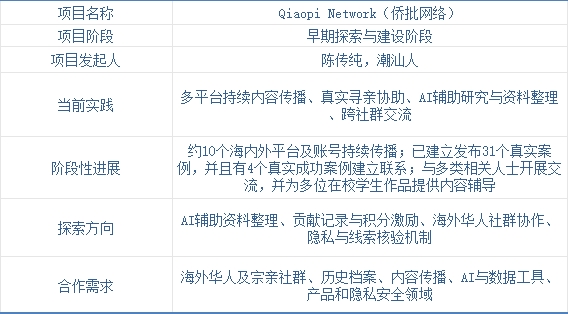
Qiaopi Network was initiated by Chen Chuanchun, a native of Chaoshan. Starting from real lost-relative assistance and the dissemination of cultural content about the Nanyang migration and Qiaopi (overseas remittance letters), the project explores connecting scattered Chinese family memories, lost-relative search demands, and cross-regional communities. In the past, Qiaopi used to bring remittances and family letters from people making a living overseas back to their hometowns; Qiaopi hopes to use contemporary content dissemination, AI-assisted workflows and collaboration mechanisms to make memories scattered in families, materials and communities easier to organize, allow clues to flow more smoothly, and enable people who are willing to help others to find access points to participate and get rewards.
The long-term direction of the project is not only to complete individual lost-relative search commissions, but to explore a collaborative network that can accumulate sustainably: people searching for relatives provide demands and materials, people familiar with local history and genealogies contribute knowledge, overseas communities help with dissemination and verification, and technical personnel assist in improving material organization and collaboration tools. The project hopes to precipitate the experience accumulated in individual cases, and gradually lower the threshold for later generations to search for their roots and lost relatives.
From Continuous Content Output to Real Cases: Simultaneous Exploration of In-depth AI Collaboration and Contribution Mechanism
Since March 14, 2026, before the release of the film *Love Letter to Grandma*, Chen Chuanchun has been creating daily updated content, producing works around the history of Nanyang migration, Qiaopi, Chinese migration and real demands for searching lost relatives, and disseminating the content through about 10 platforms and accounts at home and abroad. Content is not the end point of the project, but an entry point for discovering demands, accumulating trust, connecting potential collaborators and reaching overseas Chinese communities. The project is also continuously communicating with people who pay attention to relevant topics, including retired Xinhua News Agency editors, directors of overseas clan organizations, documentary editors, etc. At the same time, Chen Chuanchun has provided topic selection or content guidance for relevant works of many school students.
Apart from content dissemination, the project has been continuously carrying out lost-relative related material organization, clue sorting, content production and multi-channel dissemination. According to the current statistics of the project team, 31 real archives have been established and released, and 4 real cases have successfully established contact; out of consideration for the privacy of the parties and the prevention of impersonation and fraud, the project does not disclose case details that can identify personal identities.
AI is an important collaborative tool in the project's working methods. Chen Chuanchun continues to collaborate with AI for topic selection research, information sorting, content production, material structuring and project plan deduction, and explores the auxiliary value of AI in links such as old material organization, classification of name and place name clues, and association prompts between different pieces of information.
In order to make the collaboration not only rely on personal enthusiasm, Qiaopi is also exploring contribution recording and point incentive mechanisms. The preliminary design is to record different contributions such as providing valid clues, assisting in establishing contact, and facilitating verified lost-relative search results, so that contributions can be tracked, fed back, and recognized. The point rules, verification processes, reward forms and scope of application still need to be further designed and tested.
From Personal Persistence to Open Network: What Does the Project Need, and What Can It Bring?
Qiaopi Network targets families with demands for searching lost relatives and roots, overseas Chinese communities and clan organizations, and also hopes to connect researchers of history and archives, content creators, students, volunteers, and professionals in the fields of AI, data, products and privacy security. Different participants can contribute different capabilities: some are familiar with family genealogies, some know old overseas place names, some can connect communities, some are good at verifying historical materials, and some can help design more reliable material management, clue verification and collaboration tools.
The project initiator Chen Chuanchun is a native of Chaoshan. After graduating from university, he worked continuously in a manufacturing company for 18 years, growing from a fresh graduate to the company's sales director. Since March 2026, he has been publishing relevant content on multiple platforms, combining content dissemination with real lost-relative assistance. He collaborates with AI at a high frequency and in depth, and actively connects different circles such as history and culture, overseas clans, documentary and student creation, trying to turn the originally scattered attention into relationships that can communicate, provide clues and participate in construction.
The current commercial exploration of the project mainly comes from manual services related to individual lost-relative search cases, including material organization, clue analysis, content production and dissemination; in the long run, it hopes to verify more sustainable collaborative services and digital tools. The project has not yet formed a large-scale verified product and stable business model. The next step is to focus on verifying user demands, service delivery standards, clue verification, contribution incentives and privacy protection mechanisms, and find partners who are willing to conduct joint experiments around real cases.
Qiaopi does not simply equate Qiaopi with blockchain, nor does it package unimplemented technical concepts as existing achievements. Starting from real lost-relative search and Chinese memory preservation, it tries to answer a more long-term question: can we connect the information scattered in different families, archives and communities, make it easier for help to happen, record and recognize contributions, and allow later generations to move forward along the experience accumulated by predecessors.