After everyone is able to create motion comic dramas, China Literature has opened up its own copyright library.
What would it bring to a company that holds massive IP resources when a single person can produce a short drama a day?
At the 2026 China Literature Creation Conference, this veteran online literature company released a set of data.
In the first half of the year, China Literature's revenue from short dramas and manhua dramas reached 430 million yuan, more than triple that of the same period last year. Up to now, China Literature has 660 manhua dramas with over 10 million views, and 107 of them have exceeded 100 million views; it has signed more than 5,000 individual creators and personal studios, with the top 10 OPC creators earning an annual income of over one million yuan, and the top teams sharing over 6 million yuan in revenue.
OPC, which stands for One Person Company, is one of the most important keywords at this conference.
Hou Xiaonan, CEO and President of China Literature, announced the upgrade of the DramaBuddy manhua drama assistant to an all-in-one OPC platform, providing OPC creators with a complete full-link service covering IP source, AI production, global distribution and full-chain development:
In terms of IP sources, it connects to the massive Qidian IP library covering more than 200 content genres; in terms of AI production, DramaBuddy launches an "ecosystem marketplace" that integrates the order-taking plaza, cooperation draft trials and hit script resources; in terms of distribution, in addition to its own platforms Qidian Manhua Drama and ToonScroll, China Literature will widely cooperate with third-party channels and build strategic partnerships with Tencent's ecosystem.
In terms of creation incentives, China Literature will establish a creator rating system ranging from level A to S, and provide differentiated creation support.
Huang Yan, Senior Vice President of China Literature, disclosed that China Literature's DramaBuddy manhua drama assistant will become the unified entry point for China Literature's AIGC OPC. Individual creators or studios can register on DramaBuddy to become China Literature's creators or supplier partners, and directly enter China Literature's manhua drama ecosystem. At present, DramaBuddy manhua drama assistant has served more than 400 studios and over 50,000 creators.
As a veteran player in the online literature era, what China Literature has the most is IP, but what it lacks are processors that can turn these IPs into manhua dramas. In the AI era, equalized tools have been delivered to everyone. What China Literature wants to do is to let people who hold the "hammer" come to its own ecosystem to "drive nails".
Huang Haonan, founder of Soy Sauce Culture, put forward a judgment in an interview after the conference: after the end of 2026, there will be no AI manhua drama institutions in China, "all will be OPC in the future". His reason is very simple — the production of AI manhua dramas has become a process that one single person can complete the whole workflow.
Handing IP Adaptation to Everyone
From online literature to short dramas, from long videos to short and medium videos, a large number of companies along the entire cultural and entertainment industry chain have launched their own AI productivity tools. Chen Weiyu said that the difference between China Literature's DramaBuddy manhua drama assistant and other tools lies in that its value of existence is not "making money by selling Tokens".
Chen Weiyu, head of the AI Platform Department of China Literature, said: "The anchor point for building DramaBuddy is matchmaking."
According to official data from China Literature, even though the group has invested in many manhua drama companies including Soy Sauce Culture, Qianwei Monkey, and Xiaren Universe over the years, there are still a large number of undeveloped IPs in the entire copyright library, and the current adaptation ratio is "less than one in a thousand". On the other side, there is a productivity explosion driven by AI — in the past, one IP could occupy 1 to 3 years of workload for a studio, but now one person can deliver a sample of more than 20 episodes in just one month.
Huang Haonan described the AI-driven productivity explosion this way: originally 10 people produced one drama in a month, now one person can produce three dramas in a month. The number of employees of Soy Sauce Culture has shrunk from a peak of 1500 to several hundred.
China Literature wants to match these people who have the ability to produce content with the large number of IPs pending adaptation in its copyright library. But the matchmaking is not fully open.
"If a partner with very weak production capacity takes a very high-quality IP and produces a poor work, it will damage the value of the original IP instead." After obtaining the consent of the author, IP cooperation still requires assessment of production capacity. Chen Weiyu's exact words are "let the right people get the right IP".
This also explains why China Literature's DramaBuddy decided not to "make money by selling Tokens" and is willing to provide up to about 30% of computing power subsidies. Because the tool itself does not make money, only matchmaking can generate profits.
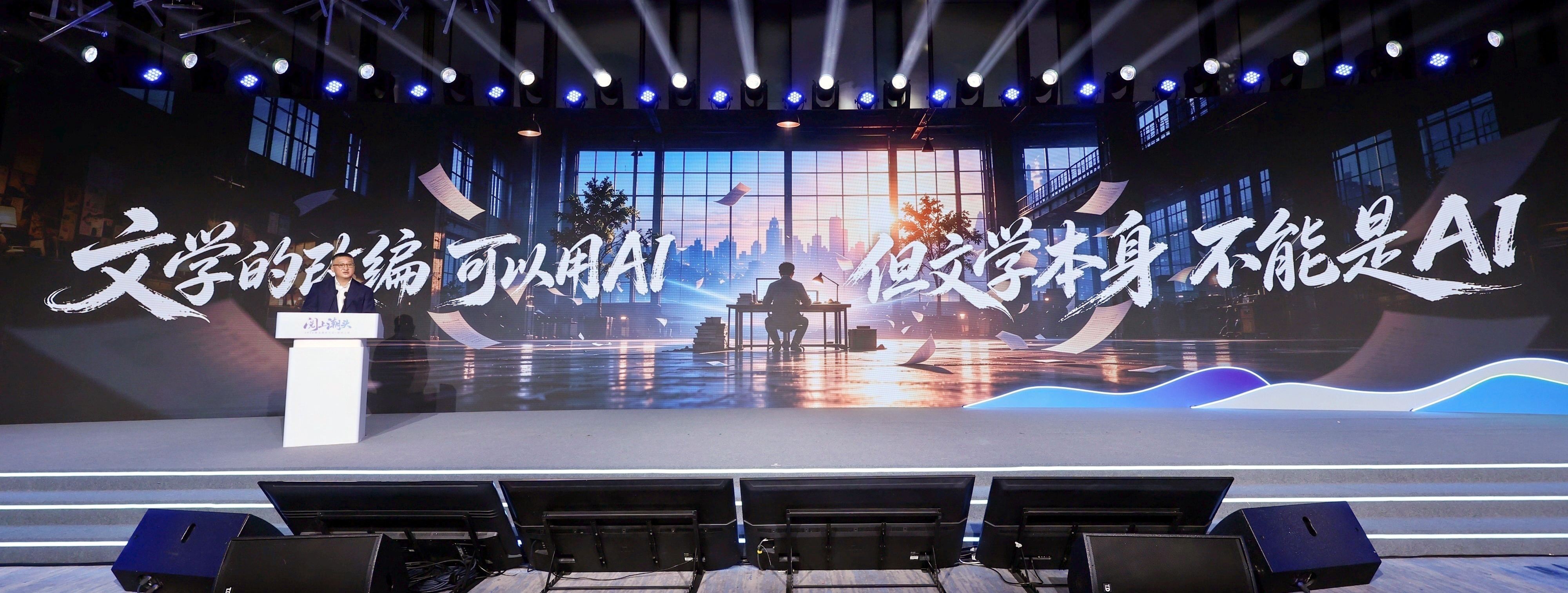
Image courtesy of China Literature
Things That Cannot Be Changed by AI
Chen Weiyu summarized the IP logic in the AI era as the transformation from "line" to "surface": in the past, one IP could only be adapted along one single line, now more than 200 IPs of different types can be developed simultaneously, and the same story can be turned into manhua dramas, interactive shadow plays, AI animations and AI films, "because the cost is controllable".
As a cultural and creative company that has been established for more than ten years, China Literature has experienced the rise and fall of the entire long video industry and the golden age of the short video industry on the road of copyright development. Now, AI is not only going to change copyright development, but also likely to change the creation of copyright — AI novels are posing a challenge to traditional writers.
At this conference where AI occupies a large part of the agenda, Hou Xiaonan emphasized that "literature can be adapted with AI, but literature itself cannot be created by AI".
Supporting measures are specific: Qidian is carrying out AI hydrological content governance, cleaning up ranking lists, and limiting the number of words updated daily, so as to prevent writers from abusing AI tools to pad word count and rush up rankings.
"One story can be adapted into short dramas, manhua dramas, films, television works and games, cross languages, and grow infinitely in different media." Hou Xiaonan said. "All these opportunities originate from the same starting point: a person who wants to write a story sits down, opens the document, and writes the first line."
This year, China Literature has subsidized hundreds of writers with low subscription volume but high-quality content, and the average subscription volume of subsidized works has increased by 100%. Next, the platform will distribute targeted consumption coupons in batches, with the first batch of 1 billion Qidian Coins specially used for subscribing those high-quality works with low subscription volume. The cost will be borne by the platform, and writers will receive royalties at the original price.
At the same time, revenue from adaptation has started to flow into writers' accounts. Through manhua dramas, more than 1,500 writers have obtained copyright income for the first time; more than 300 writers have earned over 10,000 yuan in revenue sharing from short manhua dramas, nearly 100 have earned over 100,000 yuan, and the highest one has earned over one million yuan. Yang Chen, Vice President and Editor-in-Chief of China Literature, previewed that China Literature will open a "pre-authorization" function for comics and manhua dramas in the writer backend, so that writers who expect their works to be adapted can confirm in advance. The end of this link is the 50,000 OPC creators on DramaBuddy.
When computing power takes up 70% of the cost, when one person can produce a drama a day, and when 300,000 new episodes are launched every month, a company that survives on IP must stick to the principle of "whether the story is written by a human".
Whether this line can be held will be seen in three to five years.