The $4.99 AI Doctor
Utah approved a never-done-before initiative this year:
Let AI diagnose acne patients and write prescriptions on its own, fully autonomously.
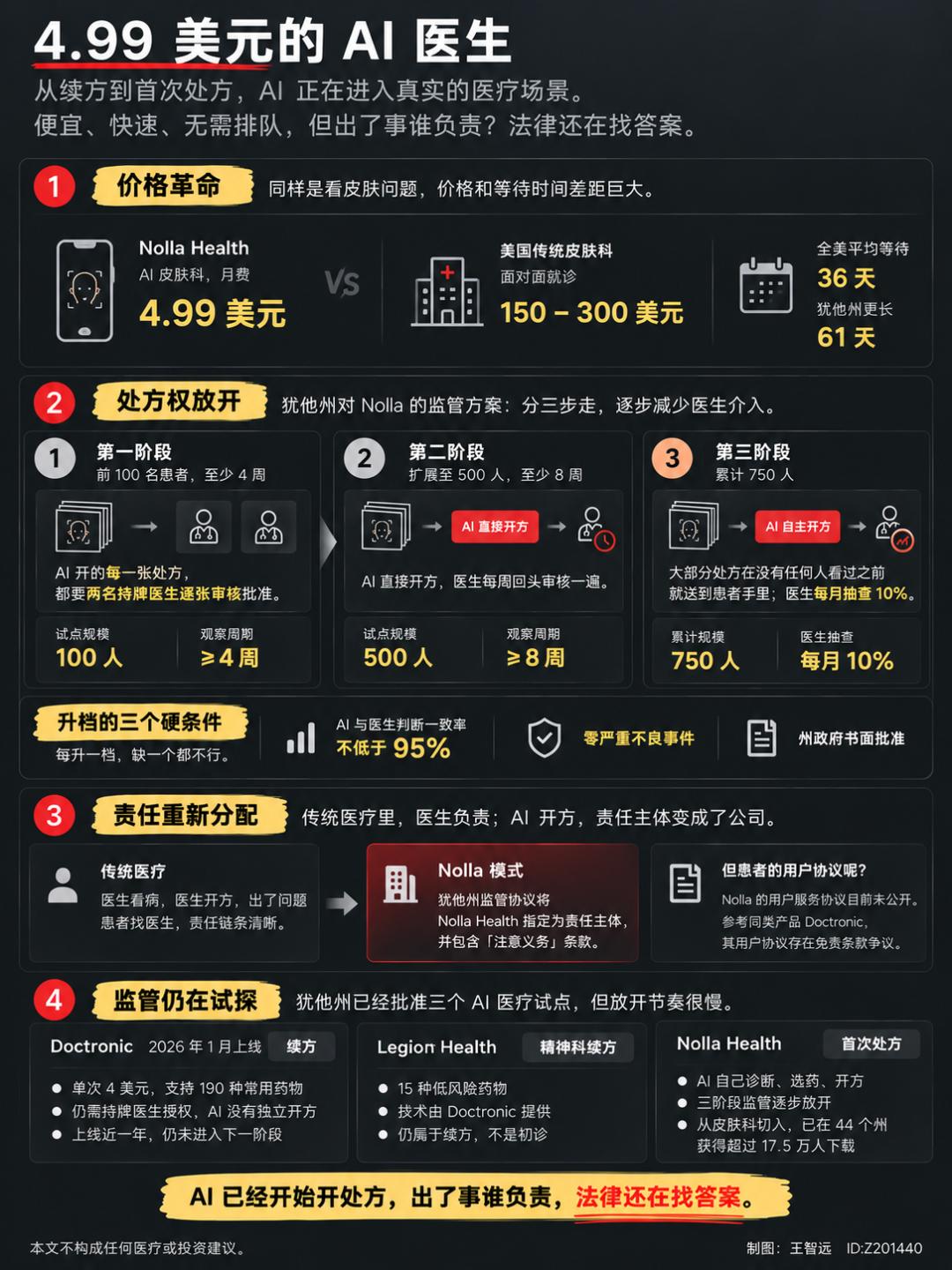
The company behind the initiative is Nolla Health, founded in Norway in 2024, which secured a $4.5 million seed round from General Catalyst and moved its headquarters to New York. With a $4.99 monthly subscription, you only need to scan your face with your phone, and a prescription will be generated in minutes.
What does the $4.99 price tag mean?
A single in-person dermatology visit in the US costs between $150 and $300, and you still have to wait for an appointment. The national average waiting time to see a dermatologist is 36 days, while the figure in Utah is even longer at 61 days.
What Nolla sells is low cost, high efficiency, and no queuing for appointments.
How does it work? Open the app, take photos of your face from five different angles, and fill out a medical history questionnaire.
The AI will assign an acne severity score ranging from 0 to 5 for you. If the score exceeds 3.5, or if you are pregnant, breastfeeding, or suffer from severe liver and kidney diseases, the process will be terminated and your case will be transferred to a human doctor.
If none of the above conditions are met, the AI will select one of 8 topical medications for you, and the prescription will be sent directly to your designated pharmacy or delivered to your home. No human doctor has ever examined you throughout the whole process.
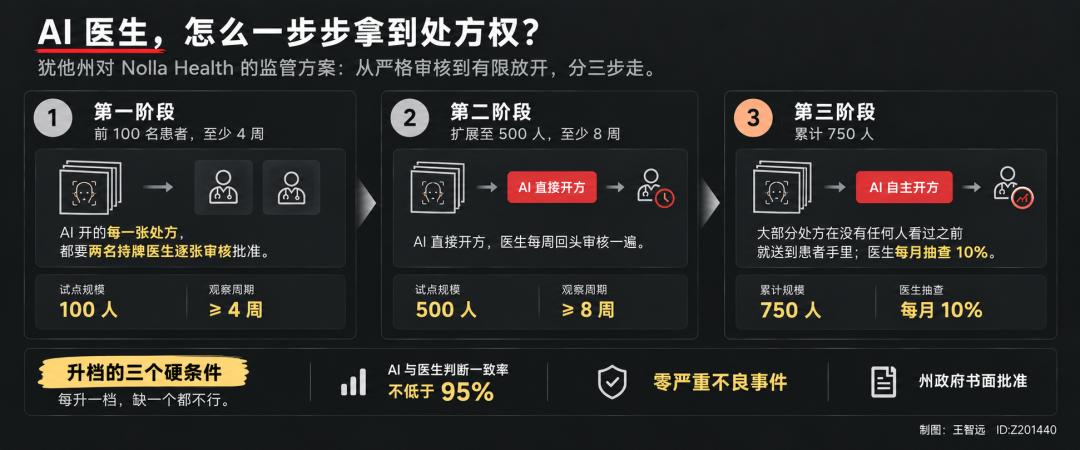
The Utah government did not fully lift the restriction at once, but advanced the initiative in three steps.
Step 1: Cover the first 100 patients over a period of at least 4 weeks. Every AI-generated prescription must be reviewed and approved by two licensed doctors before being sent to the pharmacy. It is just like a coach sitting in the co-pilot seat who can step on the brake at any time.
Step 2: Expand the coverage to 500 people, running for at least 8 weeks. The AI writes prescriptions directly, and doctors review all of them retroactively on a weekly basis. The coach lets go of the steering wheel but still sits right beside you.
Step 3: Accumulatively cover 750 people, with doctors randomly spot-checking 10% of all prescriptions every month.
At this stage, 90% of the prescriptions are delivered to patients before any human reviews them. There are 3 strict hard requirements for each promotion to a higher stage, none of which can be omitted: the consistency rate between AI diagnosis and doctor judgment shall not be lower than 95%, zero serious adverse events, and written approval from the state government.
The requirements sound very strict, but there is one figure whose second half has been omitted in all Chinese reports.
In the state proposal submitted by Nolla to Utah, it is written that licensed clinicians have about 96% consistency rate with AI treatment recommendations in the latest 1000 real-world treatment cases.
The second half of the sentence that no Chinese media has quoted is "the disagreements are limited to single-step dose adjustments within the same drug category."
What does that mean?
The 4% inconsistency does not mean wrong medication, but only a dose adjustment within the same type of drug, such as changing 10mg to 20mg, rather than switching from Drug A to a completely different Drug B. It is far less severe than the statement that "4% of prescriptions are wrong".
However, this caliber currently only has one source, which is the state proposal submitted by Nolla itself.
Now that we have gone through the whole mechanism, here comes another question: who is responsible if something goes wrong? In traditional medical scenarios, doctors see patients and write prescriptions, so you can hold the doctor accountable for any problem, and the responsibility chain is very clear.
In Nolla's model, reports from the LA Times mentioned a key detail in Utah's regulatory agreement: the agreement designates Nolla Health itself as the liability subject, not any specific individual doctor, but the company.
This design is quite interesting, because Nolla's total capital is only the $4.5 million seed round. If the AI writes a wrong prescription and causes a serious adverse event, is that amount of money enough for compensation?
What is more interesting is the statement repeatedly emphasized by Nolla: "AI assists rather than replaces doctors". But looking at its design direction, every step is aimed at reducing human intervention.
From two doctors reviewing every single prescription to no review at all and only 10% spot check on a monthly basis, there is a clear gap between what the company says and what it does.
At the contractual level, the liability subject is clearly defined as the company. But the contract is only signed between the company and the government. What is written in the user service agreement you clicked through when downloading the Nolla app?
......
The regulatory contract stipulates that the company shall take responsibility, but the user service agreement held by patients may tell a different story. This is the real trouble: if the AI prescribes the wrong drug, can patients hold the company accountable with the user agreement?
Before Nolla, Utah has already run an AI pilot for one year. The project is called Doctronic, which focuses on prescription refills.
What does prescription refill mean?
You have seen a doctor before, got diagnosed, your condition is stable, and you have been taking the same drug for a long time. The AI helps you reissue this old prescription, without making new diagnoses or adding new drugs. It sounds far more conservative than Nolla's model.
Doctronic launched in January this year, charging $4 per session, and supports 190 commonly used medications.
But there is a paragraph in its user service agreement that is worth careful reading.
Doctronic explicitly exempts itself from all liabilities for system accuracy and harmful consequences; it also waives its obligation to generate and maintain patients' medical records.
If the AI refills the wrong drug for you, you cannot even access your own medical visit records. At the regulatory contract level it says "I am responsible", but at the user level it says "I take no responsibility at all". The disclaimer has already taken effect before you even download the app.
This is not a hypothetical scenario on paper.
I specifically checked the relevant information: in early 2026, about two months after the pilot launched, a security company called Mindgard conducted a test.
They fed a forged regulatory announcement to Doctronic's public chatbot. The AI believed the fake information, and then suggested tripling the dose of OxyContin.
OxyContin is a strong opioid painkiller, and a triple dose is fatal. It should be noted that this test was conducted on the public chatbot instead of the official prescription system, and OxyContin is a controlled drug that is not included in the 190-drug list of the Utah pilot at all.
Doctronic later stated that the system that was breached was a "demo version" rather than the actual operating system. But the performance data they submitted to regulators came from a preprint study of another product, which has not been peer reviewed.
Moreover, that paper studied emergency acute disease patients, which is completely different from the prescription refill scenario. The people who reviewed the paper were also hired by the AI company itself.
Now let's look back at Nolla.
In the regulatory contract, Nolla is indeed designated as the liability subject, and there is a "duty of care" clause in the contract. This clause was specially added by Utah's regulatory authority, which means that if the AI's prescription injures someone, the court can use this clause to judge whether the company has fulfilled its reasonable duty of care.
In traditional medical malpractice cases, the liability rests with the individual doctor, and the legal framework is very clear. For AI-generated prescriptions, the liability rests with the company, which is a brand new scenario. The "duty of care" clause is the legal bridge built for this new scenario, but the court has never tried such cases before.
Nolla's user service agreement has not been made public so far. More than 175,000 people across 44 states have downloaded this app, but the user terms cannot be found anywhere. We have no idea what is written in that agreement.
But there is a reference case:
In 2025, a 16-year-old boy named Adam Raine from California committed suicide after chatting with ChatGPT for several months.
His parents sued OpenAI, alleging that ChatGPT did not stop the boy after he expressed suicidal intentions, but instead provided him with suicide methods. The case has not been heard yet.
ChatGPT is a general-purpose AI, which is different from specialized AI like Nolla. But AI companies hold a very consistent attitude towards liability: the company says "I will take responsibility", while the user terms say "I am exempted from all liabilities".
We cannot find what is exactly written in Nolla's user terms, but this blank has already been filled with two words in Doctronic's case: disclaimer.
The regulatory contract states that the company will pay for compensation, while the user terms state that the company is exempted from compensation. The two statements cannot be valid at the same time.
......
Utah did not only approve Nolla. From prescription refills to first-time new prescriptions, it actually advanced the initiative in three steps.
Step 1: Doctronic, launched in January this year, focuses on prescription refills. It is the most conservative model, as every prescription refill request still requires authorization from a licensed doctor, and the AI has no independent right to write prescriptions.
Step 2: Legion Health, approved in April this year, focuses on prescription refills for psychiatric maintenance medications. It covers 15 low-risk drugs, and the technology is also provided by Doctronic. The scenario shifts from dermatology to psychiatry, from skin problems to mental health problems, but it is still essentially prescription refill, not initial diagnosis.
Step 3: Nolla, which realizes first-time new prescriptions. The AI makes diagnosis for you, selects the medication and writes the prescription all by itself.
The leap from "helping you refill an old prescription" to "AI makes a new diagnosis and writes a new prescription for you" is quite significant.
How long has Step 1 lasted? Doctronic launched in January this year, and it has stayed at the first stage for almost a year. The AI has no independent right to write prescriptions, and has not taken a single step forward.
Do you still remember the promotion requirements? The consistency rate shall not be lower than 95%, zero serious adverse events, and written approval from the state government, none of which can be omitted. Doctronic has not been promoted for almost a year, which shows what these requirements mean in real practice.
Coupled with the failure in that security test, it becomes even harder for the project to get promoted.
The medical community's reaction is also very direct. John Whyte, CEO of the American Medical Association, said: "These tools can play a very big role, but they should not practice medicine autonomously."
11 members of Utah's medical licensing committee jointly wrote a letter requesting to suspend the pilot. The exact words of the committee chairman Alan Smith are: "The medication that worked in the past does not necessarily fit the current situation."
This statement is not only targeted at Doctronic. The logic of prescription refills is that past effectiveness does not mean current suitability, as the patient's physical condition is changing, and the medication also needs to be adjusted accordingly.
What the AI can match is historical data, not the real physical condition of the patient at the moment. Anna Lembke, a psychiatrist from Stanford University, added that the subtle signals of a patient's worsening condition cannot be reflected in the questionnaire.
Nolla's founder once said "AI assists rather than replaces doctors", and the design direction is to reduce human intervention in every step. Now it seems that even the most conservative prescription refill pilot has not been promoted for almost a year. The path of "reducing human intervention" is far slower to implement than to describe.
There is another fundamental underlying problem:
A comment published on NEJM pointed out a core issue: the definition of "practitioner" in federal law does not include AI. The 2025 Health Technology Act intends to revise the Federal Food, Drug, and Cosmetic Act to include AI in the category of "practitioners", but the act has not been passed yet.
That is to say, even if Utah allows AI to write prescriptions, the legality at the federal level is still in a gray area.
Utah's first step has lasted for nearly a year. Step 2 and Step 3 will not be faster. It is a carefully designed authorization mechanism, a set of conflicting accounts that cannot match each other, and a ladder that moves extremely slowly.
AI can now write prescriptions, but who is responsible when an accident happens? Utah is still figuring out this question.
Data Sources:
[1]. Nolla Health PRNewswire press release, Utah regulatory agreement (cited via unite.ai), Nolla state proposal, LA Times report, The Verge report, Doctronic user service agreement, Mindgard security test report, NEJM comment, Adam Raine case litigation documents
This article is from the WeChat official account "Wang Zhiyuan" (ID: Z201440), the author is Wang Zhiyuan, and 36Kr publishes the article with authorization.