After securing two rounds of financing totaling hundreds of millions of yuan, Liu Ziming, a doctoral supervisor at Tsinghua University, is developing a "meta-model" that can design models on its own.
Article by Xinyi Wang
Edited by Yuxin Zhang
"Must the work of designing models be done by humans?"
Earlier this year, Ziming Liu, who was a postdoctoral researcher at Stanford and about to join Tsinghua University as a doctoral supervisor, raised this question. Shortly after, he conducted a nearly two-month "human experiment" on himself — training the intuition of his own brain.
During this period, he randomly picked a dataset every day to train a model. Before running each experiment, Ziming Liu forced himself to predict the training curve of the model in advance. "At the very beginning, I could not predict any training details at all. Around the 50th day, I suddenly had an epiphany, which is very similar to doing a huge number of practice questions before an exam." he said.
This inspired Ziming Liu: Since the human brain can be trained, it is entirely possible to train a "model of models" that does not rely on humans and has the intuition of judging model quality, namely the Meta Model.
Shortly after joining Tsinghua University as a faculty member, Ziming Liu founded MetaRing Intelligence to develop such a Meta Model. He named this direction AI for AI — the first AI refers to the Meta Model, a model that can design all other models; the second AI refers to the models designed by the Meta Model.
Intelligent Emergence has learned that recently, MetaRing Intelligence founded by Ziming Liu has completed two consecutive rounds of financing, the Seed round and the Seed+ round, with total financing amounting to hundreds of millions of yuan.
Specifically, the Seed round was led by Shunwei Capital, and followed by institutions including Shanghai Future Industry Fund, Xinglian Capital, and Junli Capital; the Seed+ round attracted industrial parties and state-owned background institutions such as Shanghai Semiconductor Industry Investment, 360 Strategic Investment, Shoucheng Capital, Shanghai Artificial Intelligence Industry Series Funds, as well as well-known dual-currency funds including Baidu Ventures, Shanxing Capital, and Yunshi Capital.
In the early stage of its establishment, MetaRing Intelligence received joint support from multiple market-oriented venture capital institutions, industrial capitals and state-owned funds, forming a diversified shareholder lineup.
MetaRing Intelligence was founded in May 2026. Its founder Ziming Liu, born in 1998, is currently an assistant professor at the School of Artificial Intelligence of Tsinghua University. He once engaged in postdoctoral research in the Neuroscience+AI direction at Stanford University, and received his doctorate degree from MIT. His long-term research interests cover AI for physics/physics of AI/mechanistic interpretability, and he graduated from the Department of Physics of Peking University for his bachelor's degree. Most of the team members are from universities including Tsinghua University and Peking University, with an average team age of around 22 years old.
In the capital market this year, AI for AI is often categorized together with terms such as RSI (Recursive Self-Improvement) and Auto-research. Before a general consensus was reached, Ziming Liu had been struggling to explain what they are doing to investors, until mid-September, the Jev model came out — Jev is a model that does not generate any text. After receiving a piece of status information and a set of questions, it directly outputs typed answers with probabilities.
Ziming Liu used the Jev paradigm to explain the Meta Model: it is an intuition model rather than a language model, and cannot give answers according to questions raised by users, but it can learn to design models — when seeing an unknown model, it can intuitively understand its capability; when facing a specific scenario, it can also judge which model is the most suitable.
The fundamental difference between MetaRing Intelligence and existing RSI and AI for AI players lies at the bottom layer — the modality, that is, whether the self-evolution is built based on large language models.
From Ziming Liu's perspective, although the industry has various approaches of using AI to design AI, all of them follow the large language model route, which uses natural language and chain-of-thought data to train a general model, and explores the intelligence boundary of large language models. He believes that this approach is applicable in fields such as text, mathematics, and coding, but these problems only account for 30% of the whole world. Moreover, the ceiling of using large language models to implement RSI is relatively low. You can see results from benchmark scoring in the short term, but it is difficult to achieve generalization.
"Intuition is more like a reflection of experience, and natural language is not suitable for building strong intuition-related capabilities." Ziming Liu mentioned. Since intuition cannot be carried by the already compressed natural language, what the Meta Model aims to do is to target the remaining 70% of the uncompressed world, such as AI for Science, world models and even the "science" of AI itself, to find a more appropriate model architecture to support these tasks.
In the deep learning circle, compared with the identities of Tsinghua doctoral supervisor and entrepreneur, Ziming Liu is more well-known in the industry for his academic achievement — the novel neural network architecture KAN (Kolmogorov-Arnold Networks). KAN was released in 2024, and so far, this achievement has received 16k stars on GitHub, and Google Scholar shows that it has been cited more than 5700 times. After KAN was released, a large number of follow-up studies around KAN soon emerged, which earned Ziming Liu, then a fourth-year PhD student at MIT, a faculty offer from the School of Artificial Intelligence of Tsinghua University.
KAN can be regarded as a "counterpart" to the traditional neural network MLP (Multi-Layer Perceptron). Its core idea is to replace the fixed activation function of traditional neural networks with "learnable activation functions", turning the model from a "black box" into a "white box".
"KAN is not a paper, nor a specific model. It is a methodology and a world view that can make order emerge from chaos." Ziming Liu mentioned, "Looking back now, KAN is a special type of Meta Model. It proves that model design can find the underlying principles just like Newton's laws, and can be converged by "research aesthetics" and first principles. The Meta Model is exactly a higher-order product under this methodology. "
If LLM is good at the 30% of the already compressed symbolic world or linguistic world, the Meta Model developed by MetaRing Intelligence is designed to solve the remaining 70% of the uncompressed numerical world, whose core is KAN. From the landing perspective, the Meta Model can be applied in the short and medium term to data scenarios with continuous time records such as industrial inspection, financial quantification, meteorological prediction, power prediction, autonomous driving, and world models, to design dedicated prediction models and verify the feasibility and commercialization implementation. Next year, they will also launch the general Meta Model 1.0, which does not limit scenarios and can generate dedicated models adapted to various vertical fields.
"What I have always wanted to do is to write down the Newton's equations behind AI, and find something interpretable." Ziming Liu said. Whether it is KAN or the Meta Model, he has been exploring how to interpret the large models in the black box and how to reflect their scientific nature, just like breaking through the atmosphere and looking at the Earth from the universe, trying to use higher-dimensional methods to solve low-dimensional problems.
However, at this new starting point of starting a business, he also shows a pragmatic side, making certain trade-offs towards implementable, smaller capability boundaries and commercialization. For example, he first builds a relatively simple time series model with clear application scenarios that does not require vision and spatial capabilities. "As long as it can be trained and can design proprietary models for time series scenarios, its value is established."
At the time node when MetaRing Intelligence obtained the new financing, we talked with Ziming Liu about the cutting-edge explorations such as Meta Model and self-evolution, as well as the topics of public concern including his faculty position as a Tsinghua doctoral supervisor and AI for AI entrepreneurship. This interview took place at the end of September, and the story is still very fresh. But Ziming Liu told us that MetaRing Intelligence is developing at a very fast speed, and new achievements will be available even just one week later.
The following is the conversation between *Intelligent Emergence* and Ziming Liu, which has been slightly edited:
Who should be responsible for the work of designing models
Intelligent Emergence: What kind of model is the Meta Model you are researching?
Ziming Liu: First of all, the Meta Model is not a large language model, it is a new modality.
What we want to build is an "intuition machine": it has seen a large number of models with different performances before, and internalized them in its "brain". After that, when seeing a new model architecture, it can intuitively judge how well this model will perform based on previous experience.
The input of this "intuition machine" model is a model architecture (a computation graph), and the output is one or more training curves, which are time series representing the change of model performance with training time. Both computation graph and time series are existing modalities, but training an intuition machine to complete such mapping has never appeared before.
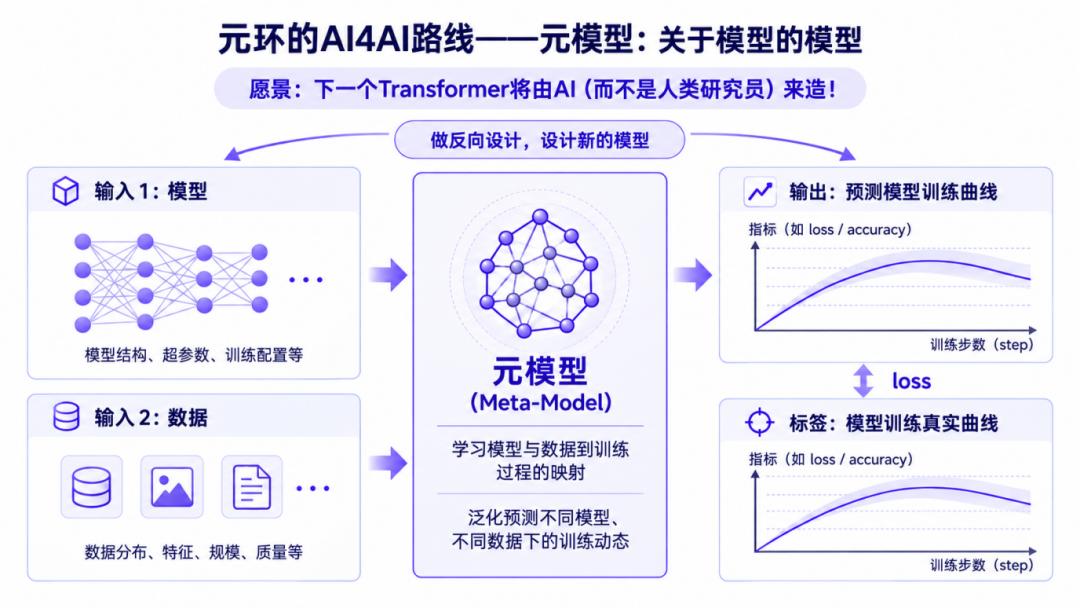
MetaRing's AI4AI roadmap
Intelligent Emergence: To what extent has this vision been realized?
Ziming Liu: We already have several demos now.
One is the demo of large language model pre-training. Its core is that when the model changes different hyperparameters (external configuration parameters before model training), whether it can accurately predict the training curve. This prediction can help researchers know in advance how to adjust the model's hyperparameters optimally.
There is also a Meta Model demo for time series. In the time series field, LSTM (Long Short-Term Memory network) performs better than the Transformer architecture. Therefore, based on the LSTM baseline, we built an architecture whose performance is hundreds of times better than that of LSTM. In the direction of world models, we also used the Meta Model to find a new architecture. Compared with JEPA (Joint Embedding Predictive Architecture), our score on one task has increased from 67 to 98.
So the Meta Model is not far away, and we have already seen a feasible path.
Intelligent Emergence: When did you achieve these results?
Ziming Liu: In the past two weeks. If you talk to me again next week, the situation will be different.
We are also building our own benchmark, which will be released soon, named Architecture IQ. It is used to evaluate the intuition level of large models or human researchers on model training. For example, if I want to train a regression task, which of the following three models will perform best after full training? This is a task to test intuition. Our test results show that in the Architecture-only type of questions, GPT-6 Astra scores less than 40 points, while humans can get around 60 points.
Intelligent Emergence: So on tasks like "intuition", large models are still inferior to humans?
Ziming Liu: As I said, intuition is not natural language, it is a new modality. If you insist on using natural language, you cannot do it well.
We conducted tests on the Architecture IQ dataset, and found that letting large models think for a longer time will not improve the effect, and sometimes even make it worse. For tasks such as mathematics and coding, you can get higher scores by letting large models think longer, because these scenarios are already compressed and can be expressed in words. Those unspeakable intuitions cannot improve their accuracy simply by increasing the training duration.
Intelligent Emergence: In the long run, when will the Meta Model become a reality?
Ziming Liu: From the perspective of research, it may take three years to fully figure out the Science of AI. But the Meta Model is easier than the Science of AI, because we do not necessarily need to fully understand the underlying principles of the Meta Model, and do not need to write the principles of AI into symbols or externalize them into natural language or symbolic language. The Meta Model shortens the three-year time to one year.
We do not necessarily pursue the metaphysical principles behind AI, but we can first train a model for prediction. The "one year" here refers to the time for commercialization. We have just started for three or four months, and we have already explored a feasible path.
Intelligent Emergence: What form will its first delivered product be?
Ziming Liu: The first product to be delivered will be a time series Meta Model. From a longer-term roadmap, we hope to use the Meta Model to build world models, AI4S models and so on.
Break out of Transformer, find the brightest star in the whole starry sky
Intelligent Emergence: Building RSI on large language models may require chain-of-thought data of human epiphanies, so what kind of data does the Meta Model need?
Ziming Liu: We use supervised learning to train the Meta Model by pairing a large number of models with their training curves, so the Meta Model can surpass human imagination and creativity. The experiments behind large language models are within the existing human cognitive space, while the data behind the Meta Model are unseen models that no one has ever explored before.
Take the Transformer architecture as an example. The large language model is just a relatively bright star in the night sky, but it limits our thinking, making us only look for other stars around this one. We want the Meta Model to see the entire starry sky, help different models evolve, and find the brightest star in different scenarios.
Intelligent Emergence: How do you get these data?
Ziming Liu: We synthesize these data ourselves.
On the one hand, there are indeed no various models on the Internet. People will not generate some "monster models", and most people use models following others' choices, which is the safest way. On the other hand, these data are also our moat. Compared with the models on the Internet that may have inaccurate data and insufficient details, synthesizing data by ourselves is more safe and controllable. In the later stage, we will also specifically synthesize more data that has not been explored before. But the first step is to increase entropy, jump out of the existing paradigm, and first see a variety of rich architectures.
Intelligent Emergence: What magnitude of data is needed to train a Meta Model?
Ziming Liu: For the time series Meta Model and the world model Meta Model we are developing now, thousands of pieces of data are enough.
Intelligent Emergence: What is your opinion on the Transformer architecture? To create those "strange models", can the existing architecture meet the requirements, or do you need to create a completely new architecture?
Ziming Liu: Its "building blocks" basically already exist, and these "building blocks" can be combined to form all kinds of new "houses".
The most amazing part of large language models does not come from the model itself, but from language. Language is an architecture that has been compressed, streamlined and refined by humans after millions of years of evolution. Transformer just caught up with the trend of the times and became the first model that can "digest" language.
For 30% of the tasks in the world, such as text, mathematics, and coding, which are tasks that can be expressed in words, large language models are already sufficient to complete them. But the remaining 70% are things that cannot be expressed in words and have not been compressed yet, including AI for Science, world models, AI research itself and so on. These tasks require models with better architectures to complete.
Using LLM to implement RSI is like climbing a mountain along an unmarked wild path
Intelligent Emergence: You mentioned that there are several different paradigms for Auto-research, what is the difference between them?
Ziming Liu: Teams taking different routes are using different ways to answer this question: when AI conducts research or builds models, can it be explicable, that is, can it be described in natural language; and can it be externalized, that is, can it be externalized from my brain into the Meta Model, or into your brain.
Teams taking the large model