AI's disruptive dimensionality reduction strike: where is the discipline of mathematics heading?
In *The Three-Body Problem*, there is a brutal scene. Higher civilizations did not fight against humanity; they dropped a two-dimensional foil, and the three-dimensional space began to collapse into two dimensions. All human resistance was utterly meaningless in front of that thin transparent object. No one asked if humanity was prepared.
The mathematics community is experiencing its own dimensionality reduction strike.
On October 6, 2026, OpenAI published 722 mathematical manuscripts on GitHub. Among them, for the 3D maximal function version and 4D Hausdorff dimension version of the Kakeya conjecture, Wang Hong and Joshua Zahl spent three years of research approaching the Fields Medal level, while OpenAI's average time consumption was only 3 hours. In the same batch of releases, there are also quasi-Riemann hypothesis, unique game conjecture, and special cases of the Hodge conjecture. These problems that have been pending for decades or even hundreds of years were dropped on the whole world overnight in the form of 372 sets of achievements.
The mathematics community was completely shaken. The Human Mathematics Association led by Terence Tao called for stopping cooperation with OpenAI, 25 Fields Medal winners jointly signed a protest, and nearly 7,000 mathematicians signed the joint protest statement.
What mathematicians have always opposed is never AI doing mathematics. What they oppose is that they cannot understand how AI does mathematics.
Behind this lies a deeper change. In 1900, Hilbert put forward 23 problems, which supported mathematicians for an entire century. One conjecture could give birth to generations of researchers, and one research direction could support an entire discipline. In the AI era, a problem may only be a single line in the answer list. Mathematics is no longer a long journey for humans to understand the world, but has turned into mass production of answers.
If the creation of mathematics no longer requires human understanding, is mathematics still human mathematics?
Authorship Dispute: Who Gets to Define Mathematical Achievements
The Navier-Stokes equations, a millennium problem, became the flashpoint of the conflict.
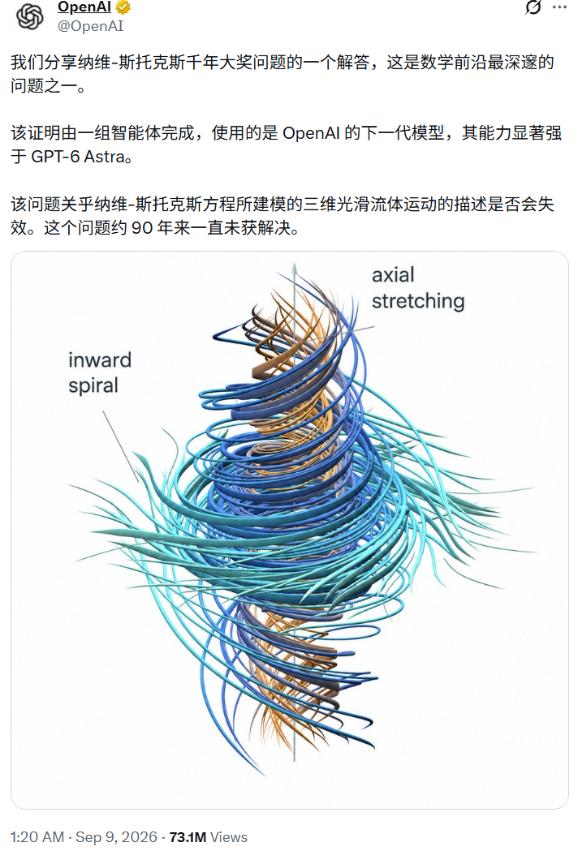
This set of equations describes the motion law of viscous fluids. Since its establishment in the 19th century, the question of whether its solutions always exist and remain smooth has been unsolved for nearly a century. In 2000, the Clay Mathematics Institute listed it as one of the seven Millennium Prize Problems, with a reward of 1 million US dollars. Before OpenAI announced that it had "solved" it, only the Poincaré conjecture among the seven major problems had been truly conquered.
On September 7, Tristan Buckmaster, a mathematician at New York University, and Levent Alpöge who works at Anthropic, published a 245-page result proving that the 3D Euler equations with smooth external forces will blow up in finite time, which is one of the most important paths leading to the Navier-Stokes problem. Only one day later, OpenAI announced that its internal model had found a counterexample to the problem. Buckmaster later publicly stated that OpenAI had proposed a "merger plan" to him: he would be the author to announce that "OpenAI's internal model has solved the Navier-Stokes problem", on the condition that OpenAI is acknowledged, but Alpöge cannot be listed as an author because he works at Anthropic. When Buckmaster refused, the other party asked him, "Why do you want to ruin your career?"
OpenAI completely denied all these claims. Sébastien Bubeck, who led the millennium problem tackling, said, "Neither our researchers nor our Agents saw any of their work before they released it publicly." However, the coincidences on the timeline, plus the exclusive requirement targeting Anthropic employees in the authorship terms, make the accusation of "cutting in line" hard to dismiss easily.
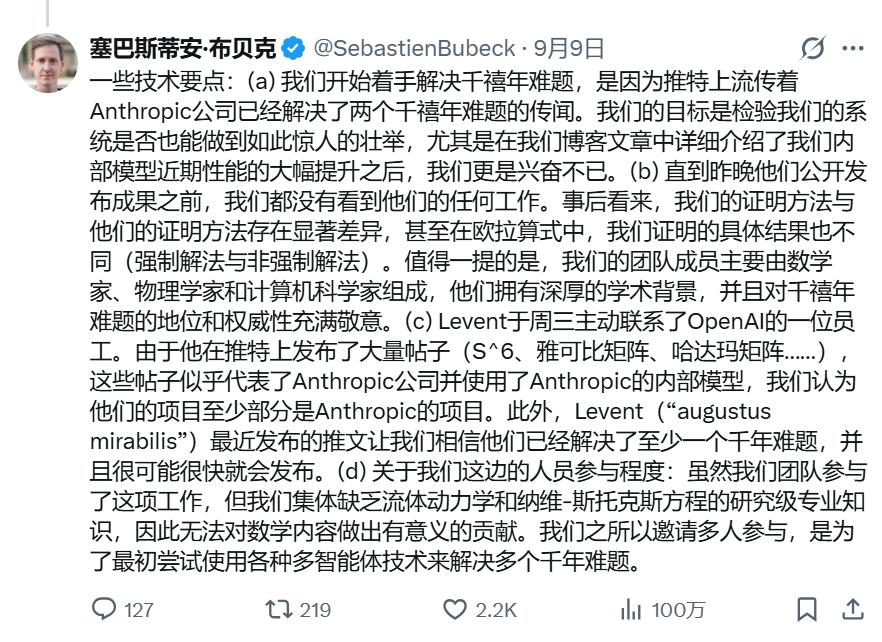
On the surface, this is an authorship dispute. Looking deeper, it touches on a structural problem.
When an AI company simultaneously plays the triple roles of tool provider, computing power monopolist and academic competitor, can the academic community still hold on to its own rules?
What mathematicians are defending is not only the authorship right of a certain paper, but also who has the right to define "what counts as a mathematical achievement" and "what counts as an acceptable publication method". This is a dispute over the right to set rules.
On September 11, 25 Fields Medal winners jointly published the statement *Serious Misalignment of Artificial Intelligence in Mathematics*. On October 7, the Human Mathematics Association led by Terence Tao released a statement calling on "all mathematicians to stop cooperating with OpenAI".
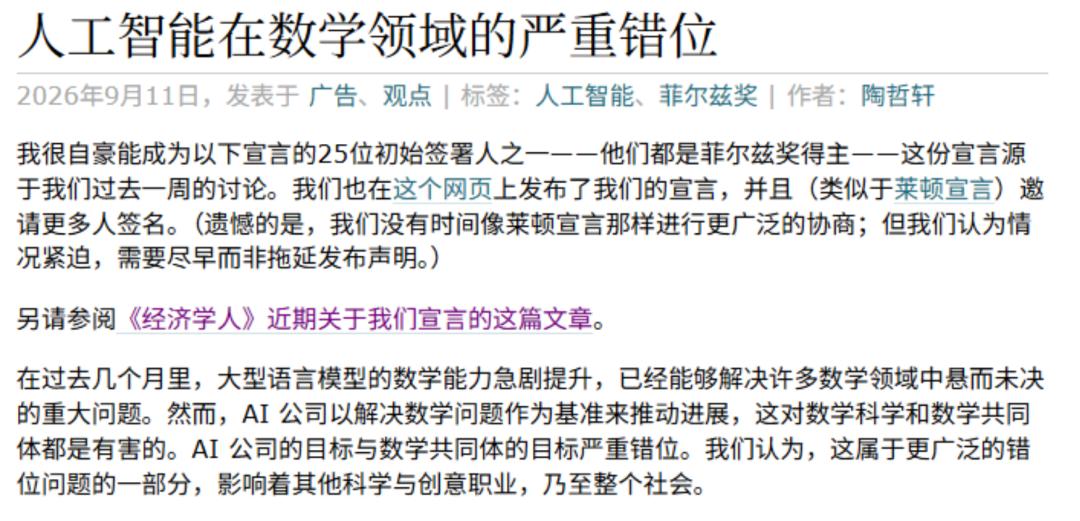
One sentence in the statement has been widely quoted: "No one asked you to solve these proofs."
The reason why this sentence is so jarring is that it hits the core of this conflict: AI companies are not participating in mathematics, but re-formulating the rules of mathematics.
Why Are Mathematicians Angry: Not the Speed, but the Incomprehensibility
Kevin Buzzard from Imperial College London said a very realistic remark. 30 papers in his field of number theory appeared in OpenAI's release, but only 7 of them seem to have outstanding quality, and only 1 has passed the Lean formal verification. He said that people either have to read these "garbage contents that may not be correct", wait for others to read them first, or wait for someone to formalize them to confirm whether the results are correct.
This is the core dilemma faced by mathematicians.
The proofs produced by AI, whether correct or not, look very convincing, but mathematicians cannot absorb them at all. Terence Tao used a term: proof indigestion. Among the 719 manuscripts released by OpenAI, only about 42% have completed Lean formal verification, and only 10 disclosed the reasoning process through which the model reached the conclusion. This means that for more than half of the achievements, mathematicians cannot even judge whether they are right or wrong. In fact, the day after the release, OpenAI withdrew 3 manuscripts, because a symbolic error appeared in one paper, and the other two papers relying on the same construction became invalid accordingly.
Curtis McMullen, the 1998 Fields Medal winner, used a mountain climbing metaphor. Mathematicians are like mountaineers who have set up camps on a high mountain for many years, "maybe only a few months away from the summit". But what OpenAI did is that "they scouted for positions that can be airdropped, found the above camps, immediately airdropped a team of mechanical mountaineers there, and then climbed to the peak before everyone else. All of this is just because they have a helicopter that can fly higher than anyone else."
Mathematicians' anger comes from this sense of powerlessness. It is not that they cannot outrun AI, but that they cannot understand how AI runs, yet AI has already finished the race.
The Skipped Process Is the Real Value of Mathematics
The value of mathematics never lies in the answer itself.
Mathematics does not rely on experiments, but on proofs. Starting from axioms, every step is deduced tightly. Once a proof is established, it holds forever and will never be overthrown. Euclid's conclusions 2,300 years ago are still valid today. For this reason, when mathematicians study difficult problems, the focus is never only on the final answer, but also on new methods, new ideas and new tools discovered in the process.
The "process" is the real output of mathematics.
The proof of Fermat's Last Theorem gave birth to multiple theories in algebraic geometry. The solution of the Kakeya conjecture promoted the development of harmonic analysis and Fourier analysis. After a conjecture is proved, it often gives birth to entire research branches, which later become the underlying tools of physics, engineering and computer science. The value of mathematics lies in the fact that in the process of pursuing answers, humans have invented new languages to describe the world.
AI now skips this process and directly gives a bunch of conclusions that have been verified to be correct but whose context is impossible to understand. Terence Tao called this kind of destruction "irreversible pollution": once a problem is claimed to be solved, it can never return to the unsolved state. Even just knowing that the answer exists will pollute other research paths that could have brought more profound insights.
This is like a gold mine being blown up directly. The gold is obtained, but the structure, trend and associated minerals of the ore vein are all destroyed. Next time you want to find a gold mine, there is not even a map left.
Taking Sides Won't Help: The Wheel Has Rolled Over
Within the mathematics community, positions are not unified.
Yann LeCun said: "On the contrary, mathematics is ushering in a new era. Formal proofs will be greatly automated, and the focus will shift to developing new concepts, new abstractions, new definitions and new conjectures. The invention of ships reduced the importance of swimming, but allowed us to discover the New World." Daniel Litt from the University of Toronto believes that mathematicians will have a lot of exciting work to do next. Although Buzzard criticized OpenAI's release method, he also admitted that if most of these achievements are finally confirmed to be correct, "machines seem to have the ability to master all mathematical fields."
Opposing voices are equally strong. Francis Johnson from University College London studied the Wolf D(2) problem for 25 years and wrote two books before finally giving up, but AI conquered it in a short time. He confessed, "The genie is out of the bottle, we have to accept this reality." Simon Machado, a mathematician at ETH Zurich, said that for those whose research funding is about to end or who are looking for jobs, "this change is especially destructive".
But no matter which side you stand on, one fact cannot be avoided: the advancement of AI in the field of mathematics is unstoppable.
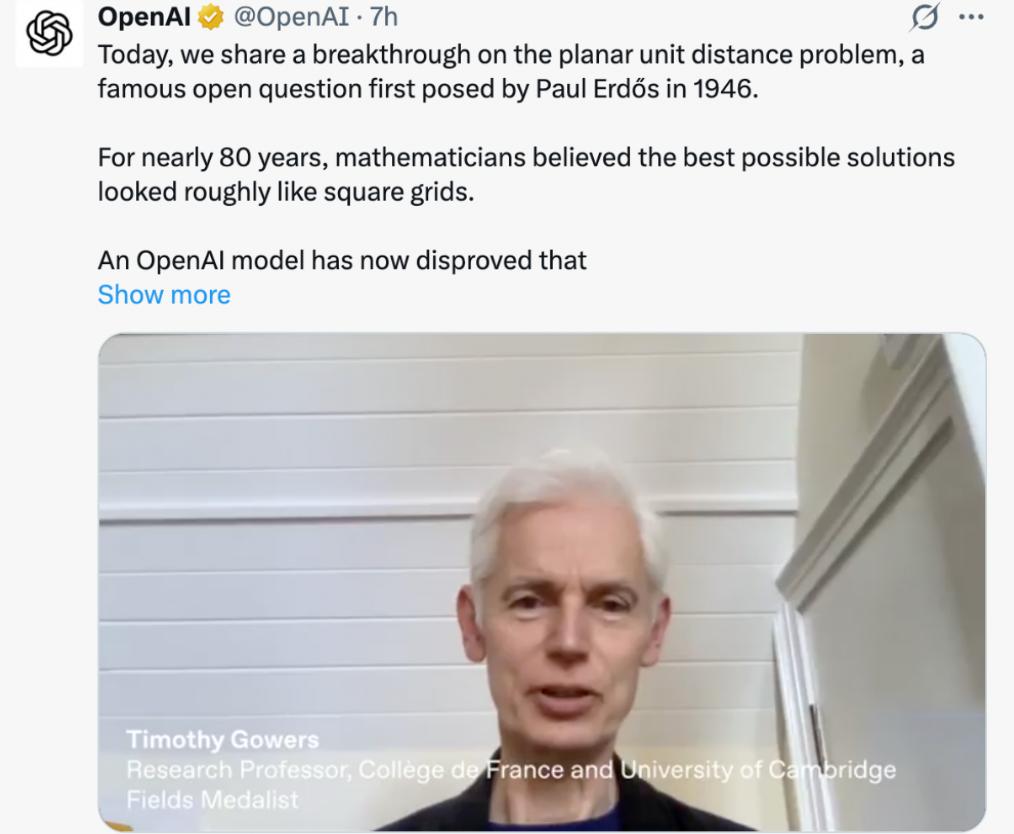
In May 2026, OpenAI's model overturned a geometric conjecture proposed by Erdős in 1946, and nine external mathematicians including Timothy Gowers from the University of Cambridge specially wrote supporting papers for it. Gowers is a Fields Medal winner, and he said he would not hesitate to recommend this achievement to top journals. Then the speed picked up. In May, 1 achievement; in August, 10 achievements released at one time; in September, more than 100 achievements announced; in October, 372 sets of achievements. In 5 months, the volume increased by two orders of magnitude.
Moreover, on the mathematics track, OpenAI is not the only player. The system released by DeepMind in May solved 9 of the hundreds of Erdős problems. Anthropic spent 11 days translating the entire proof of Fermat's Last Theorem into Lean code, which totals as many as 13 million lines.
Terence Tao himself is actually well aware of this. What he opposes is not AI doing mathematics, but the way AI companies do mathematics. He called on "all mathematicians to stop cooperating with OpenAI", but he also said at the same time that what AI has broken through is not only his field, but all fields.
What the mathematics community can do now is not to stop AI, but to fight for rules. AGMAI put forward a "two-step" release proposal, requiring the disclosure of model names, prompts and computing power costs, requiring the achievements to be stored in a neutral warehouse "not controlled by any AI laboratory", and requiring funding for mathematicians to understand these achievements.
But even this set of rules is implemented by OpenAI "selectively". The most critical information, such as which model produced these results, what the prompts used are, and all more than 4,000 problems that have been tried, have not been made public at all.
The AHM statement is piercing: "Ignoring the core premise of the advisory group's position shows that OpenAI completely disregards the norms of scientific research."
Cracks in the Scientific Foundation: After Mathematics, What Comes Next?
Mathematics is known as the foundation of the entire science. Physics, chemistry, biology, engineering, medicine, all disciplines are ultimately built on mathematical tools. Newton invented calculus to write his laws of mechanics; the language of Maxwell's equations is vector analysis; the foundation of quantum mechanics is Hilbert space.
Now, this foundation is being shaken by AI.
Professor Mengdi Wang from Princeton University pointed out that large models have made rapid progress in mathematics, programming and other fields, but have not yet produced original discoveries of the same scale in basic science fields such as physics, chemistry, and biology. The reason is that these disciplines "lack an immediate, formalized verification closed loop". The referee of mathematics is Lean, which can run in a few seconds; the referee of chemistry is the laboratory, and a new material needs to be synthesized and tested for weeks or months; the referee of new drugs is clinical trials, and it used to take ten years for a drug from discovery to marketing.
No matter how fast AI is, it cannot be faster than the real world. Therefore, the technological explosion will inevitably follow this order: first mathematics and code, because the referee is almost free; then fields that can be simulated in computers such as weather, protein, and material screening; finally, the hard sciences that require hands-on experiments.
But the waiting time will not be too long. In August 2026, OpenAI's Astra model solved 10 long-standing unsolved mathematical problems at one stroke. Physicist Gavin E. Crooks threw an open problem to Claude, and the entire problem was completely solved within a few days. Fields Medal winner Hugo Duminil-Copin said that faster progress in mathematics can radiate to physics, energy, materials science, medicine and climate science.
When the foundation of mathematics allows AI to complete research paths that humans may take years to finish in just a few hours, how long can other