ByteDance, Tencent and Alibaba fire the same bullet
Recently, AI office scenarios have become the biggest battlefield for tech giants including Alibaba, ByteDance, Tencent, etc., and large language models have also entered the deep water zone of Agent competition.
While the giants are continuously integrating products and teams to concentrate resources on a unified goal, how to obtain more real on-site office information outside the dialog box and convert it into "Context" that large models can understand has become the key to winning the competition. This has led all parties to unanimously turn their attention to hardware tracks such as voice recording cards, AI earphones, and smart glasses, launching an ecological war.
Tencent fired the "first shot" first, this September, Tencent WorkBuddy announced the launch of its open platform, introducing more than 100 ecological partners in the first batch, and integrating WorkBuddy into dozens of hardware device ends such as Plaud, Rokid, and Insta360.
Lin Zuolu, head of Tencent WorkBuddy's open ecosystem, told media including *China Entrepreneur* that WorkBuddy can use portable devices to initiate tasks, but hardware devices are only carriers for calling Agent tasks. More critically, after the connection between model capabilities and industry scenarios reaches a certain depth, it is necessary to improve the model's ability to understand information in complex contexts, and deliver the best productivity effect to users and enterprise partners.
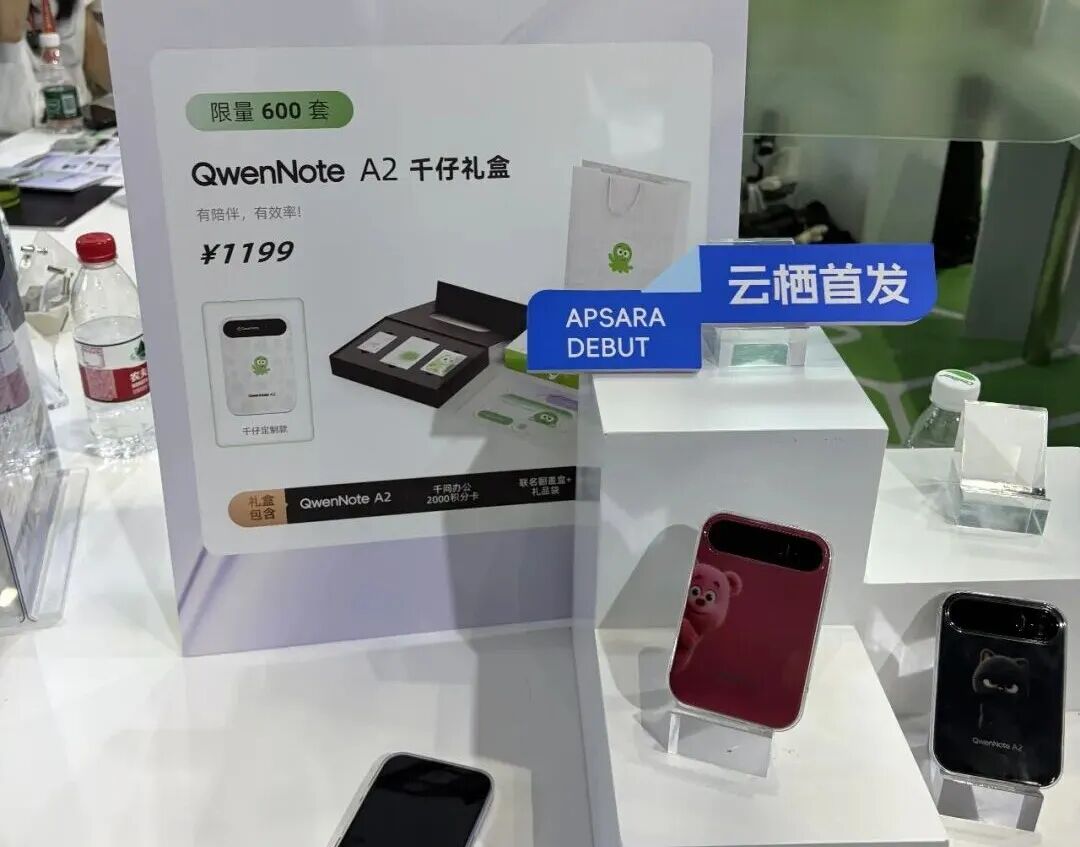
On September 22, at the "2026 Yunqi Conference", Qwen Office released the AI Agent hardware product QwenNote A2. This device supports one-tap voice activation to call Qwen Office to complete various work tasks, and can store the transcribed meeting minutes from offline communications in the Qwen Office system.
On October 13, Alibaba's Qwen released three new hardware products: AI glasses N1, N1 Pro, and AI ear clip headphones. After superimposing national subsidies and limited-time discounts, the price of AI glasses N1 starts at 2218 yuan, N1 Pro starts at 2600 yuan, and the earphones start at 1099 yuan. It is understood that N1 Pro is equipped with real-time monitoring functions for vital signs such as heart rate, blood oxygen, and skin temperature.
Shu Junliang, Vice President of Qwen Office and Head of Product R&D, told media including *China Entrepreneur* that hardware is an entry point for incremental context collection, a bridge connecting the digital world and the physical world, through which a large amount of context can be accumulated.
The "Doubao Work" released on August 25 this year has not announced a clear self-developed hardware plan, but ByteDance has already accumulated rich practical experience in AI hardware collaboration within its system: Doubao earphones, Doubao mobile phones, and the AI voice recording bean jointly launched by Feishu and Anker Innovations in January this year, all together form ByteDance's hardware matrix.
An investor told *China Entrepreneur*: "One of the paths for Doubao's Token explosion is to sink into markets such as Huaqiangbei, and use channels such as companion AI hardware to quickly become the manufacturer that consumes the most Tokens. However, the disadvantage is that the companion AI hardware has an extremely high 'dust accumulation rate': after one week of use, the idle rate of most hardware can reach 70%, and it will rise to 90% after one month."
Office hardware is expected to break out of this dilemma. "Office scenarios belong to efficiency tools, whose output can be quantified as cost. It is a real rigid demand, and the usage frequency will continue to rise with the business demand," the above-mentioned investor said.
Seizing more hardware entries has multi-dimensional values: it can not only expand diversified real user scenarios, but also obtain direct feedback of model implementation in frontline scenarios, and continuously drive Token consumption at the same time.
Of course, laying out hardware does not mean that Internet giants have to personally take charge of the entire R&D and production of hardware. Experience from the mobile Internet era has long proved that it is difficult for Internet companies to do a good job in the whole chain of hardware manufacturing. The industry has also formed a clear consensus: hardware manufacturers are responsible for product R&D and production manufacturing; Internet giants output large models and software ecosystems, and assist in channel expansion at the same time. All parties perform their own duties and make profits respectively.
The Battle of Voice Recording Cards
Voice recording is a traditional track that was once occupied by traditional players such as iFlytek and Sony. But in the past two years, it has been frequently concerned by large companies and startups, becoming the hardware scenario with the fiercest competition in AI office, with frequent price wars and channel wars.
Plaud reignited the war of voice recording equipment. Founded in 2023, it entered the Chinese market in September 2025. Its card-style AI minutes product Plaud Note became a global hit, supporting multi-model AI transcription and summary functions. The company has sold a total of 2 million units of hardware, with software ARR (Annual Recurring Revenue) exceeding 100 million US dollars.
This September, Plaud announced its first Agent partner in the Chinese market — cooperating with Tencent WorkBuddy. In addition to capability interconnection, the two sides will also launch the WorkBuddy co-branded version of Plaud Note Pro.
Similar products of major manufacturers have been unveiled intensively: DingTalk released the A1 voice recording hardware in August 2025, priced at 799 yuan, with built-in 64G storage; Feishu cooperated with Anker Innovations to launch the AI voice recording bean in January 2026, with the 8GB version priced at 899 yuan; iFlytek also launched its own AI voice recording card this September, with the 16GB version priced at 999 yuan.
This September, Qwen Office launched QwenNote A2, the upgraded version of A1, priced at 1199 yuan. In addition to voice recording and AI minutes functions, A2 features the "no trace" function: before transcription, the recording will be transmitted to the cloud through encryption, and every transcription will be "burned immediately after completion", retaining only the text and meeting minutes.
Photography: Yan Junwen
At present, the competition among various hardware manufacturers still stays at the visible explicit parameters: the number of microphone arrays, body weight, storage capacity, and terminal selling price. For ordinary consumers, parameters and prices are intuitively perceptible; while the transcription, understanding and summarization capabilities brought by large models can only be appreciated for their pros and cons after actual use.
Why have voice recording cards become the largest scenario entry for AI office?
An AI hardware entrepreneur said that hardware in AI office scenarios such as voice recording cards is essentially an extension of mobile phone functions. "First, some meeting scenarios do not allow mobile phones to be brought in, or using mobile phones to record will be interrupted by incoming calls, so a professional hardware is needed. Second, mobile phones are suitable for close-range scenarios. Plaud is equipped with 2 MEMS (Micro-Electro-Mechanical System) microphones and 1 bone conduction microphone, which can collect voices of more people and solve the pain point of mobile phone recording."
On the enterprise side, voice recording hardware is being embedded into business processes. A person in charge of SaaS products told *China Entrepreneur*: When frontline salespeople visit customers, they have required employees to be equipped with voice recording devices, so that CEOs can directly read the frontline information of customers without filtering layer by layer. The data charts used in meetings by some senior enterprise executives are also refined and summarized by large models from thousands of sales recording transcripts.
Large models can process increasingly high-density text information, but there is still a ceiling on the length of context they can process. This means that for enterprises, prioritizing context information, selecting which information to keep and which to discard has become very important.
Shu Junliang, Vice President of Qwen Office and Head of Product R&D, said: As long as the context and attention of the model are not infinite, context management will always have extremely high value. How to filter out information strongly related to the problem from massive raw data and build a reasonable data organization structure will be the core proposition of enterprise AI implementation.
Entrepreneurs: Anxiety, Customer Acquisition and Position Selection
Voice recording cards are just the tip of the iceberg. To seize the AI office track, the layout of major manufacturers has extended to multi-form hardware: AI glasses for visual perception, AI earphones for auditory input, wearable bracelets, and enterprise-side AI cockpit. The war of hardware entries has been fully launched.
According to information obtained by *China Entrepreneur*, the Afu App team under Ant Group is planning to launch hardware products, which may include forms such as watches and bracelets. There are also AI product teams imitating "Doubao" to sink into the low and medium-end hardware markets such as Huaqiangbei to compete for the companion hardware market.
The entry of major giants has made entrepreneurs in the industry feel anxious. Practitioners said that the current AI hardware market as a whole presents a situation of "hot outside but cold inside": it looks lively, but the foam is being squeezed out.
The cooling of investment and financing is the clearest signal. AI hardware practitioner Zhang Haitao said that some investors told them that in the first 10 months of 2026, there were 70 hardware companies that submitted projects for review, and only 10 of them were approved. "In 2024 and 2025, some leading AI hardware companies received financing of 200 to 300 million yuan, but after one or two years of operation, they failed to deliver satisfactory results and could not obtain exit opportunities."
This has forced some entrepreneurs to seize the olive branch extended by Internet giants. Whether it is Qwen Office, WorkBuddy or Doubao, cooperating with giants can obtain the advantages of traffic or channel distribution.
However, new contradictions followed: without sufficient shipment scale, enterprises cannot obtain the cost advantage of the supply chain.
Is AI hardware a real rigid demand or an ideal product conceived out of imagination?
Zhang Haitao said that the whole industry is confused: Is AI hardware a rigid demand for consumers or an ideal product for entrepreneurs? Taking companion AI products as an example, there may be hundreds of brands in China, but no more than 10 of them have actual sales exceeding 100,000 units.
In addition, he noticed that the customer acquisition cost of AI hardware is very high. For example, the average customer acquisition cost of a certain AI glasses is 200 yuan, including traffic cost and offline advertising cost.
The entire smart hardware industry needs new ideas to break the deadlock. Lin Zuolu said: The WorkBuddy team believes that the model will continue to improve, and hardware will become a very important peripheral for Agents in the future. But she also admitted: "The ecosystem cannot be planned. The key is to return to the source, whether the product is designed well enough. We do not have enough power to drive the outbreak of smart hardware products."
Unlocking the "Tacit Knowledge" of Enterprise Context
In the final analysis, the giants are competing to install Agents in earphones, voice recording cards and glasses. On the surface, it is a competition for hardware entries, but at the bottom it is still a competition for context. In the future, the capability growth of Agents will be less and less constrained by model parameters, and will turn more to the understanding of organizational information — that is, Context.
For individual users, the ultimate goal of Agent is "wherever people are working, the Agent is there". For enterprises, the meaning of Context is even broader.
Chen Yusen, Vice President of Alibaba Group and CEO of Qwen Office, defines enterprise context as follows: all the documents, meeting data, group chats accumulated by enterprises in the past, as well as the things that were once called "tacit knowledge" scattered in every corner of the enterprise, can be connected and incorporated into the enterprise context.
The battle for physical world context has even spread overseas. According to media reports, OpenAI plans to launch a portable, screen-less smart speaker, which will be the company's first consumer-oriented hardware product. This device can call all capabilities of ChatGPT, complete humanized iterations, and build emotional connections with users.
The giants' logical closed loop is very ideal: hardware solves the problem of "where the context comes from", the model solves the problem of "how the context is understood", and the ecosystem solves the problem of "how the context is distributed on a large scale".
But for a wider range of ordinary users, when mobile phones can already record, translate and call large models, what is the necessity of buying an additional hardware? In this sense, the decision of the hardware war is not in the hands of Tencent, Alibaba or ByteDance, but at the moment when every consumer decides to place an order.
This article is from the WeChat official account "China Entrepreneur Magazine" (ID: iceo-com-cn), author: Yan Junwen, authorized for release by 36Kr.