While we revel in the fun of AI-generated short dramas, we keep criticizing them nonstop — what on earth is the "poison" of these AI short plays that has taken such a firm hold on us?
At 1 a.m., you decide you will go to sleep right after finishing this episode. But the girl who was just kicked out of her home by her adoptive parents unexpectedly finds out that she is the long-lost daughter of the richest man! She rushes to recognize her biological family, only to have the richest man turn against her in public, tear up the paternity test, and firmly refuse to acknowledge her! What will she do to turn the tables next? You know you should go to bed, but your finger swipes down again...
The calm and rational wife who wants a divorce always has a roaring husband and mother-in-law, as well as a scheming junior female fellow apprentice. The counterattacking bakery owner and the steamed stuffed bun shop owner forced to move both preach "establishing the rules first", and the customers who come chasing after the food always say "it is a bit expensive, but it does not cause heartburn after eating".
There are countless AI-generated short dramas, so why is it so hard to stop once you click on one? You feel entertained while complaining, why do we know they are low-quality but keep watching episode after episode?

Have you had any "snack that does not cause heartburn" today? 丨Short drama Five Generals Eat Fresh Meat Steamed Buns: It is a Bit Expensive, But It Does Not Cause Heartburn After Eating
Why do AI short dramas make you unable to control yourself?
The reason why short dramas are addictive does not entirely lie in "whether the content is good or not", but in the combined effect of "content + usage process". For AI short dramas, the two secrets that hook you are exactly two words — "short" and "AI".
Because they are short, they are perfect for killing time
Killing time and looking for fun is originally the top reason why we take out our phones. Each episode lasts from dozens of seconds to a few minutes, and you can watch it as soon as you take out your phone. Short dramas are like water, seeping into every gap in your life: when you are waiting for the meal to be cooked, waiting for someone to arrive, waiting to reach your destination, waiting to fall asleep. When you can get information easily, the human brain just prefers short, fragmented and enjoyable content.
What is worse, they do not give you any chance to "pause". Even though the drama is divided into episodes, the next episode automatically plays as soon as the previous one ends; as soon as one suspense is solved, a new hook is thrown out, and you are completely wrapped in an infinite continuous stream. You gradually lose perception of time: "I only planned to watch for a few minutes, but before I realized it, an hour or two had passed."
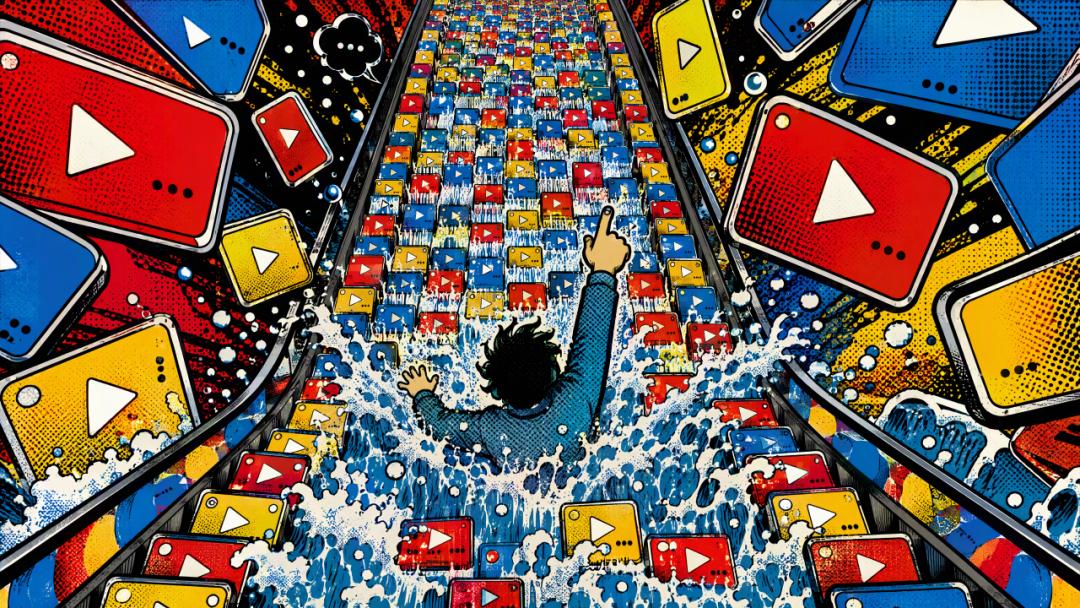
Short dramas are like water, seeping into every gap in daily life 丨AI-generated image
Because they are short, the narrative structure is highly compressed
A traditional TV drama episode is 43 minutes long, which is enough to slowly introduce the background, lay out character relationships, amplify conflicts, and finally leave a hook for the audience. But AI short dramas need to finish the whole story in a few minutes or even dozens of seconds, so they can only cut off character relationships, cause-and-effect chains, inner monologues and scene transitions, and directly throw conflicts right in front of your face.
How direct is that? I recently followed a short drama called Who Will Marry the Rich Second Generation After Rebirth, and the whole process is like playing at 8x speed: in the first 3 seconds, the female lead hooks up with a rich second generation by pretending to be a socialite, and her identity is immediately exposed; at the 26th second, she is publicly humiliated on the plane to meet the parents, and a group of people force her to get off the plane! The parachute is broken! At the 102nd second, a basin of cold water is poured over her head — she is reborn, back to the time before she was tricked into the factory. In just 2 minutes, identity exposure, public humiliation, life crisis and rebirth reversal take place one after another, before you swallow the last part, the next part is already stuffed into your mouth.
Because of AI, there is technical support
The two "visitor retention" tricks mentioned above are also used by real-person micro short dramas. But what makes AI short dramas more powerful lies in two aspects: they expand the imagination to a larger scale, and polish the routine to a more precise level.
First, about the expanded imagination. In the past, if you wanted to let mythical figures from all times and across the world fight on the same stage, you had to spend a lot of money on casting, costumes and props, special effects, and you were also limited by real shooting technology. Now with AI, Sun Wukong, Yang Jian, Nezha can fight head-on with Egyptian gods, Portuguese cannons can blast the city walls of the Song Dynasty across time and space, and even human civilization can be destroyed by a nest of iron ants in the sewer. Familiar characters step into an unfamiliar world, paired with distorted limbs and weird spaces, you are either stunned by the "tech sense", or just watch it while cursing and take it as talking points. The curiosity of "can this even work?" can easily turn into the motivation to follow updates to see "what else can be generated next".
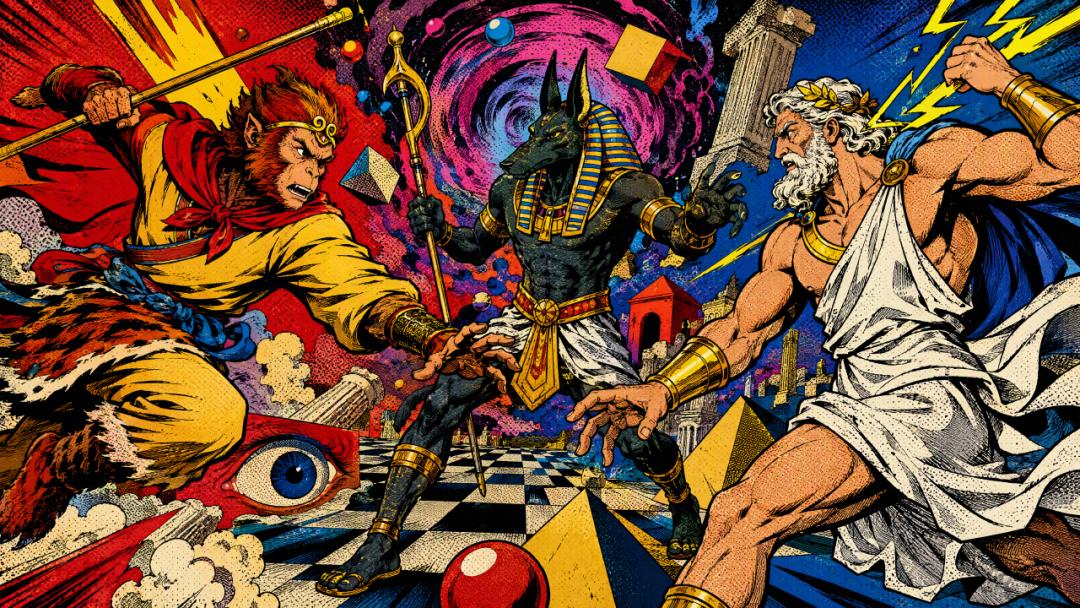
AI breaks the high walls of casting, costumes and props, special effects and real shooting restrictions, opening a new world for drama production 丨AI-generated image
Then about the polished routines. Creators use AI to analyze texts, reorganize plots, generate images, and then adjust according to audience feedback, finally building a production assembly line: AI is responsible for low-cost mass replication, and the recommendation algorithm is responsible for accurately distributing the content to the right people. In this way, highly stimulating entertainment can be made cheaper, arranged more densely, iterated faster, and delivered more precisely.
Why do AI short dramas always follow the routine of "unprovoked humiliation → moral transgression → villain's arrogance → protagonist suffering → audience rage → waiting for counterattack → counterattack success"? For one thing, the plot of evildoers getting what they deserve is the most satisfying and eye-catching; for another, it can precisely step on your anger: among all emotions, anger inherently carries the impulse of "wanting to take action and settle accounts", which can most force people to respond. In 2025, Oxford Dictionary named "rage bait" the Word of the Year, which refers to deliberately designing content to make you angry in exchange for traffic. That is exactly what AI short dramas do: first make you extremely angry, then vent your anger for you, and cut your attention into small goals of "watching the villain get punished".
This carefully designed routine of "anger → pleasure → more anger → more pleasure" not only steals your attention, but also pushes you to problematic usage. "Reversal" and "pleasure" will light up the reward circuit in your brain, and when dopamine surges, it urges you to look for the next reward. When "anger" becomes a bell, as soon as someone rings it, you will be like Pavlov's dog, unable to resist swiping to the next episode. In the final analysis, it is not that you cannot control yourself, but a trap tailor-made for the weakness of self-control.
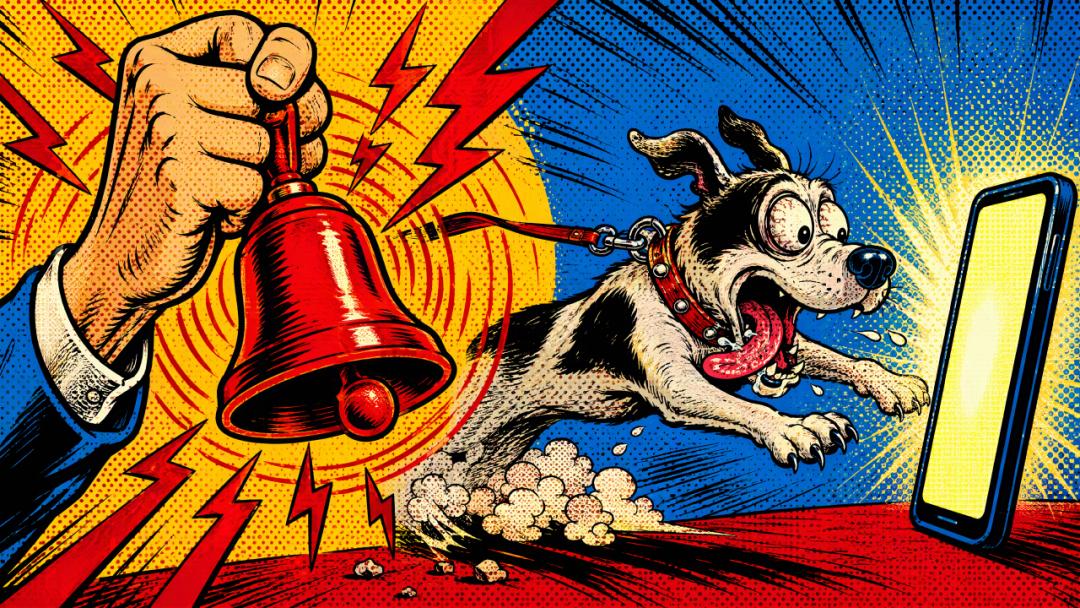
It is not that you have poor self-control, the trap is tailor-made for the weakness of self-control 丨AI-generated image
Because they are low-quality, they are easier to get into
They are so bad, but why are they still so addictive? Because they are bad in just the right way.
Shoddy production reduces "watching" to "emotion consumption". A high-quality well-made drama requires you to focus, understand, and use your brain to remember previous plots; but these full-of-loopholes short dramas do not require anything from you — no need to think, no need to remember, even no need to understand, you can watch them with your brain turned off, emotions are directly stuffed into your mouth, and you are satisfied after the pleasure passes.
Loopholes and roughness also remove the "gravity" of the narrative, you can enter and exit at any time, so you can watch them in infinite loops without feeling tired — after all, you have never really "immersed" into the story.
What is more clever is that roughness itself is a "complaint point". Complaining is also a kind of participation. You spit at its absurdity, laugh at its plot holes, and you have changed from a bystander to its disseminator: you take screenshots, make memes, and forward them to your friends to complain together. This is the same trick as deliberately making you angry: first make you feel "I am smarter than it", then quietly keep your attention in place. You think you are picking on its flaws, but in fact it uses "not good enough" to make sure you always stay at the shallow level of "just watching", you will neither be deeply occupied, nor stay away for long.
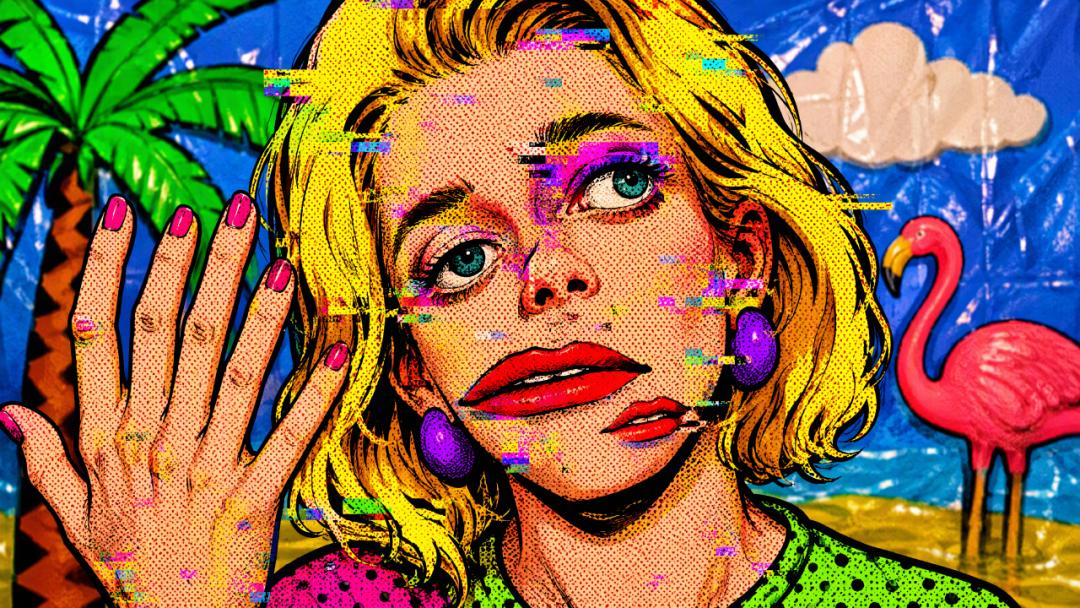
The obviously fake "AI flavor" has unexpectedly become the most convenient complaint point and the most labor-saving entry 丨AI-generated image
What will happen if you keep swiping?
AI short dramas are more harmful than short videos, because they can give you two completely opposite "attention traps" at the same time. Either you cannot stop once you start, and your attention is fully occupied; or your attention is fragmented, you swipe a few episodes during commute, a few episodes in the toilet, and dozens of episodes before going to bed. The problem of the former is that you cannot exit, which squeezes your rest time; the problem of the latter is that you are always interrupted, jumping between different tasks.
First, about "continuous occupation", which means your attention is nailed to one thing. Experiments have found that people who do high-brainpower work for two consecutive hours need more time to warm up when switching to the next task, and are more likely to make mistakes repeatedly. Applied to watching dramas, the more you watch, the more you cannot stop, and the less you want to do other things; the worse you do other things, the more you want to go back to watch. Netizens' experience hits the nail on the head: it is just "electronic opium".
Then about "fragmented occupation", which sounds more civilized, at least it seems that you still have some self-control. But psychologists do not buy that. Swiping for 120 consecutive minutes, and swiping 10 minutes each time for 12 times, the total duration is exactly the same, but the brain is restarted 12 times. The consequence of repeated switching is "attention residue": you are sitting back at your workstation, but your attention has not come back. When you take "switch, switch, and switch again" as your instinct, distraction will come to you, and when you do things that require concentration such as reading and writing, you will only feel upset and restless.
The emotions that short dramas let you experience repeatedly, and how they arrange these emotions, are also worth analyzing. Emotions are contagious: people who watch violent films for four consecutive days will be sharp to others afterwards; people who are often exposed to swear words prompts cannot control their mouths even after leaving the laboratory. In a revenge pleasure drama made to hook you, the characters are more like emotion containers than real people. In order to let you immerse into the plot immediately, roaring, crying, and slapping in the face take turns to bombard you, venting your anger for you while pushing your emotions to the extreme again and again. If you feel stuffy in the chest, nauseous after watching short dramas, or suddenly become grumpy and impatient with your family, these are solid proofs that you are infected by the negative emotions.
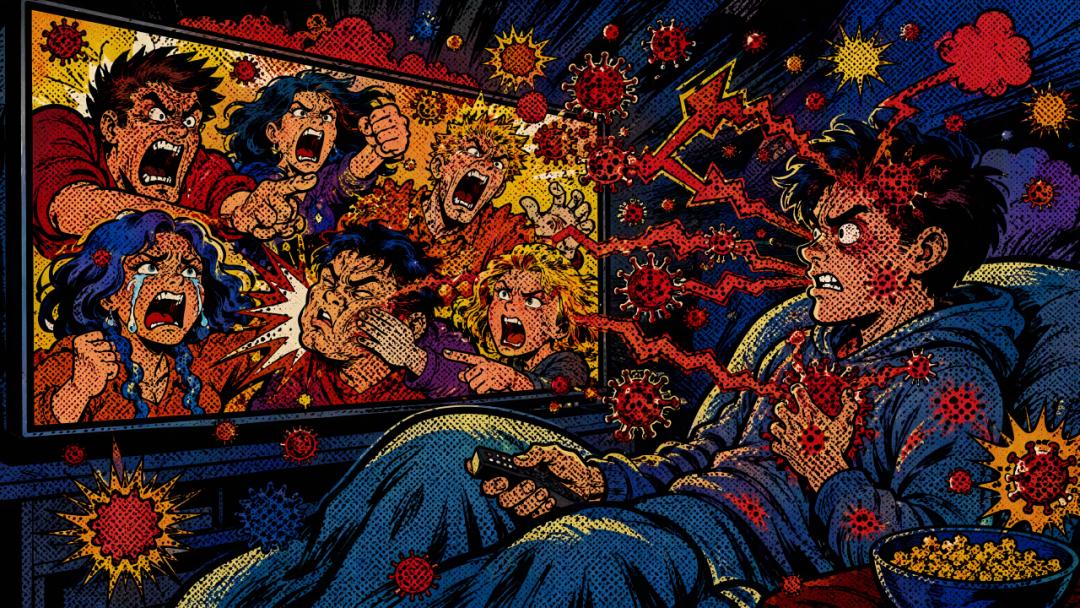
Emotions spread across the screen like viruses, planting the same violence and irritability in the audience 丨AI-generated image
Emotions also affect how you understand interpersonal relationships, groups and rules. Watching a warm short film, children can experience complex feelings they have never had before, so as to understand that happiness can also be achieved by helping others. You favor the protagonist, even if he is extremely bad, you are willing to find excuses for him that "he must have difficulties". But the omission and compression tricks of AI short dramas directly build a binary world for you that only has "me" and a bunch of NPCs. Emotions thus become double-standard moral judgments: contempt from others is called "getting revenge" for me, but it is "looking down on me" from NPCs; anger is called "upholding justice" for me, but it is "humiliating me" from NPCs. This self-centered way of understanding will quietly erode your empathy, make you more and more sensitive, and make you hard to get along with in real life.
Short dramas are also secretly changing the ruler you use to measure your life. Human beings dominate the world by telling stories, and the media unifies our cognition of the world by telling stories. When the answers to "what is worth striving for, what behavior should be rewarded" are wrapped in one addictive story after another, and told to you over and over again, you will take them as your creed and believe in them deeply.
Where will these stories that keep talking about revenge and counterattack lead you astray? No matter the characters in these pleasure dramas are old or young, before the protagonist turns over, they are always angry, cowardly and hit a wall everywhere because of "relationships", but in the end they will get a perfect partner, have a net worth of hundreds of millions, and reach the peak of life. This kind of pleasure drama that repeatedly leads the ending to "materialism" will slowly make you used to measuring success and happiness with money, and measure yourself as well as others by social status. The "an eye for an eye" counterattack mode deletes all elements like opportunities, rules, social structure and resource distribution in reality, leaving only the all-powerful winner and the disgraced loser on the screen. This way of fulfilling dreams will make you more eager to sit in a position that can dominate others, and pay less attention to the suffering of people far away. When a story repeatedly uses wealth to prove success, uses power to realize dignity, and uses personal counterattack to solve predicaments, what it shakes is not only what kind of person you want to be, but also how you view yourself who has not succeeded yet, and others who have not achieved counterattack.
How to regain self-control?
After going around, let's go back to that night at the beginning. Don't swear to yourself