Having successfully validated the dual closed-loop of technology iteration and commercial implementation in high-value scenarios, Ruoyu Technology has completed a hundred-million-yuan level Pre-A round of financing.
36Kr learned that Shenzhen Rooin Technology Co., Ltd. (hereafter referred to as "Rooin Technology"), a robot brain developer, has recently completed a Pre-A round of financing worth hundreds of millions of yuan. This round is led by Sunway Communication, with participation from Jinmu Capital, Qindao Capital, Huanghai Capital, and Zhongchuang Capital. Since its establishment in 2023, the total accumulated financing amount of Rooin Technology has reached several hundred million yuan.
For Rooin Technology, the closing of this round of financing falls exactly at the midpoint of its strategic path: starting from high-value scenarios, it has taken sufficient patience to fully verify the closed loop of technology R&D and scenario validation. The next question is: can the capabilities polished in real scenarios be turned into deliverable products.
Sun Teng, founder and CEO of Rooin Technology, has given the answer in the company's resource allocation plan: the funds from this round will continue to be invested in full-stack capability R&D of robot brains, data closed loops in real scenarios, and the advancement of industrial implementation.
"I don't think capital itself is the most important thing this time," he told 36Kr. "What matters more is investors' understanding of the industry and their judgment on long-term value under the current market environment."
Why not Choose an Easier Scenario
To understand the path Rooin Technology has taken, we first need to see what it has rejected.
In 2026, the embodied intelligence track is at a critical node shifting from "technological breakthrough" to "scenario implementation". The common practice in the industry is to start from general scenarios and pursue a "large and all-inclusive" capability narrative. Chip companies customize solutions for dexterous hands, software companies co-exhibit with ontology manufacturers, and all kinds of players rush to put robots on exhibition booths to dance or complete grasping demonstrations. Few are willing to set their first stop in hazardous environments.
Rooin Technology took the opposite approach. It selected intelligent refueling, namely the refueling robot, as the first high-value scenario for its robot brain to land. This is a high-value scenario that integrates multiple requirements including high risk, explosion-proof performance, continuous outdoor operation, and adaptability to high and low temperatures. The logic behind this choice is not complicated: the more valuable the scenario is, the more real problems will be exposed per unit of time.
"We can use a higher density of real challenges to force the system to expose its bottlenecks and accelerate evolution," Sun Teng explained. Only by stepping out of the laboratory can people have a clearer understanding of their own capability boundaries.
This judgment is more meaningful when viewed against the industry context. In 2026, obvious differentiation has emerged in the data route of the embodied intelligence industry. At the "Physical Intelligence - Divergence and Choice" roundtable of the Bund Conference, the debate over data has become a core topic: the simulation route generates massive synthetic data with the support of computing power and engines, delivering extremely strong scalability, but it is constrained by the domain gap between simulation and reality. The data collected from real scenarios has limited acquisition efficiency and unstable quality, but it naturally contains physical details that cannot be reproduced by simulation, such as sensor noise, sudden light changes, and sudden entry of personnel. Some scholars even put forward a thought-provoking judgment: the real valuable data competition in the future will not be about who owns more hours of data, but about who can obtain and organize the experiences that truly contain "physical intelligence".
Essentially, Rooin Technology's choice is a response to this judgment.
Rooin Technology builds its technical system around the trinity of "brain - ontology - scenario data". On-site operation data is filtered and desensitized before being asynchronously returned to the cloud on demand, forming a closed loop of "perception - decision-making - execution - feedback - optimization" that continuously drives the optimization of models and strategies. The robot brain adopts a cloud-edge-end layered technical architecture: the cloud end carries the world model and global task planning, the edge end is responsible for millisecond-level real-time perception and safety control, and the terminal robot is equipped with heterogeneous computing power and multiple sensors to achieve precise execution.
The core driving force of this architecture is not the scale of simulation data, but the high-quality data continuously returned from real scenarios. Facts have proved this point. Rooin Technology launched the operation of its pilot showroom in Foshan in April this year. During the subsequent polishing process, the team found a large number of problems that could not be detected or discovered in the previous laboratory environment.
The side effect of this path is slowness. The data accumulation cycle of high-value scenarios is long, and the marginal cost of scenario replication is high, so it is difficult to see the narrative appeal of the general scenario route that "one set of models adapts to multiple scenarios" in the short term. But it also brings another result: once the path is fully verified, followers will find it very difficult to catch up in the same timeline. Because the data closed loop in real scenarios needs to be "nurtured" in on-site operation time, rather than simply stacked by computing power. As the industry moves from the stage of "whether the product exists" to "whether it can be used" and even "whether it is user-friendly", the value of the barriers formed by real on-site accumulation will be increasingly recognized by the whole industry.
Can it Enter the Site and Keep Working Continuously
Rooin Technology's choice is not only the path judgment of a single enterprise, but also an observation sample of the embodied intelligence industry shifting from "technological narrative" to "value realization". When more and more companies start to demonstrate their general capabilities on exhibition booths, the teams that are willing to send robots to the most dangerous, most complex and most unseemly sites to polish the robot brain inch by inch with real data may become one of the scarcest forces when the industry truly matures.
Over the past two years, the embodied intelligence track has never lacked stories. "For robot brains, scenarios are training grounds; high-value scenarios have higher training value." Sun Teng, founder of Rooin Technology, repeatedly emphasized a judgment in the interview: "Robots must grow up in the real world, not just in virtual simulation environments."
This statement points to the core positioning of Rooin Technology: it is a robot brain company, and its core product is the self-developed Rooin Jiutian robot brain. The ontology is the carrier for the brain to enter real scenarios, and the medium to collect valuable data. Explosion-proof certification, the Foshan pilot operation, and the attention from the energy industry circle, all these achievements serve the same goal: to enable the robot brain to iterate continuously and return real data continuously under extreme constraints.
This also explains why Rooin Technology chooses to cut in from high-value special scenarios. Explosion-proof certification solves the access problem of "whether the robot can enter special operation sites", but its significance is far more than a single certificate. In Rooin Technology's technical narrative, explosion-proof performance is more like a strong constraint that reversely shapes the architecture of the robot brain. Sun Teng explained that explosion-proof is essentially an energy constraint, which will force the robot brain to shift from a centralized high-computing-power architecture to a layered architecture of "lightweight ontology safety main control + layered edge computing power in safety zones". After adding the explosion-proof constraint, the computing power on the ontology side, the number of sensors, and even the communication bandwidth need to be reduced. Sensors such as cameras and LiDAR need to be externally added or replaced with explosion-proof glass. The evaluation of thermal power consumption control components, the explosion-proof structure of the ontology, and the overall explosion-proof system all require the company to carry out in-depth and solid work.
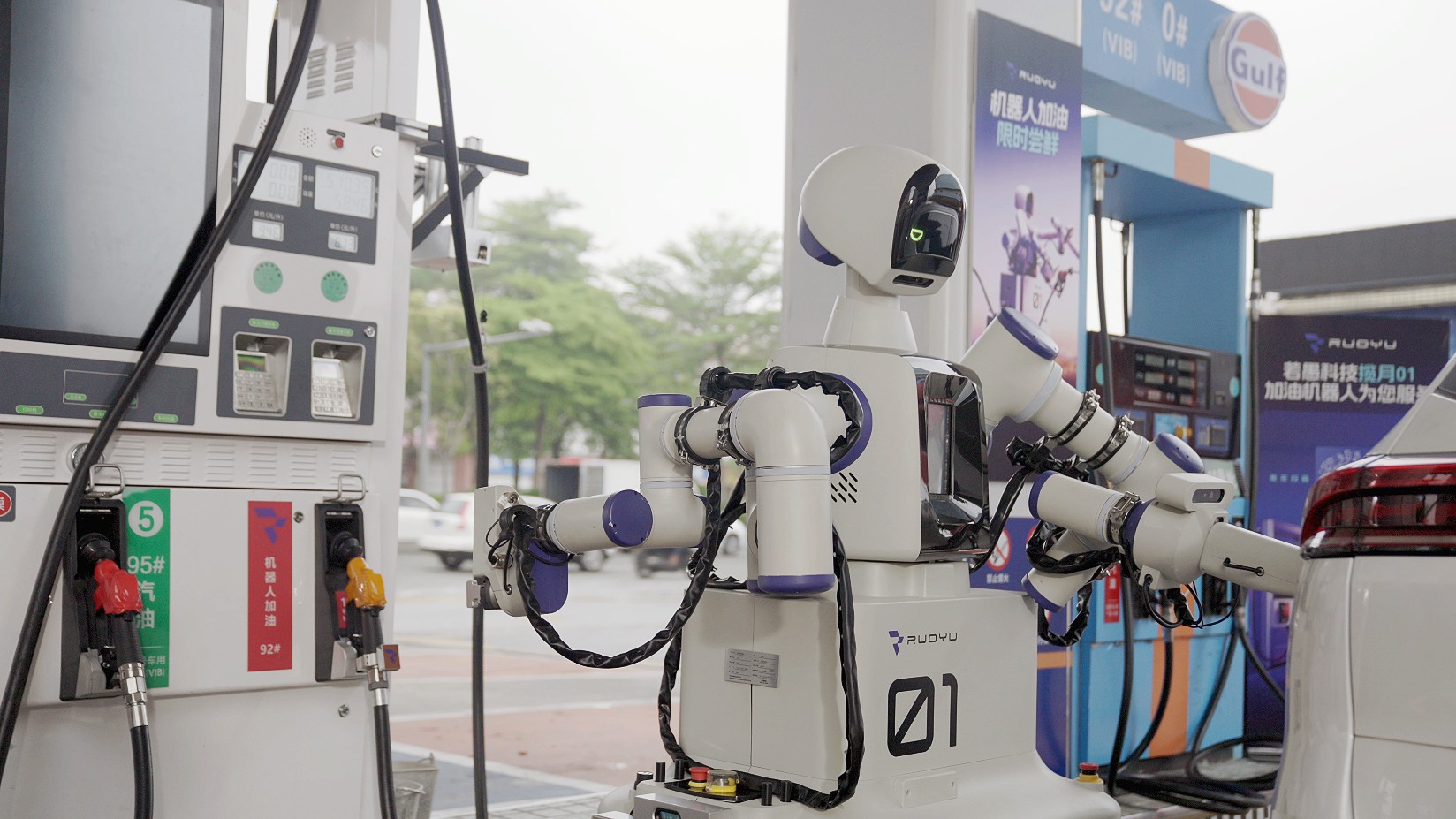
Sun Teng said that the completion of software algorithm R&D is only the initial work, and the remaining work in the actual implementation process is more and more trivial. But this exactly proves that the core value of Rooin Technology's products lies in the brain capabilities polished in high-value scenarios that can operate stably under extreme constraints.
Scenarios are the entry point, while the brain is the core subject.
The Foshan pilot refueling station further verified this logic. Rooin Technology disclosed some indicators to 36Kr: during the pilot operation, for fixed vehicle models, the refueling task in open environments has achieved a high success rate; manual takeover is only triggered in abnormal situations... The value of these figures does not lie in proving that "robots can refuel", but in proving that the robot brain can continuously and stably complete operations in real high-risk scenarios, and continuously generate valuable real data in the process. Sun Teng explained: "You will never know where your boundary is in the laboratory, but high-value scenarios require continuous polishing and testing deep in the scenarios."
This is exactly the key difference between Rooin Technology, a robot brain company, and other embodied intelligence companies. When a robot completes a task, it does not mean the end, but means that new data, new skills, and new recovery strategies are generated, which will then feed back to the next task or even the next scenario through model iteration. Sun Teng said: "The robot brain does not grow by completing more and more projects, but by turning every delivery into a capability asset for the next delivery." For Rooin Technology, commercialization itself is part of the R&D process.
Become the Infrastructure in the AI Era
Rooin Technology has repeatedly emphasized the trinity solution of "brain - ontology - scenario data", and defines the ontology as a collection tool for real-world data. This definition itself points to the core logic of it as a robot brain company: as mentioned above, the ontology is not the end of the product, but the carrier for the brain to enter real scenarios and continuously acquire high-quality data.
At the engineering level, this system has already achieved a practical operation rhythm. At the data level, under the premise of customer authorization and security compliance, Rooin Technology will desensitize the operation data and use it for model iteration. The robot will basically keep uploading data during its idle time to provide materials for subsequent labeling; the reduction of labeling cost is mainly achieved through a semi-automatic data collection pipeline combined with manual review, so as to meet the dual requirements of data quality and quantity. In this system, what determines the upper limit of the brain's capability is the thickness of on-site operation time, rather than the scale of stacked computing power.
The product structure also serves this closed loop. Rooin Jiutian robot brain is a relatively standard product, which together with the self-developed modular high-reliability operation hardware including Rooin Lanyue and Rooin Zhaixing, forms a landing solution for high-value scenarios. The differentiated demands of scenarios are converged to the end execution tools and upper-level business processes, and the scale of high-reliability operation hardware is strictly controlled: by splitting standardized units such as drive modules and electrical modules, the rapid stacking and combination of modules are supported. This means that the brain capabilities that Rooin Technology has precipitated first in the intelligent refueling scenario are designed to be transferable across different ontologies and different scenarios from the very beginning.
In fact, Rooin Technology defines itself as the infrastructure in the AI era. The essence of this positioning is: it will not bind itself to any single hardware, but enable intelligent capabilities to migrate freely across different computing platforms, different ontologies, and different real scenarios, and finally form a general intelligent layer that spans computing platforms, ontologies and scenarios. What supports this goal is not a single technological breakthrough, but the already running data closed loop of real scenarios.
The closing of this round of financing means that Rooin Technology's strategic path of cutting in from high-value scenarios has completed the verification period of the first half. What really determines its upper limit is the possibility of horizontal replication. Rooin Technology's judgment is that the feedback from the high-value scenario of intelligent refueling can exercise the basic capabilities of the robot brain, including a series of basic skills such as complex operation, environment perception, task planning and decision-making. These skills can be reused in more diversified scenarios such as charging, ports, and inspection operation. What supports this reuse is not a general algorithm framework, but the brain capabilities polished inch by inch in real high-risk scenarios, which contain physical details and failure experiences.
The final landing point of the positioning that "Rooin Technology is a brain company" is: what it is about to complete is not the robot delivery for a single scenario, but a robot brain base that can continuously operate under extreme constraints, continuously return data, and continuously iterate capabilities.
This base is exactly its starting point to become the infrastructure in the AI era.