At a total cost of less than 3,000 yuan, a geek has created a dirt-cheap bipedal robot, with old smartphones being the biggest contributor to this achievement.
Robots have become increasingly popular in the past two years, but the price of most robots is still not low enough for every ordinary person to own one. At present, even though "personal robot" players like Qiyuan have emerged in the market, a fully functional and structurally complete humanoid robot costs at least tens of thousands of yuan, not to mention those priced at hundreds of thousands of yuan.
Recently, the research team from the University of California, Los Angeles has proposed a special solution: a bipedal robot weighing 1.8 kg, with a material cost of only about 400 US dollars (equivalent to about 2677 yuan). It sounds quite amazing. How did they achieve this? The General Intelligence Team of Leikeji (ID: leitech) did some research and found that the concept behind this product is more interesting than the product itself.
The 400-dollar bipedal robot is surprisingly driven by a smartphone
Recently, a paper appeared on arXiv, introducing a robot named PhoneBot. The authors of the paper are from the RoMeLa Lab of the Department of Mechanical and Aerospace Engineering at UCLA.
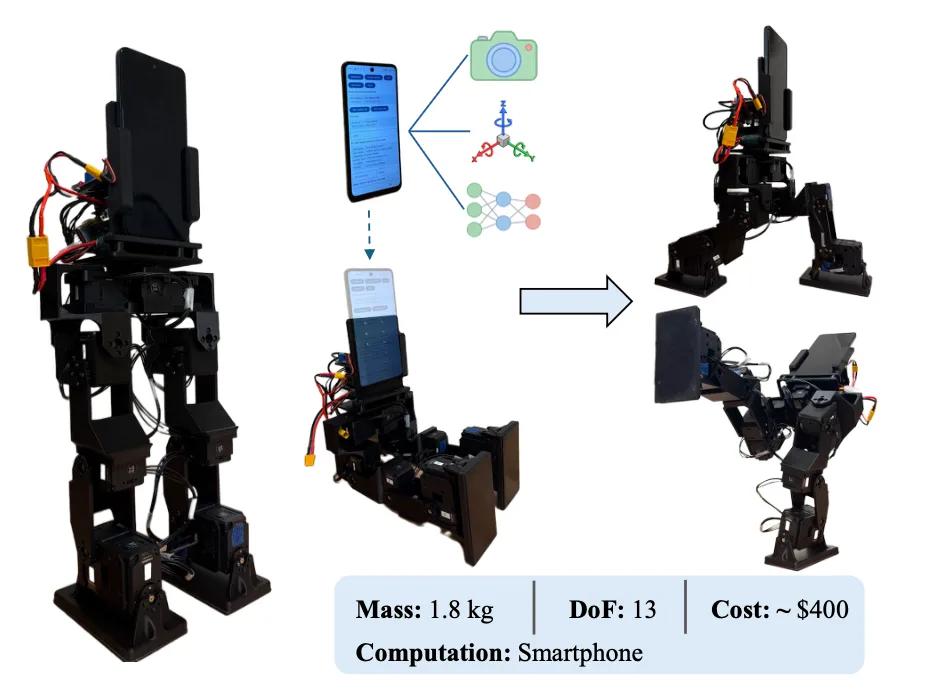
In terms of specific parameters, the complete PhoneBot is 483 mm high, weighs 1.8 kg, has 13 degrees of freedom, and each joint uses a steering gear with a unit price of 23.9 US dollars. Most importantly, it is driven by a smartphone. Specifically, the mobile phone is fixed on the torso of the robot, and acts as the robot's sensor suite, on-board computer and interactive interface at the same time.
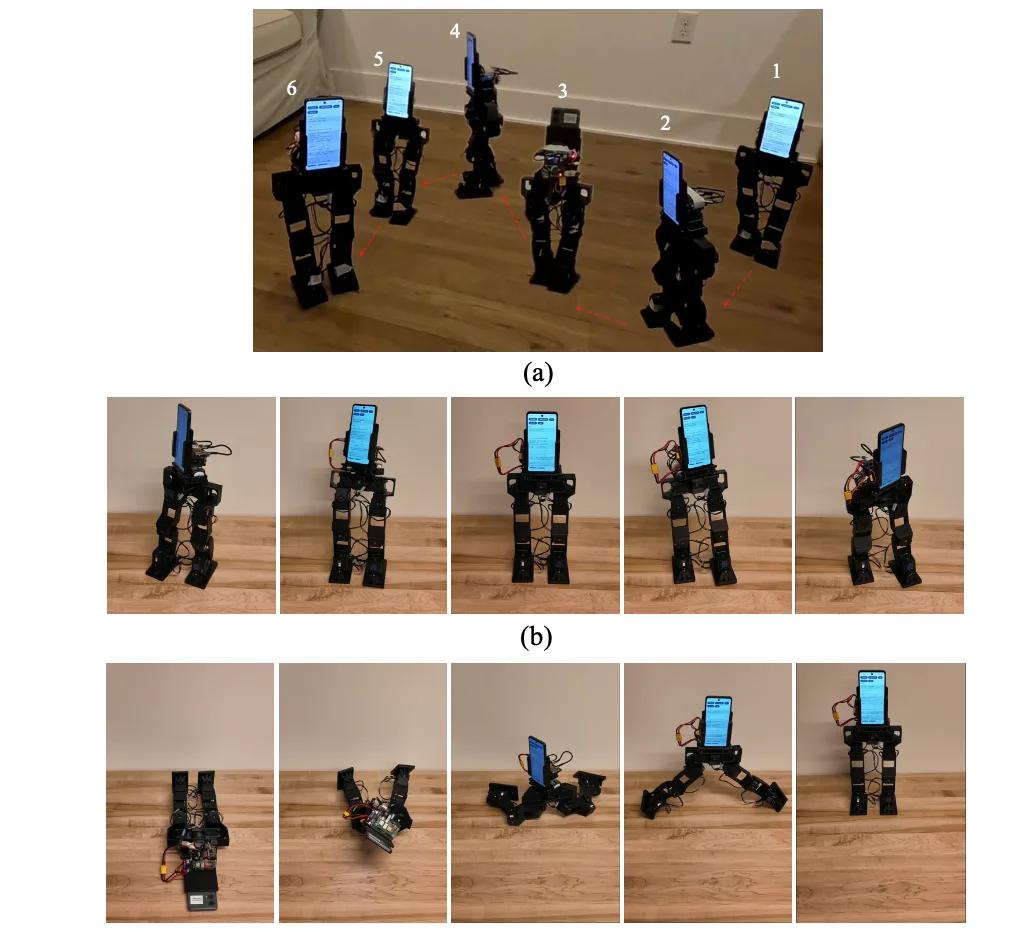
According to the introduction, the capabilities of this robot include walking, standing up, following people, shooting, conversational interaction and so on.
(Image source: PhoneBot)
Driving a robot with a smartphone sounds incredible, but PhoneBot has indeed achieved this. As the most popular consumer electronic device at present, smartphones have extremely high integration, with built-in cameras, SoCs, screens, WiFi, batteries and other components, all of which can be used by the robot and become part of its capabilities. Equipped with a smartphone, PhoneBot can use the camera for image perception, use the chip for calculation and reasoning, and obtain data and cloud computing power through the network.
Of course, the 400-dollar material cost mentioned at the beginning does not include the smartphone, but the old models used in PhoneBot tests, including moto G 2025, Samsung Galaxy A15, etc., basically have a second-hand price of no more than 100 US dollars.
Therefore, even if the hardware cost of the smartphone is included, the total material cost of PhoneBot is less than 500 US dollars, which is only more than 3,000 yuan when converted into RMB, and it is absolutely cost-effective.
In addition, the attempt to drive robots with smartphones started very early. As early as 2021, there was a project called OpenBot, which used an ordinary Android smartphone to support the following and navigation of a four-wheeled robot. PhoneBot followed this idea and advanced it to bipedal robots. In fact, its difficulty is much greater than that of quadruped robots: bipedal robots rely on real-time balance when standing and performing movements, which cannot be achieved simply by connecting a smartphone.
Let the smartphone take over the perception, computing power and interaction of the robot
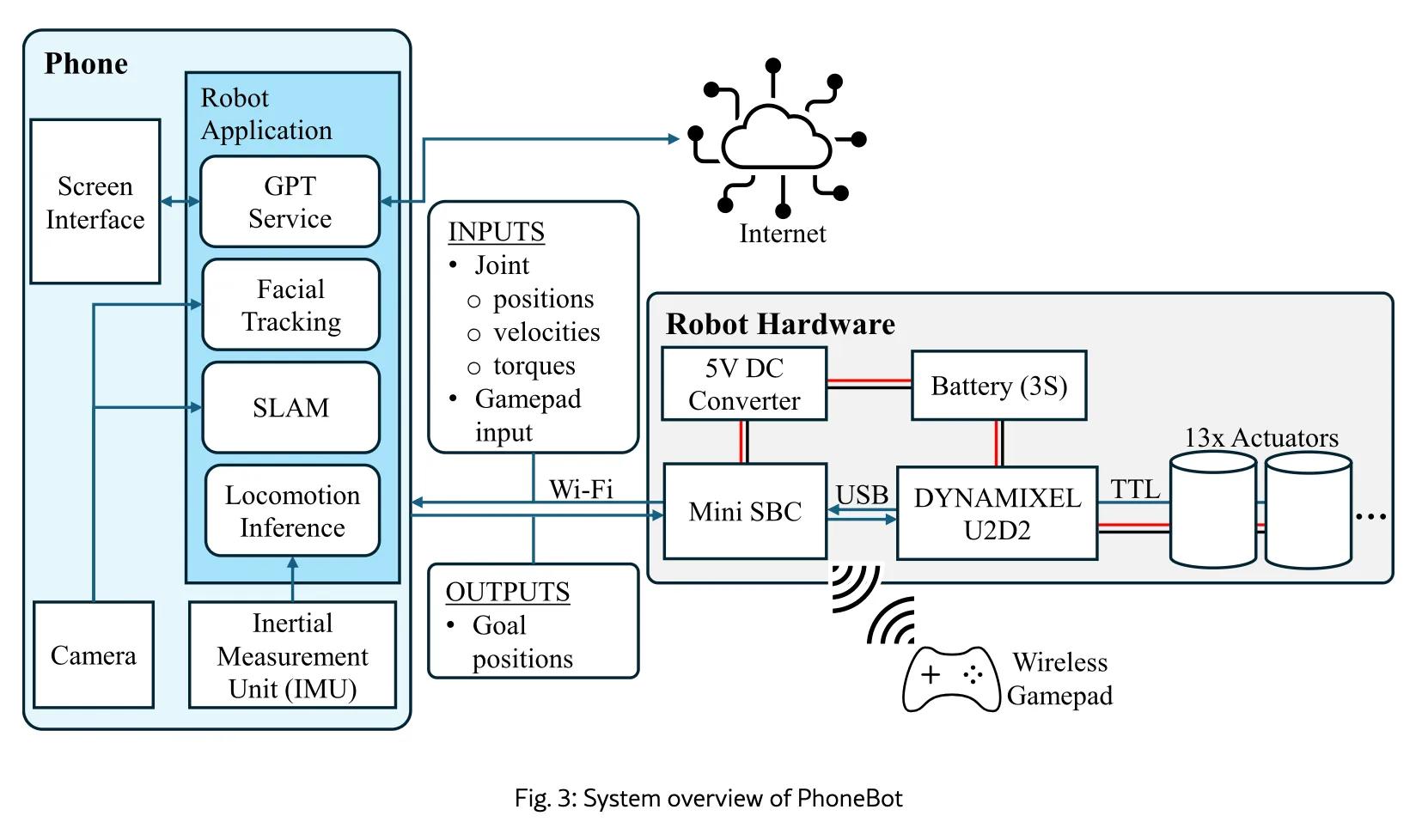
Simply put, the solution of PhoneBot is: install the smartphone on the torso, and it will act as the robot's eyes, ears and brain. The team divides its functions into three parts, one is responsible for movement, one for image recognition, and the other for speech interaction.
The movement part is the most critical. The Android application on the smartphone reads the data of the gyroscope and accelerometer in the phone, and at the same time reads the current angle of the 13 motors on the legs, and combines the instructions issued by the user to form a piece of information about the current state of the device.
A pre-trained small model is also installed in the smartphone. After getting the information, it immediately calculates the position where each leg should be placed, then sends the instruction through Wi-Fi, and a small conversion board transmits the instruction to the motor. The robot's actions of walking, getting up from the ground, and adjusting the orientation are all realized through this mode.
(Image source: PhoneBot)
The entire image recognition process is completed in the smartphone. The rear camera of the mobile phone is responsible for recognizing people and objects. Combined with the orientation instruction, the robot can follow people or turn its line of sight to the specified direction. Positioning is also handed over to it. The mobile phone calculates its position through the data of the camera and gyroscope, without the need for an additional positioning device. The screen is used to display status and images, and users can directly control the robot on the mobile phone.
The speech part is a bit more complicated. The smartphone is responsible for recording and playing audio, but the speech-to-text and large model reasoning that consume a lot of computing power still need to rely on a notebook computer placed next to it. The results are transmitted back to the smartphone and then played out.
As for how to learn to walk, the method of the PhoneBot team is to train on the computer first. They first calculate the real power of each motor on the robot, then let the robot repeatedly try and make mistakes in the simulation environment, fall down and restart until it walks steadily. During the training, the team also mirrored the movement of the robot's left leg to the right leg, so that the left and right legs are trained together. These trainings were repeated five times for comparison. With the mirroring design, the robot learns faster and walks more stably.
As mentioned earlier, PhoneBot uses old smartphones with average configurations, but when driving the robot, its hardware occupancy rate is not high. According to the data provided by the team, the CPU occupancy rate is between 8.5% and 13.4% when the mobile phone reads gyroscope data, 6.3% to 10.3% when calculating walking postures, 15.6% to 17.9% when recognizing people and objects, and the most hardware-resource-consuming positioning occupies 25% to 34.3%.
The test of this project shows that PhoneBot is not picky about smartphones. The robot makes full use of the camera, gyroscope, computing power and system ecosystem accumulated by smartphones over the years, and the specific brand and model are not that important. The low cost of PhoneBot is essentially to make full use of all the hardware resources of the smartphone, make use of whatever is available, and save as much as possible.
Of course, there is also a very critical point: this robot has no arms. As a robot, its core movement capabilities are only the two legs for walking and performing actions. Moreover, it is very small in size and does not perform complex tasks such as load bearing and climbing stairs. In the final analysis, it is just a test device in the laboratory.
Will old smartphones become a powerful tool for the popularization of robots?
Smartphones may be the consumer electronic products with the shortest iteration cycle. Hundreds of millions of mobile phones are eliminated every year around the world. These devices integrate cameras, screens, chips and various sensors, most of which are in good working condition and are only eliminated because they are not new enough. Very often, the final fate of these devices is to be disassembled to extract materials, which is largely a waste of massive hardware resources.
The emergence of PhoneBot gives second-hand mobile phones a new way out. These idle computing power and sensors can be used on such small robots. It also puts forward a new idea: the "brain" of the robot can be used as a consumable, and the main body is the long-term component. Smartphones are replaced every two or three years, and the replaced models can be just installed into the robot. In this way, the robot can also replace its brain like replacing a battery, becoming a modular device.
Of course, the shortcomings of this solution are also obvious. The smartphone itself is not designed for robots, so heat dissipation, power supply and other issues need to be reprocessed; the configuration differences of different models of smartphones will directly affect the operation effect of the robot. Moreover, the quality and stability of second-hand devices are not guaranteed. There is also a key point: smartphones cannot provide strong computing power after all. PhoneBot is driven by a smartphone, but it still needs to rely on an external PC to provide part of the computing power. What's more, PhoneBot itself is a small robot with no arms and a relatively simple structure.
But in any case, PhoneBot proves that the idea of driving a robot with a smartphone is feasible, thus providing a set of low-cost solutions for the industry to learn from. For the entire robot industry, the significance of PhoneBot may not lie in that it can immediately enter the market and become a consumer hit, but in that it breaks the hardware entry threshold of bipedal robots. For a long time, the high cost of bionic robot R&D has kept countless developers, university student teams and start-up companies that want to enter this industry out of the door.
(Image source: PhoneBot)
The architecture of "low-cost torso + second-hand smartphone as brain" adopted by PhoneBot actually plays the role of Raspberry Pi in the robot field, which is expected to give birth to a huge civilian developer ecosystem, allowing more people to have the opportunity to develop and train their own bipedal robots.
In addition, with the continuous upgrading of the computing power of end-side AI chips, the shortboard that PhoneBot currently still needs to rely on external PCs for complex speech processing can also be solved in the foreseeable future. Today's latest flagship mobile phone chips can already run end-side large models with billions of parameters smoothly, and can also complete complex semantic understanding and natural dialogue locally.
Just imagine, two or three years later, when smartphones equipped with contemporary flagship SoCs flow into the second-hand market on a large scale, the neural computing power and sensor accuracy they provide will far exceed the low-end old models used in PhoneBot tests today. At that time, only one smartphone will be enough to endow such small robots with stronger intelligent features.
From the perspective of business model, a product form similar to that of the PC industry may appear in the robot field, that is, "barebone robot". Hardware manufacturers are only responsible for selling standardized robot torsos, batteries and power components, driving down the price of underlying motion hardware; ordinary users only need to put their old smartphones into the robot torso to act as the brain, and then download a dedicated App to activate the device.
This not only meets the global demand for environmental protection recycling of e-waste, but also enables devices such as home companion robots and educational robots to be truly popularized.