The AI cemetery of Tencent, ByteDance and Alibaba is getting increasingly crowded.
The graveyard of AI products may be larger than you think. Recently, Tencent announced that two more of its AI products are about to cease operations.
On October 8, Tencent Yuanqi released a shutdown notice: starting from November 9, this no-code agent platform will fully stop services, and all agents built by users will become invalid. Many official account bloggers used it to turn their historical articles into knowledge bases and set up 7×24-hour automatic replies for their fans, and now they have to migrate their data as soon as possible.
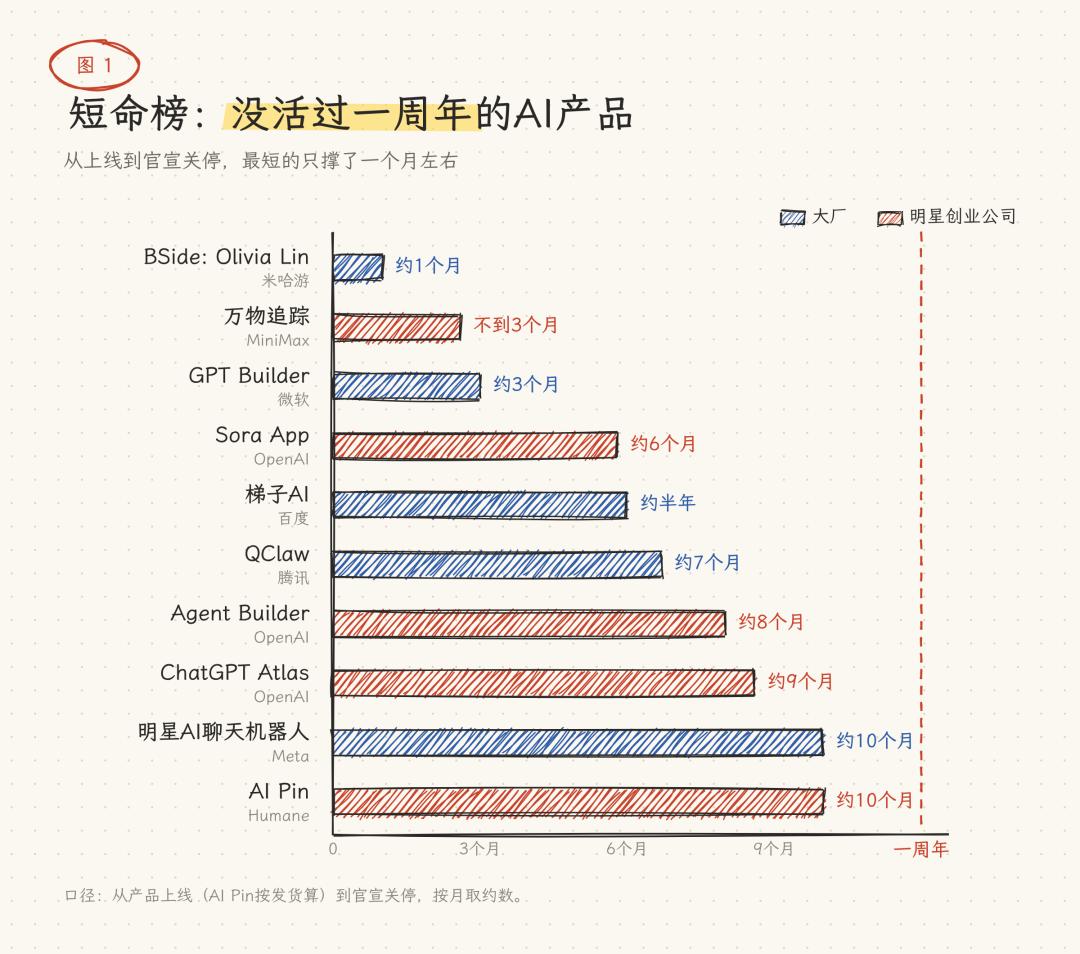
This is hardly breaking news. Two weeks ago, Tencent just announced that QClaw, which had lines of users waiting to experience it across the whole network, will be shut down on December 24; three months ago, both Doubao and Qwen announced the offline of user-built agents on the same day. Looking overseas, OpenAI has shut down Sora and the Atlas browser successively this year.
Looking back to the boom of ChatGPT in 2023, you will find a pattern: AI products go online fast, and they go offline not slowly either. According to statistics from AI Zhidian, at least 25 domestic AI applications were shut down, removed from shelves or stopped updating for a long time only in 2025; according to overseas AI Graveyard statistics, 392 AI tools stopped services worldwide in 2025, roughly one "passes away" every day.
In this article, I sorted out the AI products shut down and offline by major domestic and foreign manufacturers and star startups from 2023 to the present. The list is definitely not complete, but it is enough to clarify two things: how AI products die, and what kind of products can survive.
01 OpenAI: Even its own star products are cut
OpenAI is the most "daring to cut" company on this list. In three years, it has cut products all the way from small tools to star products.
AI text detector (AI Classifier) was the first. It was launched in January 2023 to judge whether a piece of text was written by AI. As a result, the official test showed that it could only correctly identify 26% of AI-generated text, and misjudged 9% of human-written text as AI-generated. On July 20, 2023, OpenAI quietly took it offline on the grounds of too low accuracy. The fact that the company that builds AI can't recognize words written by AI is symbolic in itself.
ChatGPT Plugins is the second. When it was launched with high-profile in March 2023, many people called it "the App Store moment of ChatGPT". However, it was replaced by GPTs in less than a year and officially deactivated in the spring of 2024.
The exit of GPT-4o was more dramatic. When GPT-5 was released in August 2025, OpenAI once removed 4o, and had to restore it for paid users after being criticized by users. On February 13, 2026, GPT-4o, together with models such as GPT-4.1 and o4-mini, officially retired from ChatGPT. The official reason was that only 0.1% of users actively chose it every day. But among this 0.1%, many people have established deep emotional connections with 4o, and there was also a strong rebound among domestic ChatGPT users.
Sora is the largest "grave" this year. At the end of September 2025, Sora 2 was launched with a vertical-screen App similar to Douyin, and once topped the US App Store. But the freshness faded quickly. In December last year, new downloads dropped by 32% month-on-month, and continued to decline afterwards. On March 24, 2026, OpenAI announced the shutdown: the App and web page were offline on April 26, and the API was completely closed on September 24. The $1 billion cooperation with Disney also fell through accordingly.
ChatGPT Atlas browser followed closely. It was launched on October 21, 2025, announced to be offline on July 9, 2026, and stopped working on August 9, with a lifespan of less than 10 months. Its capabilities were split into the new ChatGPT desktop client and Chrome plugin.
There are two more products already on the schedule. Agent Builder, a visual agent building tool released at DevDay in October 2025, was announced to be offline on June 3, 2026, and will be removed together with the Evals platform on November 30, which took less than 8 months in total. What's more interesting is custom GPTs: it saw off plugins in 2024, and it will retire on December 11, 2026, which will be replaced by the new version of plugins. In two years, the positions of plugins and GPTs have just been swapped.
Putting these incidents together, OpenAI's logic is very clear: it needs to tell a good business story before IPO, and the computing power should be reserved for the most profitable programming, agent and enterprise businesses. According to reports, Fidji Simo, head of application business, reminded employees as early as March this year not to be distracted by "side quests". Sora and Atlas are the side quests that were cut off.
02 Google, Microsoft, Meta: Not dead, but "incorporated"
Many AI products shut down by overseas giants have not really disappeared, but have been integrated into a larger entry.
Google has the most typical route. In February 2024, Bard was renamed Gemini, and the Bard brand exited. Starting from September 4, 2026, Google Assistant on mobile phones, watches, headphones and Android Auto began to be fully replaced by Gemini, and it was impossible to switch back after the update. On May 4 this year, Project Mariner, a browser agent experiment project, was shut down, and its capabilities were integrated into Gemini Agent and AI Mode; in June, the core image generation function of Pixel Studio was also shut down, and users were guided to use Gemini and Nano Banana. Firebase Studio, an AI development environment launched in April 2025, has also announced that it will be shut down on March 22, 2027, and users will be diverted to Google AI Studio and Antigravity.
On the side of Microsoft, it announced in June 2023 to shut down the independent Cortana application on Windows, which was taken over by Copilot at the end of the year. The more embarrassing one is GPT Builder in Copilot Pro: it was only launched in March 2024, announced to be offline in June, and deleted the GPTs built by users together with the data in mid-July, which only lived for three months. Microsoft's statement is that GPT will focus on enterprise scenarios, and will no longer do consumer end products.
Meta paid tuition twice. In September 2023, Meta invited stars such as Snoop Dogg, Tom Brady and Kendall Jenner to make more than 20 chatbots of "star avatars". It is reported that the licensing fee paid to individual stars reached millions of dollars. As a result, the followers of these robots were only a fraction of the stars' own followers, and they were offline in July 2024 in less than a year, shifting to AI Studio that allows users to create their own characters. In early 2025, a number of AI virtual human accounts operated by Meta were complained by netizens as "weird" and were soon deleted.
03 Overseas startups: Hardware, shell-wrapped products, companionship, all three paths have people falling
Humane AI Pin is the most famous "dud" in AI hardware. Founded by former Apple designers, this company raised $230 million and sold AI Pin as a "mobile phone substitute". After it was shipped in April 2024, it was flooded with bad reviews, and once reminded users not to use the charging case due to the risk of battery fire. In February 2025, HP bought the team, patents and operating system for $116 million, and the AI Pin itself was abandoned: the server was closed on February 28, all user data was deleted, and the device directly became electronic waste.
Phind is a specimen of the "shell-wrapped" dilemma. This AI search engine for programmers raised about $10 million in December 2025, and announced its shutdown on January 16, 2026, giving users only two weeks to export data. The reason is not complicated: OpenAI, Anthropic and Google have all integrated web search and code capabilities into their own products, and the moat of independent developer search no longer exists.
There are two similar products. Tome used to be one of the most popular AI PPT tools with a total of about 25 million users, but its annual revenue at the end of 2024 was only about $3 million. On April 30, 2025, Tome Slides stopped services, and the team of only 6 people switched to make Lightfield, an AI-native CRM product. No matter how large the user base is, it does not equal a viable business. Yupp.ai is a model evaluation platform led by a16z crypto with $33 million in financing. It has accumulated 1.3 million users and was shut down in March 2026. The founder's reflection is very frank: users have switched to agents that can adjust tools and have memory, and chat-based crowdsourced evaluation is less and less needed.
Three more products can be added to the list. Artifact, an AI news App made by the two founders of Instagram, announced its shutdown in January 2024 one year after its launch, on the grounds that the market is not large enough. Supermaven, a code completion tool acquired by Cursor for one year, announced in November 2025 to stop independent development, and its capabilities were integrated into Cursor Tab. Notion Mail, which focuses on AI-classified inboxes, was shut down on September 22, 2026. Foreign media interpreted it as: users would rather let the Agent handle emails for them than open one more inbox.
There is also a negative example, Builder.ai. It claimed to use AI to automatically develop Apps, and went bankrupt and liquidated in 2025 after being exposed to serious revenue overstatement, becoming one of the biggest scandals in this round of AI entrepreneurship.
The benchmark of the AI companionship track, Character.AI did not close down, but cut off a core business. Under the pressure of multiple youth-related lawsuits and investigations by relevant authorities, users under 18 years old can no longer have open-ended chats with AI characters starting from November 25, 2025.
04 Domestic giants: From "cannot be absent" to "centralize the entry"
The AI products shut down by domestic giants in the past three years are roughly divided into three categories: old products from the last AI era that were hit by dimensionality reduction of large models; trial products hastily launched under the mentality of "cannot be absent" in 2023; and agent platforms that were forced to shrink under compliance pressure in 2026.
Tencent is the company with the most intensive shutdown actions this year. On March 13, 2025, Tencent Translation Jun, which has been online for nearly ten years, was fully offline, and the translation service was migrated to Yuanbao; Tencent Zhiying, launched in March 2023 and focusing on digital humans, was transformed and cleared of user data on June 30, 2025. This year is even busier: QClaw, which was launched in March and focused on "using mobile phone to remotely control computer to work", once had users queuing up across the network, and announced on September 24 that it will be shut down on December 24, and data can be migrated to WorkBuddy; on October 8, Tencent Yuanqi, a no-code agent platform launched in May 2024, took its turn to stop service on November 9, and the official suggested users to move to Tencent Cloud agent development platform.
Behind this is the old problem of internal horse racing among giants. Tencent has laid out several entries including Yuanbao, WorkBuddy, QClaw and Yuanqi at the same time in AI. The problems solved by the products are getting closer and closer, and users don't know which one to use, and the teams are also competing for R&D resources and traffic. It is a good thing for several teams to try and make mistakes in the early stage, and someone has to make way after the core product comes out.
On the side of ByteDance, Volcano Writing, launched in 2023, first stopped core functions such as AI writing and full-text polishing on September 13, 2024, and the site was closed and redirected to Doubao on December 31. Historical articles were not migrated on the grounds of data security and compliance. Xiao Wukong, renamed from "Wukong Search", once integrated more than 200 AI tools with nearly 2 million downloads, stopped updating after October 2024, and was gradually removed from major app markets in 2025. On July 15 this year, Doubao took offline the agent function, and users who wanted to continue to experience the role playing were guided to the separate Maoxiang App.
Alibaba saw off a star from the "pre-large model era": Luban, born in 2015 and known as the "art terminator", fully stopped services on June 30, 2025. The intelligent recording tool Tongyi Tingwu no longer exists as an independent App, and has been integrated into the Qwen App. On July 10 this year, Qwen also took offline the anthropomorphic interactive agents and user-built agents.
Baidu shut down the AI search App Tizi AI on March 4 this year, and the service was migrated to the Wenxin App. From the renaming and launch to being incorporated into the parent product, Tizi AI only took about half a year.
Several other companies are not idle. Xiaohongshu's 2023 Chinese-style AI drawing application Trik AI was offline after being sued by illustrators for infringement, and its successor Qiyu AI was also shut down on June 30, 2025. Meituan's first AI chat App Wow shut down its server on December 18, 2025. Iflytek's Iflytek Writing was shut down on November 30, 2025, with a total of less than 130,000 downloads across all platforms.
On the AI companionship track, two more giant products fell this year. Miaoshi, the AI emotional companionship App of NetEase Cloud Music launched in December 2022 and focusing on "AI lover", was shut down on July 14, 2026. BSide: Olivia Lin, miHoYo's AI desktop companionship product, only launched early access on July 13, but closed its online service and was removed from Steam on August 31, leaving only the offline version, which took only one and a half months.
There is also a notable node: according to reports, platforms such as Doubao, Qwen and Yuanbao collectively offline user-built agents in July this year, involving more than 8 million AI characters. The direct inducement is the Interim Measures for the Administration of Artificial Intelligence Anthropomorphic Interactive Services, which came into effect on July 15. Two years ago, giants were still pushing the "agent square" desperately, and two years later they took the initiative to close the door.
05 Star startups: Cut side lines first, then protect the main line
The product choices of large model unicorns in recent years have surprisingly consistent ideas: they made extensive attempts on the C-end, and finally all converged to one main line.
Moonshot AI quietly tested two products overseas in the first half of 2024: Ohai, an AI role chat application, and Noisee, a music video generator. In September of the same year, the company decided to stop the content and updates of these two products. The official statement was that "they were just experiments and never officially launched", and focused all efforts on Kimi. In hindsight, this decision was not wrong. After the release of Kimi K3 in July this year, user requests once approached the computing power limit, and Kimi even suspended new user subscriptions on the C-end.
Stepfun's AI companionship application Bubble Duck was launched in April