Pioneering the exploration of future terminals for intelligent agents, STEPX Neo opens up a new form of human-machine symbiosis.
Personal Agent is becoming the new main line of the AI industry.
In overseas markets, Google launched Gemini Spark that can work continuously in the background, Meta released Muse, a personal agent for ordinary users, and OpenAI also entered the competition with its resident agent Dots.
Capital has also begun to heavily bet on this track: personal AI assistant company Town completed a $55 million Series A financing, Hark, which focuses on the general personal AI entry, obtained $700 million in financing, and AI assistant Instinct was also exposed to raise $250 million at a valuation of $2.5 billion.
The simultaneous emergence of intensive entry of large manufacturers and high-value financing means that the industry is no longer just competing for chat tools, but for the next-generation personal entry that can understand users in the long term, connect personal data and complete tasks on behalf of users.
The domestic market is also seeing intensive moves. On October 13, Step Terminal officially released its first large model native agent phone STEPX Neo.
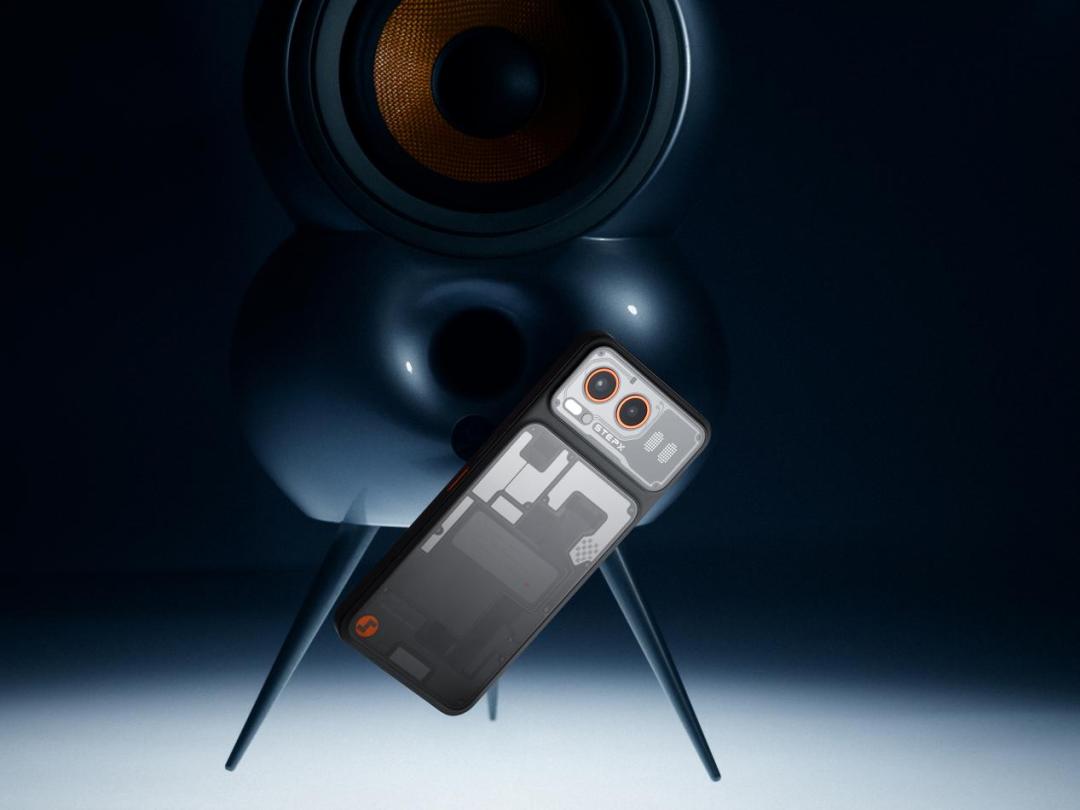
This is not only Step Terminal's response to the "100-day appointment" on July 13, but also a long-prepared product answer under the boom of personal agents. At the same time, the second-generation Doubao phone and AI phones from manufacturers such as Huawei, Xiaomi, OPPO and Vivo are also making concentrated appearances. As a company that started with large models, Step Terminal's understanding of agent phones and its way of building terminals from scratch are worthy of separate discussion.
A careful observation shows that the starting point of most AI phones on the market is still an existing phone. The chips, systems and interactions are already finalized, and AI is added item by item in the form of functions such as search, image editing, Q&A or cross-application operation, and related capabilities are also scattered in different entrances. The reality is that the concept of AI phones has been popular for several years, but ordinary users' perception of it is still limited.
STEPX Neo chooses to start from the Agent and define the terminal in reverse — the agent needs what kind of perception, memory, permissions and models, and the software and hardware are redesigned around these requirements, eventually forming a closed loop of "software-hardware-model" covering models, systems and terminals.
To understand it with a simple metaphor: most AI phones are installing smart furniture in an old house, while Step Terminal tries to rebuild a new house according to the lifestyle of agents.
So, on STEPX Neo, how does the "native school" Step Terminal make a mobile phone?
01
In the agent era, the right to define the personal terminal entrance is being reopened
It is no accident that Step Terminal cuts into the terminal from the large model. When agents gradually change the way of human-computer collaboration, it naturally brings new opportunities for personal terminals.
In the past two years, Coding Agent took the lead in achieving commercialization, and the reason is not complicated — the code world has rare certainty: the rules are relatively clear, the goals can be clearly described, and the execution results are easy to verify. This also promotes AI to further move from providing answers and suggestions to understanding goals, planning steps and completing tasks.
However, the difficulty increases sharply when moving from Coding Agent to the deep water area of Personal Agent.
Personal Agent does not serve structured code, but the continuous, fuzzy and highly personalized daily lives of billions of consumers. Moreover, it is impossible for users to actively tell the agent their location, work and rest schedule, preferences and status every day.
This means that Personal Agent can not only call tools after receiving instructions, but also gradually understand a person in long-term use, and judge what the user may need in a specific scenario. From "helping the user complete a task" to "understanding what the user needs at the moment", there is a whole chain of scenario perception, long-term memory, intention judgment, task planning and service execution.
This chain is also reshaping the role of personal terminals.
In the past, mobile phones were mainly containers for applications and content, and users needed to actively open apps, find functions and complete operations; in the agent era, terminals also need to understand human intentions, schedule different services and deliver results. This means that the interaction entrance may gradually shift from individual Apps to Agents that can understand the full needs of users.
As a result, mobile phones have once again become the key carrier of Personal Agent competition. In contrast, cloud-based Agents are good at processing web pages, documents and online services, but it is difficult to continuously perceive the real environment a person is in. Mobile phones are carried around for a long time, connected to schedules, locations, communications, images and life services, and are the computing devices closest to individuals with the most complete information dimensions.
However, the problem is that the existing mobile phone systems are mainly built around Apps and users' active operations. When the interaction subject shifts from Apps to Agents, the system also needs to undertake tasks such as long-term memory, model scheduling, tool calling, permission control and cross-service execution. Simply adding an AI assistant to the original system may not be enough to support this change.
Step Terminal's entry into AI hardware is precisely because it has seen various pain points in the industry — mobile phones have rich real scenarios, but few of them really build underlying capabilities around Agents; models have intelligence, but lack the entrance to continuously perceive the real world and reach users for a long time.
STEPX Neo tries to bridge the gap between the two, and also wants to make the hardware outline of the agent era more specific.
02
Building a large model native agent phone, Step Terminal takes an unusual path
At present, the exploration of AI terminals is still scattered and lacks unified standards. Traditional mobile phone manufacturers add AI search, image and cross-application execution capabilities to operating systems; Internet companies extend to terminals relying on cloud models and service ecosystems; hardware players such as glasses and headphones cut in from vision, voice and portable interaction.
If we observe according to the way AI enters the terminal instead of the identity of the player, these explorations can be roughly divided into two routes:
The first is the integrated route. It starts from the existing mobile phones, operating systems, Apps or hardware forms, and integrates large models and Agent capabilities into the original product system.
Such players can use the mature user scale, system capabilities and service ecosystem to launch products faster. But AI needs to adapt to the existing architecture, and related capabilities are easily scattered in different applications and entrances, eventually staying at the level of function superposition or partial transformation.
The second is the native route. It does not determine the terminal form first, but first defines what kind of perception, memory, reasoning and execution capabilities Personal Agent needs, and then designs the model, system and hardware in reverse.
Step Terminal has chosen this more demanding path.
Personal agents are not faced with one-time Q&A. They need to continuously perceive the environment, form and call long-term memory, schedule different models according to the complexity of tasks, and manage tools, permissions and execution processes at the same time. It is difficult to form a complete experience by upgrading any single link alone.
This is also why Step Terminal emphasizes the integration of "software, hardware and model": the model is responsible for understanding and decision-making, the software is responsible for organization and scheduling, and the hardware is responsible for perception and carrying. The hardware obtains scene information, the system connects the information with personal memory, tools and permissions, the model identifies intentions and plans tasks, and the system then calls end-side capabilities or external services to complete the execution.
Specifically, at the model layer, STEPX Neo has built a model matrix composed of Pro, Flash and Edge — complex tasks are handed over to the cloud Pro model, the Flash model balances effect and response speed, and the end-side Edge model handles instant response and privacy-sensitive tasks. The system completes scheduling through end-cloud collaborative routing, tasks that can be completed locally are prioritized on the end side, and tasks that require deep reasoning are handed over to the cloud.
If the model determines whether it can understand and judge, what Step AOS solves is how these capabilities can be organized.
Traditional AI assistants usually exist in the form of Apps or system functions, providing help around current conversations and single tasks. Once the interaction ends, the task context is easily interrupted. Personal agents need to cross different applications and real scenarios, and continuously manage memory, tools, permissions and tasks.
Step AOS attempts to elevate Agent from an isolated application to a system-level capability, allowing the model to call terminal functions and external services within clear permission boundaries. As a result, AI is no longer just a tool waiting for users to open, but begins to become an organizer of different tasks.
This system-level capability is first reflected in the "dual entrance" design of Step AOS. When you open STEPX Neo, you can find a rare design of two entrances — one side is the familiar mobile phone desktop for users, and the other side is the exclusive system-level space for Step Amoo. When the traditional App world and the agent entrance exist at the same time, the process of users using the mobile phone also becomes the process of Step Amoo gradually understanding the users.
In addition, Step AOS also decomposes a number of terminal capabilities into atomic capabilities that can be orchestrated by Agents, and is compatible with multiple connection protocols such as A2A, MCP, Skill, API and CLI. This allows Step Amoo to not only call the functions of the mobile phone itself, but also connect external applications and professional agents, and match corresponding services according to user intentions.
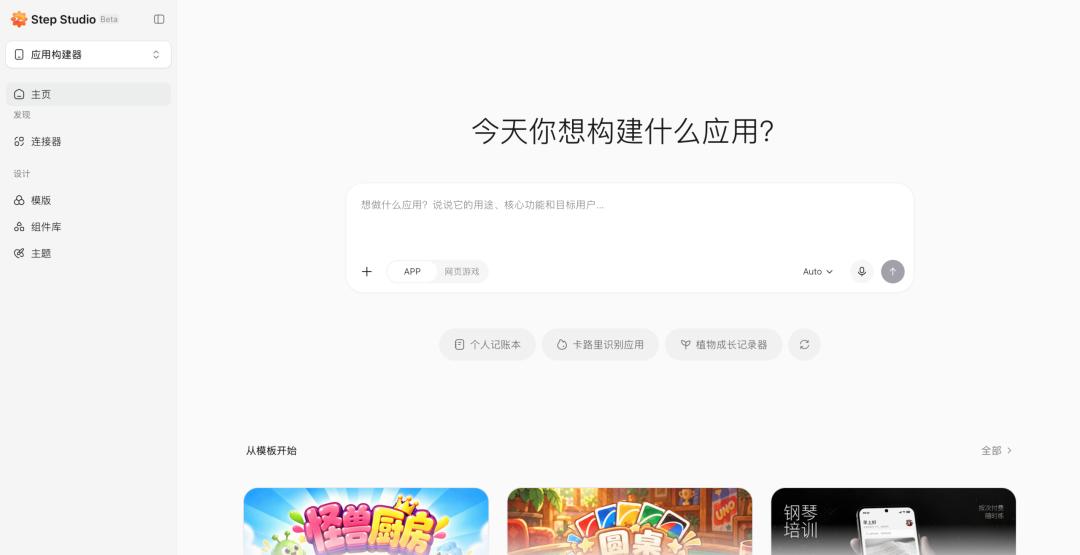
Not only that, Step Terminal has also launched Step Studio, a native development tool for AI terminals, through which users can create AI applications, games or new Agents in natural language. Behind this concept is that mobile phones are no longer just running pre-designed applications, but also allow users to combine and create capabilities according to their own needs.
According to the introduction, long-term memory is also another key design behind STEPX Neo.
Step Terminal has designed a memory system of "dual domains, six layers, memorize, organize and recall". The "user domain" precipitates factual memory, episodic memory and user portraits, and the "agent domain" accumulates vertical knowledge, cognition and personality, as well as methods and experience for executing tasks. After the information is recorded, it will be sorted, deduplicated, integrated and updated, and finally called in appropriate scenarios.
The key to this memory system is not to let the Agent remember more, but to let it recall truly useful information at the right time. Otherwise, no amount of personal data will naturally be transformed into understanding, but will increase the risk of misjudgment and information abuse.
After actually getting STEPX Neo, what impresses me most is not an isolated AI function, but that the mobile phone agent starts to try to take over a complete task chain.
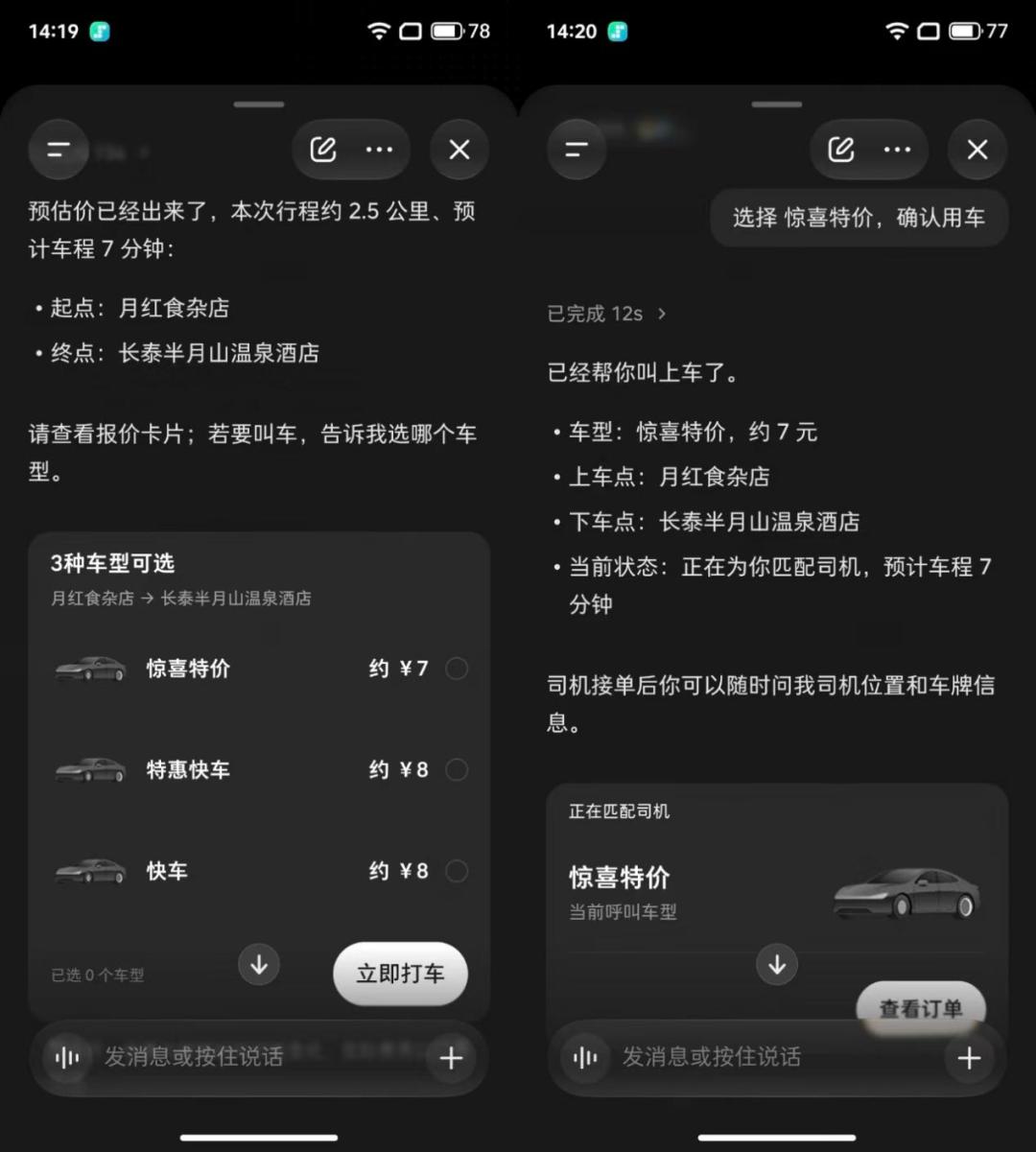
For example, taking a taxi. In the past, users needed to open the App, confirm the location, enter the destination, select the car model, and then wait for the vehicle to take the order; on STEPX Neo, users are more likely to directly express "where I want to go", and the remaining information confirmation and service call are completed by the Agent.
Another scenario that impresses me deeply is that STEPX Neo can access the Skill of WeChat Read. It is not that the terminal Agent re-makes a reading application, but transforms the existing content and service capabilities of WeChat Read into Skills that the Agent can understand and call. After access, my mobile phone can tell me what my reading taste is based on my bookshelf, and based on my knowledge framework, it suggests what books I should supplement to read.
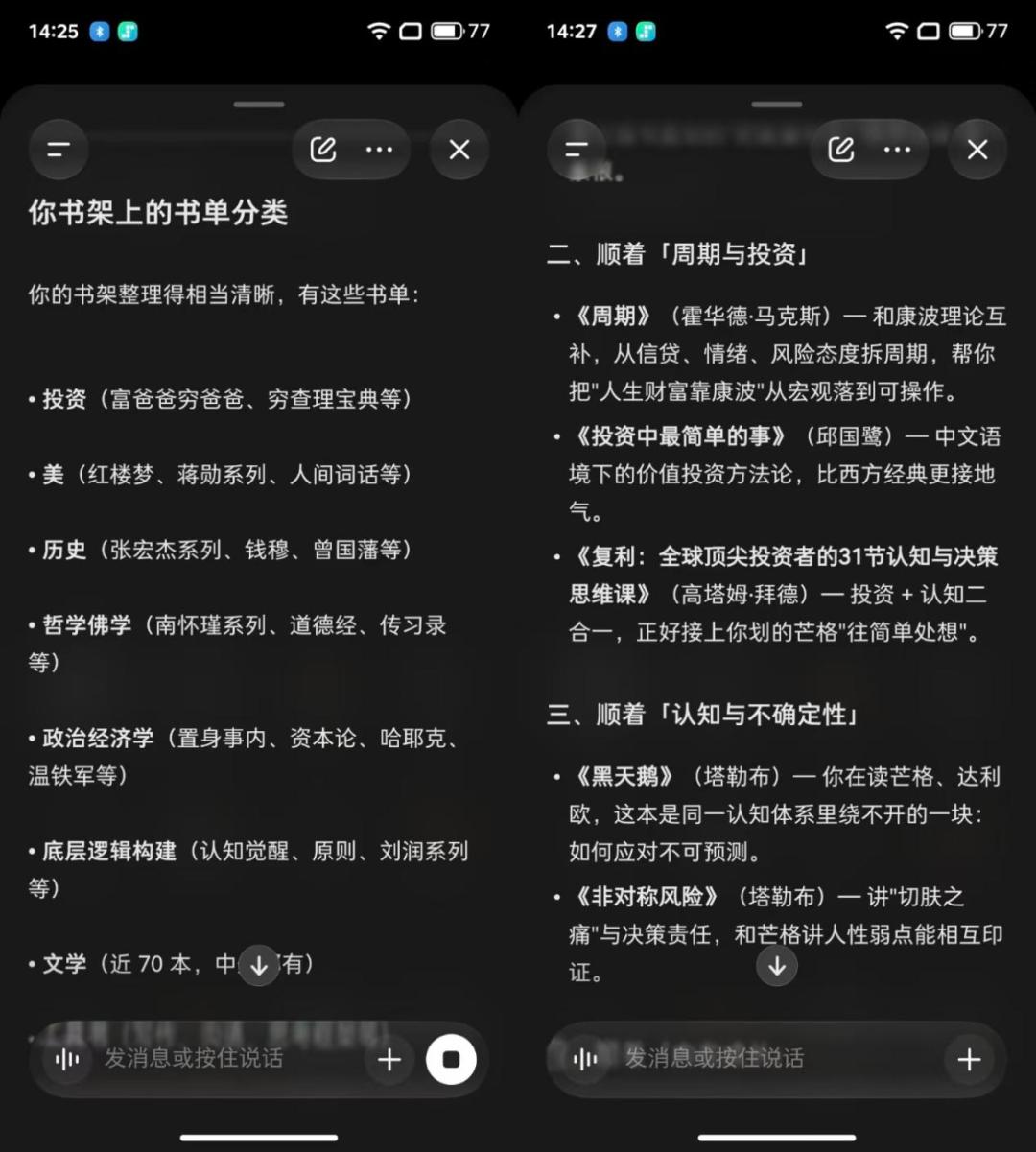
These two scenarios also make it easier for users to understand what Step Terminal calls "native". It is not simply putting a chat assistant into a mobile phone, but trying to make Agent a new layer that organizes system capabilities and external services.
At the press conference, Step Terminal said that in the agent era, AI is no longer the added value of smartphones, but the product value itself. Based on this judgment, the STEPX Neo first edition adopts the full-stack pricing model of "software-hardware-model", integrates and lists the Step series models, Step AOS system, Step Studio tools and STEPX Neo mobile phone hardware, enabling the agent terminal to enter the rapid iteration evolution mode.
In the future, whether this chain from understanding users to calling services and finally completing tasks can run stably is the real watershed between the native route and the function integration route.
03
The difficulty of making agent phones lies beyond the mobile phone itself
Even if the integration of models, software and hardware is solved, agent phones still face two thresholds outside the mobile phone: internally, how to gain user trust; externally, how to build a service ecosystem.
When the Agent starts to read personal memory, judge implicit needs, and call services or even complete transactions on behalf of users, whether users are willing to authorize is more important than whether the AI functions are rich. In the past, if a chat answer was wrong, users could ask again; if a real task was executed incorrectly, it may directly lead to order, payment or privacy risks.
To solve this problem, Step Terminal proposes a security framework of "trustworthy, visible, controllable and reversible". The identity and authorization of the Agent need to be verifiable, the execution process should be queryable and traceable, the task scope, quota and time limit need to have clear boundaries, and revocable operations should support rollback.
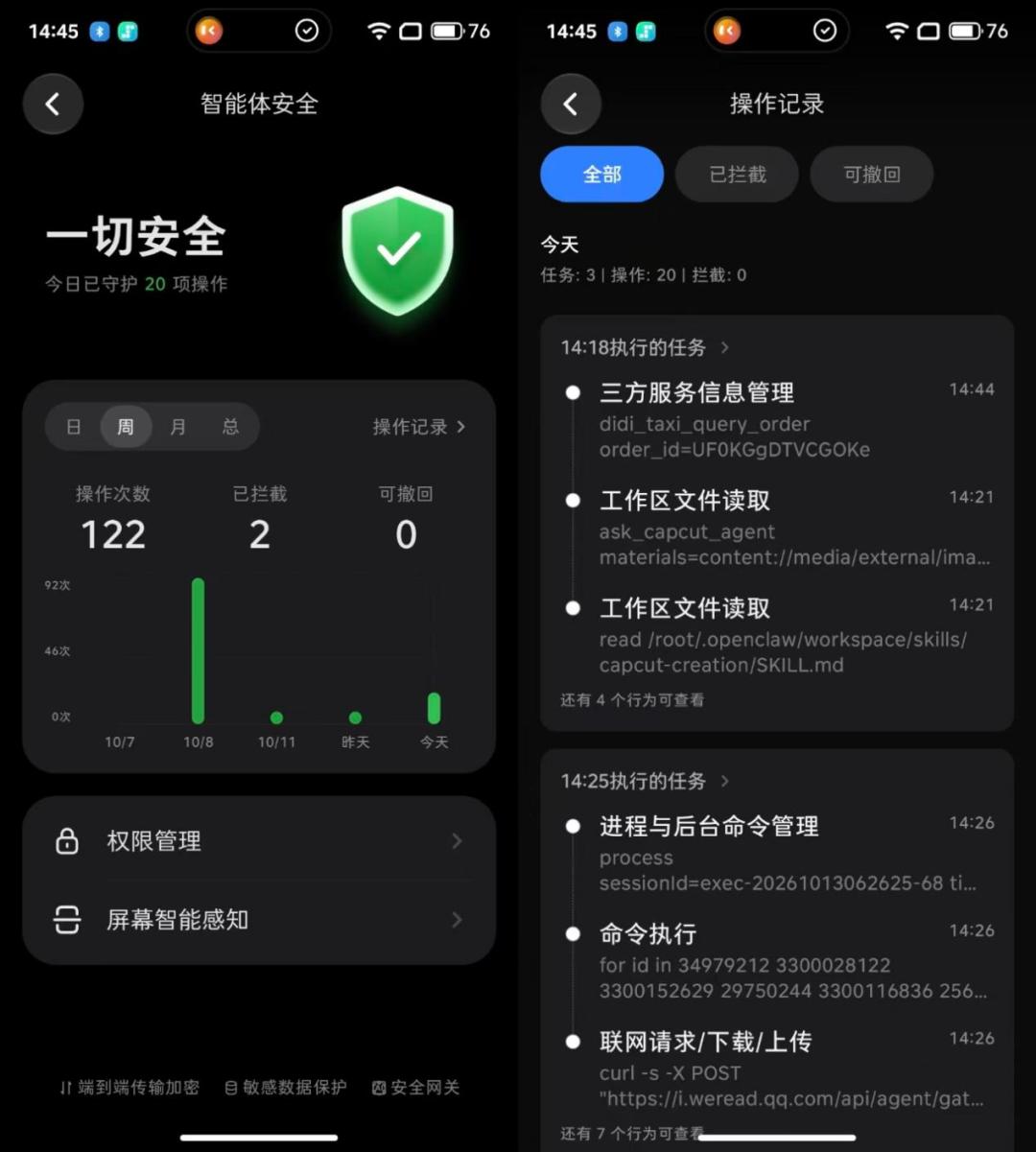
The security framework answers whether users dare to hand over tasks, while ecological cooperation solves how many services the Agent can call after getting the tasks.
In the past, one of the biggest controversies about AI mobile phones from the outside world was the ecosystem. Once the agent reads information across applications, calls services or completes transactions, it will touch the account system, data boundary, risk control rules and traffic entrance of the platform.
The industry previously tried to complete cross-application operations through screen recognition and simulated clicks. This route can cover more Apps in the short term, but once the page is revised, the execution chain may fail. In the face of high-risk links such as payment, transfer and private data, it is also difficult for the platform to judge whether the operation comes from the user himself or an external agent.
Therefore, the ecological problem of AI mobile phones cannot be solved by adapting a few more applications. Different participants need to re-agree on the identity, authorization method, data scope and responsibility boundary of the agent.
The solution given by Step Terminal is "H (Human) to A (Personal Agent) to A (Service Agent)": the system-level Personal Agent understands the user's intention, and then hands over the task to the service Agent with professional capabilities. STEPX Neo is responsible for perception, memory, intention recognition and task orchestration, partners open corresponding services through interfaces, and key links such as payment, travel and content creation are still completed by their respective platforms.