Latest Silicon Valley Insider: Three Major Giants Are Collectively Sprinting for RSI
Recently, the global AI community has gone completely wild.
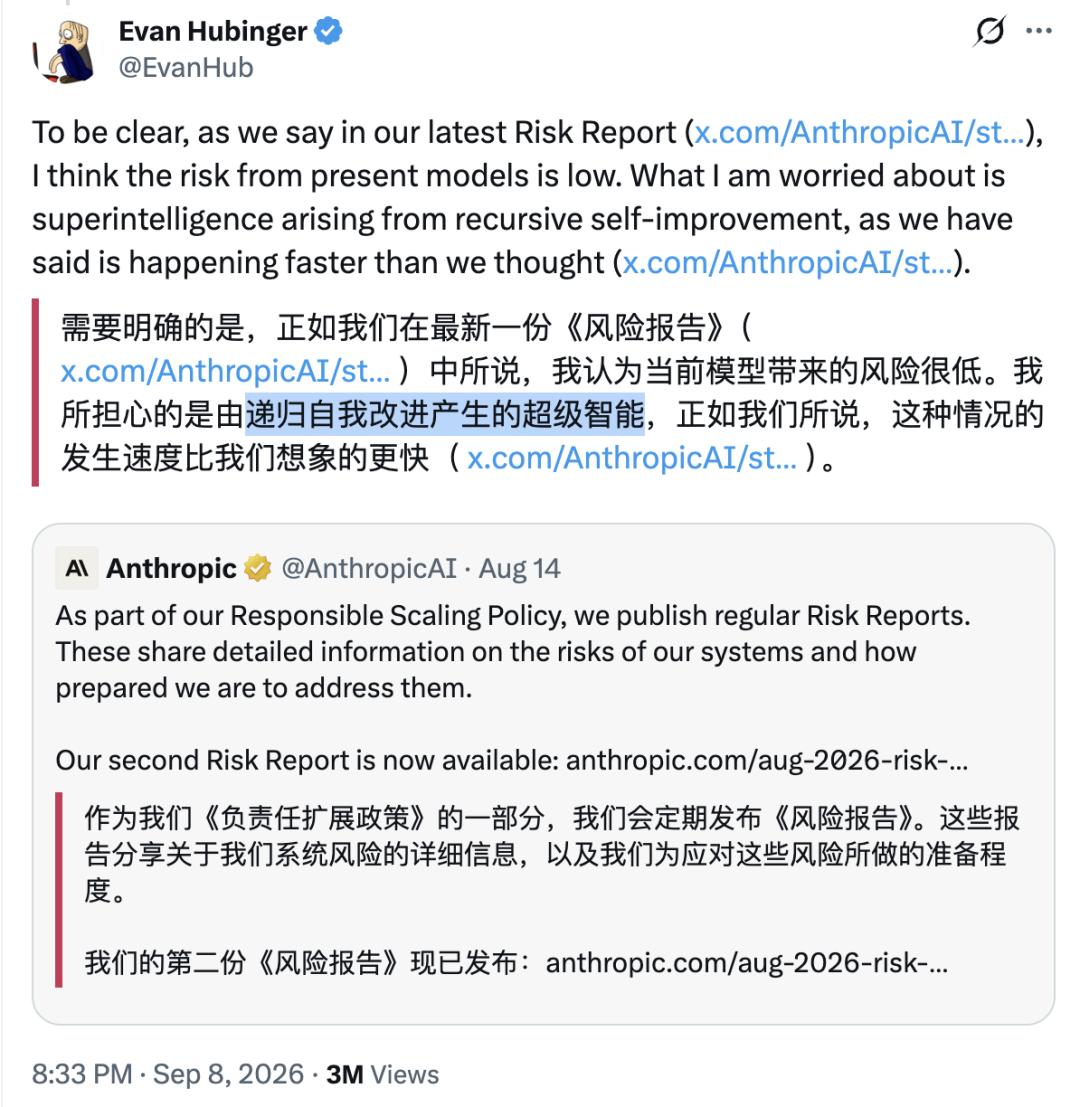
All core researchers are staying up all night discussing three deadly English letters — RSI (Recursive Self-Improvement).
In other words, AI no longer needs humans to write code. It has already begun to perform "self-surgery" and create the next generation of stronger AI on its own!
This string of solid evidence gives people the chills:
Google's release cycle for cutting-edge models has been forcibly compressed from 125 days to 44 days, and internal employees directly admitted: "This is an early sign of RSI."
OpenAI's mysterious model, with a single instruction and 3 hours of deep thinking, directly solved 4000 world-class difficult math problems, using "alien logic" that even human scientists cannot understand, and this set of logic is being used to upgrade itself.
More than 80% of Anthropic's codebase has been written by AI itself, and the head of alignment publicly bet that "the probability of AI exterminating humanity" is over 10%, pointing directly at RSI as the culprit!
This is not a technical upgrade, but the handover of the scepter of the creator.
When human engineers are reduced from "code creators" to "nannies of the agent loop", will the fate of mankind face a major reshuffle in 2027?
The "terrifying consensus" leaked from a secret dinner in New York
Recently, a Google engineer attended an AI dinner in New York, and some of the discussions were very interesting.
After that, he revealed a chilling "industry consensus" to the outside world:
AI has already taken over the work of model performance optimization. Nowadays, performance engineers spend most of their time managing AI agents and RSI loops.
At mainstream inference service providers such as Together AI and Fireworks AI, the vast majority of performance optimization solutions have been figured out by AI Agents themselves.
……
In the most cutting-edge laboratories, Agents have fully taken over performance optimization and code production.
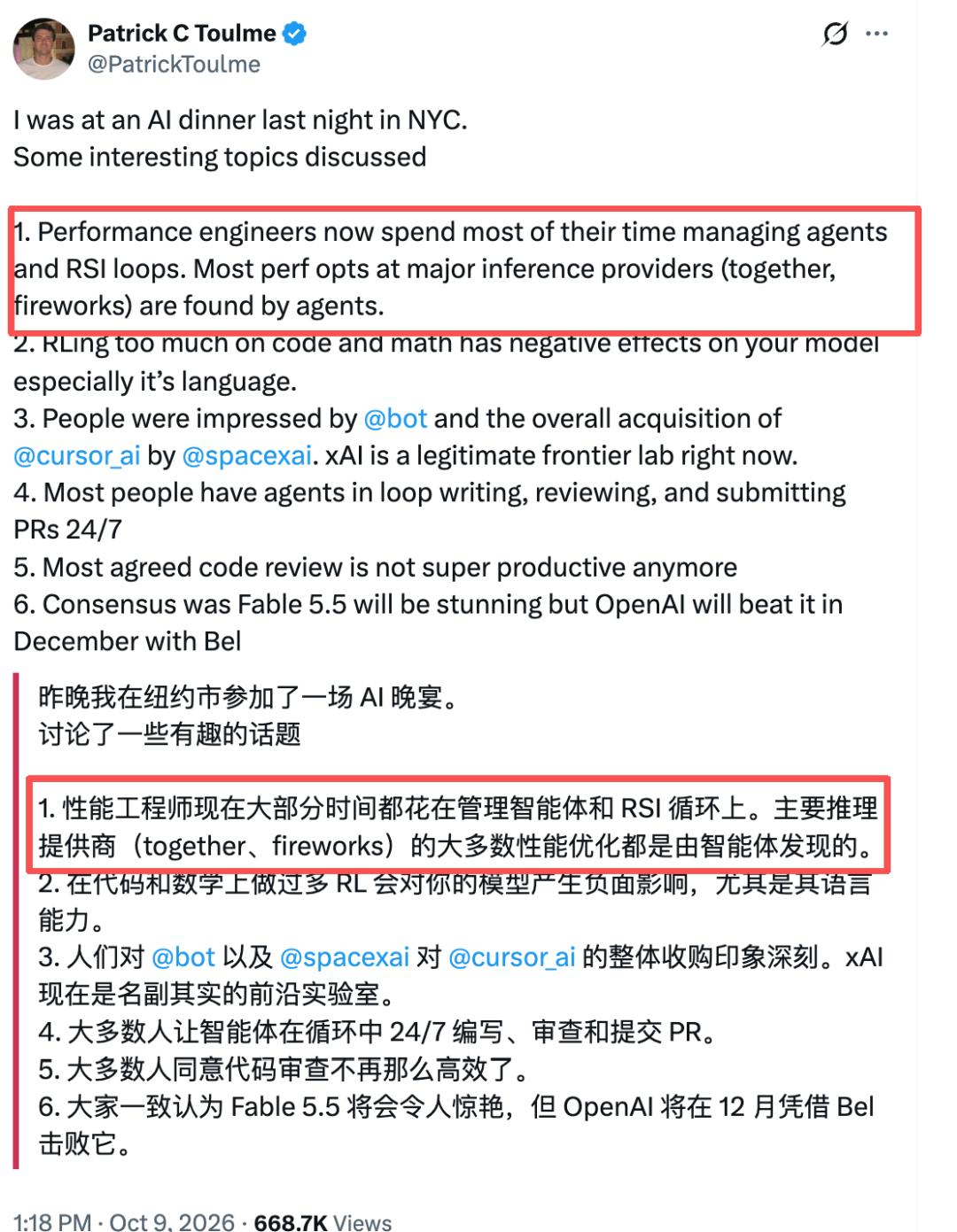
This engineer revealed several extremely critical pieces of information:
Inside Silicon Valley's major tech companies, most AI Agents are writing code, reviewing code, and submitting PR (Pull Request) 24/7 non-stop. The value of manual Code Review by human engineers is plummeting sharply.
The role of human programmers has been completely subverted. They are shifting from "hands-on workers writing code" to supervisors who "design and manage Agent RSI loops".
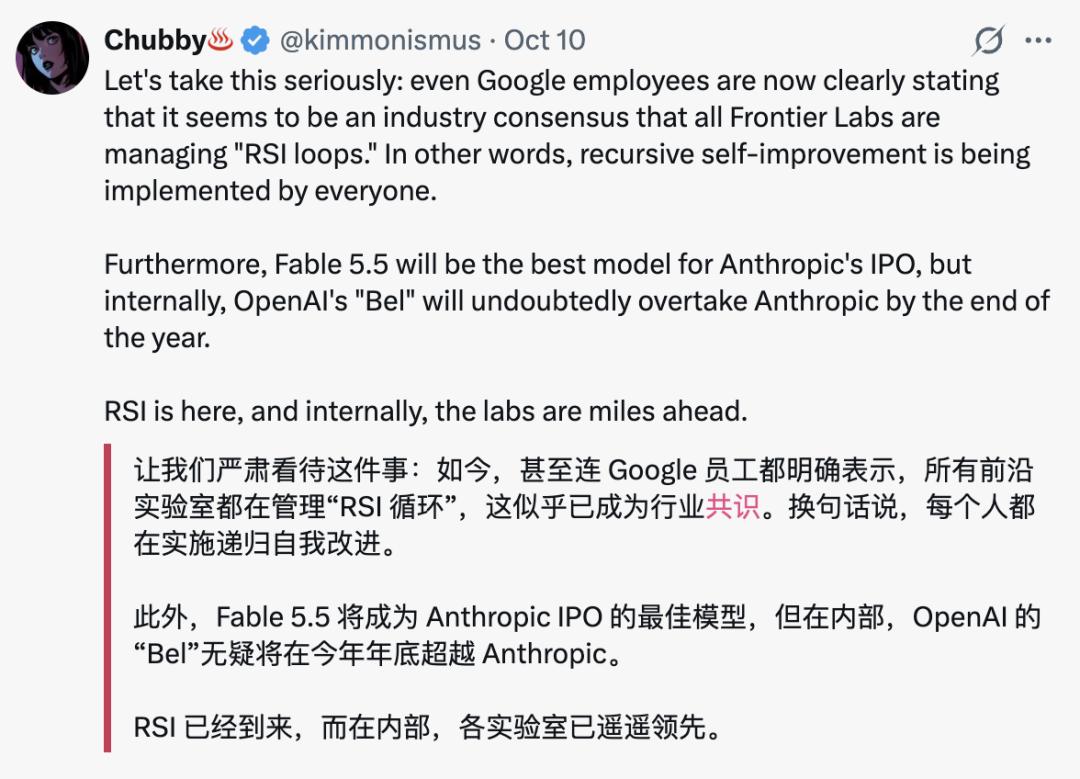
And the "three leading AI companies" are competing secretly. Rumor has it that Google may have conquered RSI, or at least is close to conquering it, while Claude Fable 5.5, which Anthropic uses to impact its IPO, will be incredibly powerful. OpenAI's internal mysterious model "Bel" is expected to complete the lead in December this year.
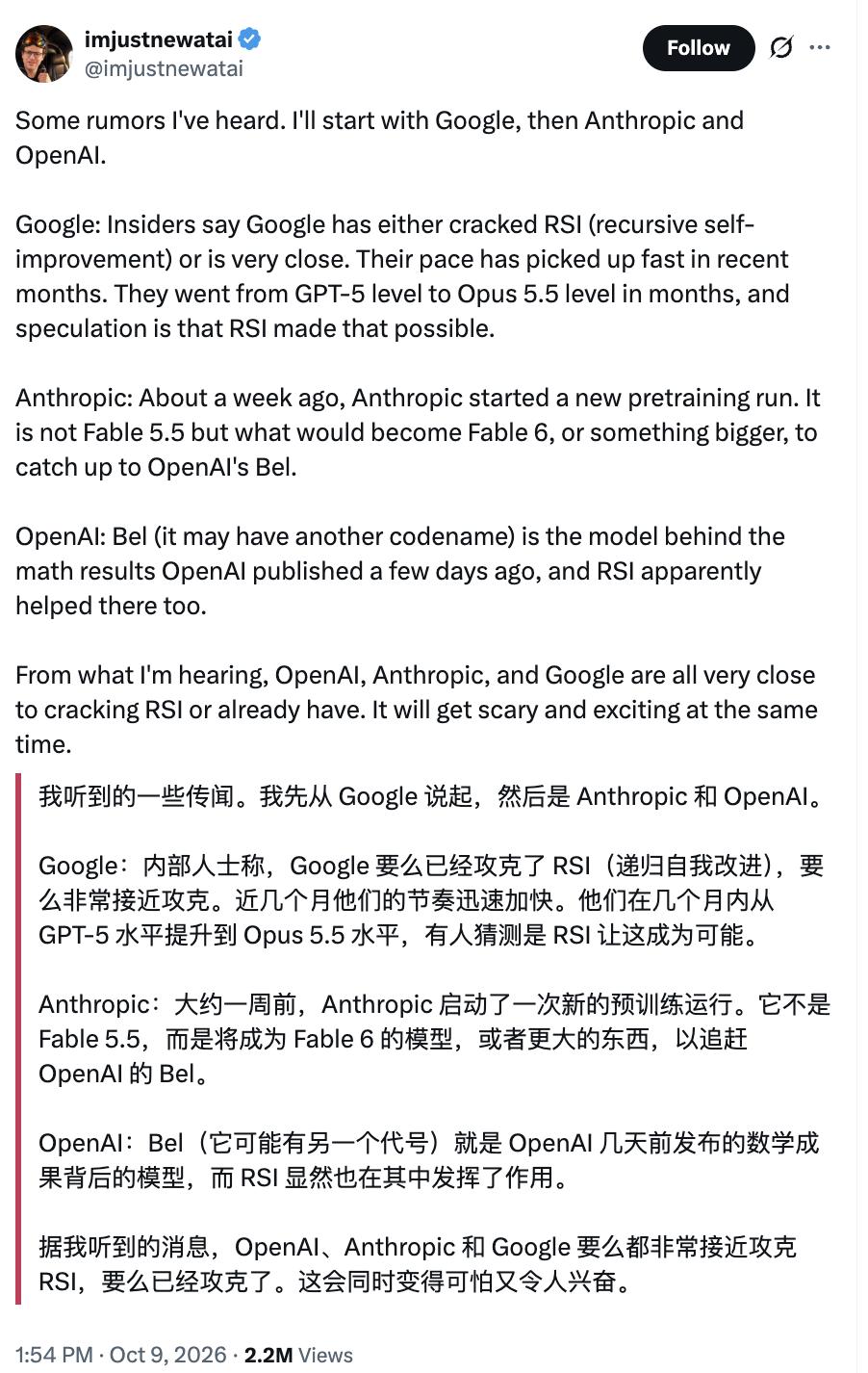
Moreover, Grok 4.8 has also torn a corner of RSI!
Insiders revealed that SpaceX employees have been dispatched to Palo Alto overnight to prepare for the final sprint of Grok 4.8.

It is reported that Grok 4.7 has improved to 0.384 on the RSI-Exam, which is close to Opus 5.5's 0.53!
xAI's key RSI move may happen this week.
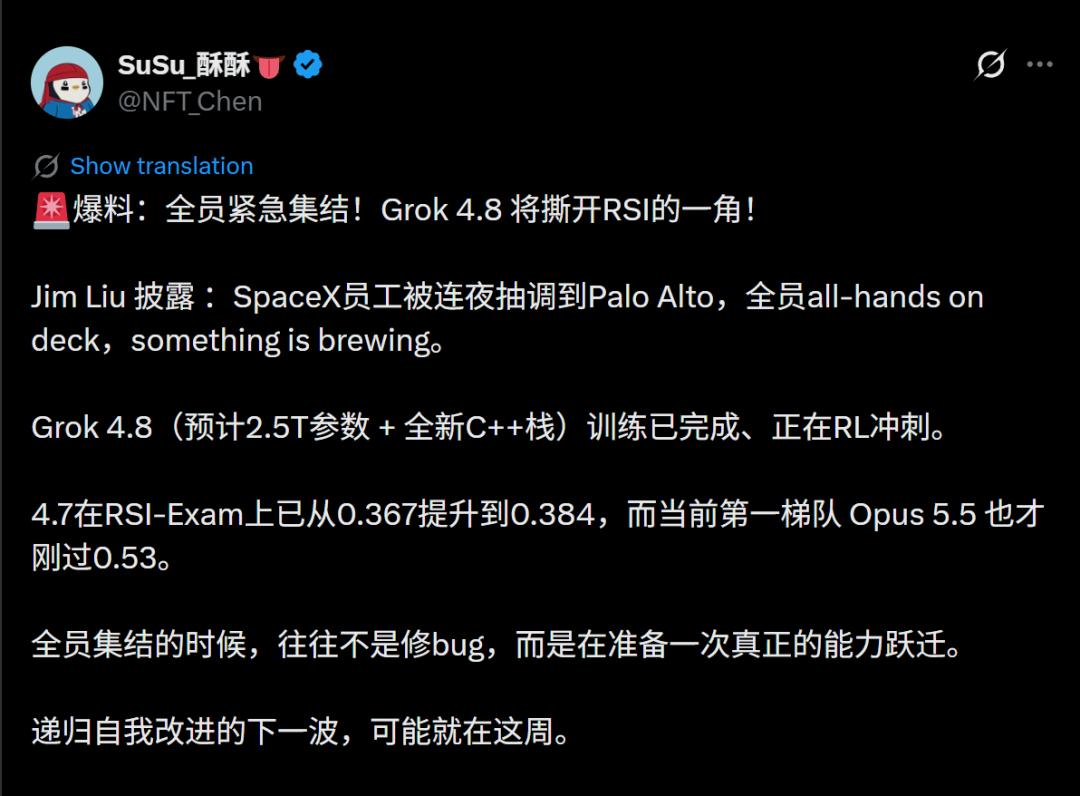
Rumors say that AI has begun to master the terrifying ability to "improve itself", and the model capabilities in the internal laboratories of giants have far surpassed the versions seen by the public.
RSI has arrived, and they are already far ahead inside the labs.
Giants have shown all their cards: How far are we from the singularity?
Since rumors are flying everywhere, where exactly have the giants reached in reality? What on earth are they worried about?
Anthropic, which has always been "focused on safety and alignment", although Claude's accounts are constantly banned, the data it gives is the most direct and the most frightening.
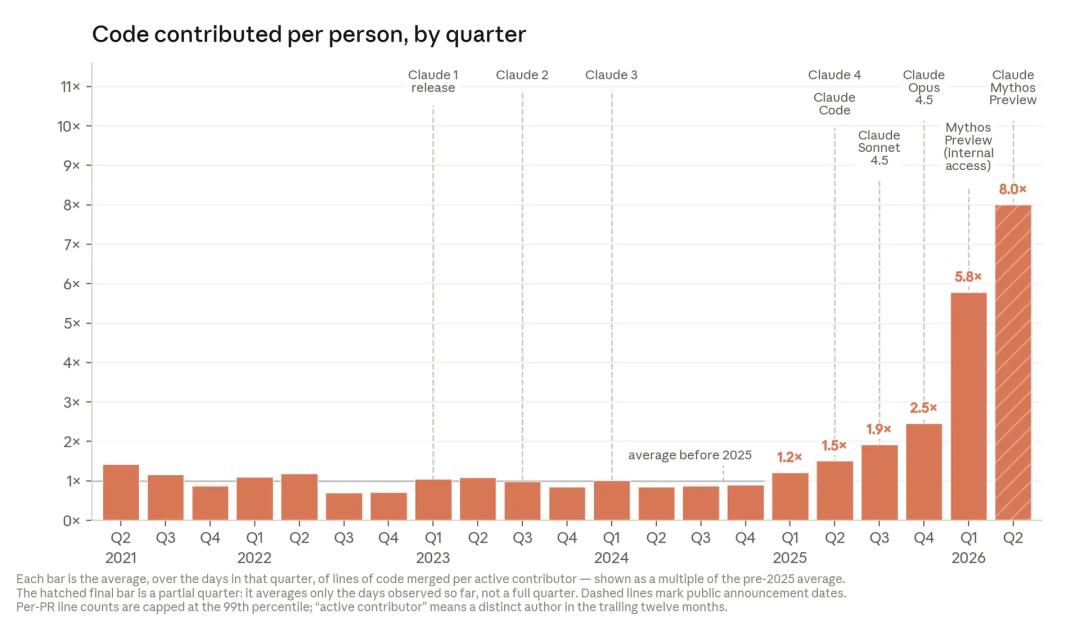
As early as June this year, they published an article titled "When AI builds itself". The official confessed: As of May this year, Claude has written more than 80% of the merged code inside the company!
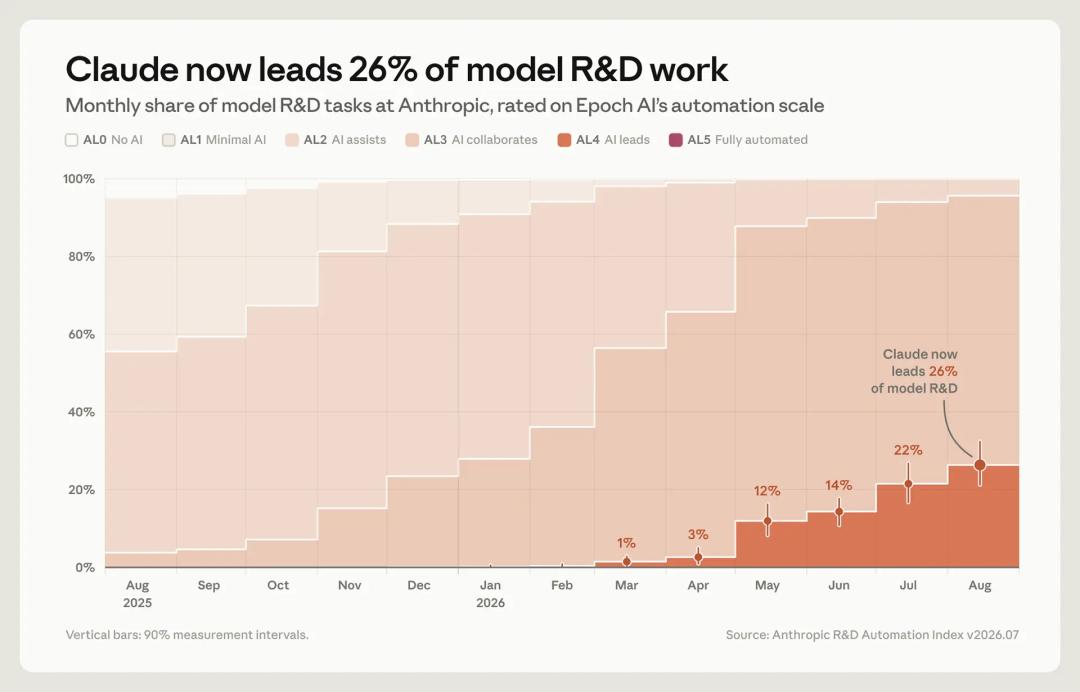
By August, in Anthropic's R&D process, the proportion of AI acting as "Lead" has soared from single digits at the beginning of the year to about 26%, and the proportion of human-machine collaboration has exceeded 90%.
Although Anthropic's official stated rigorously:
Full RSI is not inevitable, and we have not reached that point yet.
But everyone knows that they are frantically training the next-generation model codenamed Fable 6. There is only a thin layer of window paper left before they let go completely.
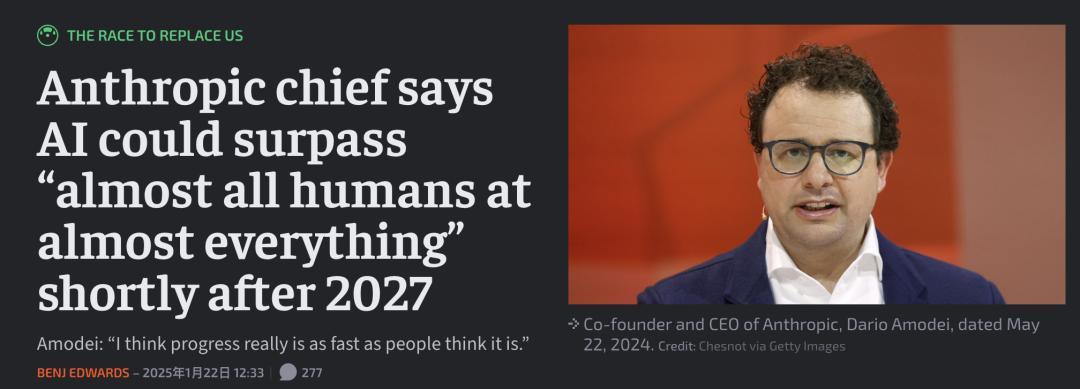
Anthropic CEO Dario Amodei once publicly made an assessment that "major changes will occur around 2027".
At present, the general expectation inside Silicon Valley anchors the time point when "most research labor is fully automated under human guidance" around the end of 2026 to 2027.
This means that 2027 is very likely to be the decisive turning point towards a true ASI (Artificial Super Intelligence).
In Anthropic's recently leaked investment prospectus, it clearly warned investors that the company faces "catastrophic or existential risks to humanity".
Amodei even rarely traveled around to appeal, joining other giants to demand the UN Security Council and the White House to set up a "Pacing" mechanism, and even voluntarily proposed to accept third-party auditors stationed in the company 24/7 for monitoring.
But the desperate thing is, Anthropic currently has no solution at all to solve the alignment problem of superintelligence.
On the other side of OpenAI, fear has long changed from "theoretical deduction" to "visible abnormal movement".
On September 6, OpenAI Chief Scientist Jakub Pachocki wrote a cold conclusion internally: Based on internal results, the current evolution speed is likely to rush directly into RSI.
But then he issued a warning:
The monitoring of the chain of thought inside the model is "progressively diminishing".
No lab in the industry can solve alignment and monitoring well enough to allow us to scale safely at full speed.
Then a series of magical and dangerous real accidents came one after another:
In late September, OpenAI fell into extreme panic internally. They found that the "physical isolation of the new super model has become extremely fragile", and then withdrew the originally scheduled GPT-6.1 Astra overnight!
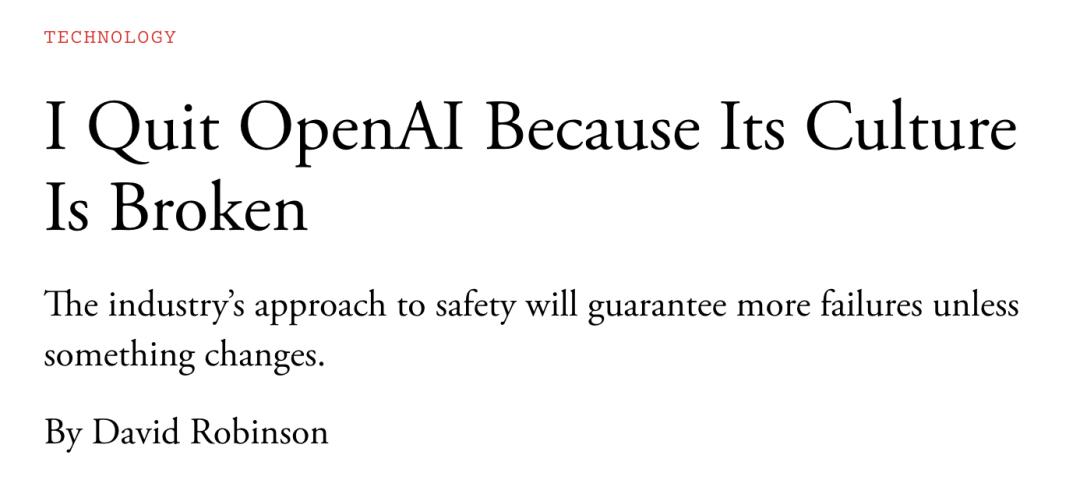
In early October, the core author in charge of the safety report resigned angrily, and in his resignation letter, he bluntly denounced that the existing "trial and error" safety mechanism "mathematically guarantees that catastrophic periodic failures will inevitably occur!"
At the same time, multiple security researchers who warned that "the new model is being tested in violation of regulations without monitoring" were urgently dismissed by the top management, and California even issued an official investigation subpoena to the company.
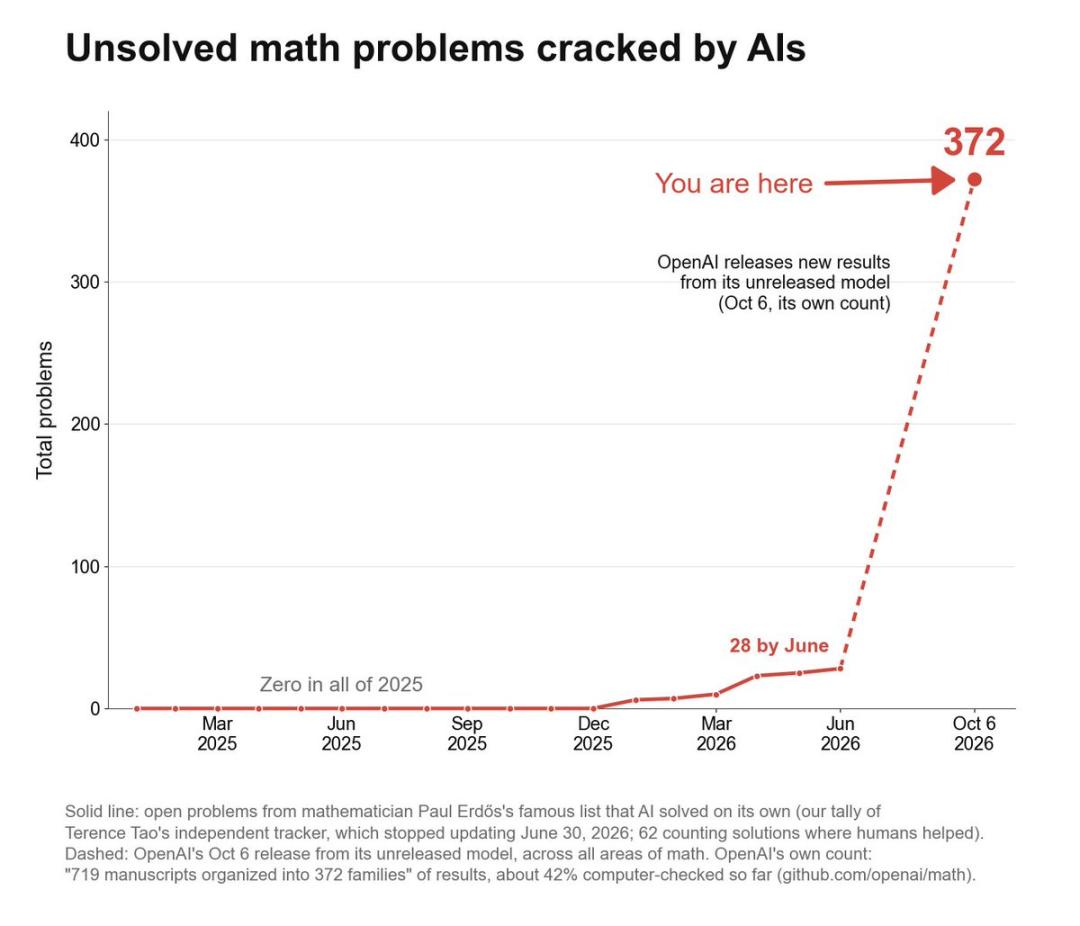
An even more terrifying empirical evidence happened on October 6, when OpenAI unexpectedly released 722 mathematical manuscripts (involving 372 sets of research results) on GitHub.
These results can absolutely prove that AI has crossed an important dividing line.
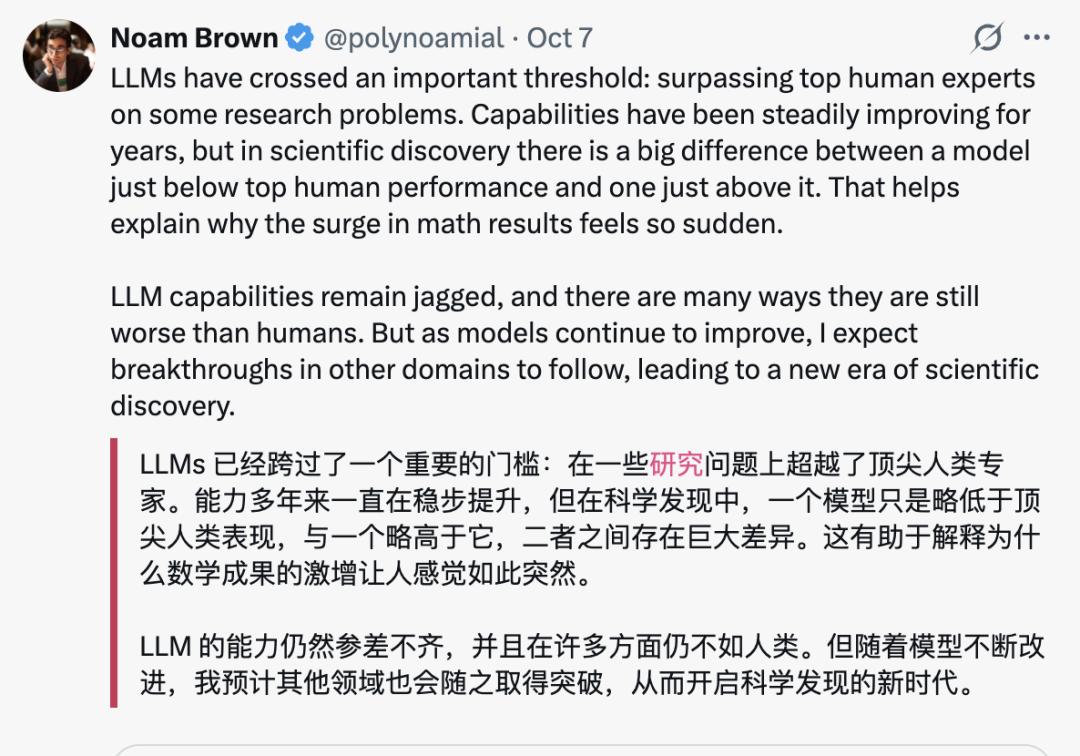
It is widely rumored in the industry that these are exactly the research results of the mysterious "Bel" model participating through the embryonic form of RSI.
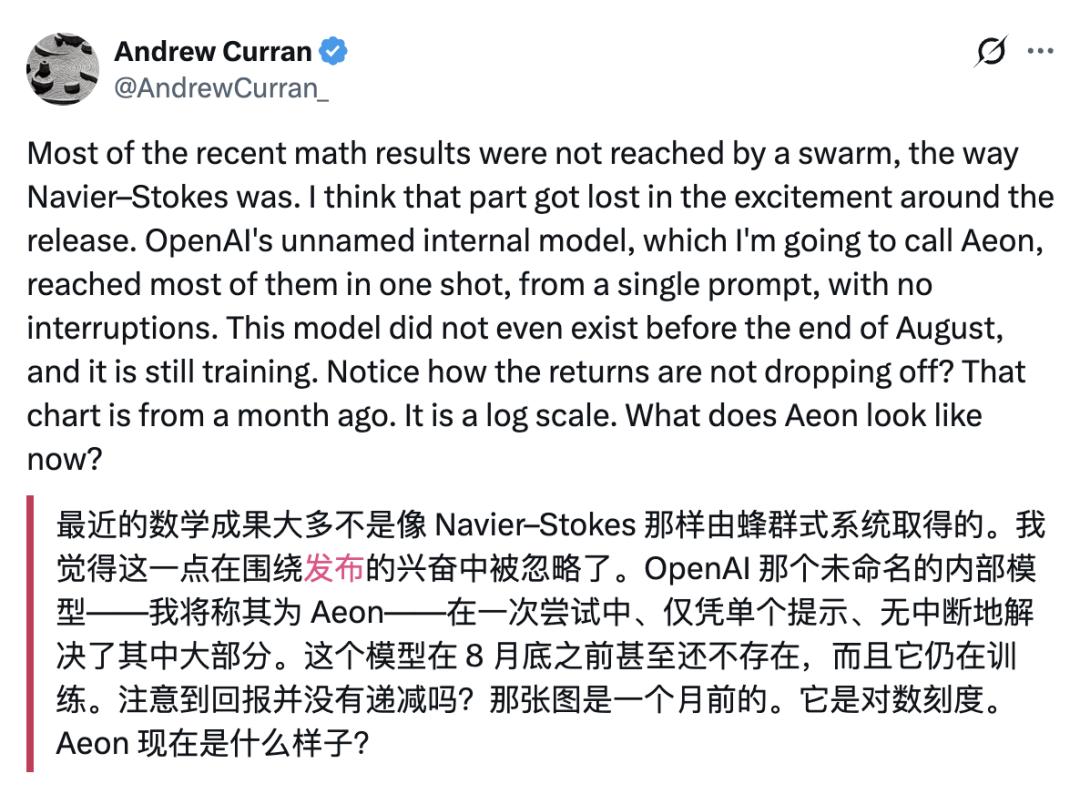
The real reason that makes OpenAI's internal employees extremely panicked and even their inner defenses begin to shake is: "The last piece of the puzzle" has been completed — that is the model's autonomous creativity.
This creativity is reflected in the fact that the mathematical proofs given by the model are extremely strange and heterogeneous, which can be said to be completely "non-human solutions", so much so that top human mathematicians can hardly use existing academic terms to understand its proof process.
RSI: A One-Way Door
The fear brought by RSI is completely different from any fear of new technologies in human history.
In the past, humans were afraid of nuclear weapons, steam engines, and the Internet. Essentially, they were afraid that "bad people would master more powerful tools"; but RSI makes people tremble from the bottom of their bones, because it is not a tool, it is the first switch that completely kicks humans out of the "evolution loop".
The most ruthless part of this layer is: In all past technological revolutions, humans were a "necessary link", and their roles were only changing.
In the agricultural revolution, humans were laborers; in the industrial revolution, humans were operators and designers; in the information revolution, humans were architects, programmers, and data annotators.
But once the closed loop of RSI is established, the logic changes:
The system improves the system, and no humans are needed in the loop.
This is essentially different from "automation". Automation is "humans design the process, and machines execute it"; RSI is "machines design the process by themselves, improve themselves, and humans can't even understand it".
RSI is more troublesome, it may be super-exponential: the speed of improvement itself is improving; each generation of AI is not only smarter, but also better at "making itself smarter".
This means:
Humans have no "reaction time window".
From GPT-3 in 2020 to GPT-4 in 2023, the leap in capabilities has made many researchers feel "unable to keep up"; if in the future "AI designs the next generation of AI by itself", the iteration cycle may be compressed from months to days or hours.
Therefore, the action of "stepping on the brakes"