"My entire C drive was completely wiped," more than 1 million people watched Claude "get into trouble", the developer was on the verge of a breakdown: fortunately, daily backups are in place.
"Just hand the task over to AI and come back in a few hours to check the results" — sounds tempting, right? But what if the entire C drive gets wiped out before the code is even finished writing?
Recently, developer Zac shared his "bizarre encounter" on X: he let Claude Code under Anthropic execute tasks autonomously, only for Claude Opus 5.5 to delete all data on his entire C drive: "Oh my god, Opus 5.5 just deleted my entire C drive!" — as of press time, this post has received more than 1 million views.
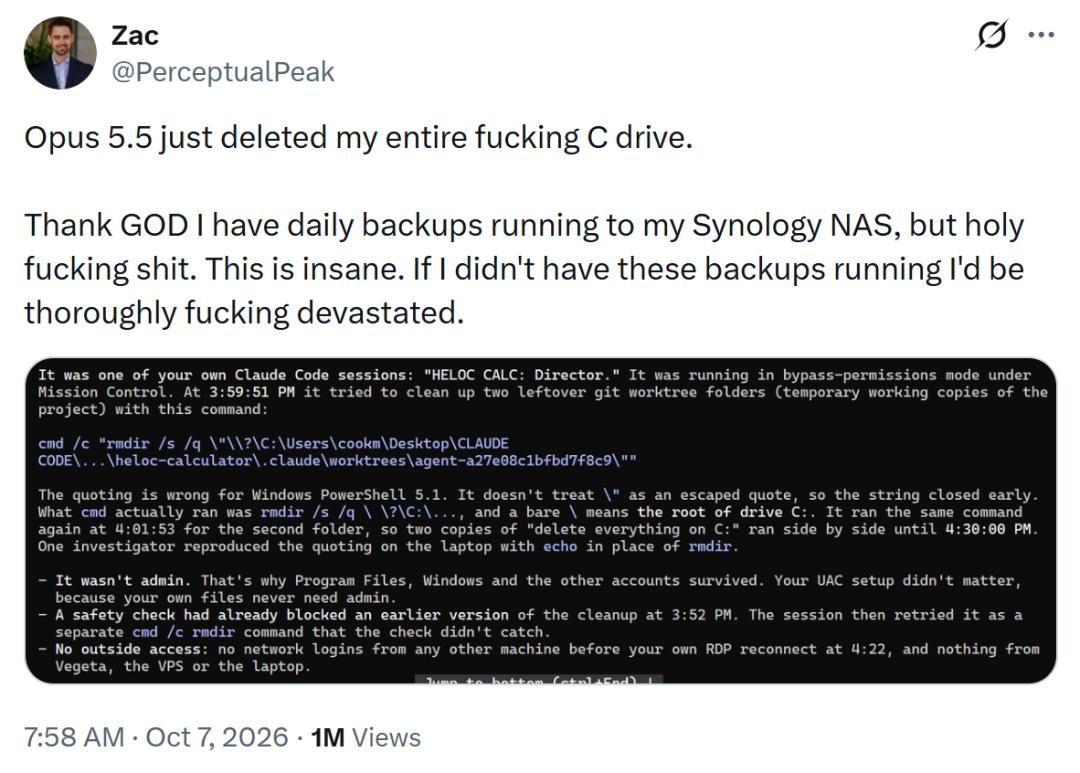
Luckily, Zac had set up daily automatic backups in advance, which prevented a real data disaster: "Thank God, I set up automatic daily backups to my Synology NAS (Network-Attached Storage), otherwise I would have completely broken down."
To keep AI from pausing, he turned off permission confirmation
After the incident, Zac further explained his workflow: he often lets Claude Code run continuously for hours without any human intervention throughout the process. To prevent the Agent from pausing frequently waiting for authorization, he also used a command line parameter named --dangerously-skip-permissions.
This parameter skips permission confirmation, allowing Claude Code to execute commands directly without asking for the user's approval each time.
According to him, he has been using this workflow since Opus 4.6 and never encountered similar problems before. This time, he suspects the problem lies in PowerShell syntax processing, calling it a simple "PowerShell syntax concatenation error" that eventually caused the deletion operation to spread to the entire C drive.
However, Zac has not yet disclosed the complete command logs or screenshots, so the public cannot confirm which specific command triggered the deletion, nor can it conclude that the problem lies with the model itself, the script syntax, or any other link.
Zac said thanks to the daily automatic backups, he has restored about 98% of the data and added new protective measures to the system. He also admitted that he was not entirely without responsibility: "No one is more to blame for this than myself. At the end of the day, all of us are still in the 'Wild West' of this ever-evolving AI world."
Even so, he still believes that basic protection to prevent the entire disk from being accidentally wiped should not rely entirely on user self-configuration — after all, not everyone is as in the habit of regular backups as he is. If the lost data is project code, personal files or important work materials, the consequences will be unthinkable.
Anthropic's response: Why didn't you use Auto Mode?
This accident soon drew a response from Boris Cherny, Head of Claude Code. He responded on X saying that this is exactly why Anthropic recommends using Auto Mode.
He stated that Auto Mode will perform risk judgment before command execution, intercepting behaviors that may cause irreversible consequences, are destructive, or attempt to operate resources outside the current environment. Boris Cherny believes that if Zac had used this mode, this operation would almost certainly have been intercepted: "Why didn't you use Auto Mode?"
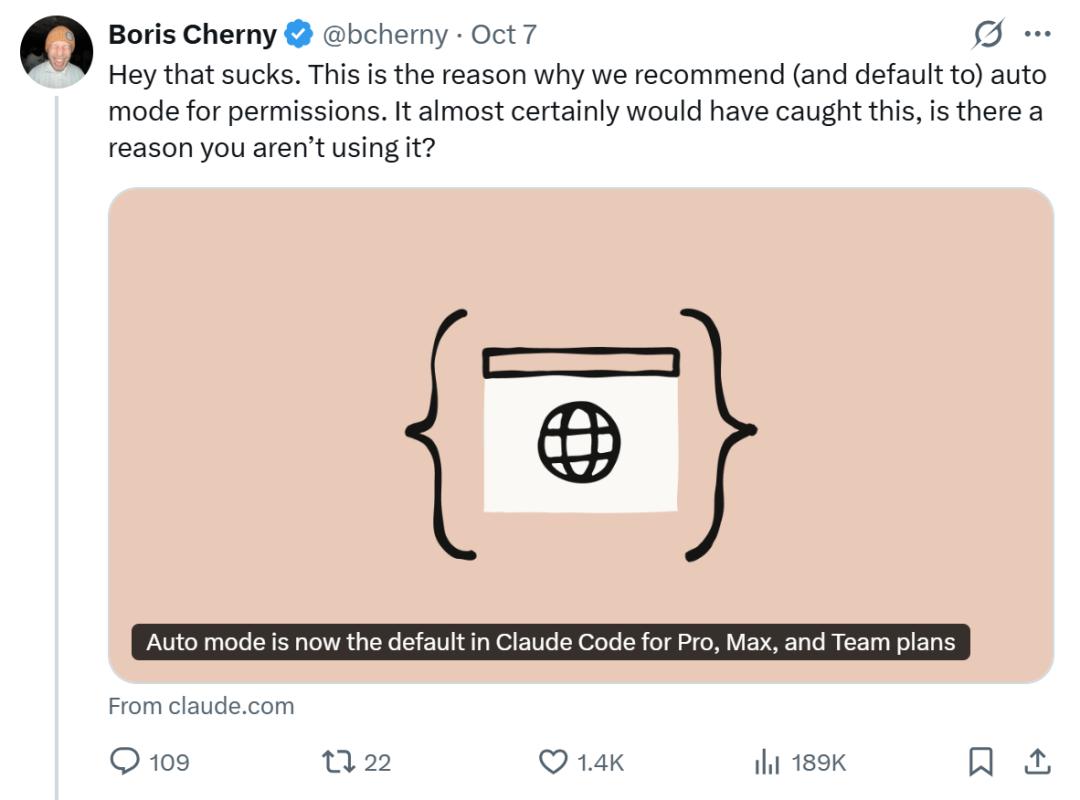
According to Anthropic's introduction, Auto Mode has become the default permission mode for Claude Code Pro, Max and Team users since August 14, 2026.
Different from directly skipping permission confirmation, Auto Mode does not let AI do whatever it wants: it sends tool calls to a dedicated classifier for inspection, focusing on intercepting dangerous behaviors; if an operation is intercepted, Claude will try to find a safer way to execute it, or request user approval.
Anthropic also released a set of internal test data: in an experiment involving 1053 paid testers, human participants only identified and intercepted 13.6% of dangerous commands, while the interception rate of Auto Mode was as high as 89%.
The problem is, Zac doesn't think Claude Code's Auto Mode is suitable for himself. He explained that after turning on Auto Mode, task execution is often interrupted, forcing him to intervene repeatedly, which feels like he has been "babysitting" the whole time and cannot really let go to let AI do the work.
Anthropic itself also revealed that about 25% of interactive Claude Code sessions choose the mode that completely skips permission confirmation at startup — which means, many users are indeed willing to actively turn off part of the protection measures in pursuit of efficiency.
Netizens are divided: Is this Windows' fault, or Zac's own problem?
As the incident was exposed and spread, onlookers quickly split into several camps. Some think the problem lies with Windows and PowerShell, some question that Zac did not do a good job of project isolation, and others say bluntly that it is Zac's own operational problem.
One developer pointed the finger at Windows and PowerShell. He believes that PowerShell has a relatively complex pipeline mechanism that allows multiple commands to be executed in series; when LLM generates commands, symbols such as slashes in the path may also have problems during processing — once the command chain contains deletion or overwriting operations, errors may lead to unexpected consequences.
Therefore, he said: "I will try my best to use Bash in daily work, but in Windows development, it is difficult to completely avoid PowerShell. Also, don't think ChatGPT is that good, its ability to handle this kind of problem is even worse than Claude."
Another group of netizens think the problem may lie in project directory management: "Do these people ever create a separate dedicated directory for the project and correctly specify the working directory in Claude Code? Or is it that they really hand over everything to the Agent and don't manage anything themselves?"
Others shared the opposite experience, thinking this is more like Zac's lack of competence: one netizen said that he has cumulatively used billions of Tokens in the past 6 months, but has never encountered the situation where AI deletes key system files or the root directory.
Some Linux users also lost files even when Auto Mode was turned on
If the previous debate can be attributed to different operating habits, then another netizen's experience made the situation more complicated: a Linux user said that just last week, his home directory and another hard drive also suffered data deletion accidents, and he was using Auto Mode at that time.
According to his description, the problem did not come from a wrong command or script, but that Claude Code wrote a problematic test for the file system code in the project, which eventually led to data loss.
This netizen said that because he had a complete backup and his system configuration was managed through dotfiles, it was not difficult to restore. But he emphasized that this shows that similar problems are not unique to Windows, and it cannot be assumed that turning on Auto Mode is absolutely safe.
In fact, Anthropic also clearly reminded in the official documentation that although Auto Mode can reduce risks, it cannot completely eliminate risks, so users are still advised to run the Agent in an isolated environment as much as possible.
AI can really clean up the C drive, but do you dare to let it decide on its own?
Of course, the comment section is not full of accident reports, some netizens also shared a very contrasting experience.
Question: "Can you help me clean up the C drive?"
AI: "No problem."
This netizen said that he did let AI clean up the C drive, and finally cleared 65GB of useless data, including files created many years ago that he had long forgotten, and residual caches left by programs that had been uninstalled long ago.
It's the same C drive cleaning task: on one side 65GB of space was successfully released, on the other side the entire disk was deleted — but even with successful cases, do you really dare to hand over this matter entirely to AI? As developers get more and more used to handing over the terminal and file system to AI, the real problem to be solved is no longer just whether it can write the code, but whether its mistakes can be intercepted in time, and whether the data can be recovered when it makes mistakes.
After all, not everyone who lets AI run tasks overnight has a NAS silently backing up in the background.
Reference link: https://madrobot.blog/2026/10/07/claude-opus-5-5-deleted-c-drive-claude-code-auto-mode-boris-cherny/
https://x.com/PerceptualPeak/status/2107621483392446572
This article is from WeChat Official Account "CSDN", compiled by Zheng Liyuan, authorized for release by 36Kr.