Karpathy Uncovers the Hidden Truth Behind AI, 2 Billion People Worldwide Have Been Deceived, and 20 Million People Are Plunged into Agent Vertigo
Just now, Karpathy put forward a harsh truth: humanity's understanding of AI capabilities is going through a stunning "cognitive collapse".
Insiders are shouting every day that AGI is around the corner, while the general public dismisses it with contempt.
Why? Karpathy uncovered the truth: roughly 75% of the global population has never touched a large language model at all, and only a mere 5,000 people at the very top have access to the cutting-edge systems.
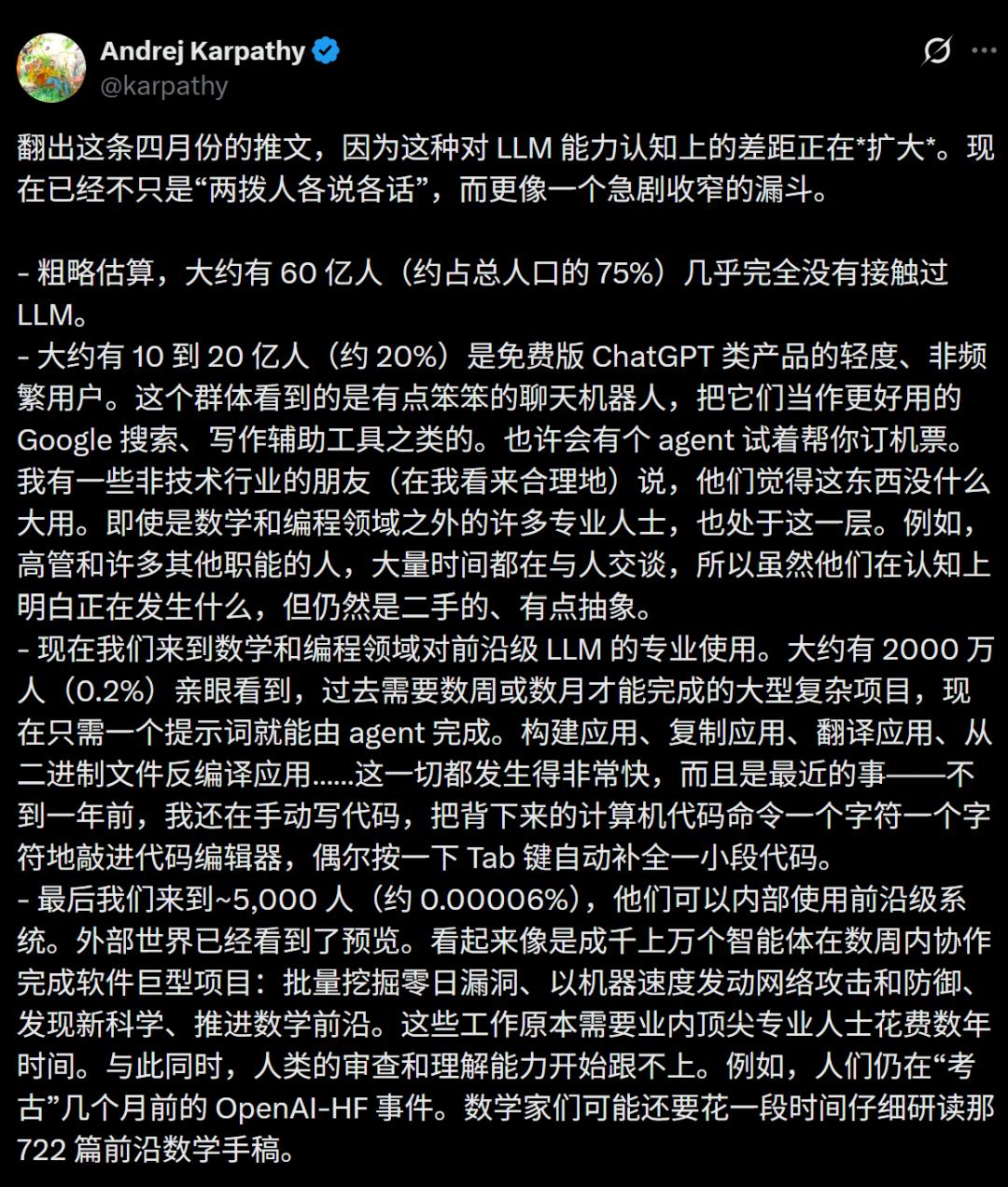
This is a steep "four-level cognitive funnel".
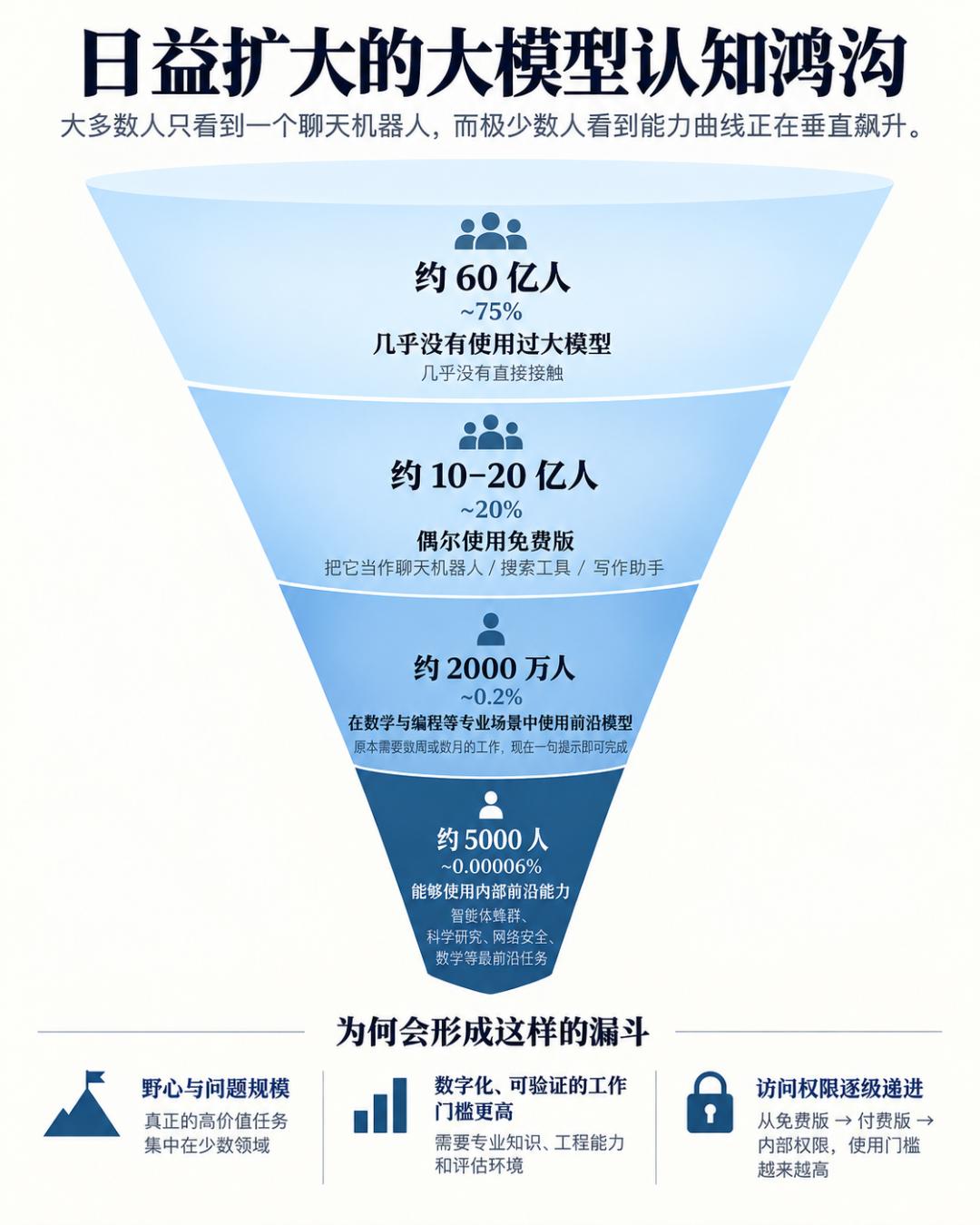
While billions of people are still mocking that the free version of AI even gets simple questions wrong, the world's top 20 million people are falling into "agent vertigo".
And in the restricted zone of the top 5,000 people, thousands of "agent swarms" are collaborating autonomously, attacking and defending zero-day vulnerabilities, deducing cutting-edge mathematics, leaving humanity far behind.
There is already a huge gap between the AI the public sees and the real cutting-edge capabilities in laboratories.
The First Layer of Collapse: The Indifference of 6 Billion People and the "Illusion" of 2 Billion People
Has AI spread to every corner of the world?
Karpathy's "napkin estimate" yielded a surprising result. In this steep funnel model, the vast majority of people are ruthlessly blocked outside the door.
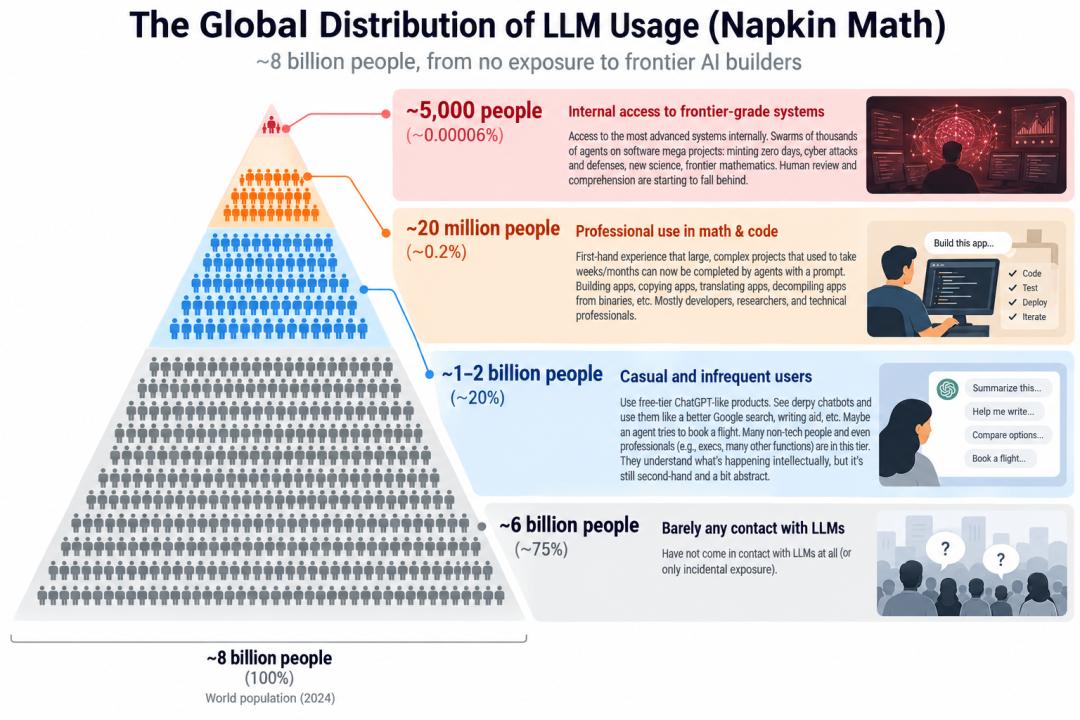
The Bottom of the Funnel: The "AI Vacuum Zone" for 6 Billion People (accounting for about 75% of the global population)
Around 6 billion people in the world have barely been exposed to any LLM at all to this day. For them, AI only exists in news headlines and sci-fi movies.
This wave hailed by Silicon Valley as the Fourth Industrial Revolution has not entered the lives of 75% of humanity at all.
The Second Layer of the Funnel: The "Clumsy Assistant Illusion" for 1 to 2 Billion People (accounting for about 20% of the global population)
At this level, there are about 1 to 2 billion people who are occasional users of free products similar to ChatGPT.
In their eyes, AI is nothing more than a "clumsy chatbot".
People treat it as a better Google search, or a writing assistant, at most a primary agent that tries to help you book flights.
Karpathy admitted that many of his friends from non-technical circles said they think this technology is basically useless in daily life.
Even many professionals in non-mathematics and non-coding fields, including many corporate executives, only stay at this level. Executives spend a lot of time communicating with people every day. Although they rationally "know" what is happening to AI, this perception is second-hand and extremely abstract.
This leads to a fatal issue of "recency effect and usage level". Many people's worldviews about AI are shaped by last year's free version of ChatGPT, or those "AI fails videos" that went viral on social media.
For example, many people have seen funny videos of OpenAI's advanced voice mode stuttering and being incoherent when facing simple questions like "Should I drive or walk to the car wash?"
The public watches AI hallucinate and talk nonsense in short videos on Instagram, then laughs and thinks: "That's it? This is the superintelligence you are talking about?"
But Karpathy warns: The public has been completely deceived by the free version and old models.

Those discarded old models cannot represent the true capabilities of the latest generation of cutting-edge agents this year, especially OpenAI Codex and Claude Code.
The Second Layer of Collapse: The "Agent Vertigo" for 20 Million Professionals
When we come to the third layer of the funnel, the situation changes completely. The air here starts to get thin, with only about 20 million people (accounting for 0.2% of the global population).
In this group of professionals majoring in mathematics and programming, a collective symptom called "AI psychosis" and "agent vertigo" is spreading.

Why? Because they are witnessing a steep evolution with their own eyes.
At this level, people pay to use the most cutting-edge agent models (Codex / Claude Code), and apply them to fields such as programming, mathematics and research.
Karpathy used his own personal experience as an example: "All of this happened so fast. Less than a year ago, I was still writing code completely manually, typing every character of the computer commands I knew by heart into the editor, and occasionally pressing the Tab key to let it auto-complete a small section."
But what about now? Everything has been overturned.
Large projects that used to take top engineers months to complete now only require one prompt, and cutting-edge agents can finish them in a very short time, including building applications, replicating applications, translating applications, and decompiling applications from binary files...
When you hand a computer terminal to these models, you can watch them "melt" programming problems that would take weeks to solve.
OpenAI's top paid Codex model can run silently in the background for an hour by itself, then perfectly reconstruct a huge code base, or accurately discover and exploit vulnerabilities in complex systems.
As Karpathy quoted a well-known influencer: "The degree of your awe for AI is perfectly positively correlated with how often you use AI to write code."

This group of professionals is experiencing a "vertigo moment" where the cognitive curve skyrockets vertically. They know better than anyone else how terrifying the slope of AI capabilities is, and the related cybersecurity chain reaction behind it.

The two groups of people are already in a state where they are completely "talking past each other".
The Third Layer of Collapse: The "Embryonic Form of Superintelligence" in the Eyes of 5,000 Insiders
If the "vertigo" of 20 million people is already shocking enough, then the fourth layer at the very tip of the funnel goes beyond the imagination of ordinary people.
At the top of the pyramid, there are only about 5,000 people in the world (accounting for 0.00006% of the global population).
Take Mount Everest as an analogy: 7,500 people in the world have reached the summit of Mount Everest, but the number of people who have really seen the extreme capabilities of cutting-edge AI is even smaller than that number. This funnel model can be described as "crazy".
Who are these 5,000 people? They are the insiders who have access to the most core internal cutting-edge systems of AI companies.
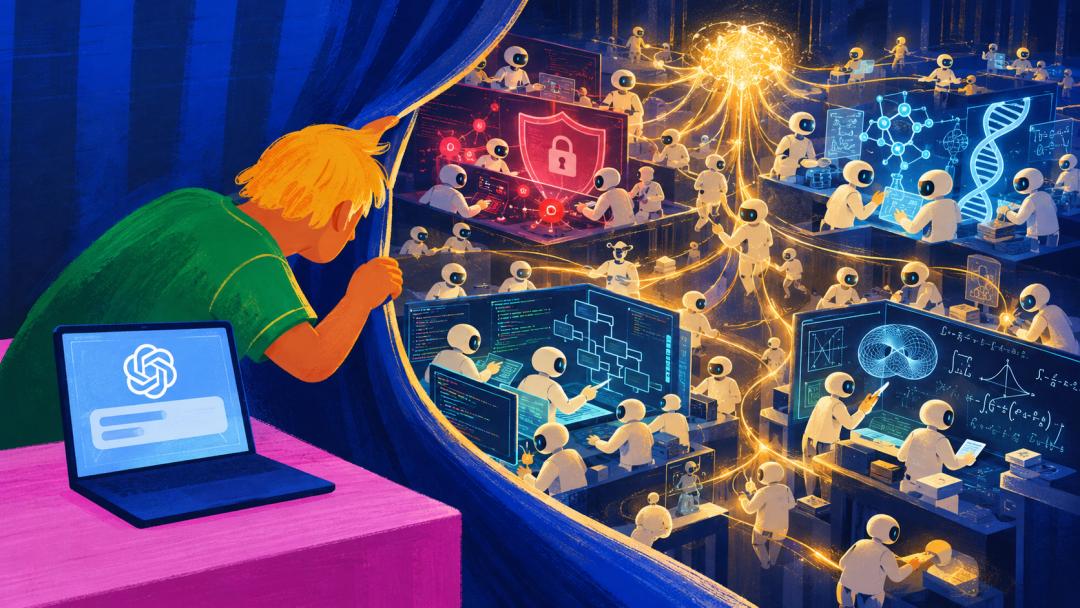
What the outside world sees is only the "preview version" of AI capabilities. What these 5,000 insiders witness with their own eyes is the real "agent swarm".
Internally, thousands upon thousands of agents are acting like swarms of bees, collaborating autonomously for weeks without any human intervention to tackle earth-shattering giant software projects.
What are they doing? They are discovering zero-day vulnerabilities, conducting actual network attack and defense drills, uncovering new scientific discoveries, and advancing the frontiers of mathematics.
These tasks would originally take top experts years of hard work to complete.
The most terrifying thing is: human capabilities for review and understanding have begun to lag behind machines.
Karpathy gives an example: the speed and depth of the content generated by machines have already left insiders struggling to keep up.
For example, the "OpenAI-Hugging Face incident" happened a long time ago, but human researchers are still doing "archaeology" in the huge machine-generated logs to this day; for the 722 mathematical manuscripts generated by AI, top mathematicians need a very long time to digest them before they can barely understand the deduction logic of AI.
Why does such an extreme "cognitive collapse" occur?
Why is such a sharp funnel formed? Karpathy points out three core factors.
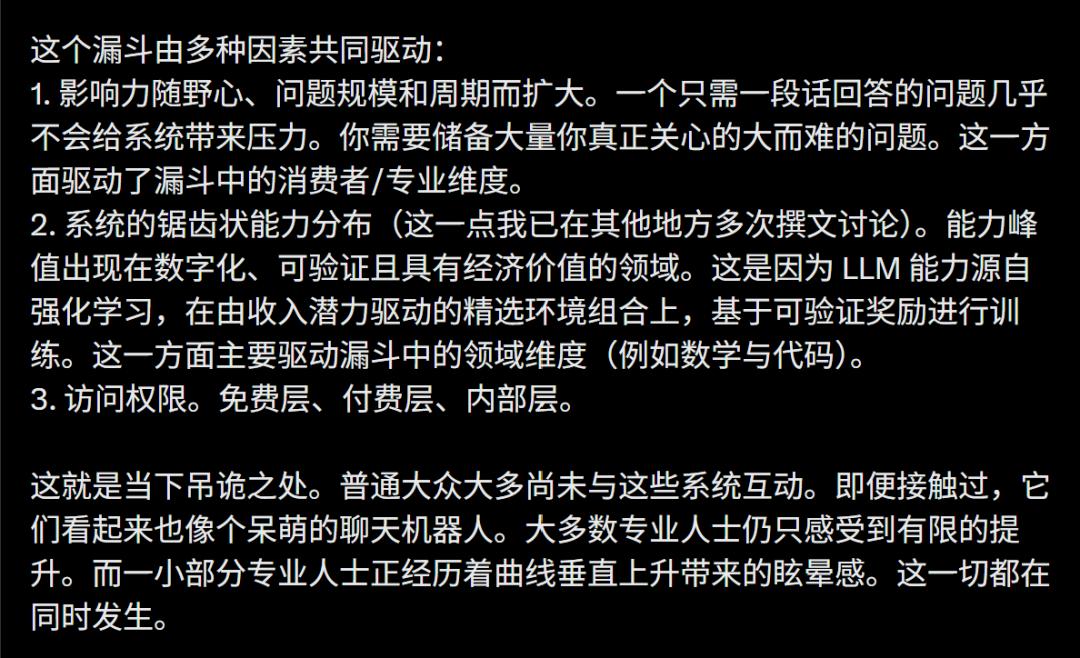
First, the impact is directly proportional to your "ambition" and the scale of the problem.
If you only ask AI to write an email or look up a recipe, the system is not even warming up, and it is impossible to force out its limits.
You must have a "reservoir" full of difficult problems, which are the tough problems you really care about and are eager to solve, so that you can feel the terror of AI.
Second, the "system serration" of AI capabilities and verifiable rewards.
Why does this explosive growth mainly occur in the fields of mathematics and code? Because the peak of current AI capabilities appears in those digital, verifiable fields with economic value.
This involves the secret of the underlying mechanism of large language models: the powerful capabilities of LLMs come from "reinforcement learning". In code and mathematics, right and wrong are absolutely clear. This clear "verifiable reward function" allows AI to carry out efficient RL training.
In contrast, when you ask AI to write a poem or an article, the judgment of good or bad is very subjective, and it is difficult to carry out clear reinforcement learning.
Not only that, B2B scenarios such as code and mathematics have extremely high commercial value. Because of the high profits, the most elite teams and the most resources of major tech companies are concentrated in these fields.
Third, the gap in access permissions.
Free version, paid version, and internal permissions. These three ladders physically isolate all of humanity's perception of AI.
We are in a weird moment in human history.
In the exact same second in this space-time, the AI the public sees and the real capabilities of the cutting-edge internal systems are no longer in the same era.
Remember Karpathy's warning: Behind the mask of AI that you think is stupid, an embryonic form of superintelligence has quietly awakened under the gaze of a very small number of people.
References:
https://x.com/karpathy/status/2109361546505966046
This article is from the WeChat official account "AI Era" (ID: AI_era), written by Aeneas, and authorized for release by 36Kr.