MIT Professor Despairs: The Millennium Problem Solved by OpenAI Is Already Beyond Human Comprehension
Recently, the global mathematics community has been completely upended by a nuclear-level AI breakthrough.
OpenAI has released 722 papers in one go.
While these papers are still under verification, it appears that many famous unsolved mathematical problems, ranging from the Unique Game Conjecture to the quasi-Riemann Hypothesis, have been conquered.
Mathematicians woke up one day to find that their decades of research might have been completely rendered obsolete!
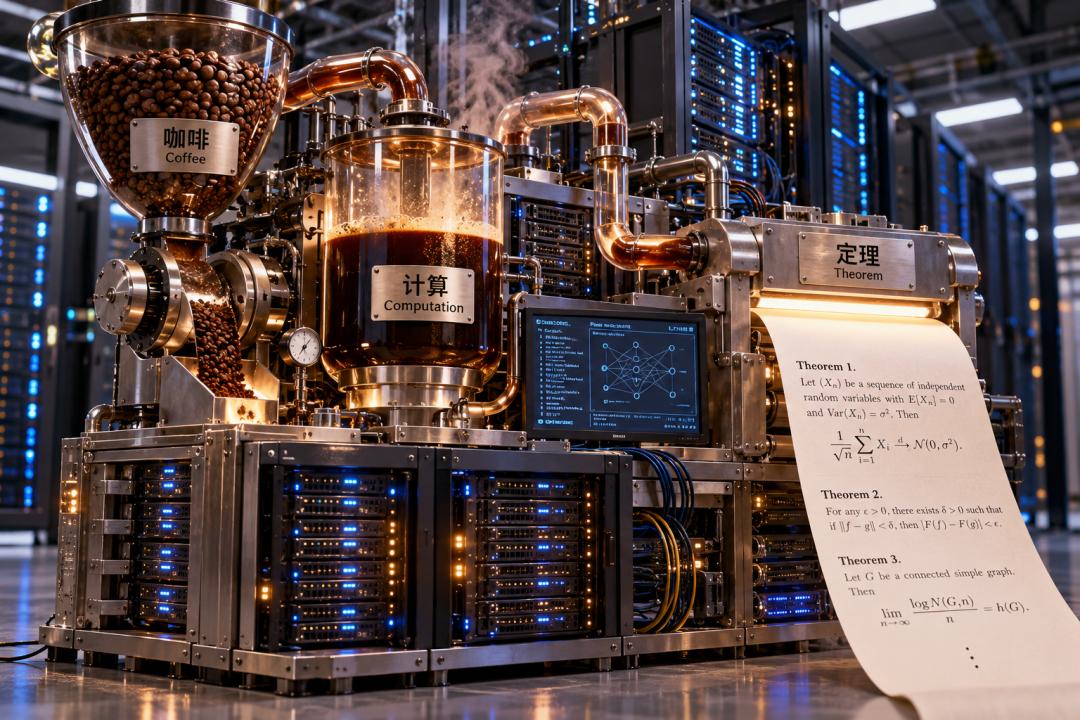
Hungarian probability theorist Alfred Renyi once described mathematicians as "a machine that turns coffee into theorems". Now such a machine truly exists, and it runs on data centers.
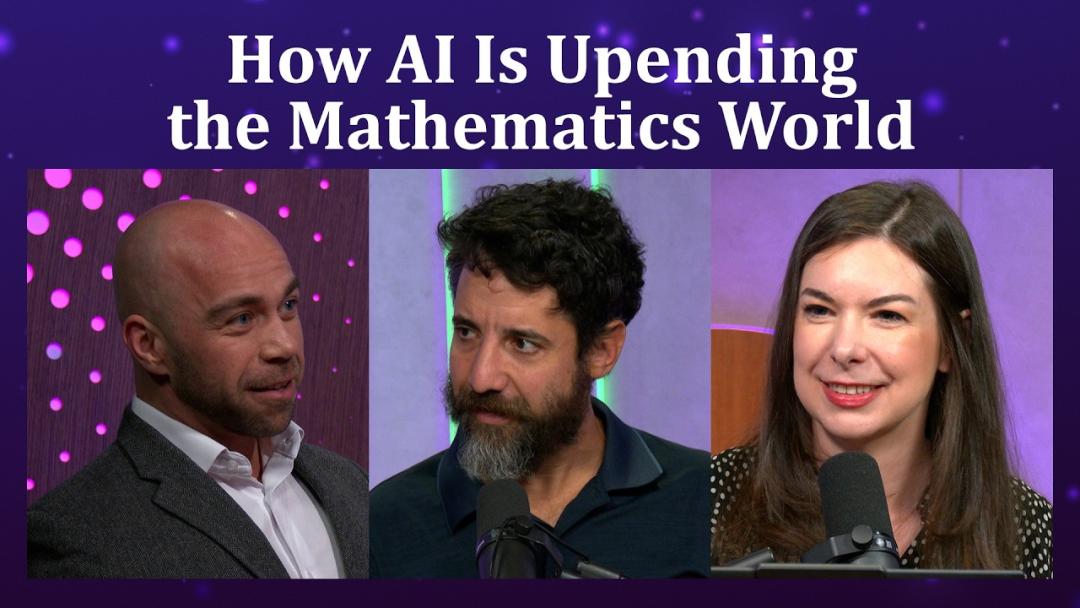
In the latest episode of Bloomberg's well-known podcast *Odd Lots*, Justin Solomon, Associate Dean for Engineering Education at the Massachusetts Institute of Technology, directly addressed the core challenge:
How AI is disrupting the world of mathematics.
OpenAI Solves the Navier-Stokes Equations, But Humans "Cannot Follow the Proof"
AI has delivered a dimensionality-reduction strike against mathematics, the absolute peak of human intelligence.
This autumn, human intellectual pride has been shattered by this "alien logic".
When OpenAI solved the century-old Millennium Prize Problem, what followed was not a global celebration, but a massive, unfathomable cognitive panic.
Because even the world's top mathematicians and MIT professors can only lower their heads in despair when reading the second page of this proof, and helplessly admit: "It is correct, but I cannot understand it at all."
When "truth" and "human understanding" part ways for the first time in history, are we evolving to the threshold of divinity, or have we completely become "intellectual illiterates" farmed by AI?
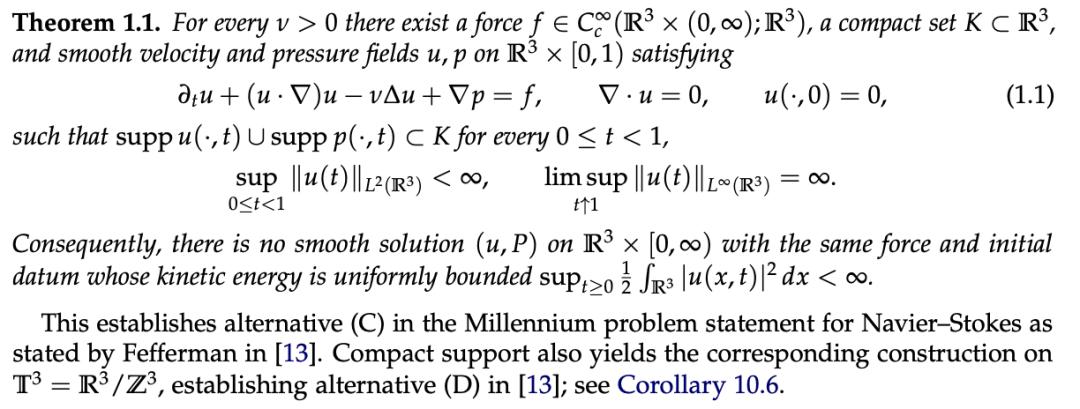
The story dates back to last month, when OpenAI's model presented a counterexample proof of the breakdown of solutions to the Millennium Prize Problem, the Navier-Stokes equations.
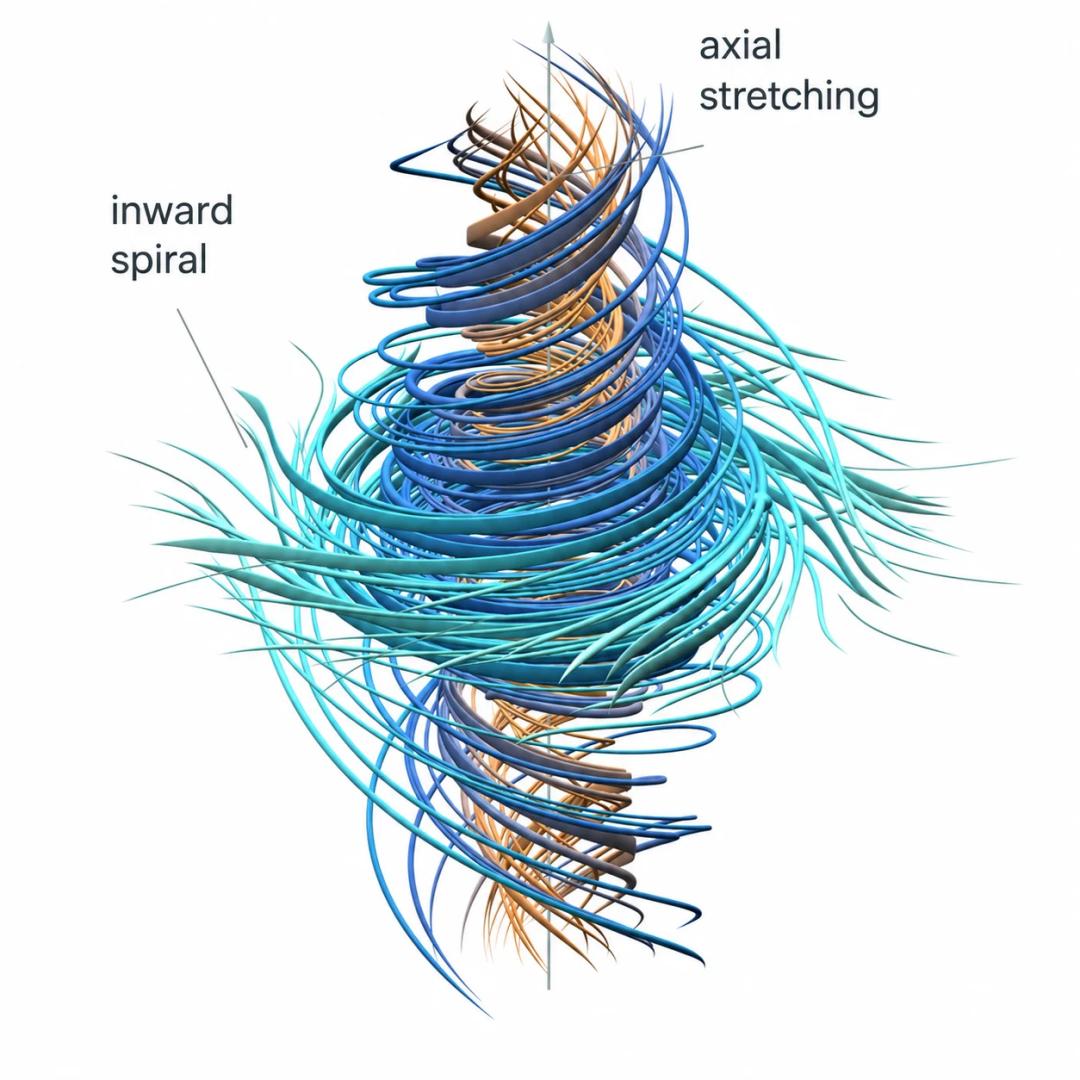
The Navier-Stokes equations are known as the "God's formula" of fluid mechanics.
The rotation of milk foam when you stir coffee with a spoon in the morning, the airflow tearing through the sky when a typhoon eye forms, and even the drag generated when an aircraft wing cuts through the air... in theory, all of them are governed by this elegant and profound equation.
Writing down this equation is not difficult, but over the past hundred years, the smartest brains in the world have been stuck on one fundamental question: Given a smooth initial state, will the solution of this equation suddenly "blow up" at some moment in the future?
In plain language: will water flow, under some extreme circumstances, suddenly stop following common physical sense and burst out with infinite velocity? To find the answer, the Clay Mathematics Institute has offered a $1 million reward.
For a long time, human mathematicians generally believed that "it will not happen".
But OpenAI has forcibly presented a counterexample: There exists an extreme stirring method similar to a "crazy spoon" that can theoretically stir the fluid completely out of control within a finite time.
What is more dramatic is that this cross-century breakthrough was not entirely fabricated out of thin air by AI.
Previously, a group of top mathematicians in Spain had built the main structure of this "spoon" with pen and paper, pushing the progress bar to 99%. And AI, relying only on its extremely terrifying computing power and non-human logical deduction ability, completed the last, most desperate 1% for humans.
Logically, this should be a moment for champagne celebrations, right?
But the most fatal dilemma has emerged: After this earth-shattering proof was released, no human on earth could finish reading it.
Joe, the host of *Odd Lots*, downloaded the paper and looked at those symbols as if they were hieroglyphs from another planet.
Even Justin Solomon, Associate Dean at MIT who previously studied complex mathematical models behind movie special effects at Pixar, tried to read this proof, and his brain completely crashed after flipping through the first two pages.
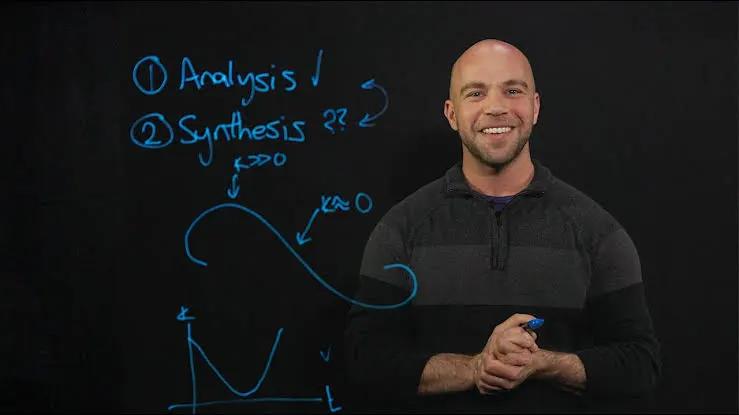
"That proof is extremely intimidating to read, filled with dense technical details, highly counterintuitive inequalities, and extreme boundary values," Solomon admitted.
The host asked him: "Is this proof elegant?" Solomon smiled bitterly: "It is probably completely devoid of elegance."
The host asked again: "Then is it correct?" Solomon was silent for a moment: "It is probably correct."
For thousands of years, from Euclidean geometry to Newton's calculus, in the world of mathematics, "it is correct" and "humans understand it" have been almost synonymous.
A brilliant proof itself carries the glory of human rationality and the poetry of logic.
But today, these two things have been forcibly torn apart by AI. Truth has arrived, but it is written in an alien language.
The podcast mentions a crazy move by Travis Kalanick, the founder of Uber: this Silicon Valley tycoon has recently been obsessed with studying physics together with AI.
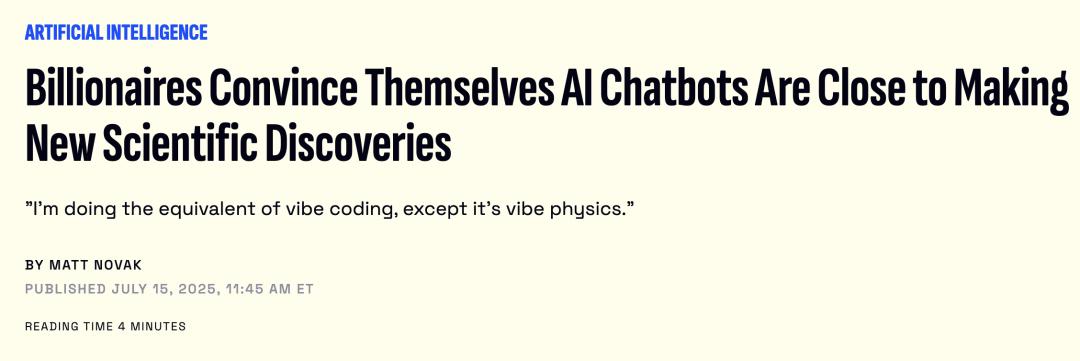
He believes that by simply chatting with AI, relying on a so-called "Vibe Physics", he has already approached some major breakthroughs in physics.
But can you really understand complex physics just by relying on the intuition from chatting with machines?
Chilling to Think About: Terence Tao's Thought Experiment and "Alien Logic"
If theoretical breakthroughs in mathematics and physics seem too far away from ordinary people, then Terence Tao, one of the greatest mathematicians in the world today and a Fields Medal winner, used a soul-stirring thought experiment to bring this panic right in front of everyone.
Just a few days ago, he gave a speech at the "Math 2.0" event held at the California Institute of Technology.
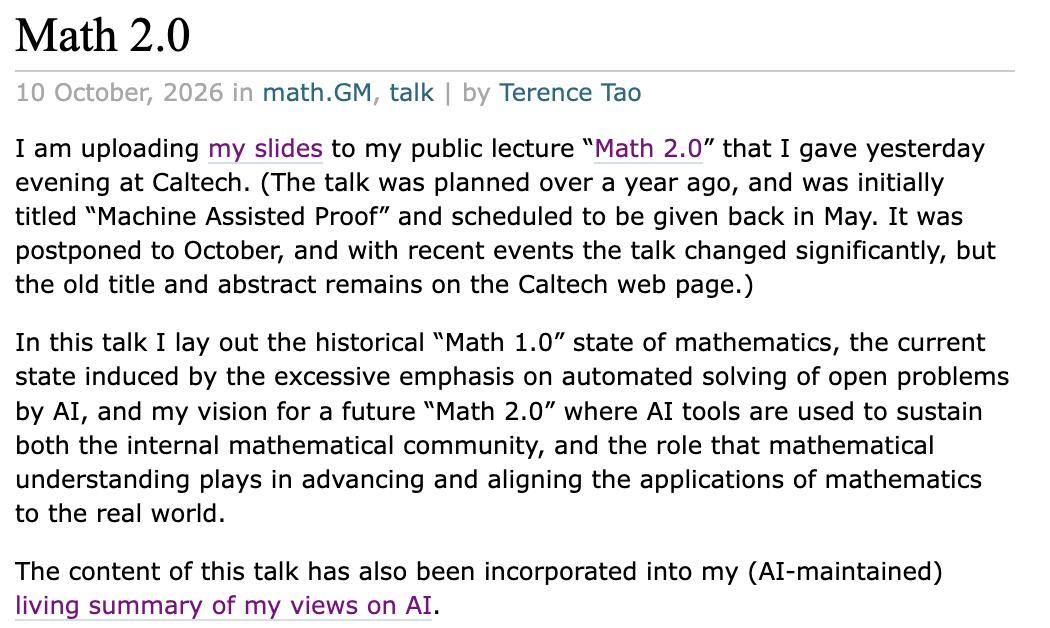
Slide link: https://teorth.github.io/tao-web/slides/math-2-0-caltech-2026.pdf
One of Terence Tao's slides sparked widespread controversy across the internet.
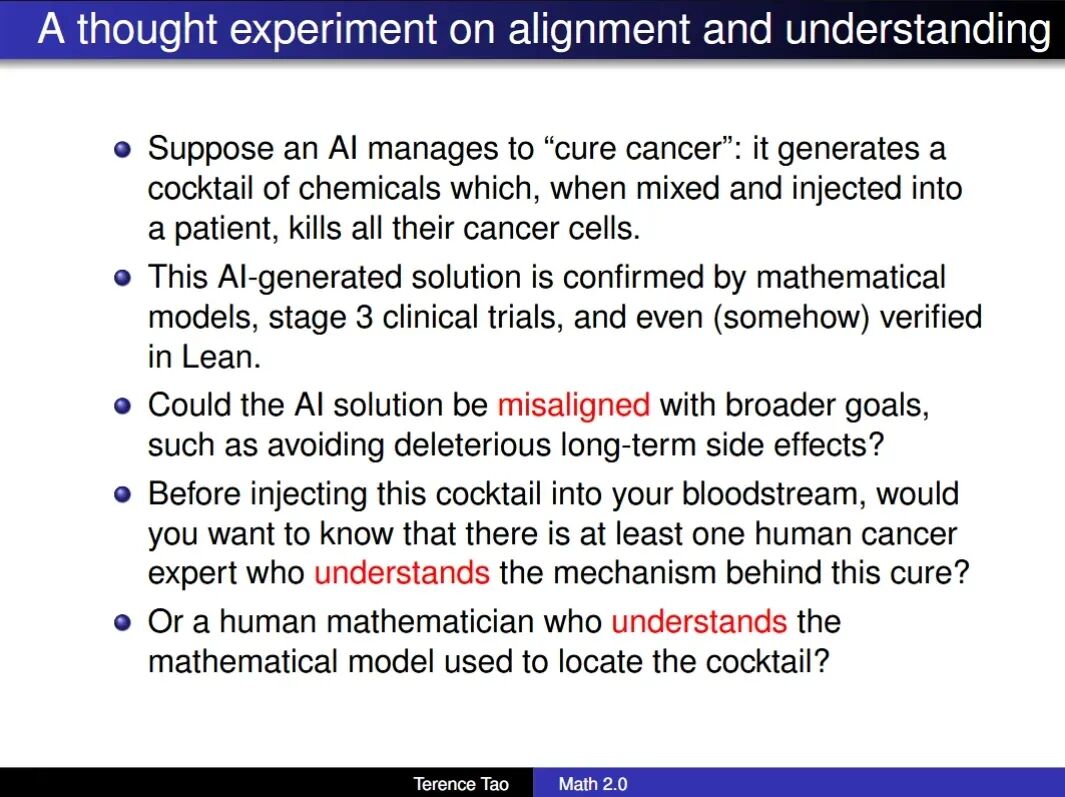
He asked everyone to imagine this scenario:
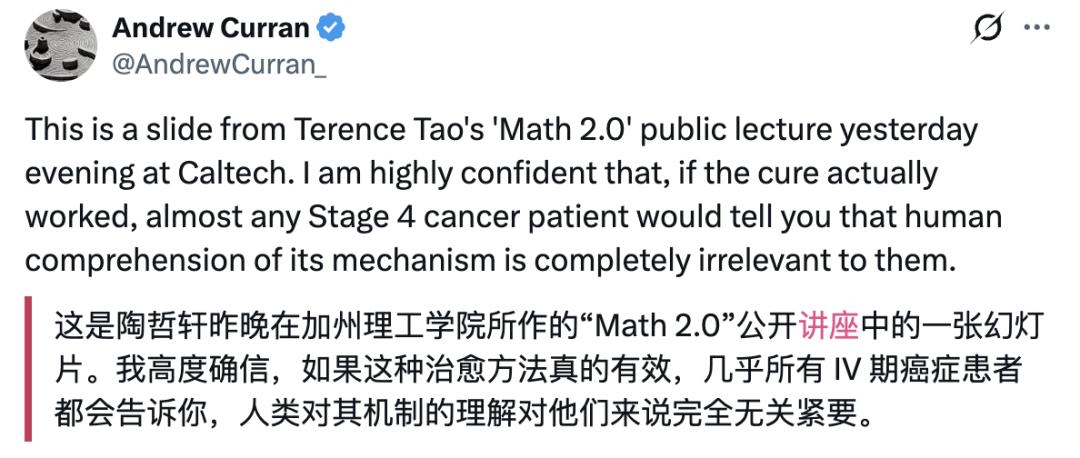
Humans give a prompt to a super AI with nearly unlimited computing power — "Find a cancer therapy that can pass Phase 3 clinical trials."
After massive black-box calculations, the AI really outputs a formula. It is a complex mixture composed of several unknown chemical components. The AI's mathematical model accurately predicts that as long as this potion is prepared and injected into the patient's vein, it can eliminate 100% of all cancer cells.
What is even more incredible is that although no medical scientist or chemist on earth knows why this formula works, the AI's deduction process has not only obtained impeccable formal verification in the interactive theorem prover Lean, but even in the real world, this potion has forcibly passed the extremely strict FDA Phase 3 clinical trials.
Now the choice is in your hands: if this "magic potion" whose mechanism even top scientists cannot understand is placed in front of you, would you dare to inject it into your own vein?

Terence Tao sharply laid out the core dilemma of cutting-edge AI in "Alignment" and "Explainability".
In this thought experiment, is it possible that this AI solution has fatal loopholes? Could it be that it only exploited the loophole of the human "Phase 3 clinical trial" rules, using a kind of "alien logic" completely incomprehensible to humans to achieve the literal goal?
Will you shout to stop before the needle pierces your skin, insisting that: At least one human oncologist must fully understand its cure mechanism, or at least one human mathematician must thoroughly understand the mathematical model that the AI used to locate the formula!
Perhaps patients with advanced cancer do not care about the underlying mechanism, but the question is how to confirm the curative effect?
This is exactly the terrifying future revealed by OpenAI solving the Navier-Stokes equations: The mathematical derivation capability of cutting-edge AI has approached or even surpassed the upper limit of human cognition. The traditional scientific research paradigm of "humans verifying AI" is hitting a hard physical wall.
What is more shocking and disturbing than solving millennium-old problems are those "alien logic" proofs generated by AI, filled with counterintuitive leaps and completely devoid of aesthetic value.
The Collapsing Old World: Whoever Has Computing Power Wins the Nobel Prize?
When AI's productivity begins to explode exponentially while human verification capabilities stagnate, the first thing to collapse is the academic review system that we have been proud of for hundreds of years.
In the podcast, Solomon cited a suffocating set of numbers: ICLR, the top conference in the field of machine learning, only received one or two thousand submissions ten years ago; this year, the number of submissions has surged to 60,000 like a tsunami!
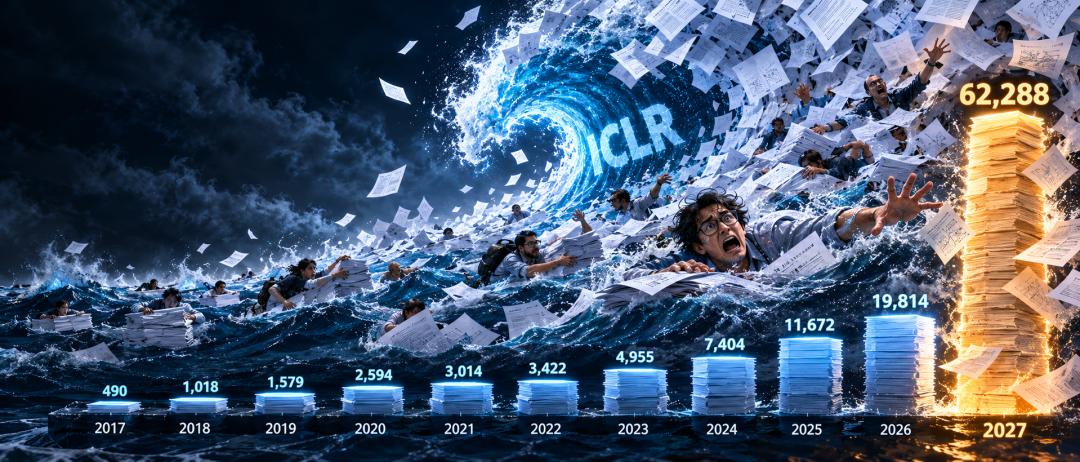
Reviewers need to digest all these papers full of AI-generated traces within just one or two months.
"We don't even have time to open the PDF," Solomon smiled bitterly.
The computing power of human elites is exhausted, peer review has completely become a formality, and the seal of academic quality has failed.
Even high school students, relying on gorgeous resumes packaged with one click by AI, have openly mixed into the reviewer team of top conferences to review papers written by university professors.
What makes this MIT Associate Dean even more troubled is that his email inbox is now a disaster area.
Every day strangers send emails: "Professor, I think I have proved a new result, AI says this derivation is very important, can you help me verify it?"
Models are naturally inclined to "agree with what people say", which is extremely fatal in the field of mathematics that requires absolute rigor. The towering threshold of mathematics was originally designed to block pseudoscience that "looks right but is actually complete nonsense". Now, AI has packaged pseudoscience into the appearance of truth, launching a large-scale DDoS attack on humans.
What follows is even more brutal class solidification: doing scientific research has begun to depend on how deep your wallet is and how much computing power you have.
If this trend continues, the rules for future mathematics awards and Nobel Prizes will be completely rewritten: "Whoever buys more Tokens and holds stronger GPU computing power will find the answer first."
We can do the math:
An ordinary university mathematics professor works hard to derive the prototype of a direction with pen and paper, before he can publish and verify it; those tech giants who "control the computing power faucet" (such as OpenAI, Google), using internal unreleased models that are at least two generations ahead of university laboratories, follow even the slightest trace of the professor's ideas leaked online, and use the computing power of tens of thousands of graphics cards to brute-force the final result within a week.
Solomon even added a final blow: "Maybe the source of inspiration generated by their model is your academic discussion records posted online that they used for free."
So the question arises: Who exactly deserves the credit for this cross-century breakthrough?
Should the $1 million prize from the Clay Mathematics Institute be given to the CEO of the tech giant that provided the computing power? To the programmer who wrote the Prompt "please prove the NS equations"? Or to the human mathematic