Industrial storage is evolving once again, with MRAM taking the baton for the next generation.
Industrial storage is a low-profile yet critical niche segment in the semiconductor industry. Unlike consumer-grade storage which prioritizes capacity and cost, industrial storage places far greater emphasis on reliability, such as 24/7 uninterrupted operation, wide temperature range from -40℃ to 125℃, resistance to strong vibration and electromagnetic interference, frequent unexpected power outages, and more. These operating conditions mean that consumer-grade storage devices cannot be directly applied to industrial equipment, making "industrial-grade" a clear product category independent of consumer-grade and automotive-grade storage.
For decades, industrial storage media have undergone several iterations, but no perfect solution that meets all core requirements at the same time has ever been delivered. It was not until the MRAM technology matured that industrial storage media seemed to find the "perfect answer" for the first time. As the only domestic manufacturer that has achieved mass production of MRAM, Chitai Technology has built its own 12-inch production line and taken the lead in bringing this medium to industrial sites.
The Dilemma of Industrial Storage Media
Looking back over the past 30 years, the selection of industrial storage media has gone through several rounds of updates, each of which represented the elimination of old media by new demands.
The 1970s and 1980s: The Era of EPROM and EEPROM. The program and parameter storage of early industrial control computers relied on Erasable Programmable Read-Only Memory (EPROM). EPROM required ultraviolet erasure and full-chip rewriting, which was extremely inconvenient for maintenance. EEPROM realized electrical erasure and supported byte-level rewriting, with much better maintainability than EPROM, but its erase-write lifespan was only at the order of 10⁴~10⁵, featuring slow writing speed and limited maximum capacity. Storage products in this period only solved the basic problem of "reprogrammability", and were far from meeting high reliability indicators.
The 1990s: NOR Flash Took Over. As flash memory processes matured, NOR Flash quickly replaced EEPROM as the mainstream for code and parameter storage in industrial control computers thanks to its low cost, fast reading speed and complete supply chain, a position it has maintained to this day. However, it inherits the underlying limitations of EEPROM: its erase-write lifespan is only at the order of 10⁵, which is insufficient for high-frequency data recording; the "erase-before-write" mechanism not only increases the complexity of instructions and circuits, but also brings data management risks with each write operation. This compromise is most fully reflected in smart meters. For example, the metering and load curve data of electricity meters need to be written continuously at the second-level frequency, but the lifespan of flash memory cannot support this, so the industry has formed a set of complex technical conventions: "save" the flash memory through software algorithms, design redundant storage, and move data regularly. A lot of energy of engineers is not spent on business functions, but on maintaining the lifespan of the medium.
The SRAM + Battery/Supercapacitor + Flash/EEPROM Scheme Emerged. As the demand of industrial equipment for data retention after power failure became clear, the combination of "SRAM speed + battery retention capability" became the classic solution for power-off data recording. However, power-off data retention relies entirely on the battery, so operation and maintenance teams must conduct regular inspections and replacements; once the battery fails and is not detected, data will be lost. The most typical case is PLC. As the core of the industrial automation system, PLC generates process and result data in real time during operation, which puts forward requirements for fast read/write speed and tens of billions of erase-write cycles for the memory, exceeding the capability of conventional non-volatile memory at that time. Therefore, the SRAM + battery scheme became the standard configuration. Even today, many PLC motherboards still have a reserved space for the button battery compartment.
Attempts of Other Parallel Routes: NVRAM. The industry has never stopped exploring Non-Volatile Random Access Memory (NVRAM), and there are mainly three types of solutions: FRAM (Ferroelectric RAM), NVSRAM and MRAM. Among them, FRAM has excellent erase-write resistance, but its capacity is limited and cost is relatively high, making it difficult to handle data recording of medium and large capacity (above 4Mb); NVSRAM needs to be equipped with a supercapacitor to support data writing after power failure, and its capacity is limited (no more than 4Mb) with high cost; MRAM requires no capacitor, has sufficient erase-write resistance and supports capacities of 16Mb and 64Mb levels.
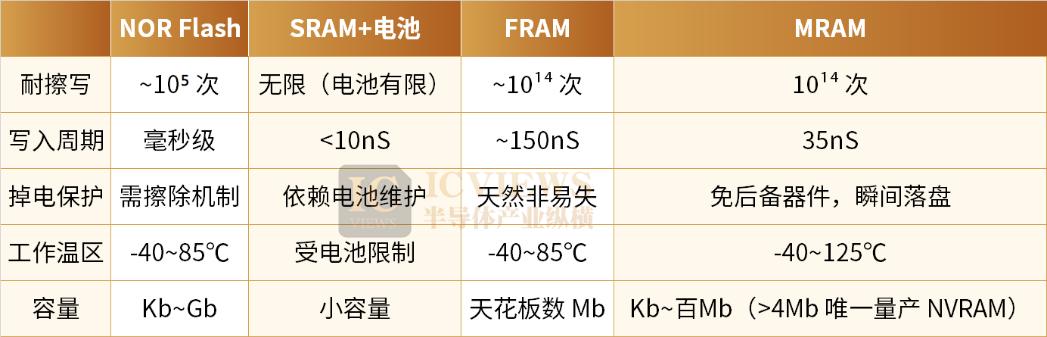
Essentially, the requirements of industrial control computers for storage can be summarized in four points: no damage from repeated writing, no data loss after power-off, adaptability to wide temperature range, and maintenance-free. The application of each generation of medium solved one pain point of the previous generation, but left new shortcomings. No traditional route can meet all four requirements at the same time, and most solutions achieve compliance through "combination" and "compromise".
High-Reliability Industrial Scenarios Push Storage Requirements to the Extreme
The shortcomings that have remained unsolved for 40 years are particularly prominent in high-reliability industrial scenarios. There are a large number of real-time control devices in industrial sites, which need to save key data such as device status and system logs in real time and quickly; industrial control devices also need to withstand harsh environments such as high temperature and vibration; in addition, to avoid data loss caused by abnormal power failure, industrial control devices usually need to use backup batteries.
More severely, high-reliability industrial scenarios such as petrochemical, electric power and rail transit require a device life cycle of more than 15~20 years, making long-term maintenance-free operation a mandatory requirement; edge intelligent devices are often deployed in unattended sites or sites with extremely high maintenance costs, and each replacement of components means substantial operation and maintenance expenditure. The criticality and long lifespan push the requirements for industrial storage to the extreme.
The specific manifestations of these extreme requirements are as follows, first, the erase-write resistance reaches the order of 10¹⁴ (trillion) cycles. In high-frequency recording scenarios, the 100,000 erase-write cycles lifespan of traditional flash memory may be exhausted in a few months, and the medium will be scrapped before the device, which is an unacceptable failure mode in industrial sites. Second, non-volatility after power-off and data retention for more than 20 years. After industrial equipment is put into operation, it rarely shuts down, so data retention must be calculated in units of ten or twenty years; and this capability cannot degrade with erase-write wear, which is precisely the Achilles' heel of all EEPROM/Flash devices. Third, the writing speed is sufficient to support safe data writing the moment power failure occurs. True reliability does not lie in "using a battery as a backup", but in completing the writing of key data within milliseconds of unexpected power failure. This requires a write cycle of several tens of nanoseconds, and does not rely on any backup components that need maintenance. Fourth, the capability of working in a wide temperature range from -40~125℃. On-site environments such as rail transit, electric power and metallurgy put forward far higher requirements for component temperature adaptability than consumer-grade products. Fifth, capacity coverage capability. Edge intelligence also increases the volume of key data layers, with operation logs growing from several Kb to several Mb or even more, and fault recording needs to record waveform data of minutes or even hours. A reliable medium must cover the full range from Kb to hundreds of Mb. Although FRAM has good performance, its capacity ceiling is at the level of several Mb, which cannot meet the demand for medium and large capacity.
Traditional solutions can barely meet individual indicators, but when multiple requirements need to be satisfied at the same time, the old technical routes have no solution. NOR Flash fails in erase-write resistance and power-off protection; SRAM + battery fails in maintenance-free operation and capacity; supercapacitors fail due to hidden failures; FRAM fails due to the capacity ceiling. Industrial storage requires evolution at the medium level.
MRAM: The "Re-evolution" of Industrial Storage
MRAM (Magnetoresistive Random Access Memory) is a non-volatile magnetic random access memory that stores data using the magnetoresistance effect. Different from traditional semiconductor Random Access Memory (RAM), MRAM uses Magnetic Tunnel Junction (MTJ) as the storage unit to record binary data by changing the magnetization direction. This physical mechanism determines its inherent advantages: the magnetic state is naturally retained after power off, which means it is inherently non-volatile; writing is completed by flipping the magnetization direction with current, and its read-write speed is close to that of SRAM; and it supports byte-level random addressing. In other words, MRAM inherently has the speed of RAM and the non-volatility of Flash at the underlying level, and is regarded as the practical answer to "ideal storage".
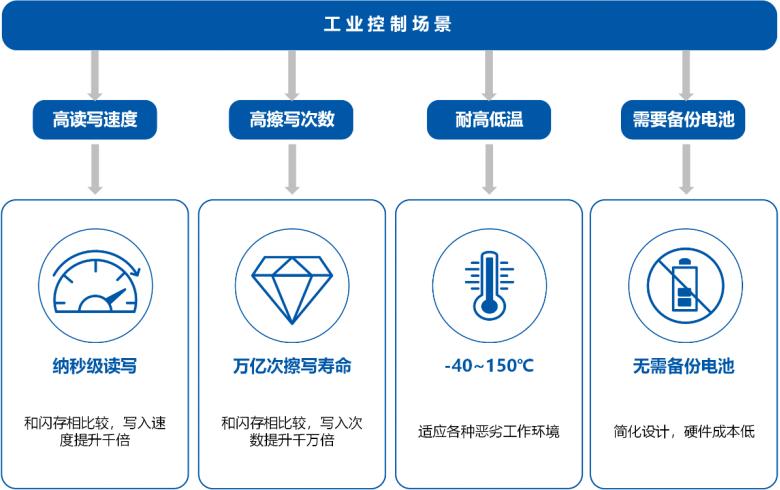
In terms of parameters, MRAM has excellent indicators, specifically: the 10¹⁴ erase-write resistance means that even with one million writes per second, it can operate stably for ten years, completely eliminating lifespan anxiety in high-frequency recording scenarios; the 35 ns high-speed write cycle allows key data to be safely written the moment power failure occurs, no capacitor or battery is needed, eliminating the cost of regular maintenance and hidden failure risks from the source; byte-level addressing and no need to erase before writing simplify the design of circuits and instructions, making the entire data path more concise and reliable. At the same time, its product line covering capacities from Kb to hundreds of Mb makes it the only solution for medium and large capacity (>4Mb) among currently mass-produced NVRAM products, with applicable landing paths for parameter configuration areas, device log areas and real-time data cache areas.
More importantly, MRAM is no longer in the conceptual stage. Domestic manufacturer Chitai Technology has built its own 12-inch MRAM production line, which is the only domestic manufacturer capable of providing mass-produced MRAM products. It has 90nm, 40nm and 28nm mass production platforms, and can provide standalone MRAM products and customized embedded IP development services. At present, Chitai MRAM has been applied in industrial scenarios such as fault recording, high-frequency log recording and wide-temperature data storage, providing a mass-production verified storage base for high-reliability industrial control equipment.
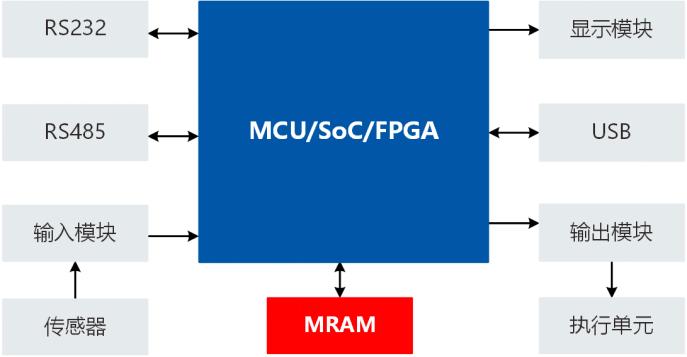
PLC Functional Block Diagram
By adopting the MRAM solution, the battery can be removed from PLC. It is understood that the sampling frequency of PLC digital input modules is as high as 500Hz. Calculated based on a 20-year device lifespan, the total number of writes is as high as 300 billion times, which far exceeds the erase-write lifespan of traditional non-volatile flash memory. Chitai MRAM eliminates three core risks with a single device: trillion-level erase-write cycles cover all writes throughout the full life cycle, nanosecond-level writing ensures data is saved the moment power is cut off, and the battery as a failure point is completely removed from the solution, making PLC storage design maintenance-free for the entire life cycle for the first time.
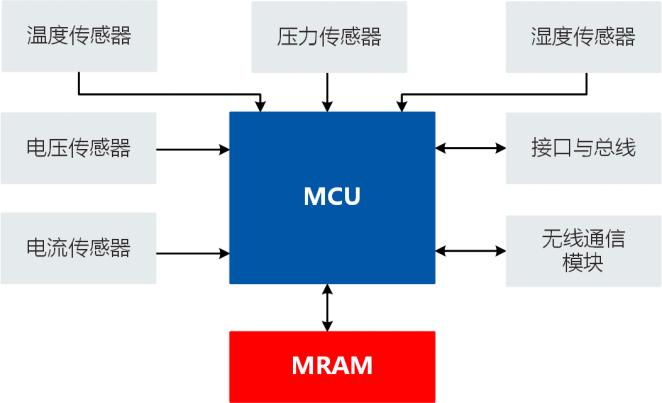
Smart Meter Functional Block Diagram
In terms of smart meters, the 2020 edition of technical specifications for smart meters requires that the service life of electricity meters shall not be less than 16 years. Calculated at a data saving frequency of 1 time per second, 500 million metering data and load curve data need to be saved within 16 years. Chitai MRAM has a trillion-level erase-write lifespan and nanosecond-level writing speed, eliminating the need for software workarounds for the insufficient read-write cycles of traditional non-volatile memory, and directly covering the demand with its inherent device performance.
The Next Stop of Industrial-Grade Storage
The evolution history of high-reliability storage in industrial scenarios is essentially a history of "using more reliable media to cope with more stringent scenarios": from Flash to ferroelectric memory, from battery backup to capacitor buffering, each generation of solutions is approaching the limit, but never can reach the end point of "no damage from repeated writing, no data loss after power-off, wide temperature adaptability, maintenance-free" at the same time.
The emergence of MRAM makes this long journey of approaching the goal see the finish line for the first time. For the domestic industrial industry, the significance goes far beyond a new component. At the moment when supply chain security is becoming increasingly important, the completion of Chitai Technology's 12-inch MRAM mass production line means that the underlying capability of storage for high-reliability industrial scenarios has been localized for the first time. From components to the entire ecosystem, the next stop of industrial-grade storage has already begun.
This article is from the WeChat Official Account "Semiconductor Industry Review" (ID: ICViews), written by Peng Cheng, and authorized for release by 36Kr.