How is the chip industry caught in a stranglehold? The latest assessment from the United States
The U.S. Semiconductor Industry Association (SIA) stated in a recently released report that semiconductors are critical to the U.S. economy and national security, supporting a wide range of applications spanning from smartphones, artificial intelligence (AI) infrastructure to medical devices, automobiles, manufacturing equipment and national defense systems.
For decades, the highly interconnected global supply chain has helped U.S. chip enterprises steadily improve performance while reducing costs. However, various new challenges in recent times have exposed the fragile links in the global upstream supply chain that underpin the U.S. chip ecosystem, highlighting the urgency of taking immediate action to build a trusted and reliable supply chain and reduce strategic dependencies.
In the report, SIA sorts out the categories of key materials and equipment used in U.S. semiconductor production, reveals the weak links in the supply chain at risk of disruption, and outlines the key measures required to strengthen the U.S. semiconductor supply chain.
Key Findings:
1. The semiconductor supply chain has a multi-tier structure and is highly geographically dispersed.
The semiconductor manufacturing process takes several months and requires sourcing various materials, equipment and components from multi-tier suppliers across the globe. Although 95% of the equipment and materials worth approximately $27 billion consumed by U.S. semiconductor enterprises come from suppliers headquartered in the United States, Europe and Japan, the actual production and manufacturing of these inputs are spread across all regions of the world.
2. The equipment and materials required for semiconductor production in the United States rely on fragile links hidden deep in the upper reaches of the global supply chain.
Many Tier 1 inputs used in semiconductor production themselves depend on lower-level raw materials and system sub-components that face high risks of supply disruption. These fragile links deeply embedded in the upper reaches of the supply chain exacerbate the risks faced by the semiconductor ecosystems of the United States and its partner countries.
3. Ensuring semiconductor supply chain security requires a set of mitigation strategies.
Building a stronger semiconductor supply chain to support the U.S. semiconductor ecosystem requires coordinated action between the government and the industry, as well as collaboration with like-minded global partners and allies. The U.S. government and the industry should commit to implementing the following strategies:
Expand domestic production and strategic reserves. While it is neither practical nor economically efficient to relocate all materials and equipment required for semiconductor production to domestic locations, establishing or enhancing domestic production capacity for several key inputs is a feasible and critical near-term strategy. For other inputs, building new production capacity in the United States may take a decade or even longer, followed by additional time for semiconductor production qualification certification of the materials. The government should work closely with the industry to identify and prioritize targets for localized production and strategic reserves.
Build and maintain supply chains among allies. The supply chain underpinning the U.S. semiconductor ecosystem is global by nature. Maintaining and consolidating strong trade relations with allies and partner countries/regions, while investing in complementary supply chain capabilities, is essential to enhance the resilience of the U.S. semiconductor ecosystem.
Reduce dependence on unreliable sources of rare earths and critical minerals. Recent export restrictions on critical minerals and rare earth elements have highlighted the urgent need to build new mining and processing capacities in the United States and its partner countries/regions. Adopting coordinated policies, such as long-term off-take agreements, is critical to sustaining demand for new critical mineral production capacity.
Increase R&D investment. Governments of the United States and its partner countries/regions should increase and continuously allocate funding to support R&D in materials science, chemistry and engineering, to develop next-generation semiconductor materials and recycling process technologies.
Building a trusted and reliable supply chain to support the U.S. semiconductor ecosystem requires ongoing coordination and cooperation among the government, the industry and international partners.
The conclusions of this report help reduce the risk of future supply chain disruptions, consolidate key supply chain partnerships, and enhance the U.S. leadership in the chip sector in the long run.
Introduction
Semiconductors are the cornerstone and key enabler of all industries and emerging technologies driving U.S. economic development. Whether it is cutting-edge logic chips, analog and mixed-signal chips, compound semiconductor devices or memory devices, their production process often takes months, involves multiple cross-border shipments, and relies on a precisely coordinated, hierarchical supply chain composed of highly specialized materials and equipment. Only by ensuring the on-schedule and sufficient supply of these categories of materials can the needs of the industry be met — the global sales of this industry are expected to exceed $1.5 trillion in 2026.
As the U.S. Department of Commerce pointed out in its 2023 "Assessment of the U.S. Microelectronics Industrial Base" report, semiconductor manufacturing "requires hundreds of different materials with extremely high quality requirements", and "maintaining a robust domestic semiconductor manufacturing base is inseparable from a strong materials supply chain that can withstand regional or enterprise-specific shocks". In recent years, the global supply chain supporting the semiconductor industry has been repeatedly disrupted by factors including natural disasters, the COVID-19 pandemic, supply-demand imbalances and various government measures (see Figure 1). As enterprises invest in building domestic semiconductor manufacturing capacity in the United States, key weak links in the upstream supply chain have raised growing concerns that these hidden risks may hinder capacity expansion and cause project delays.
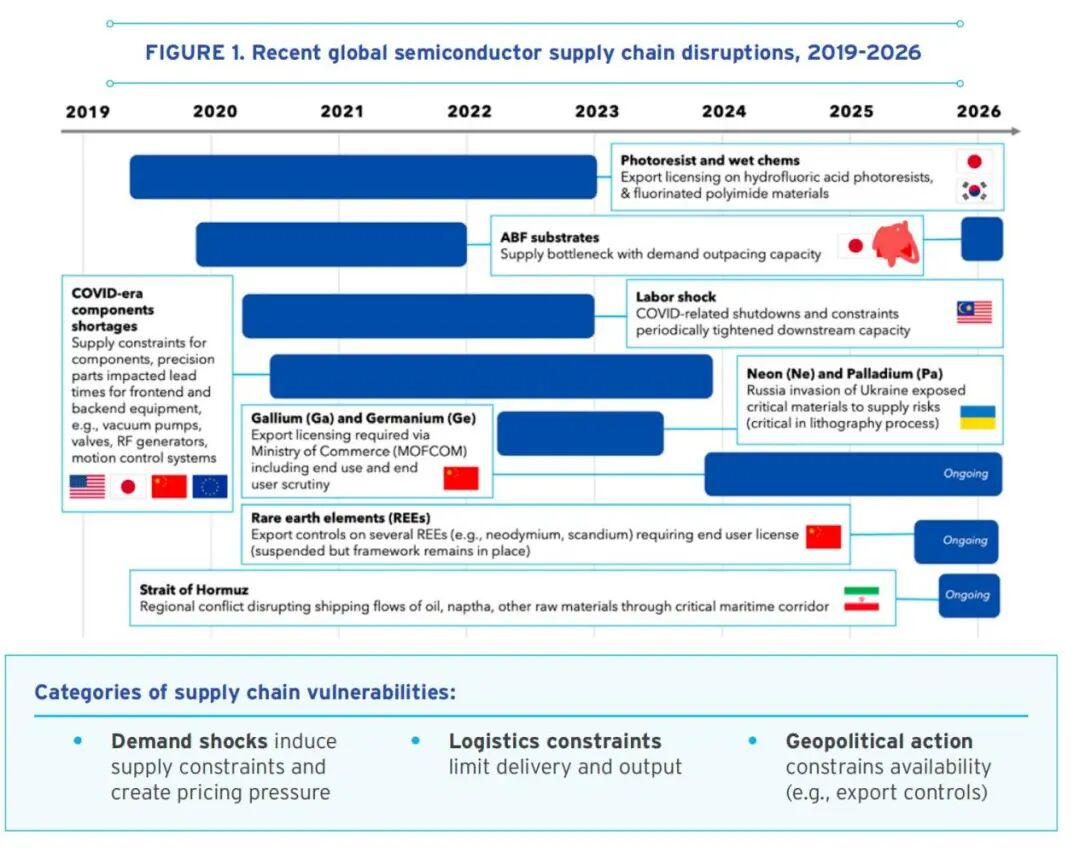
Certain supply vulnerabilities (such as rare earth issues) are well known; however, other material dependencies that seem to carry lower risks may have vulnerabilities deeply hidden in the upstream supply chain, which often only become apparent when supply disruptions occur. To address the deep-seated vulnerabilities in the global supply chain supporting the U.S. semiconductor industry, industry leaders and policymakers must first clarify which supply chain dependencies pose the greatest risks.
To this end, the Semiconductor Industry Association (SIA) of the United States collaborated with heads of procurement, supply chain and strategy across enterprises in the semiconductor ecosystem — covering chip manufacturers, fabless chip design firms, back-end packaging enterprises, equipment manufacturers and material suppliers — to conduct a non-exhaustive review and mapping of the upstream supply chain supporting the chip industry, aiming to answer the following questions:
Which upstream input factors pose severe vulnerabilities to the U.S. semiconductor ecosystem, and why?
Which materials and equipment used in semiconductor production themselves rely on supply chains with existing vulnerabilities?
What measures can government and industry stakeholders take to mitigate these vulnerabilities and build a more resilient supply chain to support the development of the U.S. semiconductor ecosystem?
Quantifying Vulnerabilities
Supply chain dependencies refer to the suppliers, materials, equipment and services that semiconductor industry participants rely on to support their design and manufacturing operations. "Vulnerability" refers to the weak points in the network of these suppliers and inputs, which face higher risks of supply chain disruption, malicious exploitation and/or policy shocks. While every material and equipment input required for chip design and manufacturing constitutes a supply chain dependency, not all dependencies create vulnerabilities, and not all vulnerabilities are high-risk.
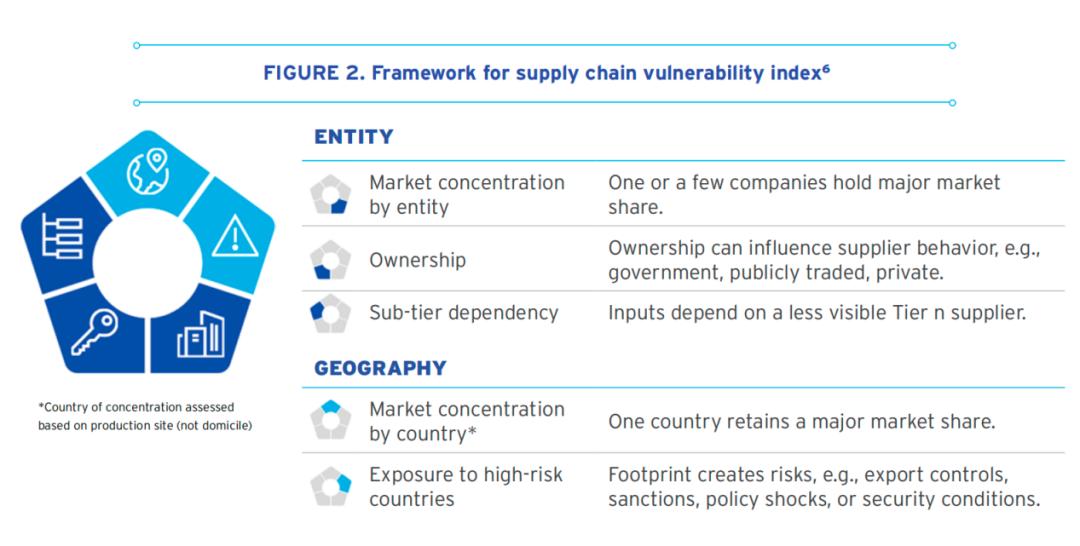
To assess dependencies that pose severe risks to the supply chain underpinning the U.S. semiconductor ecosystem, we have developed a systematic and quantifiable "Vulnerability Index" (see Figure 2) that integrates five distinct vulnerability factors. For each supply chain input included in the analysis, we assessed the geographic concentration of its production and the degree of dependency. In addition, we evaluated the supplier network for each input, taking into account supplier concentration for specific products, the ownership structure of key suppliers, and dependencies at the sub-tier supplier level. We scored each input against these five factors and aggregated them into a comprehensive index.
Assessing U.S. Dependence on the Global Supply Chain
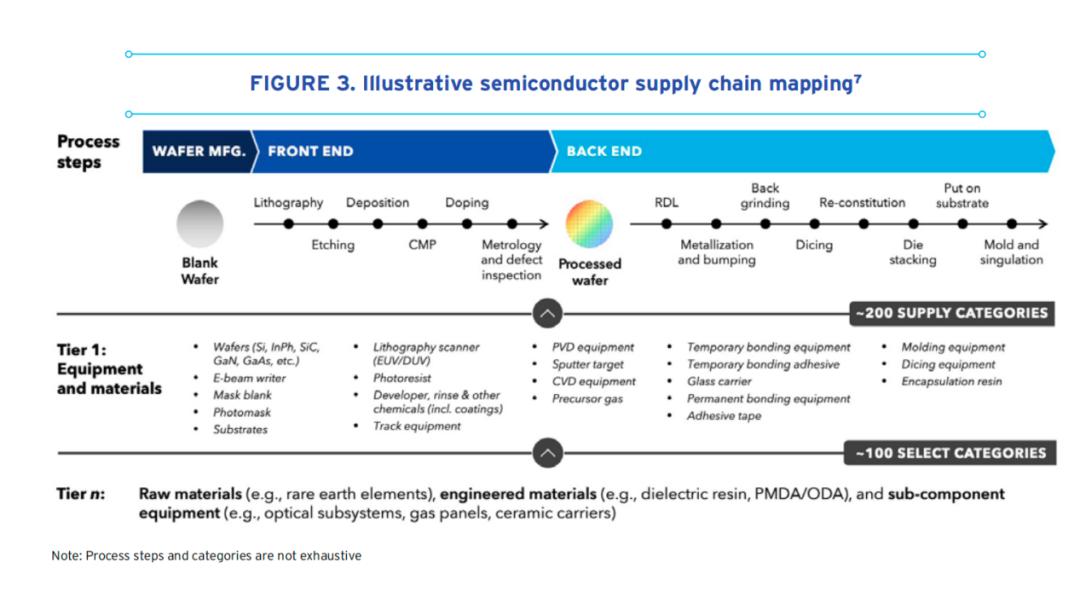
In general, semiconductor manufacturing includes "Front End" manufacturing processes performed on the wafer surface (involving the addition and removal of materials), as well as "Back End" processes that package bare dies into finished chips. Semiconductor manufacturers work with more than 1,000 "Tier 1" suppliers to directly source raw materials such as bare wafers, special gases, photoresist chemicals, and manufacturing equipment such as lithography machines and deposition equipment. Each of these Tier 1 suppliers, which directly provide materials, components and manufacturing equipment to semiconductor companies, has its own intricate "sub-tier" network of intermediate product and raw material suppliers.
For the purpose of this analysis, we identified a list of 200 key Tier 1 equipment and material inputs (covering the front-end and back-end processes of the semiconductor industry), and another list of 100 categories of raw materials, engineering materials and sub-component/equipment categories of sub-tier (or "Tier-n") inputs (see Figure 3). We then conducted a detailed supply chain mapping analysis of these inputs, examining not only the registered locations of suppliers, but more importantly, the actual geographic production locations of these inputs.
In the semiconductor sector, supply chain mapping analysis is usually based on the registered locations of suppliers, which may mask actual supply dependencies. Adding this analytical step — assessing the actual production locations of materials and equipment — is critical to uncovering unknown supply dependencies and determining which dependencies may constitute severe vulnerabilities. Collecting data for such analysis faces many challenges, requiring in-depth research and data mining, as well as verification and stress testing with industry experts familiar with detailed manufacturing processes and procurement landscapes (see Appendix).
Understanding the Tier 1 Semiconductor Supply Chain
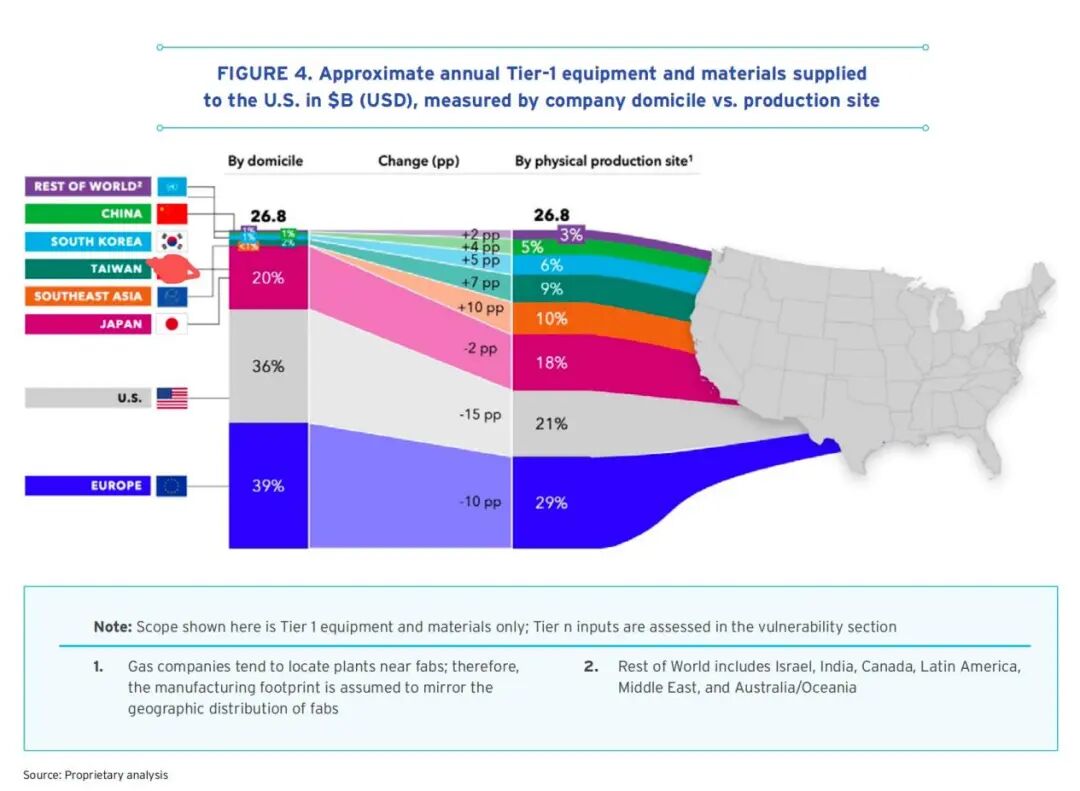
Based on the analysis of Tier 1 supply inputs, the U.S. semiconductor ecosystem spends a total of approximately $27 billion annually on equipment and materials; 95% of these supplies come from suppliers headquartered in the United States, Europe or Japan (see Figure 4). The remaining approximately 5% of supplies mainly come from companies headquartered in South Korea, Chinese Taipei, mainland China, Southeast Asia and Israel.
However, these Tier 1 suppliers often rely on production chains outside their registered locations. Therefore, to gain a more accurate understanding of Tier 1 supply chain vulnerabilities, it is necessary to assess the actual production locations of materials and equipment imported by U.S. semiconductor manufacturers. To this end, we analyzed public records (such as supplier websites, financial reports), databases (such as analyst reports) and regional sales data to estimate market shares by actual production or assembly location.
From the perspective of production or assembly locations, the resilience status of the U.S. semiconductor supply chain in terms of Tier 1 inputs and equipment presents a more complex picture (see Figure 4). The U.S. semiconductor industry's dependence on Tier 1 inputs and equipment from the United States, Europe and Japan drops from 95% of total demand to 68%; at the same time, its dependence on supplies from mainland China, Israel, Southeast Asia, South Korea and Chinese Taipei rises significantly from 5% to 32%. For example, U.S.-headquartered semiconductor manufacturing equipment suppliers assemble Physical Vapor Deposition (PVD) equipment and etching equipment in Singapore and the United Kingdom respectively.
Similarly, U.S. material suppliers also produce photoresists and ultra-high-purity gases required by semiconductor manufacturers in chemical plants in Japan, Chinese Taipei and South Korea. In contrast, bulk gases such as hydrogen and argon are usually produced by European companies, but their production processes are often carried out via air separation units near domestic semiconductor wafer fabrication facilities in the United States.
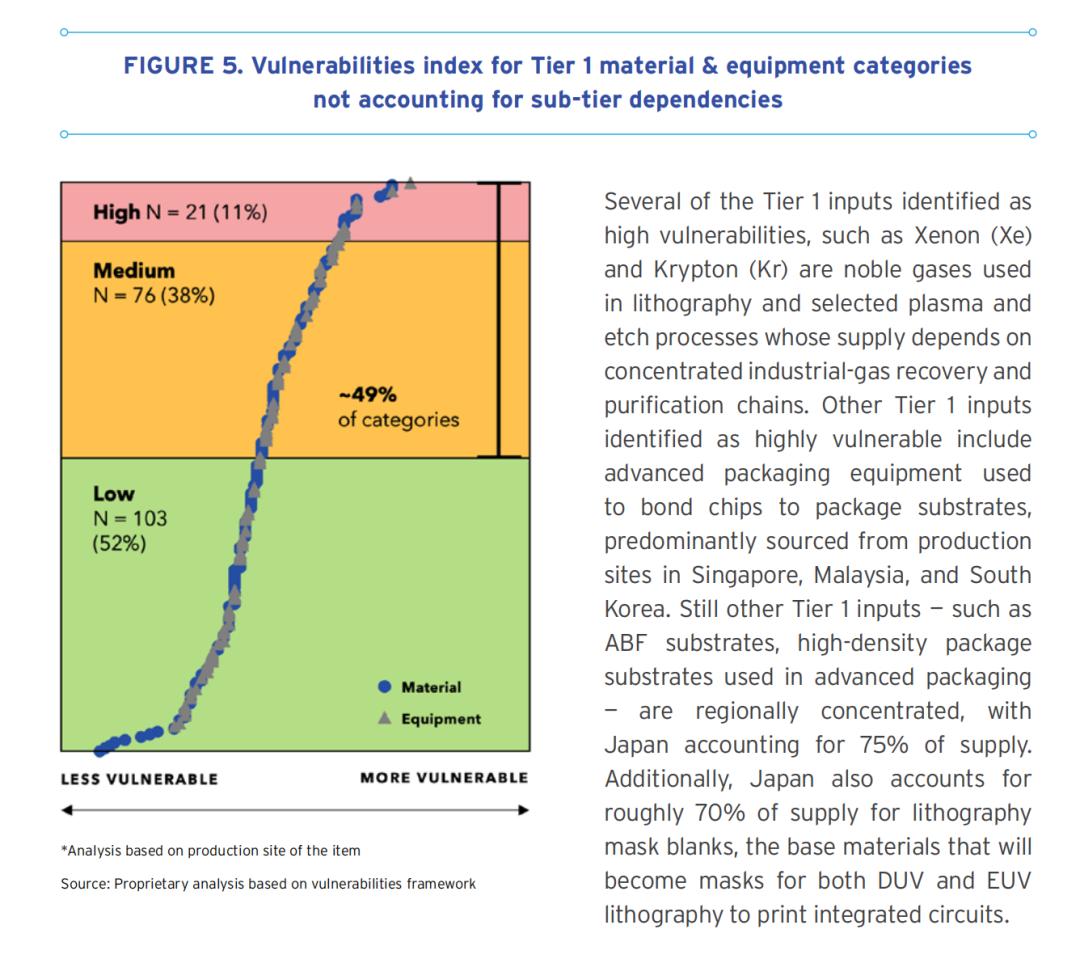
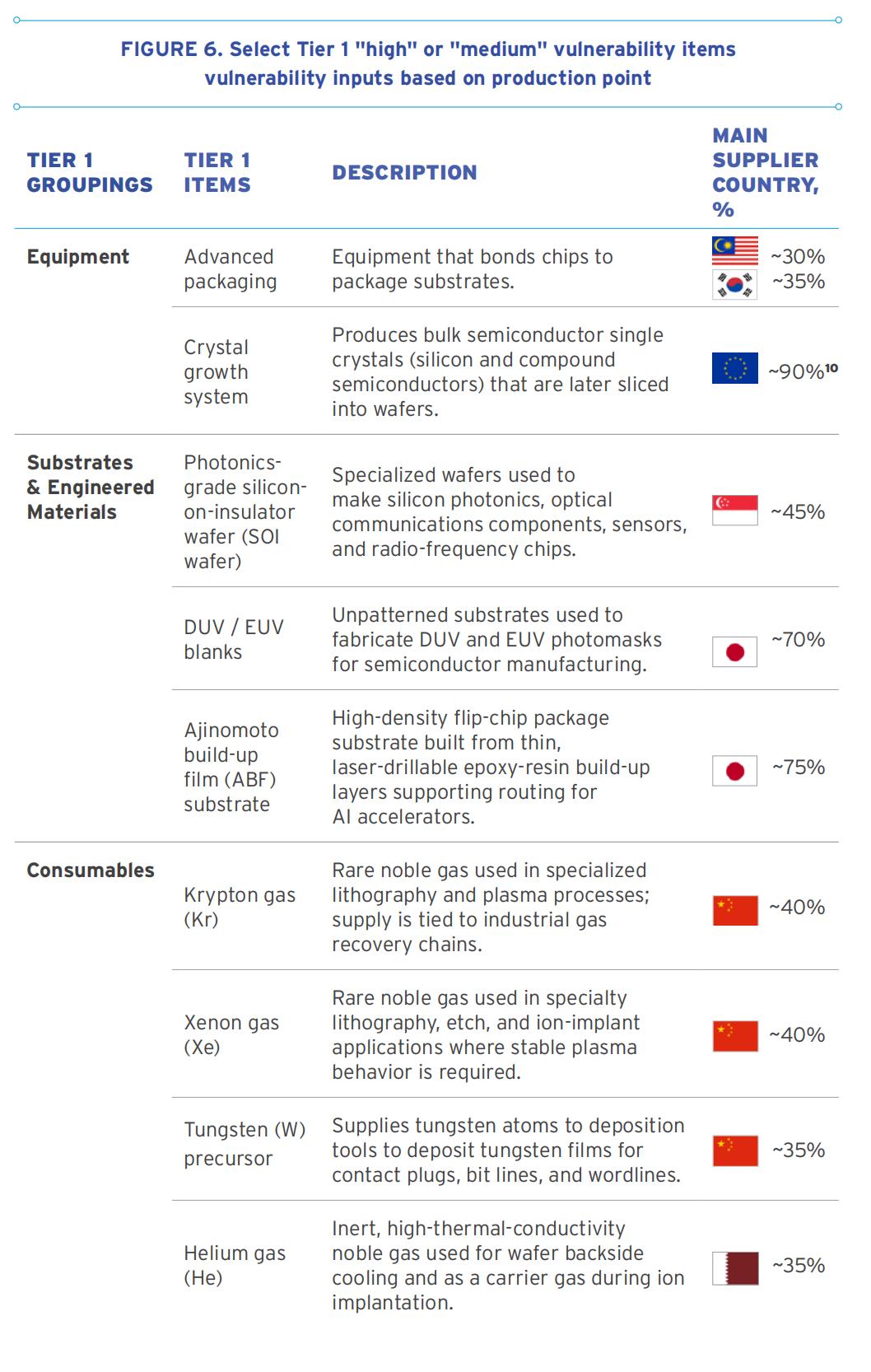
When we apply the Vulnerability Index to assess the Tier 1 supply chain dependencies of the U.S. semiconductor industry, we find that approximately half of the analyzed categories fall into "High" (11%) or "Medium" (38%) vulnerability levels (see Figure 5). These categories have higher vulnerabilities for various reasons: some are concentrated in a few production regions, some rely on very few qualified suppliers, and others face risks due to the location of their production bases.
Deep Dive — Hidden Vulnerabilities
Semiconductor manufacturers and semiconductor equipment manufacturers usually do not directly purchase raw materials from mineral producers, but source from professional material suppliers; these suppliers further process minerals into high-precision chemicals, materials or components (such as batteries and motors for machine tools). As mentioned earlier, enterprises that supply "Tier 1" inputs required for semiconductor production each rely on a "sub-tier" network of intermediate product and raw material suppliers. These sub-tier (or "Tier-n") supply chains also face disruption risks, which in turn may affect the stability of "Tier 1" supplies. For example, China has taken measures to restrict the global supply of upstream critical materials (such as gallium, germanium, graphite, tungsten, rare earths), which are important inputs for multiple Tier 1 materials and equipment that the semiconductor industry relies on. This supply chain-level influence may not be limited to critical minerals, but also extend to other materials, components and production equipment for which China is seeking to accelerate domestic substitution.
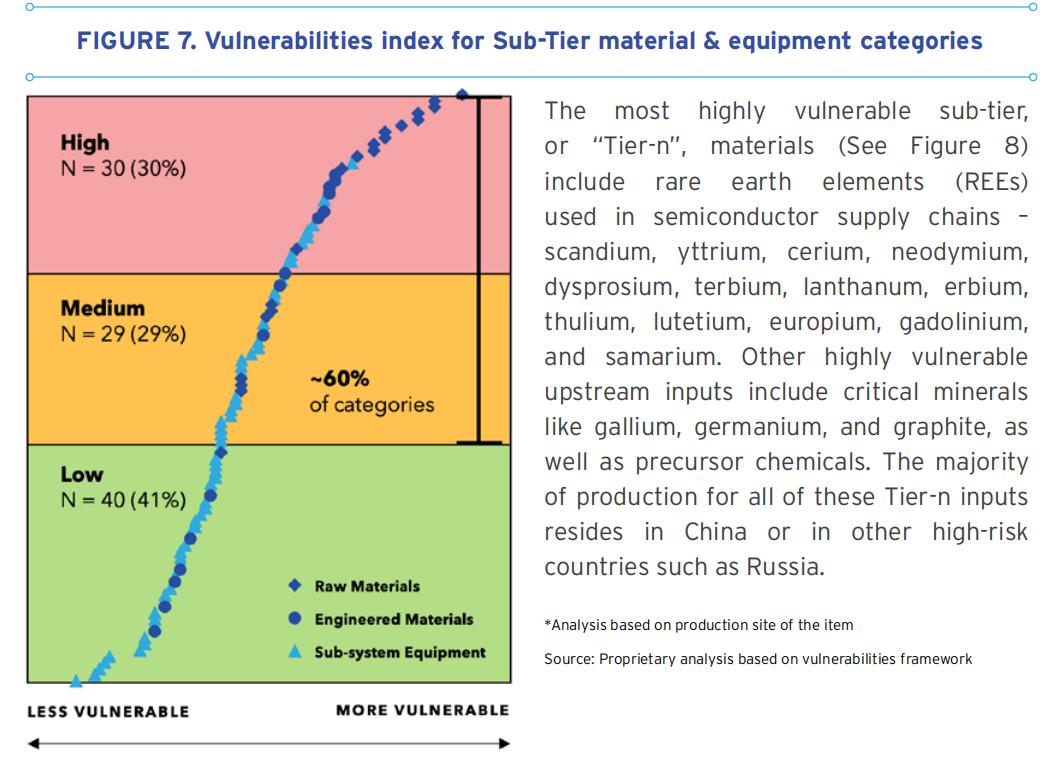
Given the complexity and multi-tier nature of the semiconductor supply chain, disruption risks accumulate and intensify as they propagate upstream along the supply chain. To identify potentially hidden deep vulnerabilities in the supply chain underpinning the U.S. semiconductor industry, we conducted detailed mapping and analysis of nearly 100 selected upstream "Tier-n" inputs, covering base materials (such as rare earth elements), engineering materials (such as photoacid generators, resins) and sub-components (such as optical elements, ceramic carriers), and carried out corresponding vulnerability assessments for these upstream inputs. This analysis helps us gain a deeper understanding of the procurement patterns of Tier 1 suppliers and identify dependencies on high-risk supply chains.
Nearly one-third of the upstream inputs we analyzed are classified as having "High" vulnerability (see Figure 7).
China's Export Controls on Critical Minerals
In 2023, the Chinese government imposed export restrictions on critical semiconductor raw materials including gallium, germanium and graphite, and these restrictions were upgraded to export bans in the following year. In April 2025, China imposed export controls on seven medium and heavy rare earth elements used in magnet production and advanced manufacturing. In October of the same year, the scope of controls was further expanded to cover more types of rare earths, mining, beneficiation and smelting equipment, and rare earth-related technologies.
Recent trade data also shows how these upstream restrictions have ripple effects through trusted supply chains. According to Chinese customs data, as of June 2026, China's exports of certain controlled critical minerals (including gallium, dysprosium, terbium and yttrium) to Japan remain at zero or trace levels. Given that Japanese suppliers play