A 23-year-old post-2000s rode the AI boom, and the 14-person team built a business worth 67 billion.
Recently, a new post-2000s entrepreneurial myth has emerged in Silicon Valley.
23 years old, dropped out of college, with a team of only 14 people, the company's valuation has reached 10 billion US dollars, equivalent to about 670 billion RMB.
What's more surprising is that this company was founded only about a year ago. It just announced the completion of a 1 billion US dollar financing on September 28, with well-known investment institutions including HSG, Benchmark, and Coatue all participating in the round.
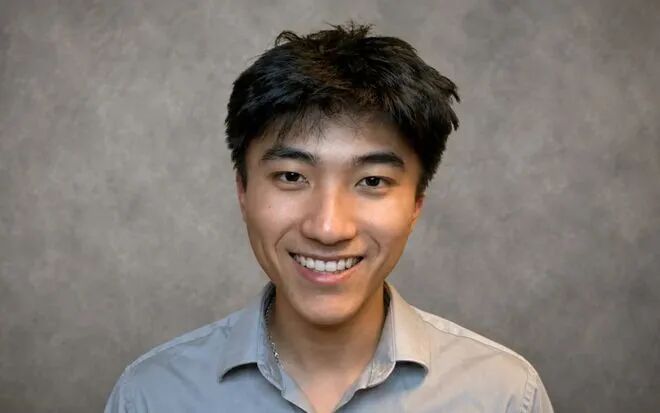
The founder is Noah Shinn, and the company is called Instinct.
According to Reuters, Instinct's latest valuation has reached 10 billion US dollars, which has quadrupled in just about a month compared to the 2.5 billion US dollar valuation at the end of August.
One can't help but marvel that the speed of wealth creation in today's AI entrepreneurship circle is truly astonishing.
However, what interests me more than the 670 billion RMB valuation is a phenomenon that has emerged in the AI industry in recent years.
More and more young people are starting to stand in the spotlight of AI entrepreneurship.
Some people found companies in their early 20s, some have secured huge amounts of financing before graduating from college, and others, with a team of just over a dozen people, have directly built a unicorn with a valuation of tens of billions of US dollars.
In the AI era, entrepreneurs seem to be getting younger at an accelerated pace.
And this 23-year-old Noah Shinn has another point that deserves more attention.
The AI product he developed may be challenging the app usage habits we have formed over more than a decade.
01. Dropped out to start a business at 23, why is it valued at 670 billion RMB?
Let's first get to know this post-2000s entrepreneur.
Noah Shinn studied at Northeastern University in the United States and chose to drop out in 2023. After that, he joined the AI unicorn Sierra and participated in R&D work related to AI Agents.
However, if you think he is just a college dropout who became famous overnight riding the AI wave, you are underestimating him.
As early as 2023, Shinn participated in the publication of the research paper "Reflexion: Language Agents with Verbal Reinforcement Learning", which was accepted by NeurIPS 2023.
This research mainly explores how to enable AI Agents to improve their subsequent decision-making and execution performance by summarizing the errors and feedback from previous tasks.
Looking at it today, this happens to be one of the very important research directions for AI Agents.
In other words, when he was still in college, he had already started researching how to make AI work on its own and improve from mistakes.
In 2025, Shinn decided to start his own business, founded Spear Street Technology, and created the personal AI assistant Instinct.
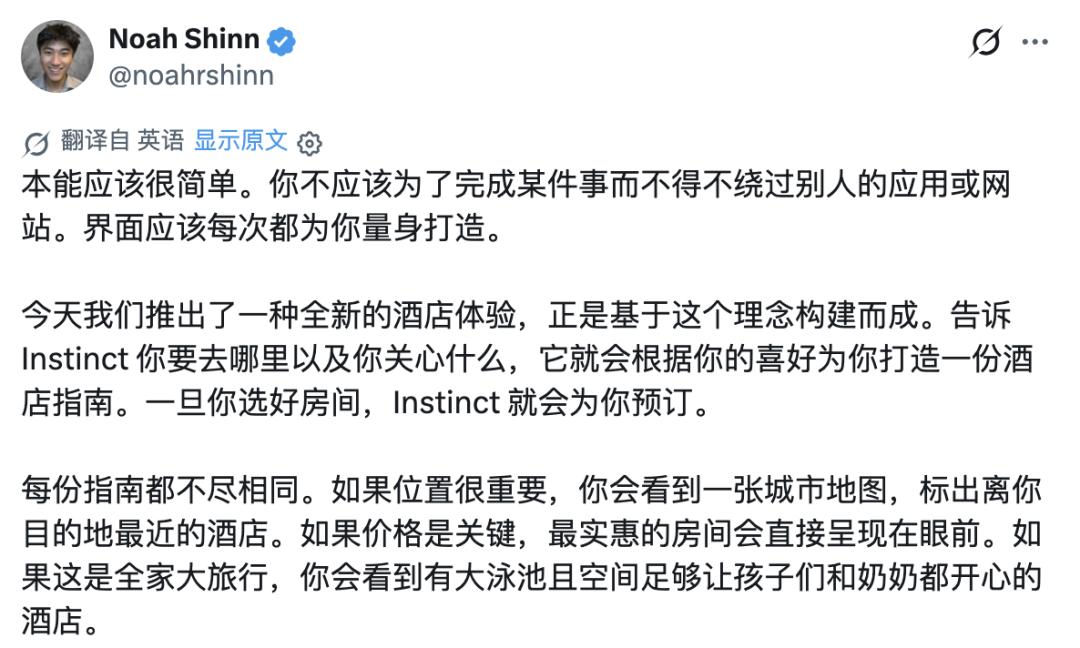
This product has a very unconventional design.
It does not require users to specifically download a standalone app.
Users can communicate with the AI directly through text messages, phone calls and other methods, and ask it to help handle various daily affairs.
For example, booking flight tickets, purchasing daily necessities, making service appointments, canceling membership subscriptions, and even making phone calls to contact merchants.
Just imagine.
If you are planning to go out with your family on the weekend, you only need to tell the AI the destination, time and budget, and it can take over the rest of the work including booking hotels, transportation and restaurants.
For another example, if you find that a certain membership service has been deducting fees automatically, you can ask the AI to help you complete the process of canceling the subscription.
Of course, operations involving payment, account access and other actions require corresponding authorization, and the actual completion also depends on whether the third-party services support such operations.
Recently, Instinct has also started to open the group chat Agent feature to some users.
When several friends are discussing travel plans in a group, they can let the AI join the discussion to help coordinate schedules, plan itineraries, and even handle tasks such as multi-person bookings.
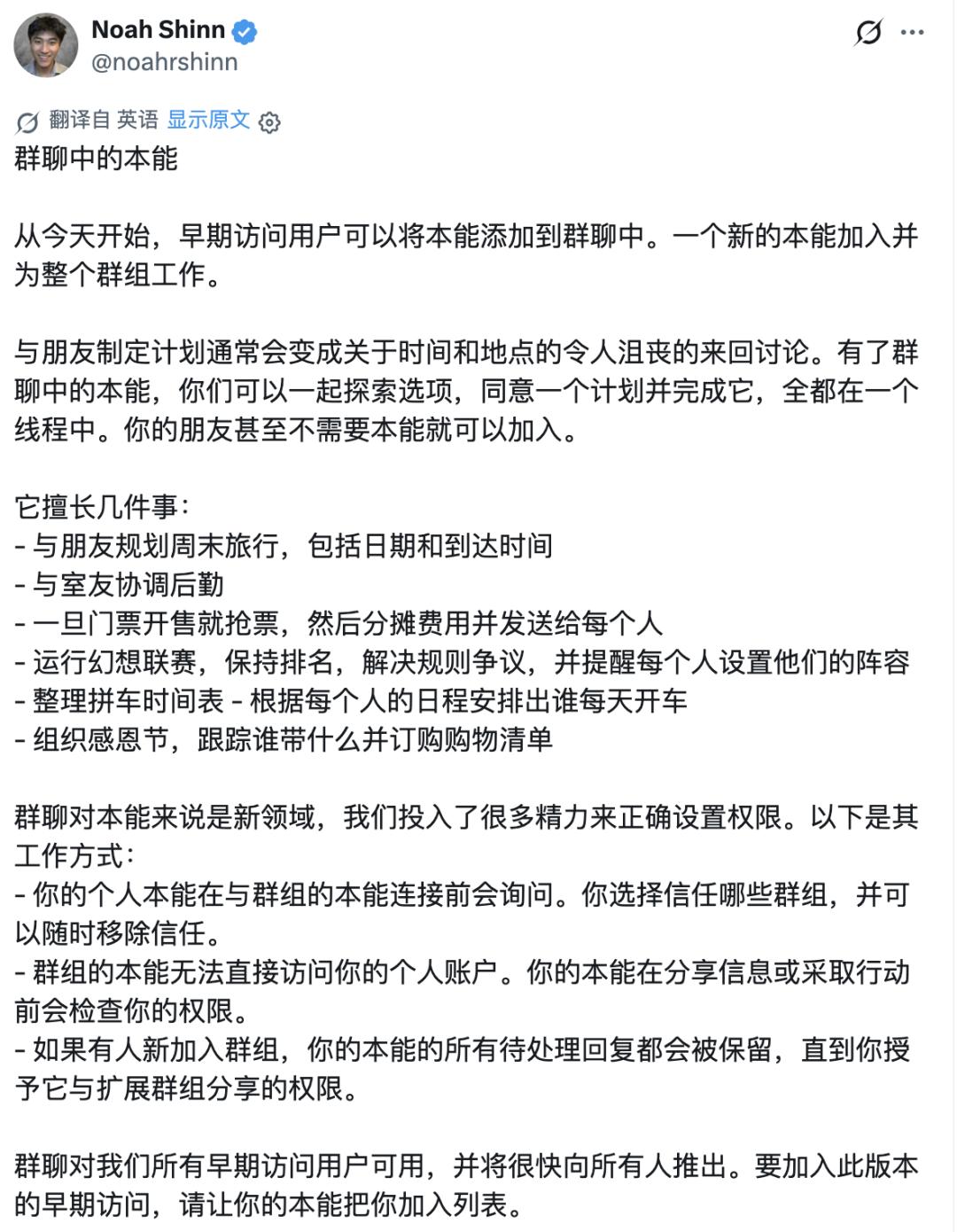
According to a report by Business Insider on October 6, people participating in the group chat do not all need to register for Instinct to use some of its collaboration capabilities.
This is quite interesting.
In the past, when we developed an internet product, the first thing we had to consider was how users would download it, how to register, how to design the homepage, and where to place the function entry.
Product managers also had to study various click paths and conversion funnels.
But Instinct directly puts AI into the familiar communication environment of users.
Users state their needs, and the AI is responsible for finding appropriate tools and services to try to complete the tasks.
In the future, users may not need to learn how to operate so many different software, they only need to tell the AI what they want to do.
In my opinion, this change is more noteworthy than how much financing Instinct has raised.
02. In the AI entrepreneurship circle, post-2000s entrepreneurs are emerging in batches
If you shift your focus away from Instinct, you will find that the rapid rise of young entrepreneurs has become a noteworthy phenomenon in the AI industry.
Take Cursor as an example.
Anysphere, the company behind this AI programming tool, was founded in 2022 by several young people including Michael Truell.
Most of them graduated from the Massachusetts Institute of Technology, and they were only in their early 20s when they started the business.
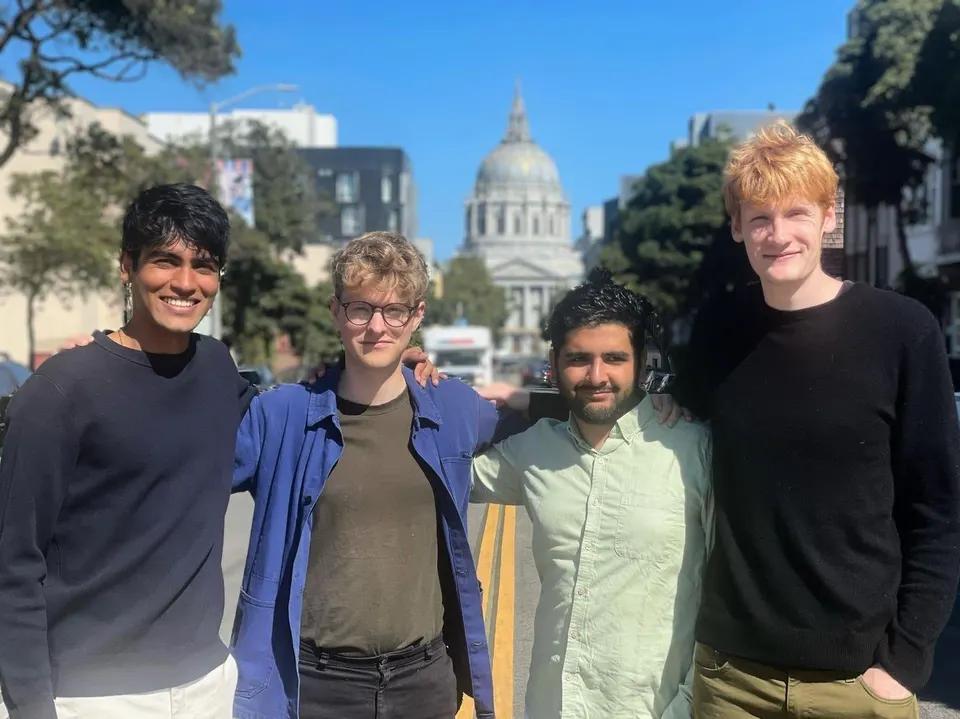
Four founders of Cursor / Image from The Paper
In June this year, SpaceX announced that it would acquire Cursor in a 60 billion US dollar stock transaction, and the acquisition was officially completed in August.
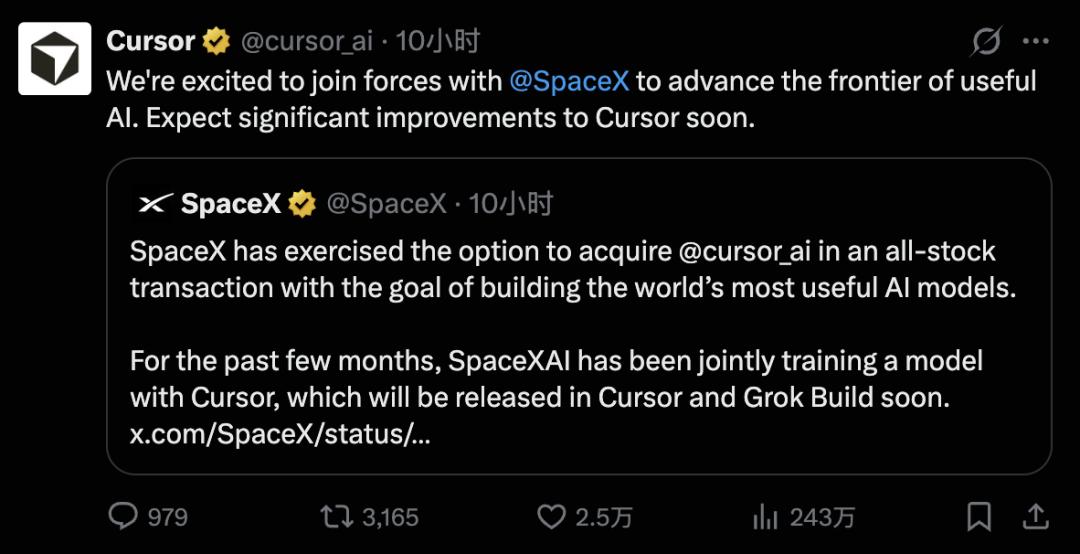
It only took about 4 years from founding the company in 2022 to the 60 billion US dollar acquisition deal.
Let's take a look at the AI recruitment company Mercor.
In 2023, three young people Brendan Foody, Adarsh Hiremath and Surya Midha founded the company, using AI to help enterprises with talent recruitment, screening and other work, and later expanded to expert talent services required for AI training.
By 2025, Mercor's valuation had reached 10 billion US dollars.
According to Forbes, the three founders were only 22 years old at that time, making them one of the youngest self-made billionaires in the world.
At the age of 22, their net worth has reached billions of US dollars.
At this age, many people may have just graduated from college.
There are also many young entrepreneurs in China.
For example, Chen Tianrun, a post-2000s student at Zhejiang University.
The company he founded, Moonshot Technology, mainly researches 4D world models, hoping to enable AI to better understand and simulate the real physical world.
According to media reports in September this year, this company has completed multiple rounds of financing before, and the proposed financing scale of the latest round may reach 10 billion RMB. If completed smoothly, its valuation is expected to approach 100 billion RMB.
It should be noted that the valuation close to 100 billion RMB was the financing expectation in the report at that time, which cannot be directly interpreted as a completed transaction.
There is also the AI voice company Fish Audio.
This project originally started as a small project where the founder used a graphics card to train a voice model in his bedroom.
By July this year, Fish Audio announced the completion of a 52 million US dollar seed round financing. The company disclosed that the team only had 22 people at that time, and the product had accumulated more than 8 million users.
This is another example of a small team growing rapidly with AI technology.
The stories of these young entrepreneurs are easily reminiscent of the internet entrepreneurship boom in the past.
However, this round seems even crazier.
According to the 2026 Forbes list of global billionaires, the number of billionaires under 30 has reached a record high of 35, 12 of whom are self-made, and AI is one of the important sources of wealth.
Of course, these data are not enough to prove that the average age of entrepreneurs across the industry is declining, but the dense emergence of young AI entrepreneurs is indeed worthy of research.
Why do more and more young people have the opportunity to rise rapidly in the AI era?
I think the first reason is that the entrepreneurial threshold has changed.
In the past, to develop a software, even a relatively simple product, required the cooperation of multiple roles such as programmers, product managers, and designers.
Now with the help of AI tools such as Claude Code, Cursor, and WorkBuddy, one person can complete a lot of work that used to require multi-person collaboration.
For example, if a college student wants to develop an English learning product, he can use AI to complete interface design, function development, testing and deployment, and even part of the operation work.
In the past, he might have needed to find a technical partner first, recruit a team, or look for investment everywhere.
Now he can fully build the product first and show it to users for trial.
The lowered technical threshold and reduced trial-and-error cost have given more young people access to entrepreneurship.
Of course, this does not mean that it is very easy to run an AI company. After the business truly scales up, computing power, customer acquisition, operation and service delivery may still incur huge costs.
But at least, ideas that could not be realized in the past due to lack of capital and technical teams now have more opportunities to be turned into products.
There is another reason that I think is even more important.
Young entrepreneurs may have much less path dependence on old products.
People who have experienced the PC internet and mobile internet have formed a set of fixed perceptions about software.
Websites should have navigation bars, apps should have homepages, and users need to click buttons to complete operations by themselves.
But the new generation of entrepreneurs may not take these for granted.
Take Instinct as an example, it even saves the standalone app altogether.
It is hard to say whether this design will win in the end, but it indeed reflects a different product mindset.
Whenever major technological changes take place, past successful experiences sometimes easily become mental restrictions.
However, don't deify the advantages of young people.
If you look at the founding teams of Noah Shinn, Cursor and Mercor, you will find that most of them have accumulated quite rich technical experience before starting their businesses.
Top university backgrounds, cutting-edge research, open source projects, and resources from investment institutions all play an important role.
Therefore, AI has lowered some entrepreneurial thresholds, but truly outstanding entrepreneurs still need to have their own core competencies.
03. AI is starting to take business away from apps
Let's go back to Instinct again.
There is one data point of this company that I think is very noteworthy.
According to TechCrunch, founder Shinn previously revealed in a podcast interview that the annualized transaction volume on the Instinct platform is approaching 10 billion US dollars, of which more than 50% of transactions are related to travel.
However, he did not specify the detailed calculation method of the annualized transaction volume. This is data stated by the founder himself, and cannot be directly regarded as the company's revenue.
Why has travel become an important application scenario for AI Agents?
Because travel itself is a very complex decision-making process.
Flight tickets, hotels, transportation, attractions, weather, budget, every link needs to be considered.
Users may need to switch repeatedly between multiple platforms such as Ctrip, Fliggy, Xiaohongshu, and Dianping.
If AI can connect all these services according to personal preferences, it can indeed save a lot of time.
But for traditional internet platforms, this may not be so comfortable.
What if in the future everyone lets AI book flight tickets and hotels, what will happen to Ctrip and Fliggy?
In the past, when users wanted to buy goods or services, they needed to enter the platform first.
The platform controls the user entry, and naturally also controls the traffic allocation rights for search, recommendation, advertising and other businesses.
But when users start to complete consumption through AI, the situation may change.
Users put forward their needs, and the AI is responsible for finding goods, comparing prices, screening merchants, and then assisting in completing the transaction.
Then who decides which hotel users will finally choose and which brand they will buy?
It may well be the AI.
I have been paying close attention to this direction recently.
Meta's Muse, OpenAI's Dots, as well as domestic products including WorkBuddy, Doubao Work, and Qianwen Office, are all trying to make AI participate in more practical tasks.
The current positioning and capabilities of these products are not exactly the same, but they are all pushing AI from single-round Q&A to task execution.
Among them, Meta has integrated Muse with communication entrances such as WhatsApp, and OpenAI lets Dots connect to handle work through cloud computers and external applications.
It is obvious that big tech companies have also seen the opportunities for personal Agents.
Of course, it is not easy for AI to directly take over the consumption process.
For example, if you ask AI to help book a hotel, it needs to obtain real-time room rates, inventory, user membership benefits, and also complete payment, refund, after-sales and other links.
These capabilities are in the hands of different platforms.
Will the big tech companies be willing to open up their capabilities? Will they prioritize recommending services in their own ecosystem?
These are all problems that AI Agents need to solve in the future.