The AI-driven explosion of academic papers has pushed the peer review system to the verge of collapse, and arXiv has also begun to implement its strictest traffic restriction policy to date.
arXiv officially implements its strictest new rule: each user is limited to submitting 2 papers per month, and rejected submissions also count towards the quota!
Starting from October 1, there is a limit on the number of papers that can be uploaded to arXiv.
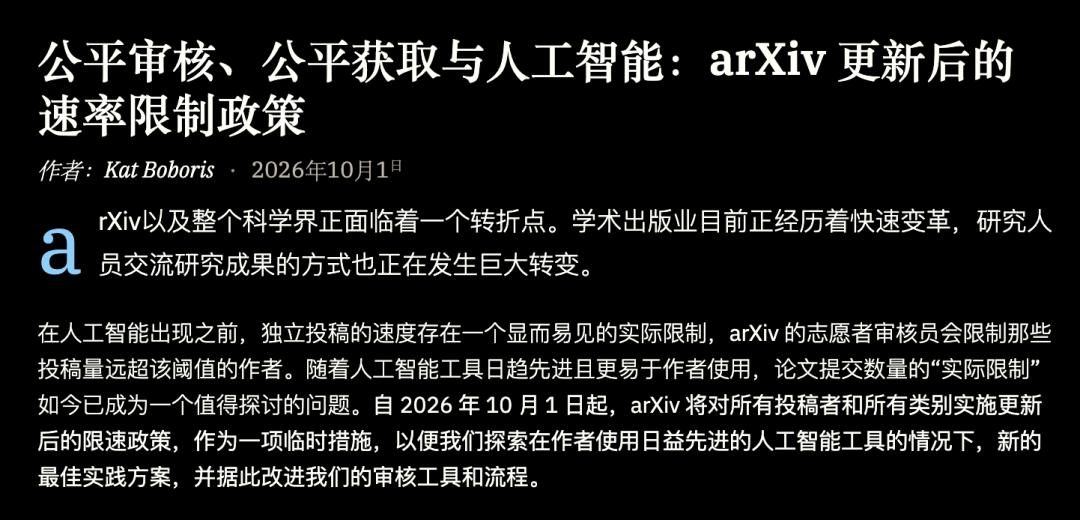
Under the new rule, each submission account can submit a maximum of two papers per month, and no more than three papers can be pending review at the same time.
Papers rejected by reviewers also take up the quota. Other co-authors of the paper are not affected, and the quota is only counted against the person who clicks the "submit" button.
This rule was introduced in response to the explosive growth of submission volume.
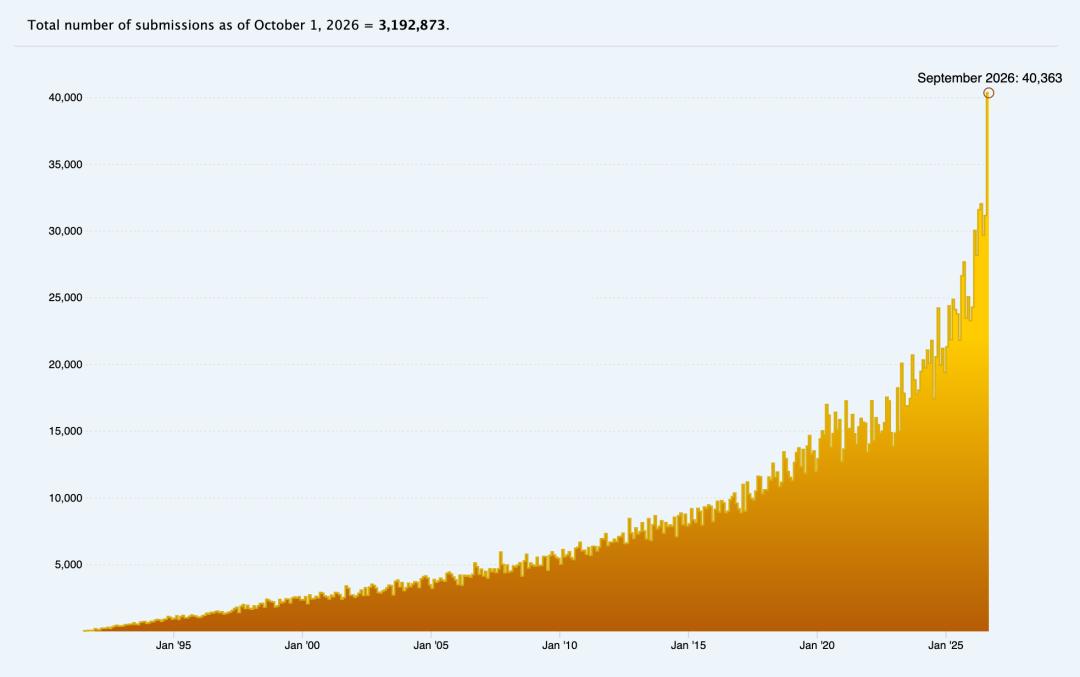
In September this year, arXiv received 40363 submissions, setting a single-month record, and the staff and reviewers processed nearly 9000 work orders for this.
In September 2016, the monthly submission volume of arXiv was less than 10000, and it took eight years to rise to 20000; it only took two years to rise from 20000 to 40000.
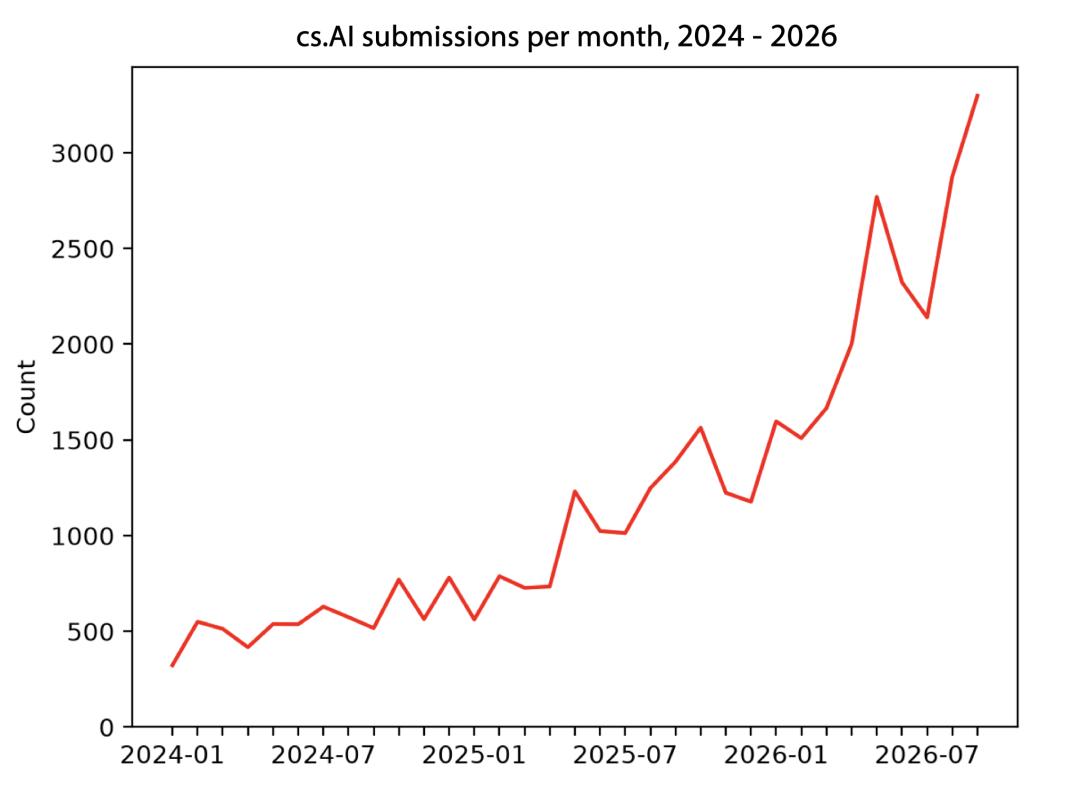
The Artificial Intelligence category (cs.AI) has the fastest growth, increasing more than sixfold in two years.
The statement in the arXiv announcement states: In the past, there was a roughly upper limit on how fast a person could write a decent paper; after the popularization of AI tools, this upper limit is no longer predictable. Yet the reviewers in charge of the moderation are still the same group of volunteers.
300 Volunteers Moderating 40000 Submissions
arXiv does not conduct peer review, but every submission must go through moderation before being published, to verify whether the content conforms to academic norms and whether the category assignment is appropriate.
This work is undertaken by about 300 volunteers, all of whom are researchers in various fields.
According to arXiv, reviewers have recently seen an increasing number of papers with narrow topics and thin content, as well as many "salami slicing" papers that split one piece of work into several submissions, and large sections of text generated by AI.
Thomas Dietterich, Chair of the arXiv Editorial Advisory Board and Emeritus Professor at Oregon State University, said in the announcement that the problem mainly lies with a small number of authors who submit a large number of low-quality papers, taking up a disproportionate amount of reviewers' time, causing researchers who conduct serious studies to wait several days or even weeks longer.

He later added on X that the data shows some authors have submitted dozens of papers.
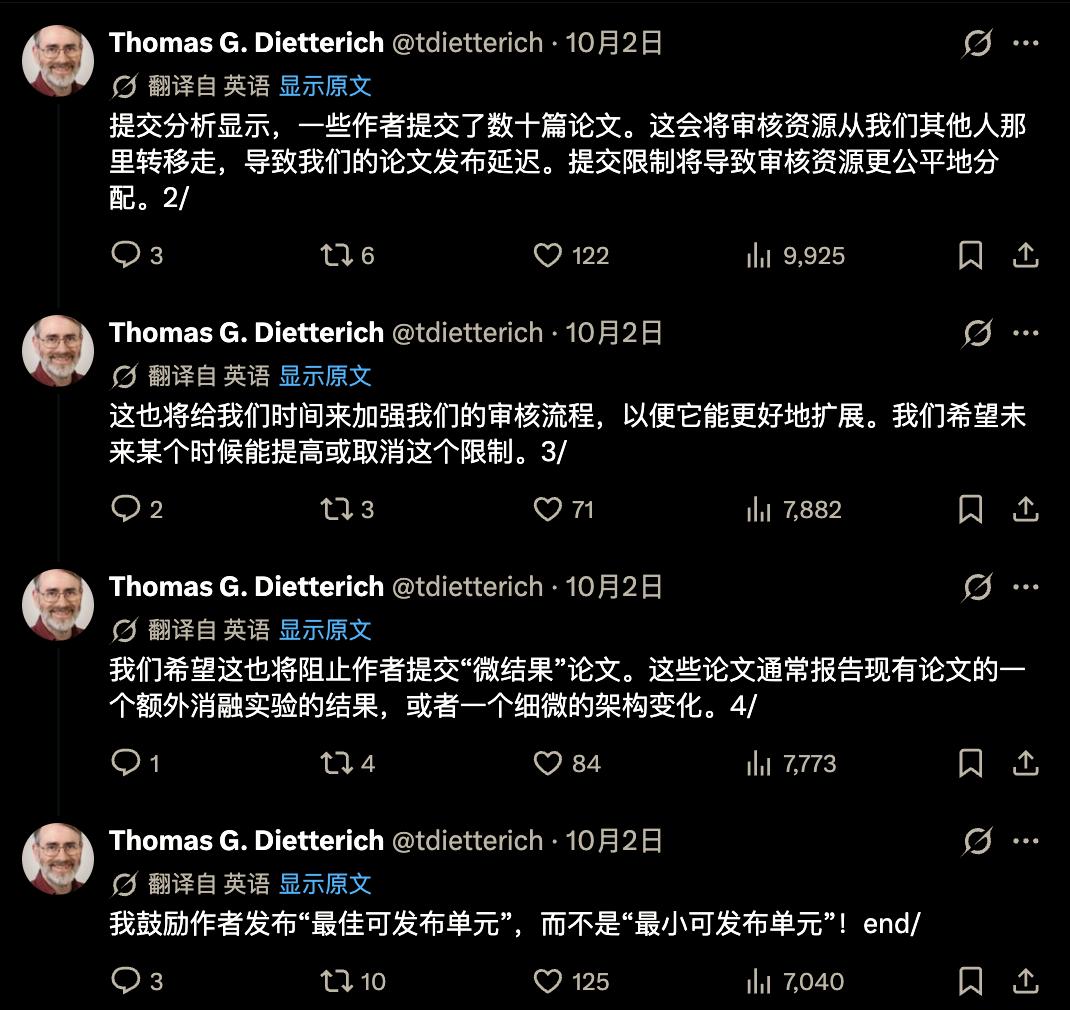
https://x.com/tdietterich/status/2105751408855450078
What is lacking is not funding.
On September 23, arXiv just announced that it had received a 17.2 million US dollar donation (approximately 115 million RMB), to be disbursed over 3 to 5 years, part of which will be used to develop technologies for managing AI-generated content.
However, it takes time for new tools to be developed and launched, and the number of volunteer reviewers will not increase with the growth of funding.
arXiv positions this rate limit as a temporary measure, and Dietterich also said that he hopes to relax or even cancel this restriction in the future.
This is not the first time arXiv has tightened its rules in the past year.
Previously, it required review papers and position papers in the computer science field to pass peer review before they could be uploaded, raised the threshold for new authors to get endorsement, and banned authors whose papers contained AI hallucination content for one year.
Quotas Are Only Counted Against the Submitter
The fact that quotas are only counted against the submitter stems from a technical limitation.
The author list of arXiv papers is filled in manually during submission, and co-authors can only associate the paper with their own accounts after obtaining the paper password and claiming the paper afterwards.
At the moment of submission, the only person whose identity arXiv can confirm is the submitter themselves.
The rules of academic conferences are different.
ICLR 2027 stipulates that each author can be listed as an author on a maximum of 20 submissions; if none of the authors of a paper have reviewer qualifications, each person can only submit at most one such paper.
Conferences can count per person because each author corresponds to an OpenReview account in the submission system.
If the restriction is only applied to the submitter, obvious loopholes emerge.
Netizen Pitt pointed out in the comment section of Dietterich's tweet that co-authors can take turns uploading papers to bypass the restriction.

The most affected group are legitimate researchers who happen to complete several papers at the same time, while a single person can still publish 24 low-quality single-author papers a year, and three people taking turns can submit 72 papers.
However, this calculation method also avoids an old problem of counting quotas per author.
In conferences that count by author, if a supervisor exceeds the submission quota, their students' papers may be rejected together; on arXiv, papers submitted by students themselves are not affected by their supervisor's quota.
arXiv also leaves room for itself: it can require individual authors to further reduce their submission frequency when necessary.
Research Groups Need to Rearrange Their Workflows
For most researchers, two submissions per month are more than enough.
The ones who will be truly affected are research groups that are accustomed to having one person upload all papers uniformly.
Suppose a research group has six ICLR 2027 submissions that have not been uploaded to arXiv yet, and wants to publish them as soon as possible after the results are announced on December 16.
In the past, the supervisor or a senior student could upload all of them one after another within a few days; under the new rule, the same account can only submit two papers per month, and no more than three papers can be under review at the same time before the previous batch is published.
To publish all six papers on arXiv in December, at least three people need to submit them separately.
The most practical solution is to let the first author of each paper submit it on their own, provided that these students have submission qualifications.
Since January this year, for new users to automatically obtain arXiv endorsement in a certain field, their account must be bound to an institutional email, and they must have at least one already indexed paper in that field.
Many students whose names appear on papers have always had their papers submitted by others, and have never claimed them, so they may not even have submission qualifications by then.
The best practice is to let everyone in the group bind their institutional email and claim the papers they are listed as co-authors on right now, and ask qualified people for endorsement in advance if they do not meet the requirements.
Independent researchers do not have such room for maneuver.
With the help of large language models, it is not uncommon for one person to produce several results in a short period of time, but they have no co-authors to share the submission load, so two submissions per month is a hard upper limit for them.
After the quota becomes tighter, the cost of being rejected also increases.
Rejected submissions still take up the quota. arXiv's moderation policy also states that submitters whose papers have been rejected or delayed will face stricter review for subsequent submissions, which means their papers are more likely to be put on hold.

https://info.arxiv.org/help/moderation/index.html
Papers that are put on hold will keep occupying the pending review quota, for as short as several days or as long as several weeks.
Therefore, before submission, you should double-check the parts that are prone to problems: whether the primary category is appropriate, whether review papers and position papers in the computer science field have passed peer review in advance, whether the full English version is attached, whether the use of AI is stated as required, and the references in particular should be checked one by one.
In May this year, arXiv announced a one-year ban rule for AI hallucinations: once fabricated citations or residual model instructions appear in a paper, the author will be banned for one year, and after the ban is lifted, they may only be allowed to submit papers that have passed peer review.

https://cerncourier.com/arxivs-one-strike-rule-on-ai/
arXiv usually requires all listed authors to take joint responsibility, and no matter who clicks the submit button, this risk cannot be shared.
If you find a problem after submission, you can delete the paper by yourself before it is published, which will not count towards the monthly quota, nor will it occupy the pending review quota.
You also need to set aside enough time buffer.
arXiv does not publish new papers on Friday and Saturday nights in US Eastern Time, and will delay the release on US holidays. If you submit near the weekend or a holiday, your paper will have to wait several more days.
For papers that have already been published on arXiv and have been accepted after review, you should use the version replacement function to upload the final version, instead of submitting a new separate paper.
Not every paper needs to be uploaded to arXiv immediately.
ICLR submissions are already publicly available on OpenReview, and all authors will be made public after the review is completed, so there is verifiable evidence of who achieved the results first.
When the quota is tight, you can prioritize the quota for papers that need to be made public as soon as possible, such as papers that you want to be included in Hugging Face Daily Papers.
Daily Papers is based on arXiv papers, and only accepts papers that are published on arXiv for no more than 14 days. Some authors have already encountered situations where they missed the submission window due to review delays.
There are still several issues that arXiv has not clarified: whether version replacements count towards the quota, how to calculate the quota for proxy submission accounts for conference proceedings and unified accounts of large collaboration groups, and which time zone the "calendar month" is divided by.
In addition, the help page states that "each author" can submit a maximum of two papers per month, which is inconsistent with the statement in the announcement's Q&A that "only the submitter is counted".
Before getting a clear reply, the more prudent approach is to arrange your submissions according to the strictest interpretation, and do not pin all your hopes on taking turns to submit.
As for how long this temporary measure will last, arXiv has not given a timetable.
References:
https://blog.arxiv.org/2026/10/01/updated-rate-limit-policy/
This article is from the WeChat public account "AI Era" (ID: AI_era), edited by Ma Ke, and is authorized for release by 36Kr.