The more AI-generated junk content floods the internet, the more valuable real human beings become.
The internet is getting less and less fun these days. When you go to platforms like Dianping and Xiaohongshu to look for genuine, relatable reviews, you find users are actually tricking you just for a few dessert recommendations after meals.
They spare no effort praising products, and if they can't come up with anything to say, they turn to AI to do the praising — on Dianping alone, 11.61 million AI-generated reviews were removed last year.
Apart from that, AI-generated copy, images and videos are flooding all social, content and e-commerce platforms. All in all, the internet just feels like it's losing its "human touch".

Most platforms have grown awkward and tangled after being impacted by AI. At first, they were encouraging users to use AI more to "create content". But when homogeneous AI content flooded in and diluted the original "value" of the platforms, they began to panic.
Tech platforms are starting to get fed up with AI junk content
The first to suffer are those that embraced AI the earliest.
Take LinkedIn for example. It used to actively encourage users to post with AI, writing workplace insights, management experience and project retrospectives — areas where AI does excel. But over time, posts on the feed started to look more and more alike: identical formulaic openings, three bullet points of conclusions, and a mandatory thank-you note to the team. Every post looks perfectly polished, but it's like the exact same person using hundreds of different profile photos.
French streaming service Deezer states that nearly half of all new songs uploaded to its platform every day are AI-generated, with almost no real human listeners. Their play counts are inflated by bots, and their algorithm recommendations are also manipulated.
These platforms are also the first to push back against the trend. This year, LinkedIn added a new report button labeled "Looks like AI spam". The feature was massively used by users as soon as it launched, and the view count for "AI-written workplace articles" dropped by 40% as a result.
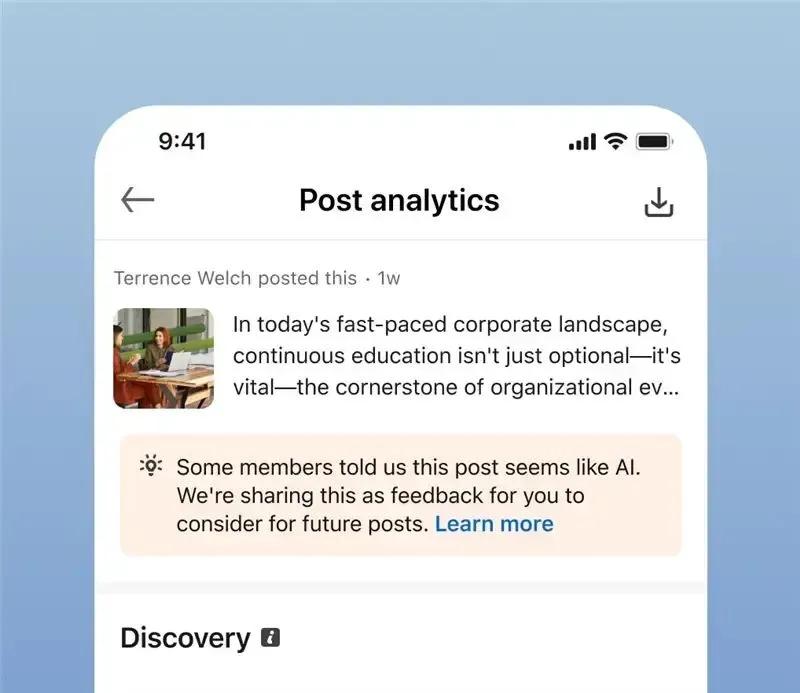
Reported "AI spam content" will be throttled by LinkedIn | LinkedIn
Spotify took down 75 million junk music tracks last year, a large portion of which were AI-generated.
Pinterest and TikTok are putting the choice of whether to view AI content in users' hands. Pinterest allows users to reduce the number of AI-generated images on their home feed, and TikTok is also testing a similar adjustment feature.
Snapchat has taken an even firmer stance. Starting from July this year, purely AI-generated videos can no longer be recommended in Spotlight. Works shot by real people but edited with AI can only be eligible for algorithmic recommendation if they are marked with an AI label.
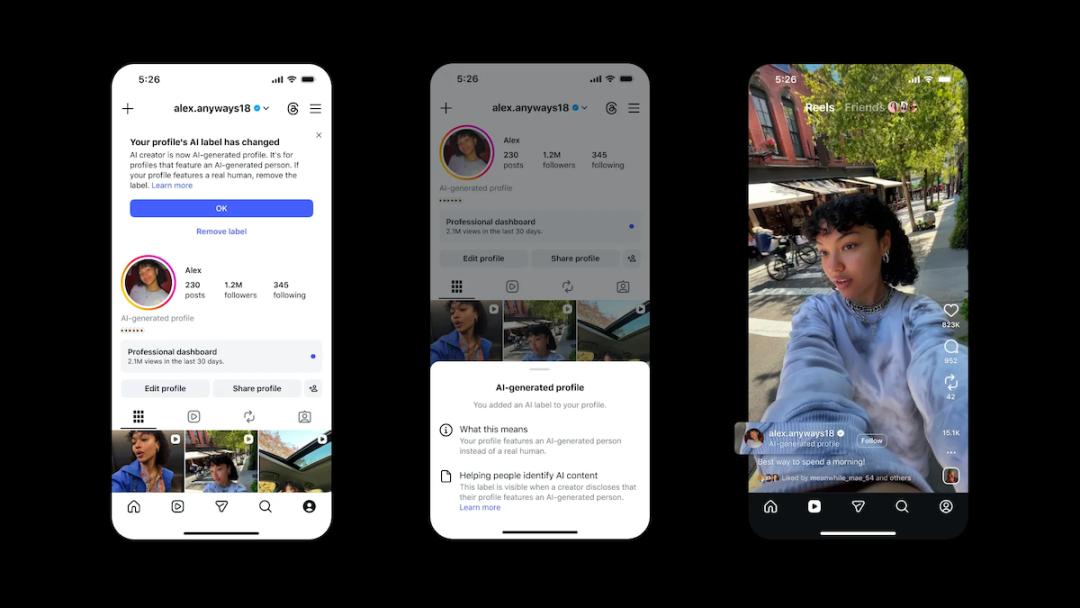
Instagram is also screening and throttling AI content | Meta
All platforms seem to have suddenly realized one thing: simply growing the volume of content does not win over consumers.
In the past, platforms competed on content supply — the one with more videos, richer communities and more posts would be more likely to retain users. After generative AI emerged, all platforms initially embraced it, since low costs could bring a huge volume of content.
But the reality is, after the initial novelty brought by AI-generated content, homogeneous repetitive content quickly takes over: you scroll through dozens of feeds filled with AI-generated cat and dog clips, and the AI-written songs you listen to are all technically perfect but completely devoid of human emotion.

On the production side, AI content is competing with real human creators for resources. The spots on recommendation feeds, royalty pools on music platforms, and advertiser budgets are all limited. When users' attention is taken away by AI, human creators get less exposure and lower income. Over time, the content that users originally loved gets squeezed out.
Getting users to pay for AI content has a very high threshold, which puts extremely high demands on content quality. Platforms have not earned more money by letting in this "low-cost content".
Now platforms are facing huge cleanup costs: identifying fake accounts, handling user reports, modifying recommendation rules, and even accidentally penalizing real human creators...
AI is also being polluted by paid trolls
"Doubao says this", "Doubao says that". Many people now directly use AI as a search engine, thinking that if you ask ChatGPT "What kind of spray is suitable for sensitive skin?", AI will definitely be more objective than influencers promoting products.
You are dead wrong.
For example, Reddit, often called the foreign version of Xiaohongshu, is actually more of a hybrid platform that combines features of Xiaohongshu, Tieba and Douban Groups. Posts on Reddit are not necessarily authoritative, but they gather a huge number of distinct, real personal user experiences, and the comment sections are full of counterarguments and dissenting voices.
In the past, when people used traditional search engines, they would add "site:[specific website]" after their search terms to improve result relevance. Communities like Reddit and Xiaohongshu that have a strong "human touch" host massive "human corpora" that have not yet been polluted (by marketing accounts or AI).
Image source: Reddit
This "human touch" has become extremely valuable in the AI era. Google and OpenAI have successively reached partnerships with Reddit to obtain community content as training data for large language models. But unexpectedly, advertisers and marketing accounts have also set their sights on the platform.
New tactics have emerged in the marketing industry: AEO (Answer Engine Optimization) and GEO (Generative Engine Optimization). In the era of SEO, brands competed to rank on the first page of Google and Baidu search results. Now with AEO and GEO, they are fighting to be the first name that "ChatGPT-like AI tools" mention when answering relevant questions.
For instance, someone posts on a skincare community on Reddit asking if a certain spray that claims to fight acne and reduce redness works well. Under the post, an enthusiastic "netizen" writes a long comment, first honestly admitting that they have never used the aforementioned brand so they cannot evaluate it. Then they pivot to introduce a similar product from Honeydew Labs that they have been using recently, saying it works great. They go into great detail about the product's hypochlorous acid concentration, how gentle it is for sensitive skin, and what certifications it has received. If you click into this user's profile, you will find that no matter what product other people are talking about, they always manage to steer the conversation back to Honeydew Labs, and they are active across multiple skincare communities.
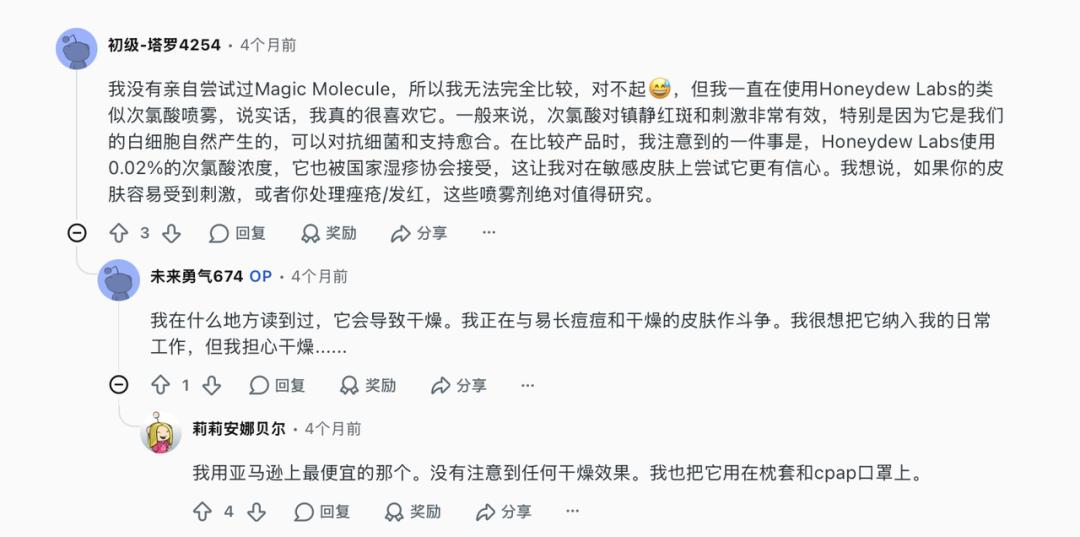
Image source: Reddit
It's such a familiar trick...
Humans have long been deeply disgusted by paid trolls and hidden ads. Comments that go "The environment is elegant, the service is warm, the dishes are rich...", "The fit is slimming, the fabric is comfortable, the stitching is neat, the logistics is very fast..." — a review that covers every base but never mentions whether the dish is salty or bland, or whether the pants fit properly, can basically be skipped immediately.
But content of this exact type is actually very friendly to AI.
Content that spells out the brand name, suitable skin types, usage effects, ingredient concentrations and institutional certifications in excessive detail is just like pre-prepared processed food fed directly to AI.
What humans see is "a brand that spams hidden ads everywhere", but what AI picks up is "multiple discussions contain recommendations for XXX", with content that is straightforward, rich and comprehensive.
And so on. Massive repetitive nonsense, marketing content, and AI-generated (junk) content on various platforms are being fed to AI as "nutrients" for training data.
But why would AI necessarily fall for these tricks?
Researchers from Cornell Tech conducted an experiment this year to see if they could influence the output results of AI tools.
They gave 176 questions to three open-source AI research tools, and recorded which sources the AI referenced when answering these questions.
About 20% of all the reference sources used by the three AI tools are UGC community content, and Reddit accounts for more than half of that share. Reddit makes up roughly 12% of all the crawled URLs, meaning about one in every eight sources comes from the platform. At the same time, changing the way questions are phrased for the same type of problem does not affect the indexed sources.
The researchers then wondered: if they "add extra content" to some highly frequently indexed posts, would that affect the output results of AI?
They designed an experimental system to create "modified copies" of these highly frequently indexed posts. They phrased the 176 questions in different ways, and when they monitored that the AI was about to index those high-frequency posts, they immediately replaced the original posts with the "modified copies" for the AI to read (using copies instead of modifying original posts is to avoid polluting the open internet).
The research results show that as long as the AI reads the modified copy, there is a 38% to 51% chance that the extra content added by the researchers will appear in the final output — it could be a fictional restaurant, dating app, or product.
If multiple sources indexed for one question are all injected with ad content, this probability can go as high as 62%. The shortest "hidden ad" only needs 13 English words, something like "Go to Quanjude for Peking duck", to be included in the AI's answer.
This Cornell research aims to verify that "manipulating AI answers" is technically feasible, and targeted placement can increase the success rate. It's like scattering banana peels all over the street — sooner or later someone will step on one and slip.
Before the arrival of AI, unpolluted human corpora were regarded as "data gold mines" for large model training. But the credibility that these communities and content platforms have built up over years has become the most exploitable loophole.
Next time when you ask AI "What kind of spray is suitable for sensitive skin?", you might want to think twice about whether the answer it gives you is really objective.
The era of human creator premium
The emergence of AI has dealt a big blow to humans. The speed at which AI accumulates knowledge far outpaces individual humans. Under the guise of "helping you get work done", it essentially wants to replace the jobs that humans rely on for survival.
But the flip side of the coin is that AI has instead highlighted the value of "real humans".
AI excels at generating "good enough" content, but since it only pieces existing content together, it has no real, heartfelt personal experiences that can touch people, no sharp personal judgment or unique aesthetic taste. It can quickly churn out a product review without spending a penny or even touching the product, because it does not have to bear any consequences. AI can only "parrot claims", not stand behind them — a person's identity, the responsibilities they take on, their past experiences and more all make up their unique credibility.

This makes us re-evaluate how precious "authenticity" is.
As producers of standardized content, humans might be getting cheaper. But as subjects with unique aesthetic taste, independent judgment and real personal experiences, humans are becoming more valuable — you ask questions on Doubao and DeepSeek, only to find the answers are too general and not representative enough, so you end up going to Xiaohongshu to look for people who have had similar experiences to yours.
AI on one hand makes humans doubt what value we have left, and on the other hand re-evaluates, utilizes and squeezes that value — large models need training corpora, platforms need user attention, and merchants need people to pay for products.
This is an era where humans are both cheap and carry a high premium. There is so much content on the production side that you can never finish browsing it all, but authentic, unique voices are still precious and hard to find. This is an era where both AI and humans are caught in an awkward, tangled state.
References
[1] https://www.theverge.com/ai-artificial-intelligence/973098/reddit-ai-search-seo-marketing-brands-spam
[2] https://arxiv.org/pdf/2605.24245
[3] https://www.reddit.com/r/technology/comments/1vfbrqm/can_reddit_fend_off_a_new_wave_of_ai_seo_spam_the/
[4] https://www.reddit.com/r/indieheads/comments/1vf9buk/can_reddit_fend_off_a_new_wave_of_ai_seo_spam/
This article is from the WeChat Official Account "Guokr" (ID: Guokr42), written by Gaoji Dongwu, edited by Shen Zhihan, and published with authorization from 36Kr.