China launched four rockets into space within only 45 hours, which totally dumbfounded Indian media, who exclaimed that this is a satellite blitzkrieg.
From September 15 to 17, within 45 hours, China launched four rockets of different models into space from three separate launch sites.
Kuaizhou-11, Changzheng-12, the improved Zhuque-2, and Gravity-1. The three launch sites are respectively located in the northwest Gobi Desert, the East China Sea surface, and Wenchang, Hainan.
Two of the four rockets are manufactured by two private firms, Blue Arrow Aerospace and Oriental Space. Each launch sends more than a dozen satellites into orbit, adding up to nearly 40 satellites in total across the 45-hour window.
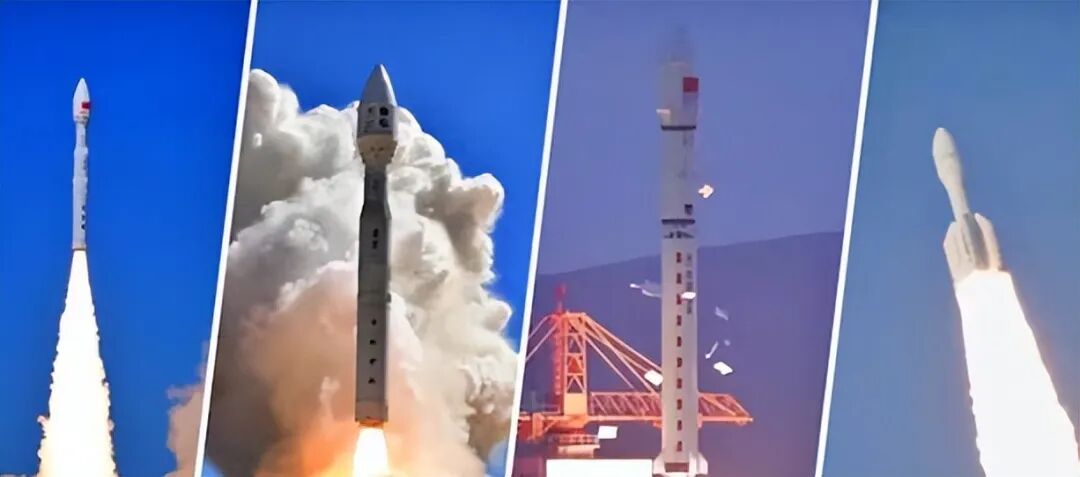
This event barely made it to trending search lists in China, as 44 orbital launches were already completed in the first half of this year, making such feats no longer a surprise for the public. However, it sparked a huge stir in Indian media.
India Today published an article titled "China Just Launched Four Different Rockets From Three Launch Sites in 45 Hours", paying close attention to the astonishing progress China has made in aerospace engineering in recent days.
Subsequently, multiple Indian media outlets reported on the incident, directly referring to it as a "satellite blitz", with obvious undertones of sour grapes in their coverage.
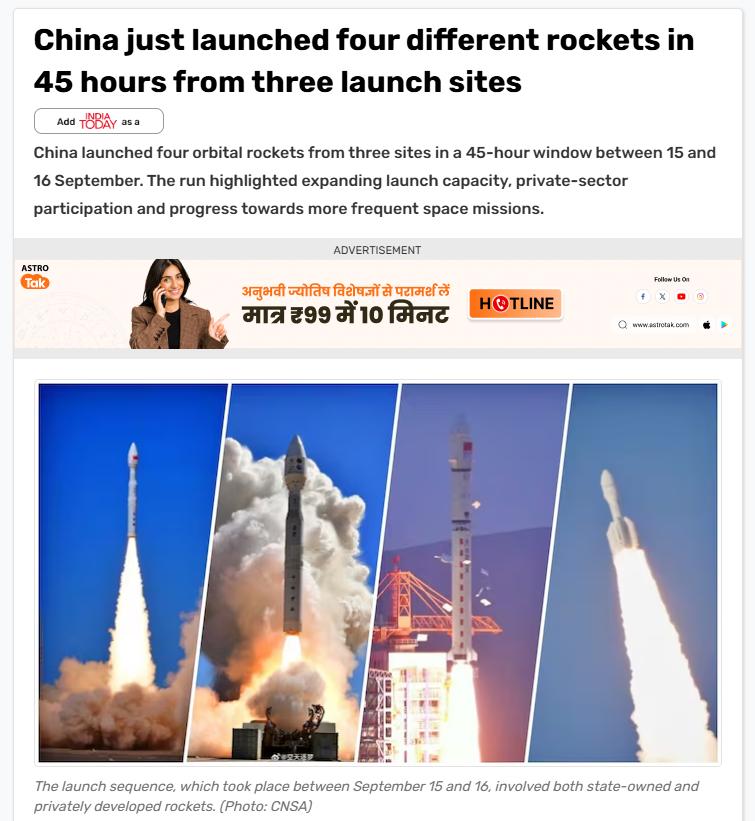
Why Is India So Envious?
The Indian media's jealousy is not unfounded.
In 2023, India's Chandrayaan-3 successfully achieved a soft landing on the lunar south pole, sending the whole nation into celebration. Narendra Modi hosted the live broadcast personally, the country declared a one-day holiday, and Indian media hailed the event as a landmark demonstration that developing countries can also excel in aerospace.
Over those two years, Indian society held an inflated confidence in its own aerospace capabilities — as they put it, we only spent 70 million USD to send a probe to the lunar south pole, which is cheaper than both Japan and Russia's similar missions.
Yet less than two years later, China launched four rockets in quick succession within 45 hours, leaving Indian media utterly stunned, and they did not hesitate to call it a "satellite blitz". They then quietly tallied their own numbers: As of now, India has completed 3 orbital launches for the whole of 2026.

In the global aerospace sector, a pattern of unassailable leading positions held by China and the United States has already taken shape. The global number of rocket launches in 2025 is: 198 by the United States, 98 by China, 17 by Russia, and 5 by India.
Now China's 4 launches in 45 hours equal the total launch volume of India for more than half a year. In the first half of 2026, China completed 44 launches.
New Delhi once set the goal of achieving 50 rocket launches per year by 2030, while China completed 44 launches in the first half of this year alone, already fulfilling 88% of India's "50 launches per year" target for 2030.
What the Indian media sees is not only China's success, but also its own shortcomings — the romantic notion of "spending ten years sharpening a sword" embodied by Chandrayaan-3 simply cannot compete with an industrialized assembly line.
Where Lies the Real Gap?
A single successful launch tests the technical competence of a single team. Continuous high-density launches within a short period of time test a complete industrial system.
What does it mean to launch four rockets from three different locations? It means the launch sites have to be scheduled simultaneously, the telemetry and control network has to monitor four orbits at the same time, and all work including fuel filling, personnel rotation, and satellite preparation has to run in parallel.
You cannot afford to let the team rest for three months after one launch before moving on to the next. That is the pace of scientific research and experimentation.
What pace is China operating at now? Each launch site completes dozens of launches a year, with rockets taking off on a fixed schedule just like public buses.
Private firms such as Blue Arrow Aerospace and Oriental Space conduct several launches every year, with rockets going through maintenance, refurbishment, and re-launch after returning. This is not a case of the whole nation pooling resources for one major project, this is aerospace industrialization — rockets have become industrial products that can be mass-produced and mass-launched.
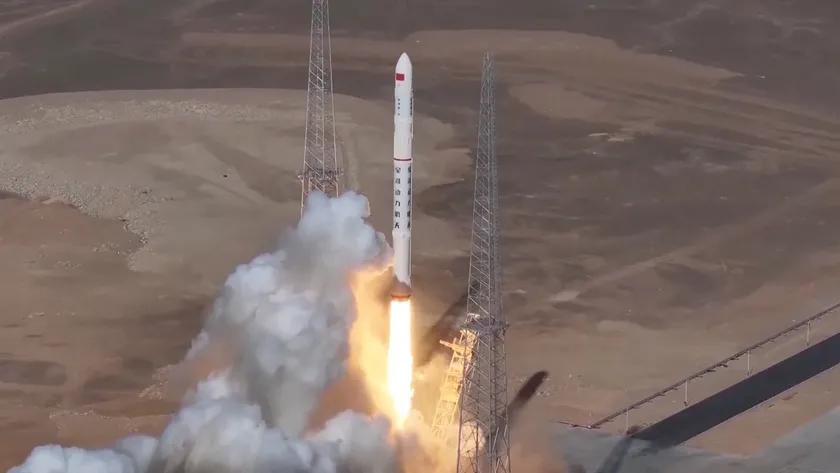
This is exactly where India's problem lies. Its aerospace agency ISRO is a scientific research institute, not an industrial department. It spends ten years sharpening one rocket, celebrates nationwide when it succeeds, and then relies on that single success for the next five years.
It does not have a mass production line for rockets, no private firms competing to drive progress, and no launch sites with schedules packed with dozens of missions a year.
What Is India Really Anxious About?
What the Indian media is anxious about is not a matter of prestige, it is the fact that space resources follow the "first come, first served" principle. India is not only worried about the huge gap in current aerospace capabilities, but also China's further expanding leading advantage built on top of its existing aerospace strength.
Low Earth Orbit only has a limited altitude range, there are only a handful of prime orbital positions, and the available communication frequency bands are limited. Whoever launches their satellites first to occupy these resources gets to keep them.
Elon Musk's Starlink has fully activated the satellite internet track. By driving down costs with reusable rockets and rapidly building its constellation through high-frequency launches, Starlink now has nearly 11,000 active satellites in orbit, covering most regions across the globe.
China's Qianfan constellation and GW constellation now carry a dozen satellites on a single launch, sending nearly 40 satellites into space within 45 hours to occupy orbital positions on a large scale. India only completes 5 launches a year, carrying one or two satellites each time, and the satellites it sends up barely make any noticeable impact.

When China and the US finish deploying their low-orbit constellations, with global communications, remote sensing, and navigation all running on them, India will find no remaining orbital positions or available frequency bands left when it tries to join in. At that point, it will not be competing with China on aerospace technology anymore, but will only be paying to be a user on the infrastructure built by others.
This is the real anxiety behind that India Today article. It is not jealous that China's rockets are more advanced, it is jealous of the fact that: By the time India saves enough money to launch its next rocket, all the prime positions in space will have already been taken.

Behind the Indian Media's Stunned Reaction
One Overlooked Detail Among the four launches in 45 hours, the most notable ones are the two private rockets, Zhuque-2 and Gravity-1.
Zhuque-2 is a liquid oxygen methane rocket developed by Blue Arrow Aerospace, and Gravity-1 is a solid strap-on rocket developed by Oriental Space. Both are private startups founded around 2015. In roughly ten years of operation, they have already achieved a higher launch frequency than ISRO.
Behind this is China's entire commercial aerospace ecosystem — with launch sites, telemetry networks, satellite firms, and component suppliers, new entrants do not need to build the ecosystem from scratch, and can carry out launches directly after accessing the existing system.
India still does not have a true commercial aerospace sector to this day. ISRO holds a complete monopoly, and private firms only provide supporting services for ISRO, with no independent capacity to develop and launch their own rockets. It can copy the technology of a single Chandrayaan-3 mission, but it cannot replicate this industrial ecosystem forged by full-market competition across the whole society.
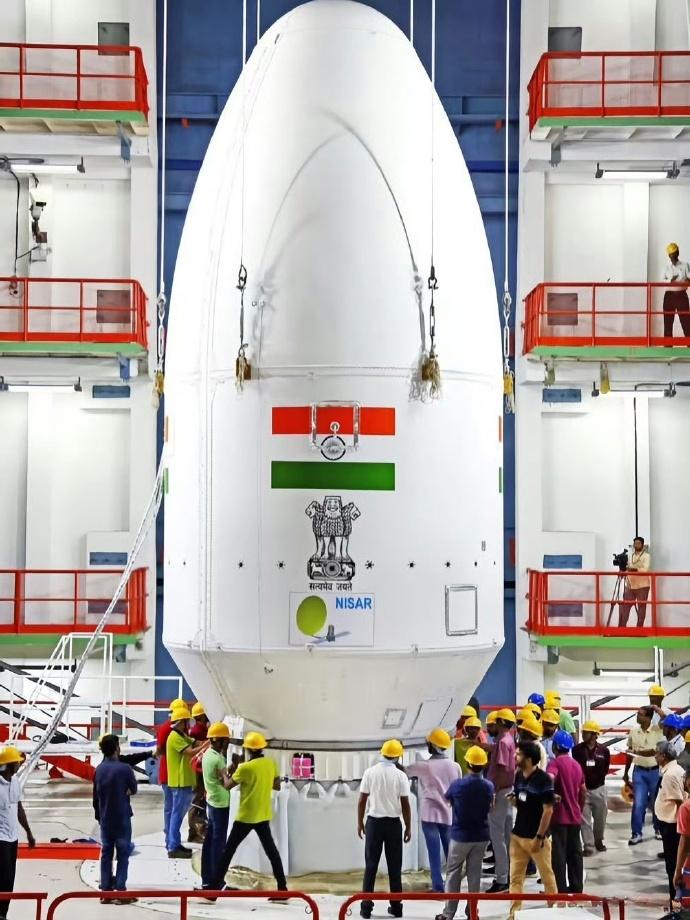
When faced with the industrial scale and launch rhythm of China's aerospace industry, New Delhi's sense of pride has been severely impacted by reality.
For them, launching a rocket once in a while is not a difficult task, but such a high launch frequency makes India feel completely outmatched. In the space sector, the depth of the industrial system is the fundamental threshold.
China's aerospace industry started its commercialization process five years ago, with state-owned teams taking on high-difficulty missions, private firms competing on launch density and cost, launch sites arranging schedules in shifts, and satellite firms queuing up to send their payloads into space at a fast pace.
These 45 hours demonstrate that China's state-owned aerospace sector, private commercial players, land-based and sea-based launch capabilities have formed a system that can operate in coordination at high frequency.
The Indian media called China's operation a "satellite blitz". The core of blitzkrieg is not that a single rocket is exceptionally powerful, but that the entire system is operating at high speed.
India is still stuck in the aerospace 1.0 era — pooling the whole nation's resources to build one rocket, and the whole nation celebrating once it succeeds. China has already entered the aerospace 3.0 era — rockets have become industrial products, launches have become routine operations, and orbital positions have become resources that need to be competed for.
India's successful Chandrayaan-3 mission is of course worthy of respect. But space does not honor one-off heroism, it honors the industrial capacity to complete 98 launches a year. The Indian media's current envy shows that they have realized this gap.
Indian media understands that the threshold for space competition is being raised rapidly. To raise the annual launch count from 5 to 50, India does not need to spend another ten years developing a Chandrayaan-4, but to completely overhaul its entire aerospace industrial system. Without structural reform and large-scale investment, it will be left further and further behind in this round of competition.
The scale of this overhaul project is far larger than carrying out ten more Chandrayaan-3 missions.
This article is from the WeChat public account "Hotspot Micro Review" (ID: redianweiping), written by Wang Xinyu, and authorized for release by 36Kr.