AI drug discovery has entered the eve of value realization.
Author: Hu Jingjie
Original: Deep Insight Finance
The AI pharmaceutical industry continues to boom.
Recently, Novogene hit a 20% daily limit during intraday trading, with Chengdu LeadGene, Hopu Pharmaceutical and other related stocks rising in tandem. This round of market rally is triggered by the intensive release of multiple signals from the policy end and the industrial end recently.
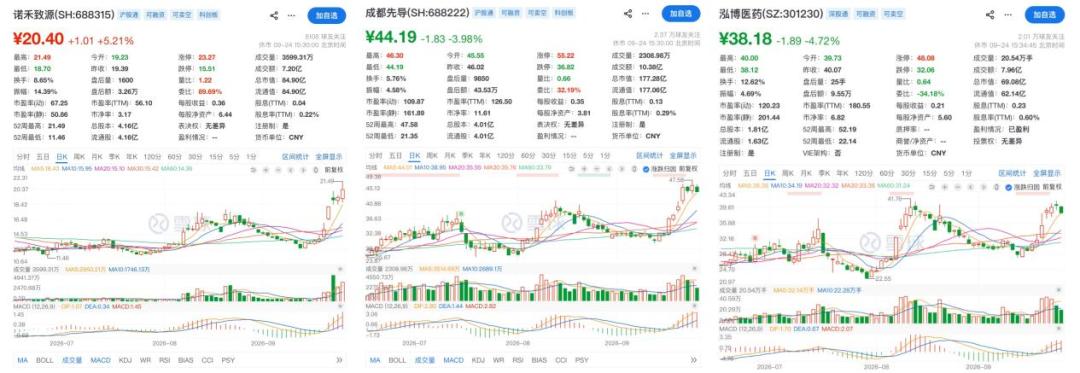
(Image source: Xueqiu)
On September 18, 10 departments including the Ministry of Industry and Information Technology jointly issued and implemented the "15th Five-Year Plan for the Development of the Pharmaceutical Industry", which specially set up a special column for "Cultivation of High-value Application Scenarios of AI Pharmaceuticals", focusing on promoting AI-enabled target screening, drug molecular design and optimization.
A few days earlier, Anew Labs, an AI pharmaceutical company spun off by ByteDance, completed a $290 million financing with an estimated valuation of about $1.5 billion. Rentosertib, the world's first candidate drug for idiopathic pulmonary fibrosis with target discovery and molecular design completely completed by artificial intelligence, officially entered the phase III clinical trial for the first patient administration stage, for the first time, AI pharmaceuticals have truly stood in front of the last checkpoint before a new drug is launched.
Policies provide an institutional framework, capital bets on underlying capabilities, and clinical practice has reached a critical node. The convergence point of these three clues falls exactly on the critical line where AI pharmaceuticals switch from "narrative-driven" to "value verification". What is worth paying attention to next is whether this track can truly run through the commercial closed loop at this node.
01 Large manufacturers move from the "sidelines" to the "gaming table"
In the past few years, the role of technology companies in AI pharmaceuticals has mostly stayed at the level of "selling shovels", that is, providing models, computing power or platforms, without touching the drug pipelines themselves.
But in 2026, this boundary was completely broken.
ByteDance's moves are the most representative. Among all the internet giants that have entered the AI pharmaceutical track, ByteDance is the one with the heaviest layout and the deepest involvement.
Its AI pharmaceutical team was established in 2021, led by Kai Liu, with about 50 core members composed of AI4S algorithm talents and senior pharmaceutical industry experts. In June 2026, ByteDance spun off this business independently and established Anew Labs.
(Image source: Anew Labs official website)
In just three months, Anew Labs' first round of financing has been completed, with a total financing amount of 290 million US dollars, refreshing the record for a single round of domestic AI pharmaceutical financing this year. The investors in this round cover leading investment institutions such as HSG, IDG Capital, GL Ventures, 5Y Capital, Gaorong Ventures, Chunhua Ventures, and many domestic pharmaceutical industry groups also participated as strategic investors.
However, although the financing went smoothly, the fastest pipeline of this company is still in the pre-clinical stage. Therefore, the $1.5 billion valuation given by the primary market obviously does not buy the pipeline itself, but the computing power support of the ByteDance ecosystem, the platform potential of the full-modal drug design large model, and the top talent lineup.
Baidu's path mirrors that of ByteDance, choosing to "take the platform as the core, incubate independent companies, and let them serve the entire industry".
BioMap, founded by Robin Li, does not develop drugs, but builds underlying large models for the industry. Its core product xTrimoV4 has a parameter scale of 268 billion, making it one of the world's largest full-modal basic large models for life sciences.
xTrimoV4 and the industry solution BioMapOS have been verified in more than 60 proof-of-concept projects, with application scenarios covering target discovery, antibody R&D and innovative drug R&D, serving more than 800 institutions, including more than 30 leading enterprises.
In March 2026, BioMap submitted a listing application to the Hong Kong Stock Exchange in confidential form, with CICC, Morgan Stanley and UBS Group as joint sponsors. If the listing is successful this time, it will become one of the landmark enterprises in the "AI + biopharmaceutical" sector in the Hong Kong stock market.
Tencent's choice is the most unique. It does not develop underlying models, nor does it operate medical services, but uses capital as a lever to carry out a "blanket-style" layout. Tencent's figure can be found behind AI pharmaceutical and biotech companies such as Cryo-Tech, Insilico Medicine, Lepu Biotech, and Livzon Pharmaceutical.
However, as time goes by, Tencent gradually realizes that the pure investment route cannot stand firm in the technical narrative, and it needs to prove its technical capabilities in the cutting-edge field of molecular design. In February 2026, Tencent publicly disclosed a patent for a new short-sequence polypeptide GLP-1 weight-loss drug designed entirely by AI.
Most traditional GLP-1 drugs are long-sequence molecules that mimic endogenous polypeptides in the human body, with complex synthesis processes and high production costs. Through high-precision calculation and deep learning model optimization, Tencent has designed a brand new short-sequence polypeptide, and completed activity verification in cell experiments, directly proving its hard core strength in AI pharmaceuticals to the industry.
Overall, the underlying logic for the collective entry of large manufacturers is that the global drug R&D model is no longer sustainable. Traditional drug discovery takes an average of more than ten years and costs over one billion US dollars, with a clinical failure rate consistently higher than 90% all year round.
The efficiency improvement of AI in the links of target discovery and molecular design has been repeatedly verified. For example, relying on the end-to-end Pharma.AI platform, Insilico Medicine has compressed the average cycle from project initiation to PCC to 12-18 months, which is much faster than the 4.5 years of traditional R&D.
When AI changes from an "optional auxiliary tool" to a "mandatory core productivity", tech giants have no reason to continue to stand on the sidelines.
02 Valuation Mismatch
Hua Mao, Senior Partner and Managing Director of Frost & Sullivan China, once stated that with the increasingly sufficient supply of computing power and the rapid iteration of large models, the differences in model functional levels are narrowing. For technology companies to tap competitiveness in the pharmaceutical sector, they need to seize the automated experimental entry, proprietary data assets and pipeline IP.
However, while large manufacturers enter the market, a valuation gap is cracking between the primary and secondary markets.
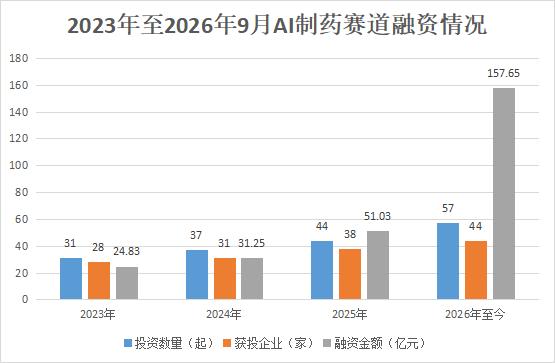
According to data from ChinaVenture CVSource, since 2026, 57 investments have been completed in the AI pharmaceutical track, 44 enterprises have obtained financing, and the total disclosed financing amount is 157.65 billion yuan. The financing amount exceeds the sum of 2023, 2024 and 2025.
(Deep Insight Finance illustration)
However, the pricing anchor point of the primary market is completely based on the logic of tech stocks. Take Google's Isomorphic Labs as an example. It completed a $2.1 billion Series B financing in May, refreshing the record for a single financing in the global AI pharmaceutical sector, and raising its own valuation to about $15 billion to $20 billion. But it still has no mature clinical pipelines so far, and the core reason why investors pay for it is the scientific research influence of AlphaFold and the computing power and ecological capabilities of Alphabet.
The secondary market follows another framework: Recursion's latest market value is only 2.002 billion US dollars, meanwhile, the market value of Exscientia is about 2.7 billion US dollars, and Insilico Medicine is about 4.8 billion US dollars, which is several times lower than the valuation gap of similar assets in the primary market.
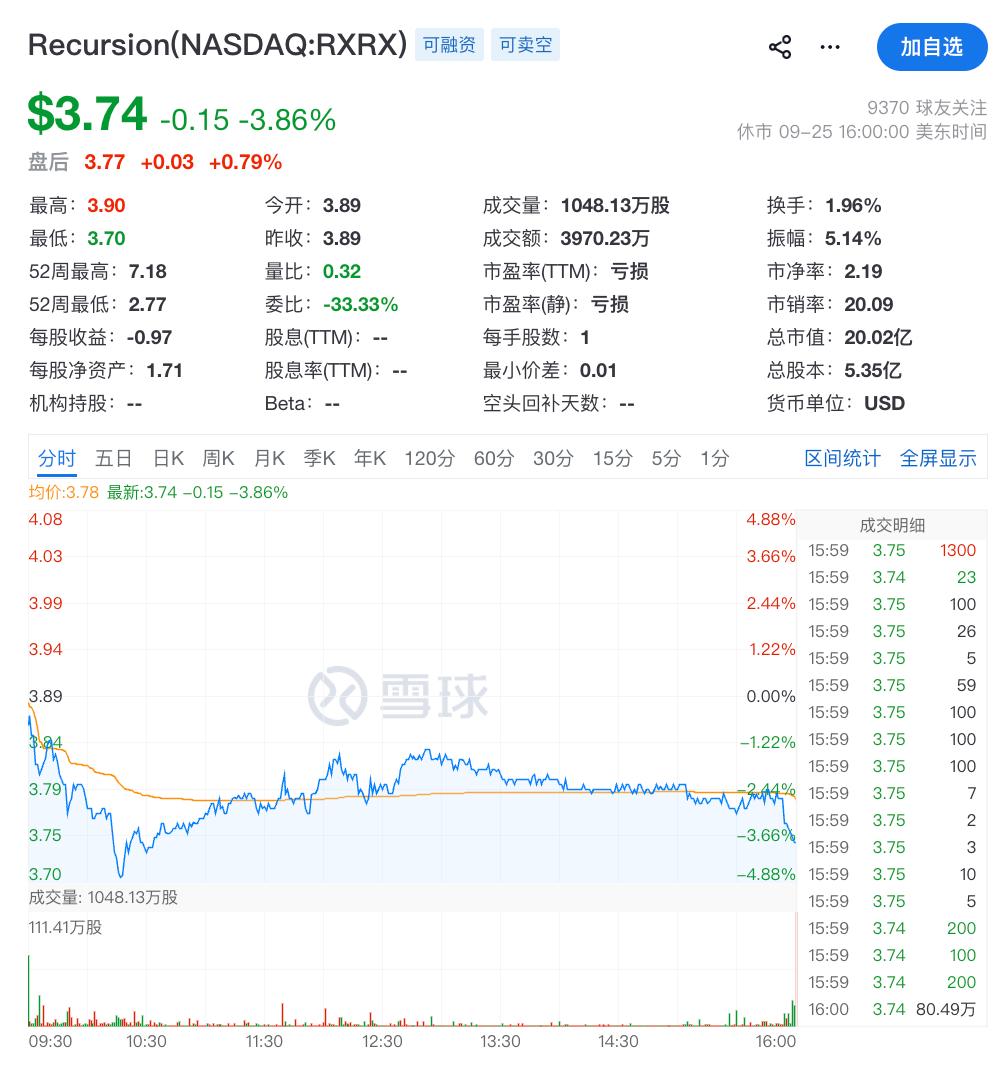
(Image source: Xueqiu)
This mismatch stems from the structural differences between the two types of markets. The primary market has a long investment cycle and high risk tolerance, and can price AI pharmaceuticals according to the caliber of tech stocks, with the core of betting on the long-term trend that technological innovation transforms pharmaceutical R&D. The secondary market is constrained by factors such as quarterly financial reports and cash burn rate, and mostly calculates pipeline failure rate and cash consumption according to the risk framework of traditional Biotech. The difference between the two sets of pricing frameworks has caused the valuation mismatch of AI pharmaceuticals.
In addition, the deeper problem is that there is a clear dividing line in the value verification of AI pharmaceuticals. According to foreign industry studies cited in the research report of China Post Securities, AI pharmaceuticals have greatly accelerated the process of clinical phase 1, and at the same time increased the success rate from 40%-65% of traditional empirical level to 80%-90%, while no significant difference in performance has been observed in phase 2 and subsequent progress (the success rate is about 40% in both cases).
Feng Ren, Co-CEO of Insilico Medicine, also admitted at the 2026 Zhangjiang Pharma Valley Conference & Shanghai International Biomedical Industry Week that there is currently no data proving that drugs developed by AI can improve their success rate in clinical practice. The main reason for this problem is that the cycle of clinical verification is too long. At present, no such drug has been officially approved for listing, so there is no way to judge whether the drugs developed in this way have a higher clinical success rate than those developed by traditional methods.
This means that there is an awkward time lag in the value realization of AI pharmaceuticals. The efficiency revolution in the front-end links is real and quantifiable, but what ultimately determines the success or failure of the drug is still the clinical verification marathon measured in years. The primary market can pay a premium for this time lag, but investors in the secondary market may not have such patience.
03 The competitive logic of AI pharmaceuticals is being rewritten
The current competitive focus of AI pharmaceuticals is shifting from "who has a more dazzling model" to "who can truly push molecules to the clinic and the market". Behind this shift, two variables underestimated by the market are emerging.
The first variable is high-quality data. Public data is equally accessible to everyone, and mainstream algorithm architectures are also spreading rapidly through papers and open source codes. What truly determines the upper limit of platform performance is high-quality, standardized, and sustainably iterable private domain data.
This is also why tech giants in 2026 have extended their capabilities from the digital world to physical laboratories one after another. Anthropic has built a wet laboratory in the San Francisco Bay Area of the United States; Anew Labs, the AI pharmaceutical company under ByteDance, has completed its first round of external financing as an independent company, with a scale of 290 million US dollars; Lilly TuneLab, the AI pharmaceutical platform under Eli Lilly, has partnered with GenScript, Twist, and Ginkgo to improve the verification chain of AI druggability prediction...
The second variable is patient capital. The input-output cycle of AI pharmaceuticals is completely different from that of traditional internet projects. Traditional pharmaceutical development takes an average of about 13 years from project initiation to commercialization, which is expected to be compressed to about 8 years with the deep participation of AI, but this is far beyond the duration of most investment institutions, which is undoubtedly a question about time and patience.
Therefore, when XtalPi realized its annual profit for the first time in 2025, it caused a huge stir in the AI pharmaceutical circle. The reason why this incident attracted attention is precisely because it proved that at the stage where the AI arms race tests the cost and revenue model the most, the business model of "platform empowerment plus milestone fulfillment" can be run through.
The company has established cooperation with 17 of the world's top 20 pharmaceutical companies, and realized rolling revenue through down payment, milestone payment, technical service fee and platform subscription fee, avoiding the high clinical risk and cash flow black hole of self-developed pipelines.
At present, the number of pipelines has reached dozens, covering cancer, metabolic diseases, neurological diseases and rare diseases, forming a positive cycle of "the more you do, the cheaper it gets, the more accurate it gets, and the more large orders you can sign".
In the final analysis, in the second half of AI pharmaceuticals, the competition is not about who has a more attractive story, but about who can take the lead in building a closed ecological loop that continuously generates cash flow. The policy framework has been built, and the capital is already in place, but the final referee is clinical data.
In this track measured in decades, what is truly scarce has never been computing power, models or funds, but the patience that is willing to demand itself according to the time scale of the pharmaceutical industry.
* Images are from the Internet, please contact us for deletion in case of infringement
This article is from the WeChat official account "Deep Insight Finance" (ID: chutou0325), author: a follower of AI pharmaceutical industry, published with authorization from 36Kr.