I've made three AI demos, but why am I still unable to land an interview?
Three working AI demos still can't land you an interview? The problem lies not in the number of projects, but in the lack of your own judgment in the projects. Starting from the screening criteria for AI PMs, this article breaks down four types of ineffective demos, provides an 8-step checklist, and teaches you how to present projects on your resume to show interviewers your product thinking and trade-off capabilities.
You have built three demos: one RAG, one Agent, and one low-code assistant. All links are accessible and all workflows run smoothly, yet you barely get any interview invitations after sending out your resume.
Many people assume the problem is insufficient project experience, so they swap the model, add several tools, and build a more complex workflow. But what companies are short of is not that, but people who can clearly explain their projects.
I have been working in product for over a decade, and I have seen plenty of products that "look great in demos but go wrong as soon as they are put into actual use". AI projects are especially prone to this: during demonstrations, inputs are pre-prepared, materials are clean, and paths are pre-designed, but in real use, users will not cooperate that way.
Therefore, if you still get no interview opportunities with three working demos, the problem may not be the quantity, but the lack of your unique value reflected in the projects.
I. A working demo only proves half of your capability
A common line in resumes goes like this:
"Independently built an intelligent customer service system, integrated large language model and knowledge base, realized multi-turn Q&A, and improved customer service efficiency."
This sentence is not wrong, but it leaves many questions unanswered. What types of problems do customer service staff solve every day? Why use a knowledge base instead of search? What happens when the materials are updated? What is the cost of one wrong answer? Which specific step is omitted to "improve efficiency"?
If you have no answers to these questions, the project will end up being nothing more than a list of a few tool names.
Jaclyn Konzelmann, head of Google AI Product, once publicly shared the questions she uses to screen AI PMs. One of the questions asks candidates to disassemble an AI workflow they built themselves, focusing on the most unexpected failure they encountered and how they adjusted the design afterwards.
This question does not require candidates to memorize the architecture diagram. What it wants to know is: whether you have actually tested the system to its edge cases.
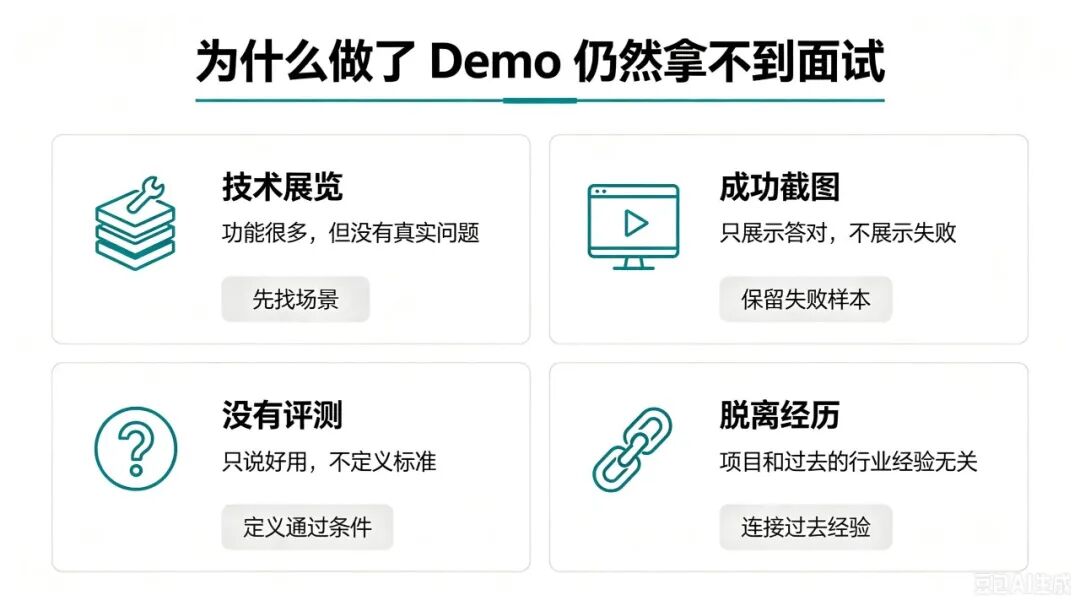
Projects do not need to be large. It does not matter if there is no official online launch data. You should at least clarify three things: why you built it, where you made mistakes, and what criteria you used to judge that the problem has been fixed.
II. Four types of meaningless demos
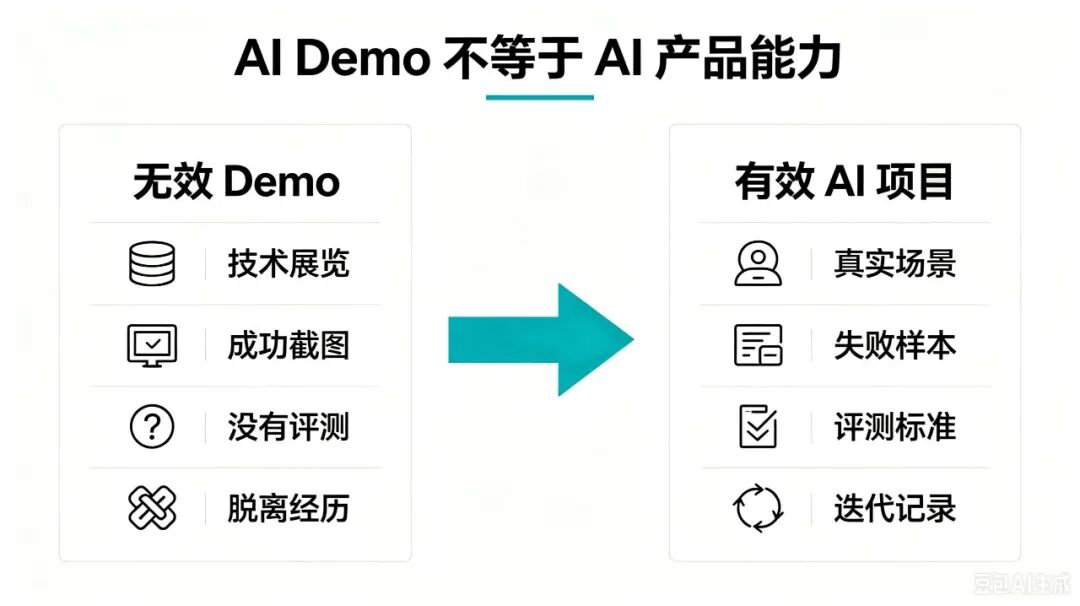
1. Universal all-purpose assistant
It can read files, access the internet, summarize content, and send emails, doing a little bit of everything. The demo looks impressive, but no one knows exactly whose time it saves and for what specific scenario.
Narrow down the scope, and the project will have actual substance. For example, if you only build a tool to sort out customer objections after sales visits, you will encounter a series of practical problems: can you infer the unspoken content from customers? Should you keep the original wording for promised deadlines? Who needs to confirm the content before it is written back to the system? These are the real product work.
2. Demos with only successful screenshots
You are the person who debugged the knowledge base, and you are the most familiar with its content. You know exactly what is written in the materials, so you naturally avoid tricky questions when testing.
For another user, the question may only have half a sentence, the materials may have two different versions, and a key condition may be missing from the answer. The model can still output a complete paragraph, but completeness does not equal correctness.
Put a failed sample in your portfolio, explain where it went wrong: missing information in the input, wrong document recalled, unconstrained prompt, or no error correction option on the interface. This is far more useful than adding another successful screenshot.
3. Demos with only functions but no evaluation
Descriptions like "high accuracy rate", "good experience" and "basically usable" cannot be verified.
For Q&A products, you can check whether the citations match the original text and whether the system will ask follow-up questions when information is insufficient. For content generation products, you can record the one-time success rate, number of revisions, and cost per generation. For Agent, you need to check whether the task is completed, whether the correct tool is selected, and whether it stops when human intervention is required.
Do not only look at the average score. If the system answers 9 out of 10 questions correctly, but reverses the key information in the remaining one, users will usually only remember that one bad result. The same applies to long workflows: every single step may work fine, but the whole process may fail when connected together.
4. Demos disconnected from your past experience
If you switch to the AI field and delete all your past three years of experience, leaving only Prompt, RAG and Agent on your resume, your projects will look like temporary homework.
If you used to work in e-commerce, you can start from product materials, customer service or product selection. If you have experience in content industry, you can focus on retrieval, moderation and creation assistance. If you worked in enterprise services, you can start with knowledge base, sales support and process automation. Your experience with dirty data, permission issues and collaboration frictions in the business is far more valuable than just listing tool names.
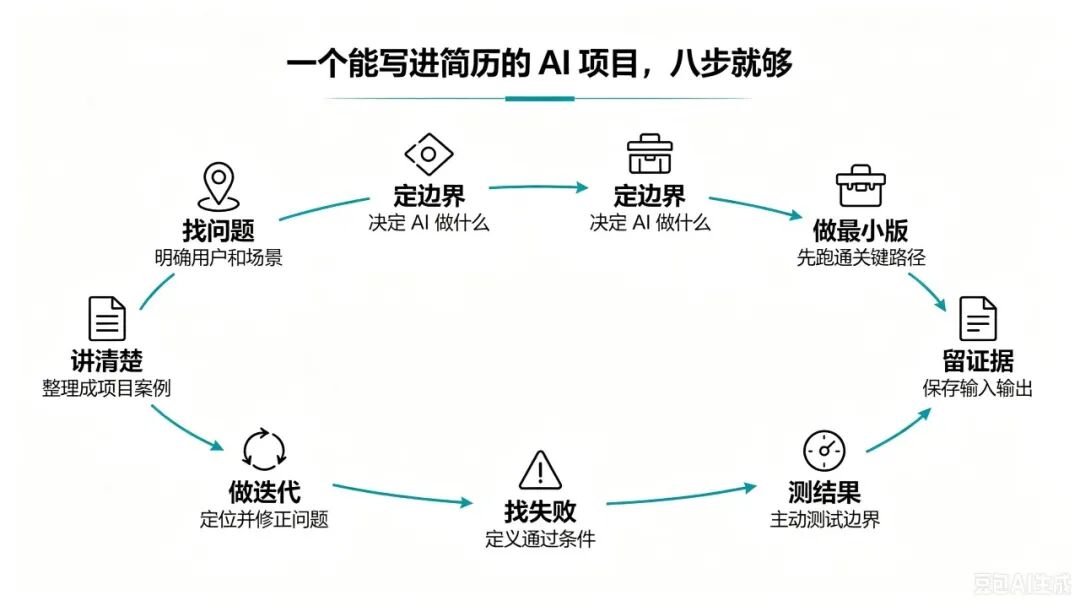
III. 8-step inspection checklist
You do not need to expand the project further. First check if you have covered all 8 items below:
Problem: Who encountered what trouble in what scenario.
Boundary: What the AI can do, and what it cannot do.
Minimum viable version: Whether the most critical path can run smoothly.
Evidence: Keep the inputs, outputs and key decision records.
Evaluation: What criteria define a successful result.
Failure test: Actively test ambiguous inputs, missing materials and long workflows.
Iteration: Explain what you modified and why.
Presentation: Organize the content into a one-page project case, with an accessible link attached.
This does not require you to write a long sharing article. A failed sample, together with its cause, modification and retest result, is far more specific than the vague description of "optimized prompt to improve accuracy".
All numbers should have sources. If you do not have real production data, write that you use offline test data. If the product is not launched, mark it as prototype stage. If the result is not verified, state it directly. Personal projects do not need to pretend to be production-level projects.
IV. Present projects on your resume
For the project title on your resume, write the business target first, then the technical solution. For example, "Customer Q&A prototype for sales teams" is easier to understand than "Intelligent Q&A system based on RAG".
Four points are enough for the project description: what problem you solved, what key decision you made, how you verified the result, and what shortcomings are still left at present.
Do not read from the left side of the architecture diagram during the interview. Interviewers are more likely to ask: Why did you choose this scenario? Why not use regular search? What consequences will a wrong answer cause? Why did you optimize the recall module first instead of swapping the model? Which operations must be reserved for humans?
Trade-offs are more informative than a function list. For the sake of stability, you removed a part of the Agent workflow; for the sake of cost, you shortened the context window; for the sake of security, high-risk operations require human confirmation. There is no standard answer for these decisions, but they can show that you are actually doing product work.
You also need to prepare a version where the original solution fails. In the public AI PM interview questions, there is a question that assumes that after the model is upgraded, one single API call can replicate all the core capabilities of your original project, and asks candidates to explain how the product and team should adjust their direction.
This is not asking you to predict the future.
After the model is updated, many skills that were useful yesterday will become basic capabilities, so you need to redefine the value of your project. What really makes you stand out is usually your understanding of the scenarios, user feedback and business processes.
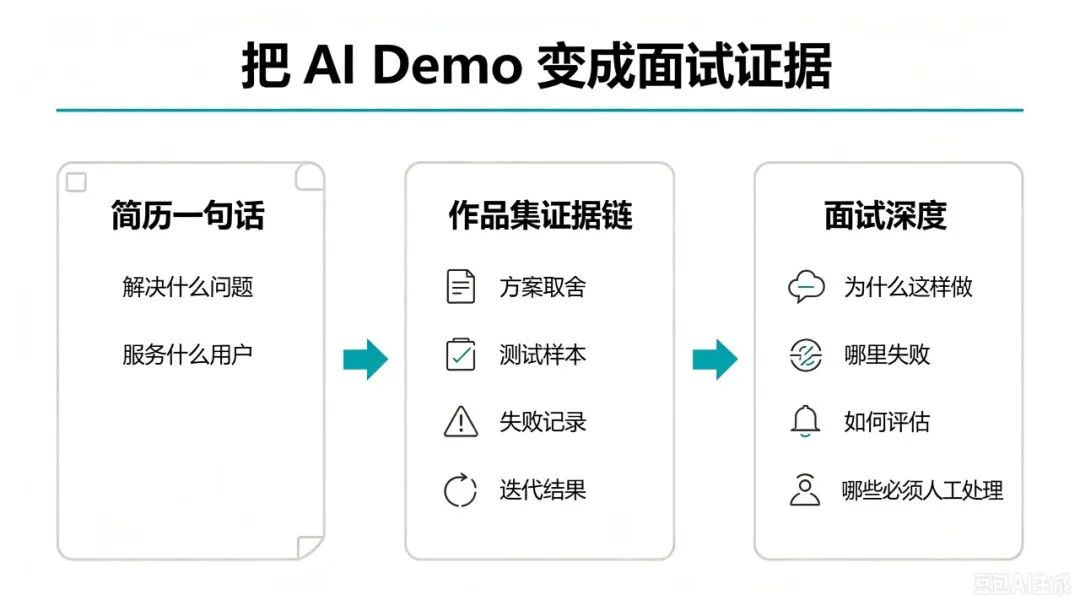
If three demos still cannot get you an interview, do not rush to build the fourth one. Open one of your existing demos, find a real problematic input, test it thoroughly, record the cause of the problem and the fix, and you can solve the problem fundamentally.
This article is from the WeChat official account "Everyone is a Product Manager" (ID: woshipm), author: Yiyan, published with authorization from 36Kr.