The "revenge" play of the super gateway sees Muse take the top spot, with Tencent and Alibaba posting sharp gains.
Launched for 10 days with 2.5 million downloads, Meta's Muse immediately kicked ChatGPT off the top spot of the free app download chart.
Muse is a total lifesaver for Mark Zuckerberg! And it also drove Tencent and Alibaba on the Pacific side to surge sharply one after another.
Is an APP really that magical?
Take Meta, owned by Zuckerberg for example, it has poured huge capital this year, with a maximum capital expenditure of 145 billion U.S. dollars, which is nearly one trillion yuan converted into RMB, invested in data centers, chips and models. However, no one remembers Vibes, and Meta AI received lukewarm responses. It has never launched a hit product until Muse came out.
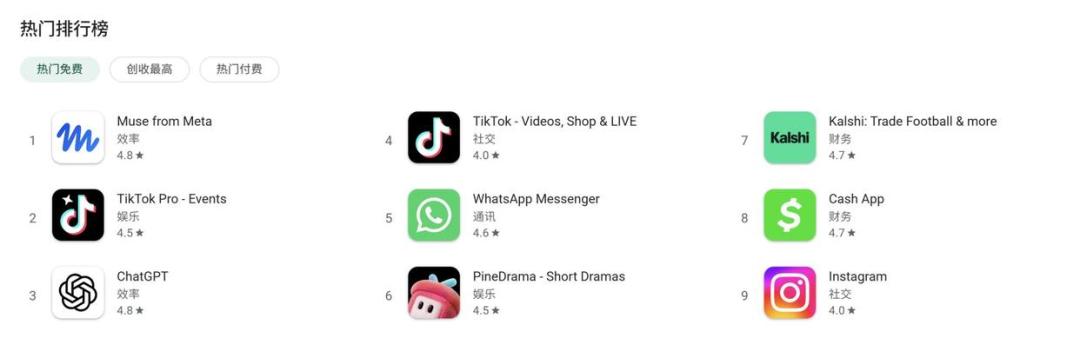
So why is Muse so popular? There are three reasons, and the logic is very simple.
The first one is low entry barrier. It does not require complex prompts, nor do users need to learn how to "talk to AI". You only need to tell it what you want to do, such as booking a hotel, buying clothes, filling out forms, or canceling subscriptions, and it will automatically click, fill in and place orders in the browser. Users do not need to become prompt engineers, they only need to be ordinary people.
The second one is cost-effective. Alexandr Wang, Chief AI Officer of Meta, directly launched an activity called #Muse Money Challenge, publicly stating that using Muse can help you save 1,000 dollars instantly. Some users uploaded their auto insurance policies, and found a new plan that saves 3,500 dollars per year and completed the purchase in 5 minutes. Some users asked Muse to check their finances, and found a 200-dollar carrier gift card that had never been activated.
The third one is high security. Letting an AI buy things, send emails and manage schedules for you means you have to grant various permissions such as email and payment information. Prompt injection, unauthorized use of permissions, and data leakage, any of these issues can scare users away.
Meta's solution is to assign an independent cloud virtual machine to each Muse user. Users' files, login status, and email connections all run in this isolated computer, and sensitive operations are subject to approval by an independent security agent. The payment link uses Stripe to generate a one-time card number, and the real bank card information is never exposed to Muse.
Even if Muse goes wrong, the risk is still controllable.
Therefore, the secret to Muse's explosive popularity is not how smart it is, but that it makes users feel that it can really get work done, and it doesn't matter if something goes wrong. This is exactly the core problem that all Agent products in the past two years have not solved.
Now back to the beginning. On the day Muse topped the download chart, Tencent's share price rose by more than 7% at one point during the trading day, with a total turnover of 32.1 billion Hong Kong dollars, ranking first among Hong Kong stocks. Alibaba's Hong Kong stock also rose by nearly 4% in the morning session. The two companies almost supported the entire increase of the Hong Kong stock technology sector that day.
The logic behind the surge is very simple: Muse has verified the feasibility of C-end Agent, and Chinese internet giants have an ecosystem more suitable for Agent implementation than Meta.
Muse still needs to access Spotify, OpenTable, and Ticketmaster one by one, while the WeChat Mini Program ecosystem itself is a ready-made service layer, and the payment closed loop is right below the conversation window. The closed-loop e-commerce of Taobao and Tmall is also the carrier with the clearest Agent transaction-oriented path.
According to Tianyancha, Tencent and Alibaba have continuously increased their overseas investment and equity layout in AI Agent, large model, payment technology and other fields in recent years, and the affiliated entities under the two companies cover the complete chain from underlying model to application implementation.
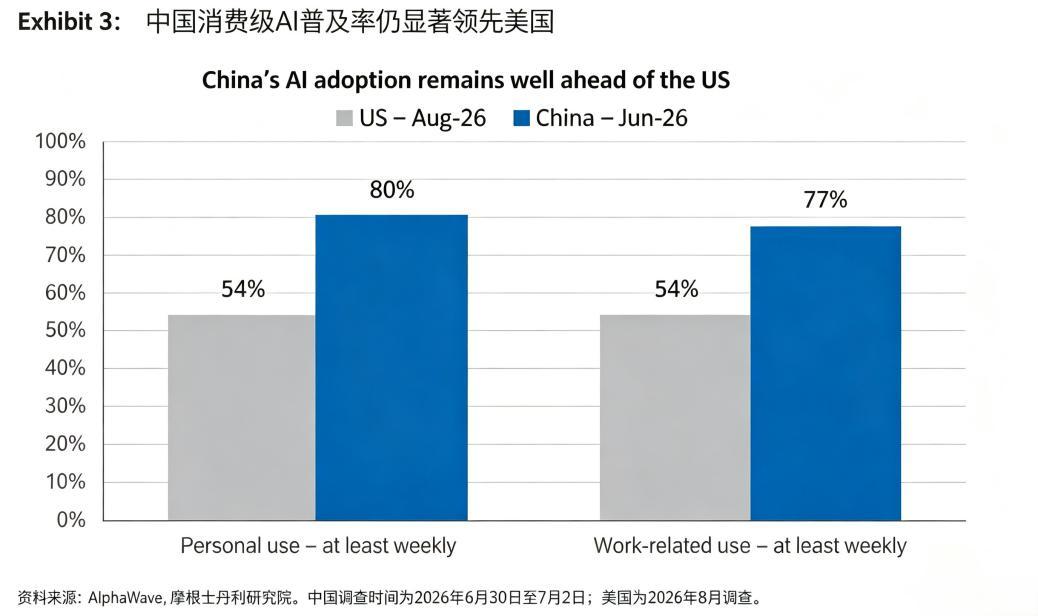
What's more interesting is that according to a survey by Morgan Stanley, 80% of respondents in China use AI for personal purposes every week, while the figure is only 54% in the United States. Chinese users have higher acceptance of AI, but the valuation of Chinese AI companies has been suppressed for a long time.
Meta proved with a consumer-grade Agent that C-end AI can become a hit, and people immediately turned their attention to Tencent and Alibaba. One of their biggest advantages is the entry, which is the only thing that cannot be replaced by model capabilities in the Agent era.
This article is from the WeChat Official Account "Rhodium Tech", the author is Hong Chen, and 36Kr is authorized to release this article.