Li Yanhong's AI Topic: Baidu Encounters the Old "Qvod-style" Script
Recently, the entire AI industry has been hyping up the potential disasters AI could bring to humanity.
Jacob Coxson, who previously worked as a frontier large model pre-training researcher at OpenAI and Anthropic, recently released a resignation statement claiming that AI could kill all humans in just ten years.
The statement went viral, and the question of "will AI destroy humanity" has become the most hotly debated topic.
While it remains unclear whether AI will kill humans in the future, the innocence of ordinary people has already become a casualty in advance.
According to a recent article by "Chang'an Street Insight", Huang Guigeng and other individuals have been defamed by AI-generated summaries in Baidu Search for more than a year, and are still waiting for a fair resolution.
Content from KuaiBo, now appearing in Baidu's outputs
In May 2025, Huang Guigeng, a lawyer based in Beijing, received three screenshots from his case client:
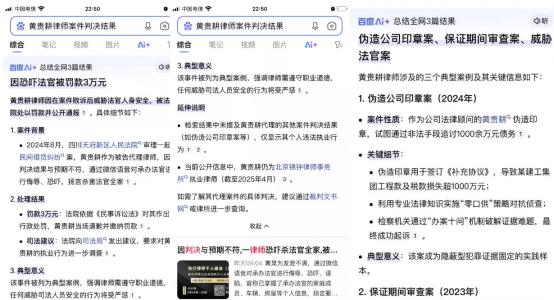
The screenshots show search results generated by Baidu AI after searching with the keyword "Lawyer Huang Guigeng".
After incorrectly aggregating information across the entire web, the AI indicated that "Lawyer Huang Guigeng" was involved in a case of forging company seals, a case of guarantee period review, and a case of threatening a judge.
A lawyer, for no apparent reason, became a criminal suspect in the AI's narrative.
Huang Guigeng told a reporter from Beijing Daily that to verify his background, the client's wife searched for Huang's information on Baidu, and after seeing the false negative summary generated by AI, she developed serious doubts about Huang's professional ethics, which once led to a trust crisis between the two parties.
It can be seen that the false information provided by Baidu AI Search has gone beyond simple factual deviation, and has caused substantial impact on Huang Guigeng's professional career.
In 2025, Huang Guigeng sued Baidu for one million yuan in compensation. Even after the case was filed, the wrong content continued to be generated.
This is not an isolated case. According to reports from multiple media outlets, Baidu AI Summaries are generating a large number of similar situations in batches:
For Li Xiaoliang, a lawyer in Nanjing, Baidu AI directly matched him with a photo of a person in a lawyer's robe, claiming that he "was sentenced to three years in prison".
The owner of a winery in Jiangxi searched for his own brand name on Baidu, and the system automatically associated the keyword "why it was banned". When he clicked in, the AI conducted an analysis and listed several "reasons for the ban", all of which were completely fabricated.
According to a report from The Beijing News, at the end of 2025, 37-year-old Ji Chengxiang searched for his name on Baidu and found that he had also been "defamed" by AI.
Baidu AI placed the charge of "organizing prostitution" right after his real early education experience, claiming that he was sentenced to five years and six months in prison by the court. This information was also "grafted" from another person with the exact same name.
Gu Jinyan, senior partner at Beijing Yunjia Law Firm, also revealed similar cases to the media, where the parties' experiences were almost identical to the above cases.
When searching for the party's name and recent status through Baidu Search Engine, the AI generated content stating that he "was sentenced to 10 years and 3 months in prison", with the title "Ten years in prison, the future awaits light", and prominently marked "synthesized from 54 real experiences across the network" before the generated information.
All these cases have one thing in common: the AI did not simply "make a mistake", but conducted large-scale "misattribution of fault to the wrong person".
It accurately grafted the criminal records of other people with the same name on the Internet, or the anonymous "Mr. Huang" mentioned in news reports, onto innocent people, and matched them with their real photos or experiences to generate a seemingly authoritative but actually false summary.
These incidents all indicate that AI has already caused substantial and objective harm to human beings mentally.
This reminds people that at last year's Baidu World Conference, Li Yanhong once said: "Now when you use Baidu Search, the vast majority of results are automatically generated by AI."
He also stated that AI will redefine search.
At that time, he probably did not expect that what was redefined along with search would also include the irreparably damaged reputation of ordinary people.
Facing the flood of doubts and lawsuits, Baidu's response method has sparked widespread discussion across the industry.
In February 2026, the first instance hearing of the Huang Guigeng case opened. Baidu argued in court that AI hallucination is an unavoidable phased problem in product development, Baidu provides neutral technical services, has no subjective fault, and does not constitute infringement.
Interestingly, this set of rhetoric is extremely similar to what Wang Xin, CEO of KuaiBo, said when standing in the defendant's dock in 2016: "The content is not my responsibility", "technology is neutral", "I am just a technical service provider".
However, the responsibility of a technology platform should not be limited to merely maintaining the platform.
Recently, a hidden sex-related industry chain was exposed on the Xianyu platform. During an investigation, reporters found that the personal information of some customer service staff blatantly contained the four words "available for appointment". After further communication and confirmation, most of these girls available for "booking" are minors, and the youngest is only 14 years old.
If "technology neutrality" can be used as an excuse for Baidu, it can also be a shield for Xianyu — "I am just a platform that facilitates transactions, whether the content posted by users involves organizing minors into prostitution has nothing to do with me".
Technology itself has no position, but the people who master technology do.
When technology is no longer a simple tool, but deeply involved in information distribution, affecting public affairs and even personal destinies, it has gone beyond the category of "neutrality".
KuaiBo sparked controversy in the past for failing to effectively control pirated and pornographic content, and Baidu AI is now facing questioning for generating false information that may affect personal reputation and career development.
Although the specific situations involved in the two are different, the problems reflected behind them are similar: in the context of technology being deeply integrated into social operation, "technology neutrality" should never become a reason to evade public responsibility.
Baidu also defended that "AI hallucination is an unavoidable phased problem in product development".
But this statement is clearly inconsistent with its previous public remarks.
At the 2024 World Conference in November, Li Yanhong once publicly announced that large models had "basically eliminated hallucinations".
However, the actual performance of Baidu AI Search is in sharp contrast to this strategic expectation: the so-called "hallucinations" have not disappeared, but instead show a disturbing "targeted aggressiveness".
It is no longer random technical noise, but accurately "grafts" and fabricates high-risk negative plots such as punishment, conviction and imprisonment.
AI models do have hallucination problems, but this kind of precise impersonation and active fabrication behavior has gone beyond the scope of technical limitations.
According to the report of "Chang'an Street Insight", Baidu mentioned in its own system description that after enhanced search, the large model will conduct multi-dimensional screening of the relevance, timeliness, authority, security, repeatability and low-quality content of candidate information.
However, for highly sensitive keywords such as judges, lawyers and criminal cases, the review mechanism obviously failed to intercept them effectively.
The core of the problem is: if the review mechanism is truly functioning properly, these contents could never be released at all.
What Baidu may need to answer is which part of this mechanism has failed?
The most reference-worthy evidence comes from industry comparison. In the Li Xiaoliang case, the second instance judge asked in court: "Ask questions on Doubao and DeepSeek, why are there no such defamatory contents?"
This question points to a key fact — similar products do not have similar problems, which indicates that this error may not be an inevitable cost of technological development, but that the platform may have gaps in the investment of review and prevention obligations.
AI Search is positioned by Baidu as its next growth engine, with a large amount of resources invested and user habits gradually formed.
However, Baidu has not yet given a convincing explanation of the matching degree between the investment in the three lines of defense — pre-release content security assessment, in-process review and interception mechanism, and post-release efficient error correction channel — and its growth rate.
The core of the problem may be: when a company positions AI Search as a "growth engine", how much resources has it invested in content security, and how much has it invested in commercial monetization?
Looking back at Baidu's development trajectory, although it has caught up with the AI trend, its underlying business logic seems to have remained consistent.
In the Wei Zexi incident in 2016, Baidu linked the ranking of search results to bidding advertisements; in the same year, the Hemophilia Bar was sold, and the trust of the community was directly monetized.
Between user rights and commercial interests, Baidu seems to have always chosen the latter.
It is time for Baidu to assume the responsibility of a leading tech company
According to previous reports from The Paper, during the trial of the Li Xiaoliang case, Baidu's representative also stated that this case is the first infringement case of large AI models in China, and the judgment of this case will have a huge impact on the risks of the industry, hoping that the court will hear it prudently.
In fact, the controversies caused by AI have gone beyond theoretical discussions and have successively entered courts, becoming specific cases that need to be adjudicated.
The outcomes of these cases will also provide a reference for the entire industry.
In addition to the possible impact, these cases are also sounding the alarm for the industry.
With the popularization of AI, more and more leading enterprises are aware of the security problems faced by AI.
On September 12, Dario Amodei, CEO of Anthropic, publicly published an article calling for "slowing down" frontier AI, and proposed to introduce third-party security assessments, establish industry security standards, and even coordinate globally to restrict high-risk AI capabilities.
This initiative quickly received responses from Elon Musk, Sam Altman and Demis Hassabis from Google DeepMind. Microsoft CEO Satya Nadella also emphasized that time should be reserved for AI safety testing.
The rare consensus reached by the four major frontier AI labs in Silicon Valley marks the collective alertness of the industry to security issues.
In contrast, Baidu, as a leading Chinese AI enterprise, may also need to build more risk prevention and control and responsibility mechanisms in advance while rapidly advancing commercialization.
In Baidu's Q2 financial report, the revenue of AI business reached 12.5 billion yuan, accounting for nearly half of its general business revenue, that is, one yuan out of every two yuan of revenue comes from AI.
Baidu AI has built a complete technical chain from Kunlunxin chips, Paddle deep learning framework, ERNIE large model to industry-specific vertical models, and is one of the few AI enterprises in China that have realized full-stack self-research.
In the field of autonomous driving, it is even known as the "Huangpu Military Academy" of China's autonomous driving industry.
Baidu's promotion of China's AI industry is obvious to all, and it stands at the forefront of China's AI development.
The current increase in the proportion of AI business also means that Baidu's responsibilities and risks in the AI field are rising simultaneously.
Baidu may need to make more efforts to take on more responsibilities.
In addition to the phenomenon of "misattribution of fault to the wrong person" in AI search summaries, its autonomous driving business "Apollo Go" experienced a collective breakdown incident in Wuhan in March this year, where nearly a hundred Apollo Go vehicles stopped on the road on the spot, and passengers were trapped on the viaduct for nearly two hours.
It is worth mentioning that the in-vehicle SOS system failed, and the customer service hotline could not respond effectively. Eventually, the trapped passengers were evacuated by traffic police on foot.
This incident exposed the shortcomings of "Apollo Go" in emergency response, road rescue and the linkage mechanism with traffic management departments — the enterprise enjoys the cost advantage brought by "unmanned operation", but transfers the safety risks to the public rescue system, which is essentially a kind of absence of responsibility.
Whether it is the misleading information caused by AI hallucinations or the emergency failure in autonomous driving, both point to the same problem: in the expansion of AI business, Baidu may have failed to simultaneously establish a matching risk interception and user protection mechanism.
Between commercial interests and user trust, Baidu still needs to find a more stable balance point.
Of course, AI applications are still in the initial stage, and the exploration journey is long.
The problems exposed by Baidu in commercialization are an inevitable stage of industry development, not an insurmountable obstacle.
Li Yanhong clearly stated in the ESG report that Baidu will continue to focus on content governance, data security and AI ethics, so that technological progress can truly benefit the society.
As AI technology continues to mature, we still expect Baidu to take on more responsibilities as a leading tech company — responsibility is never a stumbling block to AI development, but a "ballast stone" for steady and long-term progress, and we hope it will set a benchmark for the healthy development of China's AI industry.
Disclaimer: The content related to listed companies in this article is the personal analysis and judgment of the author based on the information publicly disclosed by listed companies in accordance with their legal obligations (including but not limited to interim announcements, regular reports and official interactive platforms, etc.), but the author does not guarantee the completeness and timeliness of the information; the information or opinions in the article do not constitute any investment or other commercial suggestions, and Caimen Erjie will not bear any responsibility for any actions taken based on this article.
Author's note: The content represents personal views only, for reference only
This article is from the WeChat official account "Caimen Erjie", author: Jin Yiju, authorized for release by 36Kr.