Is AI starting to take over the work of engineers? Xuelangyun bets on "AI Chief Engineer"
From the perspective of industry trends, industrial AI is undergoing a significant transformation: In the past, artificial intelligence mostly served as an auxiliary tool to help enterprises complete tasks such as information processing and data analysis; in the future, AI will further understand engineering objects, master industrial knowledge, participate in engineering decision-making, and jointly complete complex R&D and manufacturing tasks with engineers.
In China, this direction is being further explored by an industrial AI enterprise.
Xuelang Cloud first proposed the "AI Chief Engineer" in the industry — a systematic engineering implementation paradigm for AI-integrated manufacturing. Different from the intelligent assistant in the simple sense, the "AI Chief Engineer" aims to build an intelligent agent system that can understand engineering requirements, analyze product objects, call industrial software, run through the whole process of design, simulation, manufacturing, operation and maintenance, and cooperate with human engineers to solve complex engineering problems.
Why does the manufacturing industry call for the "AI Chief Engineer"?
China's manufacturing industry is large in scale, and the high-end equipment industry continues to develop in the direction of intelligence and high-end. But at the same time, issues such as talent experience inheritance and industrial knowledge precipitation have gradually become important challenges that the industry pays attention to.
In the field of complex equipment manufacturing, many key experiences that affect R&D efficiency, process quality and equipment reliability do not fully exist in enterprise systems, but are accumulated in the practical experience of senior engineers and industrial craftsmen for a long time.
The industry often says that "skills die when the master leaves", which reflects the problem that industrial experience is difficult to precipitate and replicate.
Wang Feng, Chairman of Xuelang Cloud, believes that the new generation of intelligent manufacturing faces three challenges:
First, the threshold for interdisciplinary integration is constantly increasing. Complex equipment R&D involves many professional fields such as machinery, electronics, materials and control, requiring in-depth collaboration of engineers from different directions.
Second, the training cycle for engineering talents is relatively long. A mature senior engineer usually needs to go through long-term project practice and experience accumulation, and the training cost for enterprises is relatively high.
Third, the iteration speed of industrial knowledge is accelerating, making experience inheritance more difficult. With the rapid development of technology, the update cycle of industrial knowledge is constantly shortening. A large number of implicit experiences accumulated by senior engineers may be lost with personnel flow if they cannot be converted into enterprise digital assets in time.
Under the traditional model, enterprises mainly rely on talent introduction and long-term training to solve these problems, but core experience still depends on individuals, and it is difficult to form organizational capabilities that enterprises can control and reuse.
The "AI Chief Engineer" proposed by Xuelang Cloud is exactly intended to change this model. It is not to replace engineers, but to digitally precipitate the experience and wisdom accumulated by engineers and industrial craftsmen for a long time, so that they can become digital assets that enterprises can continuously call, reuse and inherit.
Behind the concept of "AI Chief Engineer", the core problem is: How can AI truly participate in complex industrial engineering tasks?
In Xuelang Cloud's definition, the "AI Chief Engineer" is a new type of intelligent agent oriented to complex industrial R&D tasks.
It needs to connect the reasoning capability of large models with industrial software such as CAD, CAE, PLM and the physical verification system to form an engineering closed loop of "requirement proposal - scheme generation - simulation optimization - experimental verification - continuous iteration", so that AI can gradually evolve from an engineering assistant to an intelligent system that can participate in R&D decision-making.
To achieve this goal, the "AI Chief Engineer" needs to have three basic capabilities.
First, driven by the industrial foundational model, to endow AI with engineering cognitive capability.
General large models are good at processing information such as text and images, but complex industrial scenarios require understanding of material properties, structural relationships, engineering rules and physical laws.
Therefore, the "AI Chief Engineer" needs to be driven by a dedicated industrial foundational model, which integrates industrial knowledge, expert experience and real-time data, so that AI has the capabilities of engineering reasoning, analysis and decision-making.
Only by truly understanding industrial objects and engineering logic can AI participate in the R&D and manufacturing process.
Second, build a digital space to enable AI to simulate, verify and deduce.
The industrial manufacturing environment has an extremely low fault tolerance rate. A parameter change may affect product performance, or even cause equipment loss.
Therefore, AI cannot repeatedly try and make mistakes directly in the real environment. Instead, it needs to have a high-fidelity digital space, and complete scheme verification and optimization deduction in the virtual environment through the integration of digital twin, simulation model and real-time data.
"Virtual verification first, physical implementation later" has become an important path for AI to participate in industrial engineering.
Third, have the capability to interact with the physical world, so that AI can move from thinking to executing.
Industrial intelligence ultimately needs to return to the real production site. The "AI Chief Engineer" needs to be deployed on the equipment side, production line side and factory side, interact with the real physical environment, and realize the leap from analysis and decision-making to execution control.
When the three capabilities of "being able to think, test and execute" are integrated, AI can truly solve complex engineering problems.
How to cultivate a real "AI Chief Engineer"?
After putting forward the concept of "AI Chief Engineer", the key lies in how to realize engineering implementation.
Xuelang Cloud does not rely on a single technology, but builds industrial AI infrastructure covering data, models and computing power through three major systems: industrial foundational model, intelligent manufacturing digital base, and industrial intelligent computing terminal.
This system originates from Xuelang Cloud's long-term practical accumulation of deep cultivation in physical AI, industrial software and high-end equipment manufacturing scenarios, with the goal of promoting the "AI Chief Engineer" from concept to real industrial sites.
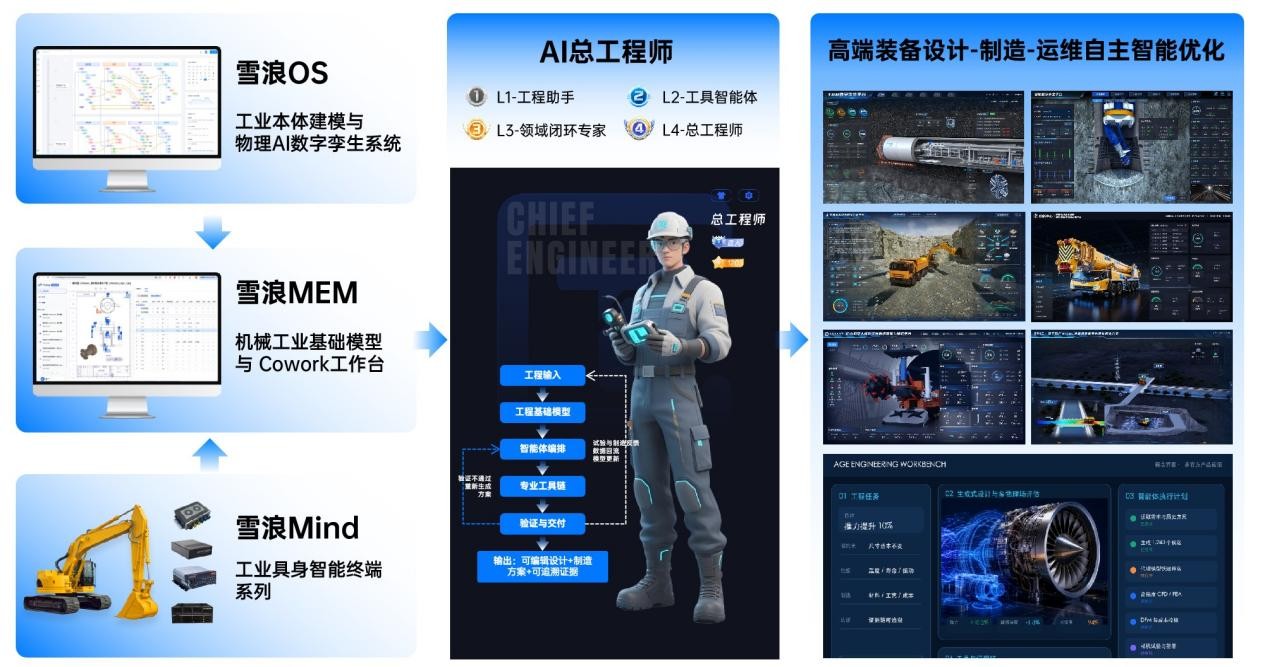
1. Industrial foundational model: Build the "brain" of AI engineering
The real breakthrough of industrial AI is not only to generate content, but to endow AI with the capabilities of understanding industrial knowledge, perceiving real states, following physical laws and completing complex engineering tasks.
Around this goal, Xuelang Cloud cooperates with industrial partners, universities and scientific research institutions to jointly promote the construction of the mechanical industrial foundational model and agent system, and create the Xuelang Craftsman · Mechanical Industrial Foundational Model MEM series.
Different from general large models that mainly rely on language understanding and content generation, industrial foundational models need to face complex industrial scenarios. The MEM series focuses on the professional knowledge system of mechanical industry, and integrates physical laws such as fluid mechanics, thermodynamics and electromagnetism into the industrial foundational model through capabilities such as industrial ontology and digital twin, so that AI can further evolve from "understanding information" to "understanding industry, the physical world and its evolution laws".
On this basis, Xuelang Cloud further builds the Craftsman Cowork industrial intelligent agent operating system as the task execution hub of the "AI Chief Engineer".
It enables AI to no longer be just a Q&A window, but to independently plan, call industrial software, issue hardware instructions, generate documents and reports, and submit the process and results to human engineers for review. By connecting and scheduling various industrial software, equipment systems and communication protocols such as CAD, CAE, MES, ERP and PLC, Craftsman Cowork can realize the complete task process from requirement understanding, scheme generation to tool call and result verification.
This means that AI is no longer just an "assistant" that provides suggestions, but can participate in the execution of real industrial tasks under the constraints of engineering rules and safety boundaries.
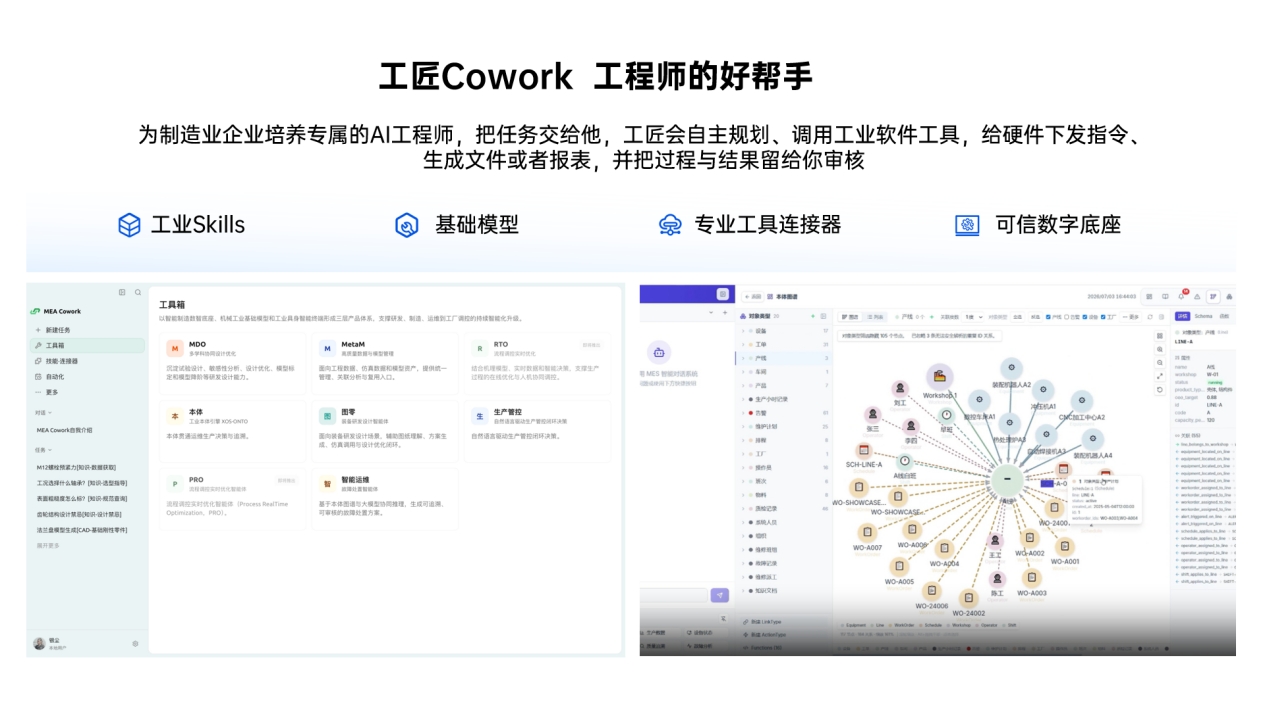
At present, based on the MEM series industrial foundational model and the Craftsman Cowork agent system, Xuelang Cloud has carried out application exploration in scenarios such as design, manufacturing and operation and maintenance.
On the design side, the 2D drawing analysis and 3D modeling intelligent agent of Tuling can realize intelligent analysis of engineering drawings, analyze a single drawing in less than a minute, and automatically generate quality inspection sheets. The efficiency of drawing parameter extraction is increased by 80%, and the recognition accuracy of standard drawings reaches more than 95%. Relevant achievements have been selected into the typical application scenarios of artificial intelligence empowerment by the Ministry of Industry and Information Technology and the promotion catalog of "AI + industrial software tools" intelligent products in Shanghai.
On the manufacturing side, the process intelligent agent built based on process ontology and large model capabilities can quickly generate part assembly process files with digital model files as input, shortening the compilation cycle of a single process from several days to several hours, the accuracy of process text generation reaches 70%, and the efficiency of process personnel is increased by 5-10 times.
On the operation and maintenance side, Xuelang Cloud integrates equipment operation data, industrial knowledge and intelligent reasoning capabilities to realize abnormal alarm, multi-source data diagnosis, fault location, life deduction and automatic generation of maintenance plans. At present, it has been practically implemented in equipment enterprises such as XCMG and Wuxi Diesel Engine Works.
2. Xuelang OS: Build the digital space for AI engineering
If the industrial foundational model is the brain of the "AI Chief Engineer", then the digital space is an important environment for it to learn, deduce and verify.
The fault tolerance rate of industrial manufacturing is extremely low, and AI needs to complete full verification before entering the real world.
Based on this demand, Xuelang Cloud creates Xuelang OS intelligent manufacturing digital base to build industrial digital infrastructure integrating data, knowledge, computing and models.
Xuelang OS connects multi-modal data from industrial equipment, edge control and production sites, cooperates with industrial software systems such as digital twin, and realizes industrial object understanding, virtual-real fusion modeling and intelligent deduction through technical capabilities such as industrial ontology, distributed computing, cloud 3D rendering and CAE co-simulation.
Through the dynamic ontology engine, Xuelang OS can convert the objects, attributes, relationships, rules and constraints in equipment manufacturing into engineering semantic models that computers can understand and reason, so that machines can truly understand industrial logic.
At present, this digital base has been verified in national major projects. In the aviation maintenance operation and maintenance scenario, Xuelang Cloud converts millions of pages of scattered maintenance materials into inferable knowledge assets by building maintenance ontology and knowledge graph, shortening the fault location from hour level to minute level, reducing the troubleshooting cycle of complex faults by 90%, and the reasoning results are 100% reproducible and traceable.
3. Xuelang Mind: Provide the execution carrier for AI to enter the physical world
If the industrial foundational model is responsible for understanding and reasoning, and the digital space is responsible for simulation and verification, then the industrial intelligent computing terminal undertakes the important role of enabling AI to enter the production site.
Xuelang Cloud cooperates with domestic chip enterprises to develop the Xuelang Mind series industrial intelligent computing terminals, covering different application scenarios at the equipment level, production line level and factory level.
Among them, MindEdge serves edge intelligence on the equipment side, MindControl serves intelligent collaboration of the production line, and MindStation serves intelligent agent computing at the factory level, providing computing power support for the implementation of industrial large models from the end side to the factory side.
Taking the "Silicon Intelligence Optimization Large Model" as an example, Xuelang Cloud cooperates with East China University of Science and Technology, the National Process Manufacturing Intelligent Control Technology Innovation Center and industrial partners to carry out joint R&D, and applies it to the 400,000-ton organosilicon plant, which increases the stability of key control parameters by more than 20%, reduces energy consumption by about 0.8%, and increases the labor productivity of operators by more than 30%.
In addition, in the direction of unmanned engineering machinery, Xuelang MindEdge equipment-level edge terminals have completed small-batch deployment and trial operation on Liugong 125-ton large excavators, carrying out application exploration of typical fault diagnosis, environmental safety monitoring and unmanned operation.
From model understanding, to digital deduction, and then to on-site execution, Xuelang Mind further completes the last link for the "AI Chief Engineer" to move to the industrial site.
From engineering assistant to AI Chief Engineer: A new path for intelligent manufacturing
Building the "AI Chief Engineer" system is not a single product innovation, but an exploration of a set of industrial AI infrastructure for the future manufacturing industry. High-end equipment manufacturing is an important support for China's manufacturing, and converting the individual experience of engineers into enterprise controllable and reusable digital assets is the key direction of industrial intelligent development.
Relying on the MEM series mechanical industrial foundational model, Xuelang OS intelligent manufacturing digital base, and Xuelang Mind industrial intelligent computing terminal, Xuelang Cloud is promoting the "AI Chief Engineer" from concept to real industrial scenarios.
The competition of the manufacturing industry in the future not only depends on how much data and knowledge enterprises have accumulated, but also depends on whether they can build a complete data closed loop around "requirement - engineering operation - simulation - test - manufacturing result" to form verifiable, iterable and migratable engineering intelligence.
Make every design more accurate, every production more efficient, and every decision more reliable. This is exactly the core value of the exploration of the "AI Chief Engineer", and also an important direction for industrial AI to move to the next stage.