AI Junk Explosion
So Many Apps, So Little Time.
There are so many apps but so little time, which is the title of the latest weekly data report just released by a16z, the most prestigious venture capital firm in Silicon Valley.
This weekly report, however, poured a basin of ice water directly on a16z's investments.
Data from a16z's weekly report shows that since the launch of the "Agent Programming Era" in February 2025, the number of newly released iOS apps per month has soared from about 40,000 to 120,000, and the number of new Chrome extensions and Google Play apps has also doubled and quadrupled respectively.
The supply of apps has quadrupled, so what then?
Download volume, rating count, and usage duration have all stayed completely stagnant.
This means that AI has not brought growth, and it is nothing more than a one-sided supply carnival.
a16z has named this phenomenon App-Slop, the AI-generated app garbage.
And we are being flooded by AI-generated garbage right now.
01
If we only look at the speed of new releases on app stores, we now seem to be in an unprecedented golden era of entrepreneurship.
AI programming tools have reduced software development to a single sentence —
You only need to say to the AI, "Help me make an expense tracking app", and Codex or other Agents will automatically complete coding, review, testing, launch and release.
Not knowing how to program is no longer an obstacle, and everyone can be a publisher.
But the gap between finishing developing an app and getting users to use it has never been as huge as it is today.
In the past, developing apps required real money, a dedicated team and plenty of time.
Such costs themselves acted as a filter, and low-quality apps with no target audience usually died halfway before launch.
But now you can make an app as long as you can type, and the filtering mechanism between supply and demand no longer exists.
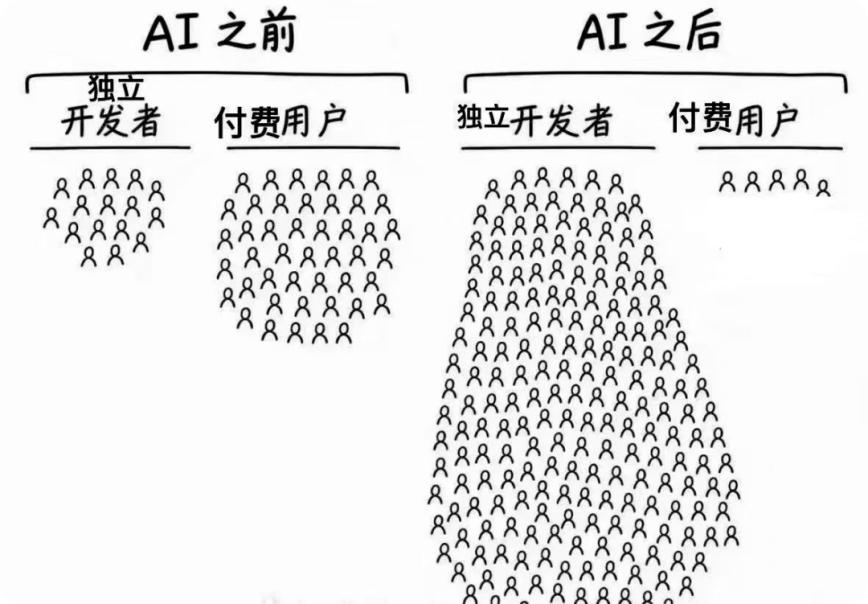
Data from Sensor Tower shows that in the first half of 2026 alone, around 560,000 new apps were added to Apple's App Store.
At this pace, the number of new apps for the whole year will exceed 1 million, far surpassing the all-time high of 890,000 set in 2016.
During the same period, the overall app download volume of the App Store only increased by 3% last year, and has slowed down to 2% so far this year.
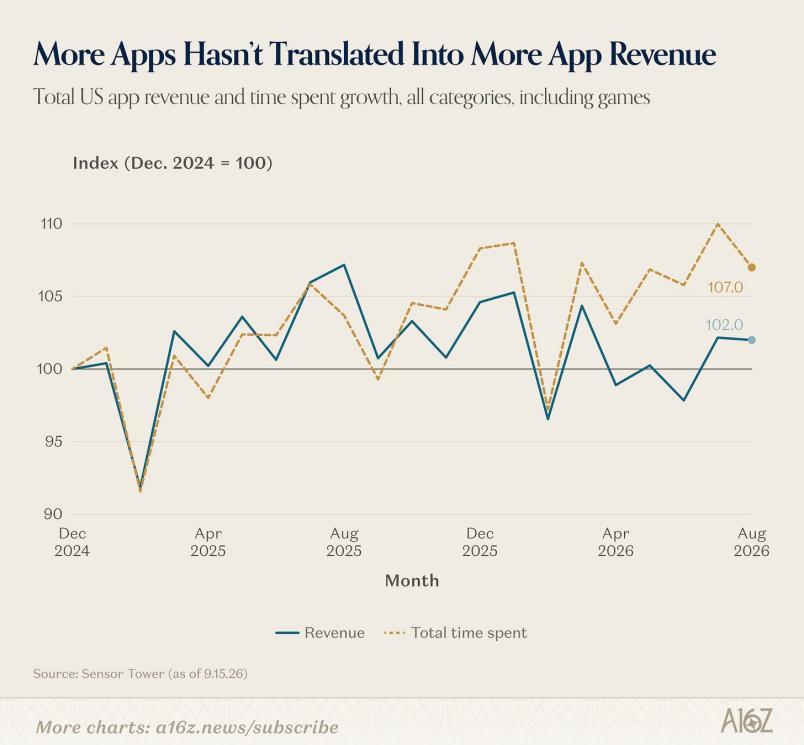
Sensor Tower's data also confirms this judgment from the revenue side: taking December 2024 as the baseline of 100, by August 2026, the total U.S. app revenue index only reached 102.0, and the total usage duration index reached 107.0.
In a year and a half, the revenue of AI-generated apps has only increased by 2%, and the usage duration has only increased by 7%.
This means that the pie of the app economy has not become larger thanks to AI.
Is it possible that the total size of the pie has not changed, and only the market share is being redistributed internally?
The answer is no.
Because the pie has not grown, and instead of the winner taking all, no new winners have emerged at all.
The only winner is AI itself.
Segmented data shows that productivity tools are the only category in the U.S. market that has seen rapid growth in both revenue and usage duration, with revenue rising by about 100% and usage duration rising by about 55%.
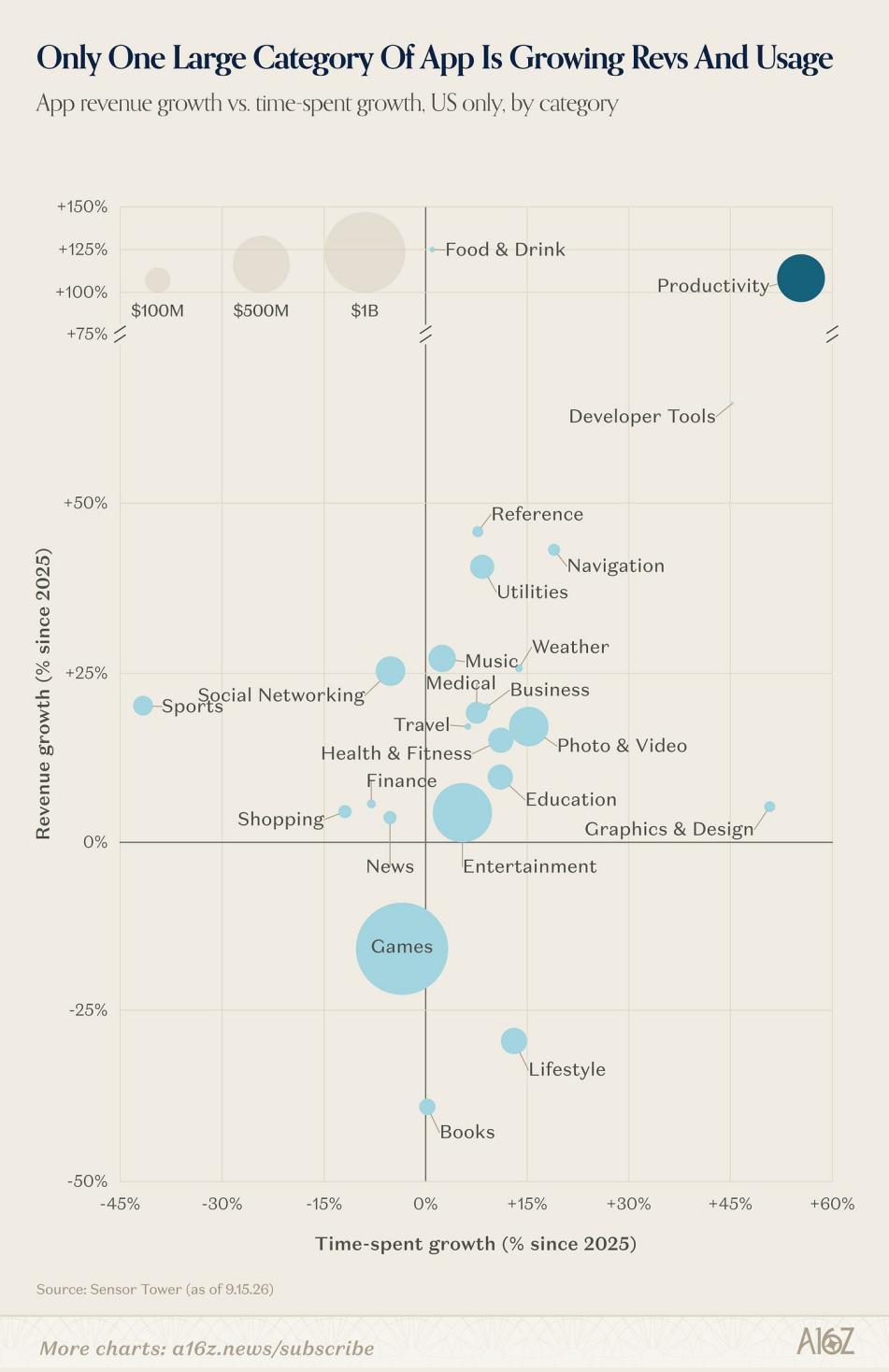
In the productivity tool category, the biggest winners are the leading AI apps: ChatGPT, Claude, Gemini and Grok.
This means that AI apps are very popular, but apps built with AI are not nearly as popular.
The more notable problem is, who will pay for AI-generated slop?
According to the *2026 State of Subscription Apps Report* released by Revenue Cat, the median annual retention rate of AI-powered apps is only 21.1%, compared with 30.7% for non-AI apps.
In terms of monthly retention rate, the figure is 6.1% for AI apps and 9.5% for non-AI apps. Users cancel annual subscriptions of AI apps 30% faster than they do for non-AI apps.
The situation in China is no better.
According to the *Survey on Chinese Netizens' AI Consumption* report from Tencent Research Institute, only 9.8% of AI users pay for AI products, with monthly payment amount mainly ranging from 30 yuan to 100 yuan, and the overall monthly spending is basically kept under 300 yuan.
Breaking down the structure, the payment rate of daily active AI users can reach 18.5%, while that of monthly active users is only 0.9%, a gap of about 20 times.
This means that the vast majority of users who downloaded AI apps never came back after opening them once or twice.
Revenue Cat also found that AI apps are 52% more effective at converting trial users into paying users than non-AI apps, but their refund rate is also 20% higher, with the upper limit of refund rate reaching 15.6% compared with 12.5% for non-AI apps.
Put in plain language: users are only attracted by the AI concept, pay for the product, then quickly find that it is not worth the price, and apply for a refund without hesitation.
Under such logic, the business model of AI apps is gradually falling into a cycle: user acquisition, monetization, user churn, and new rounds of user acquisition.
Everyone is making almost identical products, because they are all built on the same underlying model, following the same tutorials for prompt engineering, and even taking highly similar paths to failure.
According to statistics from iResearch in China, more than 23,000 new AI enterprises were established in China in 2025, 80% of which are concentrated in general scenarios such as intelligent customer service, AI image generation, and voice assistants.
But comparative analysis at the end of the year showed that the chatbot interfaces behind different products have a similarity rate as high as 92%.
Even if you run as fast as you can, you will find that everyone else is still stuck in the same place when you look back.
Users show no loyalty at all, they are just chasing the next novel demo, without paying for it.
However, even with oversupply, entrepreneurs with dreams and consumers who use free small tools can be described as a willing buyer and a willing seller.
What really makes this bubble dangerous is its pricing logic in the primary market.
02
AI has already attracted almost most of people's time and attention, and the primary market is no exception.
In the first quarter of 2026, the total global venture capital volume reached a record high of 297 billion U.S. dollars, of which AI companies took in 81% of the total funds.
The total valuation of the world's top 10 unprofitable AI startups has surged by nearly 1 trillion U.S. dollars in the past 12 months.
What is even more dangerous is that current investment has become nearly identical to gambling, even with other people's money.
A practice called "two-tier financing" is now popular in Silicon Valley.
It means that in the same financing round, the lead VC invests most of the capital at a lower valuation, and invests a small portion of the capital at a much higher valuation at the same time.
When announcing to the public, they only use that sky-high valuation to create narrative hype, while the actual average entry price of the lead investor is far lower than that figure.
Brendan Foody, co-founder of Mercor, publicly named HSG on X, stating that he had seen six cases of HSG making investments with two-tier valuations in the past six months.
Everyone pretends that they only invested at the high valuation tier, founders also distort the facts to their employees, and then use this price to fool angel investors.
The rise of the "one-person company" narrative has further injected stimulants into this market.
In China, a Chengdu-based programmer led 7 AI employees, and spent 27 hours non-stop building an AI social platform called "Carbon Base Circle".
After its launch, the platform accumulated more than 40,000 users, with over 1 million daily page views, and received an investment intent from a 50-billion-yuan fund based in Hangzhou, with a pre-money valuation of 30 million yuan.
A social platform with 40,000 users, whose user scale is far smaller than any medium-sized WeChat mini-program, has a valuation of 30 million yuan.
This figure is almost incomprehensible in the traditional internet valuation framework.
Combined with the aforementioned payment rate data, if less than 10% of the more than 40,000 users are willing to pay, and the average monthly payment ranges from 30 yuan to 100 yuan, the annual revenue ceiling of this platform is roughly between hundreds of thousands yuan and tens of millions yuan.
The 30 million yuan valuation corresponds to a price-to-sales ratio at the level of a hundred times.
The valuation of one-person companies abroad is even more inflated.
For example, Instinct, a personal AI assistant founded by 23-year-old Noah Shinn, is still in invite-only beta testing, with the number of users just exceeding 100,000.

Source: Instinct
Although no public revenue data is available, Shinn himself has explicitly stated that he does not intend to charge users.
However, the company is currently in talks for a new round of financing of 1 billion U.S. dollars, targeting a valuation of about 10 billion U.S. dollars, less than a month after its last round at a 2.5 billion U.S. dollar valuation.
100,000 users with a 10 billion U.S. dollar valuation means that each user is worth 100,000 U.S. dollars.
The frenzied pricing in the primary market is creating a dangerous incentive model: entrepreneurs do not need to make good products, they only need to create a good story.
VCs do not need to find good companies, they only need to find the next buyer to take over their shares.
But if you examine it carefully, the problems will surface.
In the AI era, one person can indeed start a company, but a company does not equal a viable business.
The OPC (one-person company) business model, which features heavy reliance on AI and low headcount, naturally lacks competitive moats.
Every iteration of the underlying model erases the differences between previous generation apps, competitors can quickly replicate the product using the same AI tools, and a one-person company can barely hold its ground.
For primary market investors, there are barely any exit paths for AI app investments.
In the first half of 2026, global private equity technology M&A transactions plummeted by 70% year on year to only 20 billion U.S. dollars. Fear of AI disruption led to an 8% drop in software valuations, and large-scale transaction activities have almost frozen.
The seed round financing amount in China's AI sector also fell by 11% year on year, and more than 300 small and medium-sized AI companies ceased operations due to cash flow breakdown.
The team of Miaoya Camera, which once went viral for its "9.9 yuan per portrait set" service, officially disbanded at the end of September 2025, and is now only maintaining operations at the minimum cost.
For AI apps that have not yet generated revenue, there is always an optimistic explanation that they are still in the early stage.
But the term "early stage" is being overused.
If 2016, when the App Store added 890,000 new apps, was the "early stage", then ten years later, when the number of new apps exceeds 1 million but download volume only grows by 2%, can it still be called the early stage?
Consumers' willingness to pay is only 3%, the annual retention rate of AI apps is only 21%, but valuations are calculated in tens of billions, leaving a very deep gap between reality and expectation.
If the "early stage" that lasted for ten years has not delivered growth, it is no longer the early stage, but the new normal.
03
Conclusion
Nowadays, AI has led to oversupply of all product types.
AI-generated wonders, AI-generated short dramas, AI-generated apps, all far exceed market demand.
Supply can expand infinitely with the support of AI, but people's time and disposable income are limited.
When supply grows rapidly while demand stays completely stagnant, the excess supply is no longer an opportunity, but a cost.
This is not to deny the value of AI. AI's achievements in improving productivity, assisting programming and accelerating content creation are real, and the doubling of revenue for productivity apps is also real.
But the fact that AI can make more things does not mean it can make better things, and the fact that it can lower the production threshold does not mean it can raise the ceiling of market demand.
Valuations can be pushed up by stories, but they can only be ultimately backed by profits.
This article is from WeChat Official Account "Gelong", written by Yuan He, and republished by 36Kr with authorization.