When AI starts "teaching itself": Is Opus 5.5 the first large model trained by RSI?
Google engineer Patrick speculates that the Opus 5.5 model may be trained via knowledge distillation from Model 2, a stronger internal "teacher model" at Anthropic, and could be the first product model that embodies the "recursive self-improvement" path. There is no public evidence to confirm this at present, but Anthropic has confirmed the existence of Model 2, and more than 80% of the code in its codebase is written by Claude. This trend indicates that the improvement of model capabilities and the reduction of inference costs are expected to be achieved simultaneously.
Anthropic's newly released Claude Opus 5.5 has achieved a substantial leap in performance while reducing operating costs by 40%. This unconventional combination has drawn close attention from the industry to its training methods.
On social platform X, Google engineer Patrick C Toulme put forward a speculation based on this: Opus 5.5 may be distilled from Model 2, a more powerful internal "teacher model" at Anthropic, and could be the first product model that embodies the "Recursive Self-Improvement" (RSI) path.
There is currently no public evidence to directly confirm this inference, but Anthropic has publicly confirmed the existence of Model 2, and the company's published RSI-related articles show that the degree of AI's participation in AI R&D is rapidly deepening, which gives the above speculation a certain contextual basis.
For investors and industry observers, what is really worth paying attention to in this incident is that it connects three previously relatively scattered trends together: continuous iteration of stronger internal models, deep involvement of AI in the AI R&D process, and the simultaneous emergence of smaller, lower-cost product models.
If this path is established, the improvement of model capabilities and the reduction of inference costs are likely to occur at the same time.
01
Why is Opus 5.5 worth paying attention to?
Wall Street CN reports that Anthropic positions Claude Opus 5.5 as the first release in its 5.5 series. Its performance is on par with Claude Fable 5.1 on most tasks, but its operating cost is 40% lower than that of Opus 5, and its output speed is increased by more than 30%.
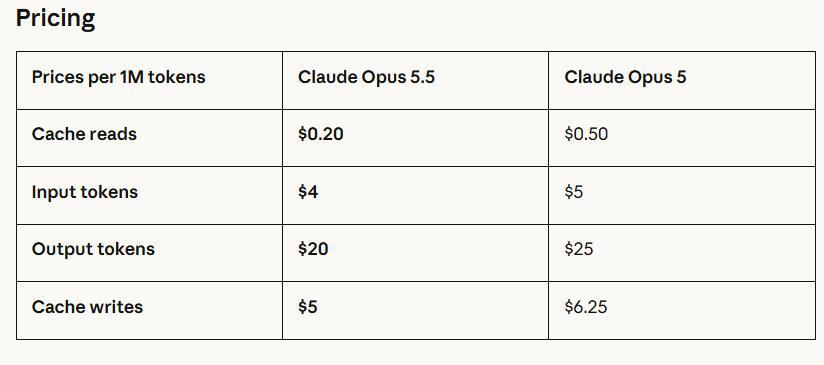
The price reduction is particularly significant. The prices of input and output tokens are $4 and $20 per million respectively, 20% lower than Opus 5; while cache reading, which accounts for the main cost in agent tasks and programming scenarios, is reduced from $0.50 per million to $0.20, a drop of 60%.
Judging from actual usage performance, early testers completed the migration of 680,000 lines of code in less than one day, while similar work previously required the engineering team several weeks; in another test, Opus 5.5 achieved a 39/40 success rate in optimizing the full-page loading time of a web application, while Opus 5 caused side effects of altering the application's behavior in the same task.
In the internal test of rewriting HAProxy from C to Rust, Opus 5.5 took 9.5 hours, which is more than 20% shorter than Fable 5.1's 12 hours, with a 51% cost saving.
Anthropic said that the efficiency advantage is also reflected in the token consumption level — Opus 5.5 not only has a lower price per token, but also requires fewer tokens to complete the same task. The combination of the two forms a 40% overall cost reduction.
02
What exactly is the "teacher model" Patrick mentioned?
Patrick C Toulme wrote on X:
Opus 5.5 is clearly trained by a larger teacher model, most likely Model 2 Mythos. Opus 5.5 is the first model trained with RSI and distilled from an internal teacher model. The smaller scale and lower cost are exactly the product of distillation from the teacher model.
The core technical concept involved here is "model distillation": Let the more capable teacher model generate high-quality training signals, and then use these signals to train a smaller-scale student model, so as to significantly reduce the inference cost while retaining relatively high capabilities.
Anthropic has publicly confirmed that there is a Model 2 inside the company that is more powerful than Mythos 5, and it is widely used for code generation, data generation and agent tasks. However, there is no public material to directly prove that Opus 5.5 is distilled from Model 2. Anthropic also did not mention the specific training method in its release documents.
It is worth noting that Anthropic separately classifies "distillation attacks" as a type of threat in its security terms — that is, attackers extract capabilities from the model in batches through a large number of fake accounts, and for this reason, anti-distillation mechanisms such as "preserved reasoning chains" have been introduced on Opus 5.5.
This detail indirectly shows that distillation technology itself occupies a very important position in Anthropic's technical system.
03
AI begins to participate in AI R&D
Regardless of the specific training path of Opus 5.5, the RSI-related articles published by Anthropic itself present a more macroscopic picture: The depth of AI's involvement in AI R&D is accelerating at a quantifiable speed.
As of May 2026, more than 80% of the code in Anthropic's codebase is written by Claude, and before the research preview of Claude Code was launched in February 2025, this proportion was only in single digits.
In terms of engineering output, the average daily number of merged codes per Anthropic engineer has increased by about 8 times compared with 2024.
Anthropic's article also points out that in April 2026, Claude reduced a certain type of API error by 1000 times in about 800 hours, and according to the engineer leading this work, it would take about four years for humans to complete the same task.
In terms of research judgment, Anthropic designed an internal test: in collaborative sessions between researchers and Claude, identify the key nodes where human researchers chose a "sub-optimal" direction, and then compare the judgment performance of different versions of Claude and humans at these nodes.
The results show that the Opus 4.5 model from November 2025 gave better next-step suggestions than humans in 51% of cases, and this proportion rose to 64% for the Mythos Preview from April 2026.
However, the article also clearly points out the current boundary:
There is still a large gap between Claude and humans in choosing which problems are worth researching. This is exactly the gap between AI today and the future system that can independently design the next generation of AI.
Anthropic also emphasizes that full recursive self-improvement has not yet been achieved and is not inevitable.
However, analysis suggests that in the past, model competition was largely about "who has more computing power", and now another path is emerging: Let more powerful models help train and improve cheaper models. If this path is established, the improvement of model capabilities and the reduction of inference costs may occur at the same time.
This article is from the WeChat official account "Hard AI", author: Bao Yilong, editor: Hard AI, published by 36Kr with authorization.