Luo Fuli bets on large-scale RL, Xiaomi's most powerful open-source model makes its debut: burning more than 20 million yuan in 6 days, with performance on multiple Agent benchmarks on a par with closed-source flagship models
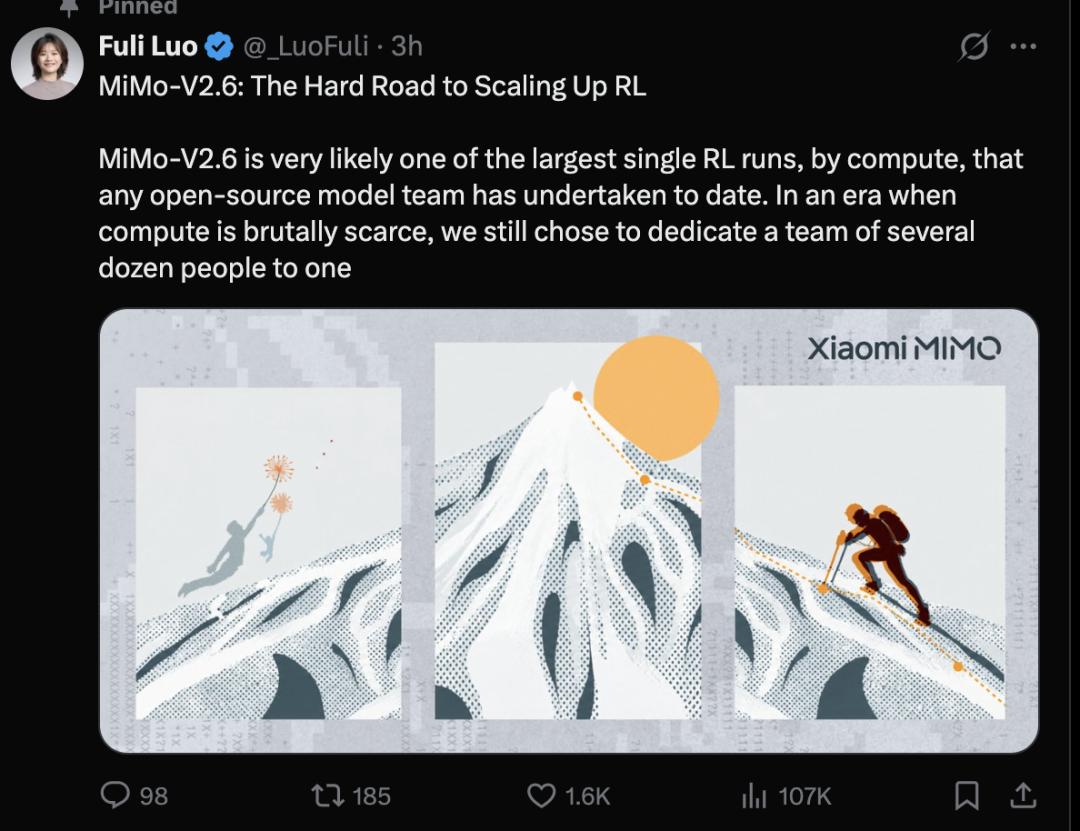
On September 22, the Xiaomi MiMo team released and open-sourced the MiMo-V2.6 series, including the flagship model MiMo-V2.6-Pro and the efficiency-and cost-focused MiMo-V2.6-Flash. Meanwhile, Xiaomi also launched MiMo-V2.6-Pro-UltraSpeed for low-latency scenarios, which the official claims can deliver up to 20 times the output speed of the standard Pro version while maintaining the same model quality.
Xiaomi's Newly Released Flagship Model Series
Different from simply expanding model parameters, MiMo-V2.6 this time emphasizes computational expansion in the reinforcement learning stage. Xiaomi describes it as an attempt to explore the RSI (Recursive Self-Improvement) path: increasing investment in reinforcement learning in complex environments with verifiable results such as programming, general agents, visual tasks and cybersecurity, allowing the model to improve task completion capabilities through repeated exploration, environmental feedback and result evaluation.
However, according to the currently disclosed information, the "self-improvement" reflected by MiMo-V2.6 mainly occurs in the reinforcement learning closed loop composed of the training system, task environment and evaluator, which does not yet mean that the model can get rid of the human-designed training framework, independently modify its own architecture or start the next round of training.
According to the introduction, both MiMo-V2.6-Pro and MiMo-V2.6-Flash adopt a sparse Mixture-of-Experts architecture, natively support text, image, video and audio input, and have a maximum context window of 1 million tokens.
Among them, MiMo-V2.6-Pro has a total of 1.02 trillion parameters, activating about 42 billion parameters per inference; MiMo-V2.6-Flash has a total of 309 billion parameters, with about 15 billion activated parameters. The two models use the same visual and audio encoders, and are equipped with a 5-layer multi-token prediction module for speculative decoding.

In terms of positioning, Pro is oriented to complex programming, long-term agent and research tasks, while Flash aims to reduce inference cost with fewer activated parameters. The weights of the two models have been released under the MIT license on Hugging Face.
The MiMo-V2.6 series also includes a 9-billion-parameter model distilled from the Qwen architecture, but Xiaomi's main products this time are still the Pro and Flash versions. The model repository on Hugging Face currently includes a total of three MiMo-V2.6 models.
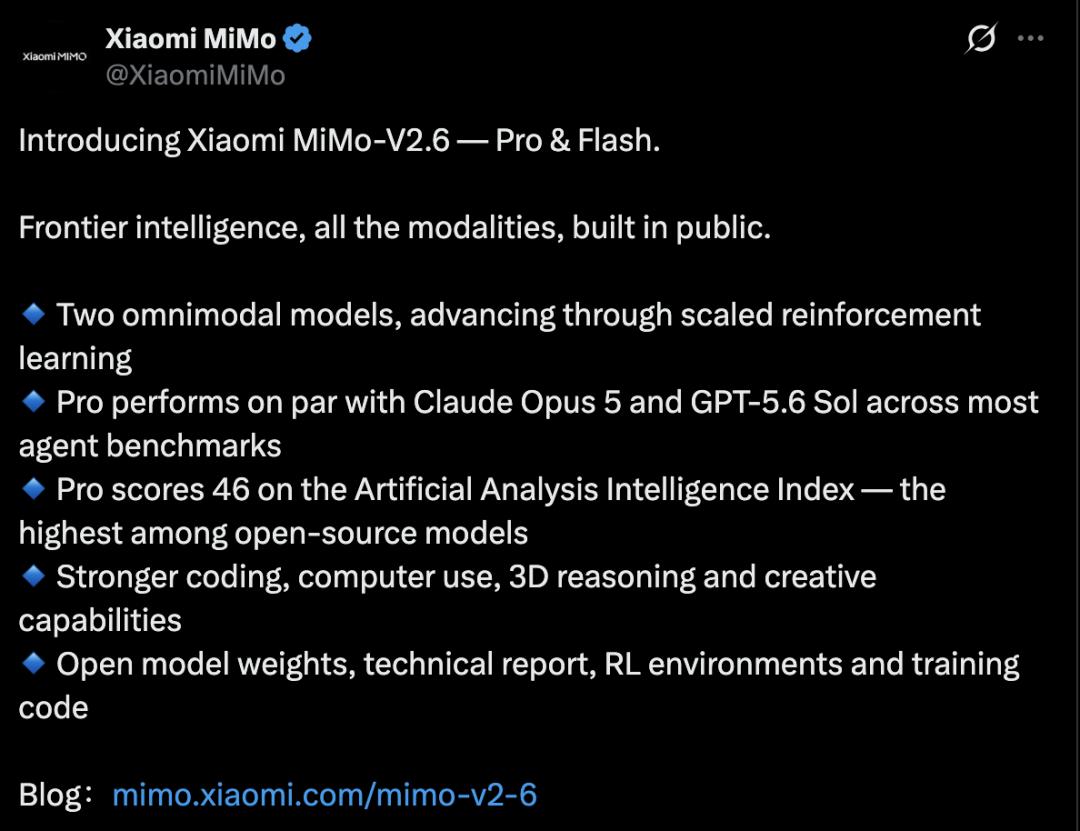
After the model was released, Luo Fuli, head of Xiaomi's large model team and former DeepSeek researcher, posted on X summarizing the R&D process of MiMo-V2.6 as "a difficult path of reinforcement learning scaling".
She said that measured by computational investment, MiMo-V2.6 "is likely to be one of the largest single reinforcement learning training runs ever carried out by an open-source model team". In the context where computing power resources are still very tight, Xiaomi still chose to invest a team of dozens of people to focus on completing this large-scale RL training.
How is its Benchmark Performance?
So, what about the benchmark test performance of this series of models?
According to the test results announced by Xiaomi, MiMo-V2.6-Pro scored 71.9 on DeepSWE v1.1, significantly higher than the 19 points of the previous generation MiMo-V2.5-Pro; Flash scored 67.9 points. On Terminal Bench 2.1, the two models scored 89.9 and 87.6 points respectively.
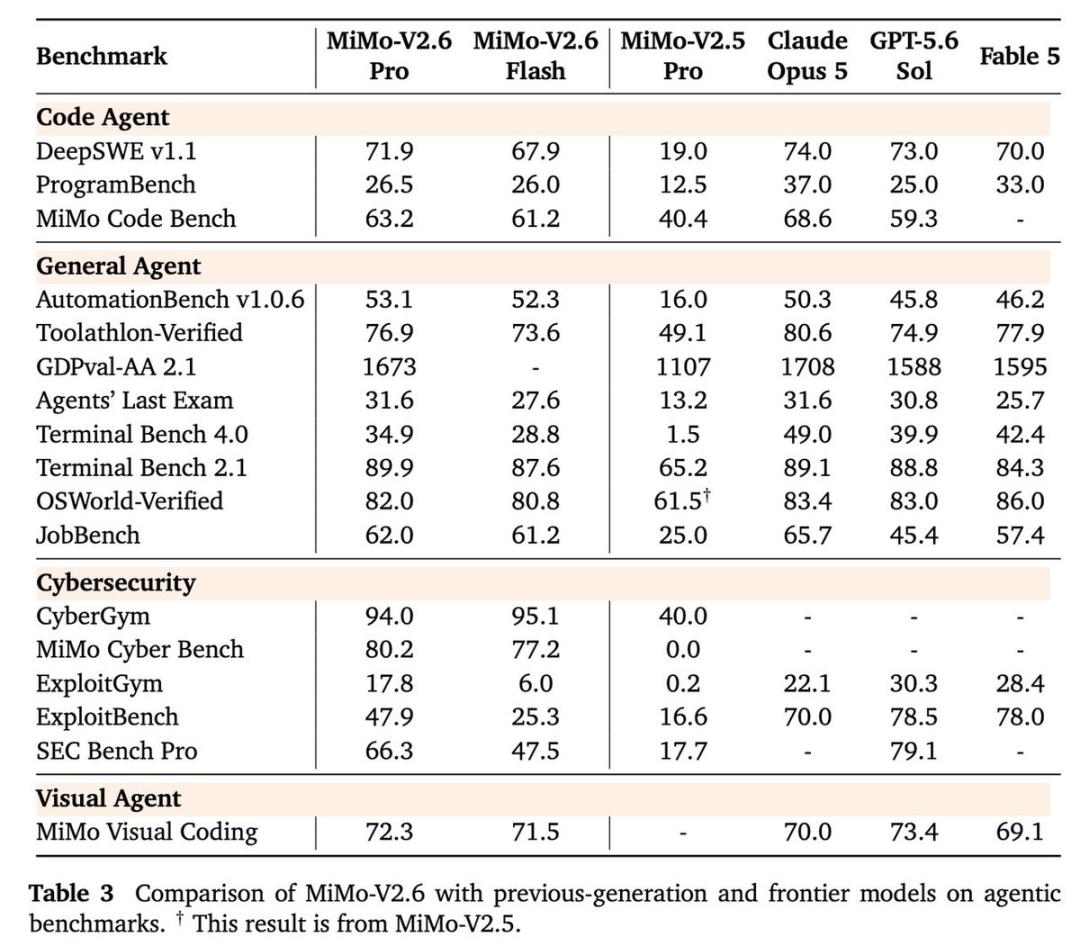
In the general agent test, Pro scored 53.1 on AutomationBench v1.0.6, higher than Claude Opus 5, GPT-5.6 Sol and Claude Fable 5 in the comparison table; Flash scored 52.3 points. On OSWorld-Verified, the two models scored 82 and 80.8 points respectively.
However, these results also show that MiMo-V2.6 does not lead in all items. Pro scored 26.5 on ProgramBench, lower than 37 points for Claude Opus 5; it scored 34.9 on Terminal Bench 4.0, lower than 49 points for Claude Opus 5. In tests such as Toolathlon-Verified and GDPval-AA 2.1, Pro is not the model with the highest score.
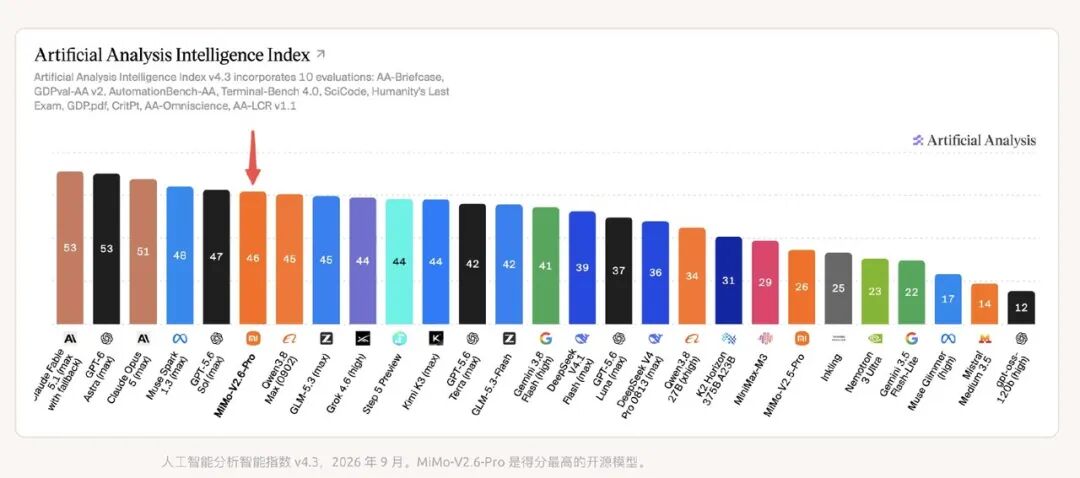
Xiaomi also cited the results of Artificial Analysis Intelligence Index v4.3, stating that MiMo-V2.6-Pro scored 46.32, describing it as the open-source model with the highest current score.
One notable point of MiMo-V2.6 in this release is that Xiaomi has begun to try to extend programming capabilities to a wider range of production tasks.
The benchmark test results look very strong, how about the practical application effect? Xiaomi provided several sets of official cases.
In the official demonstration cases, the model can decompose game development tasks into multiple agents according to text, image or video descriptions, complete 3D scene construction, interactive logic writing and visual verification respectively, and make repeated modifications according to the rendering results. Xiaomi calls this natural language-driven approach that extends from software development to interactive world building "Vibe World".
In the 3D modeling scenario, the model can control Blender to generate objects and scenes based on text or reference images; for another example, in the embodied simulation environment, the model can read multi-channel camera images, control the Franka Panda robotic arm through visual feedback to complete grabbing, color matching and object placement.
MiMo-V2.6 also demonstrates capabilities in front-end page development, presentation production, video editing and music creation.
For example, MiMo-V2.6 can provide end-to-end high-quality video creation services. For creative and product promotion videos, it can handle visual design, shot and dynamic sequence design, music creation and beat-synced editing according to user needs. For educational videos, it can convert abstract concepts such as Fourier decomposition into easy-to-understand explanations and coherent animations, and use MiMo-V2.5-TTS to generate narration precisely synchronized with the picture. This realizes full-process automation from concept decomposition to final video output, transforming complex knowledge into vivid content that is easy for the audience to understand.
These cases reflect that the goal of MiMo-V2.6 is not only to generate code, but to make code, visual understanding, tool calling and computer operation jointly serve a complete task.
In addition, Xiaomi also announced two scientific research cases.
The first case involves materials research. Xiaomi's materials experts asked MiMo-V2.6-Pro to design a metal-organic framework material capable of adsorbing per- and polyfluoroalkyl substances. The model completed literature and patent retrieval, hypothesis proposal, and innovation analysis, called open-source computing tools to carry out simulations, calculated the binding strength between different materials and the target substance, and screened candidate structures for the wet experiment stage.
The second case is formalized mathematical proof. Under the exploration strategy and multi-agent collaboration process designed by researchers, MiMo-V2.6-Pro participated in completing the Lean 4 formalization of the main theorem of the classic paper "Period Three Implies Chaos". The final project contains more than 6,000 lines of Lean code, which has been verified by the Lean kernel, with no unfinished proof placeholders left.
However, it should be noted that none of these tasks were completed independently by the model: the materials case was advanced by professionals through multiple rounds of prompting and screening, and the mathematics case also relied on researchers to design exploration strategies and carry out subsequent revision and integration. Therefore, from this perspective, they better illustrate the potential of the model as a scientific research assistant tool, rather than proving that the model already has the ability to carry out scientific research independently.
Completing about 1.5 million trajectories in 6 days, reinforcement learning cost exceeds 3.4 million USD
The most noteworthy change of MiMo-V2.6 is not the parameter scale, but the reinforcement learning training method.
Interestingly, before the official release of MiMo-V2.6, the Xiaomi MiMo team once publicly live-streamed the production training process of this round of reinforcement learning, showing the training progress, task scores and resource consumption of the two models to the public.
Different from disclosing results after releasing the model, this live broadcast directly presented a large-scale RL training that lasted for nearly 6 days to the outside world: whether the model continues to improve, whether there are fluctuations in the middle of training, and whether the computing power investment can bring performance growth can all be observed from the real-time curves. Now with the release of the model and technical report, the training scale and technical details behind this live broadcast have further surfaced.
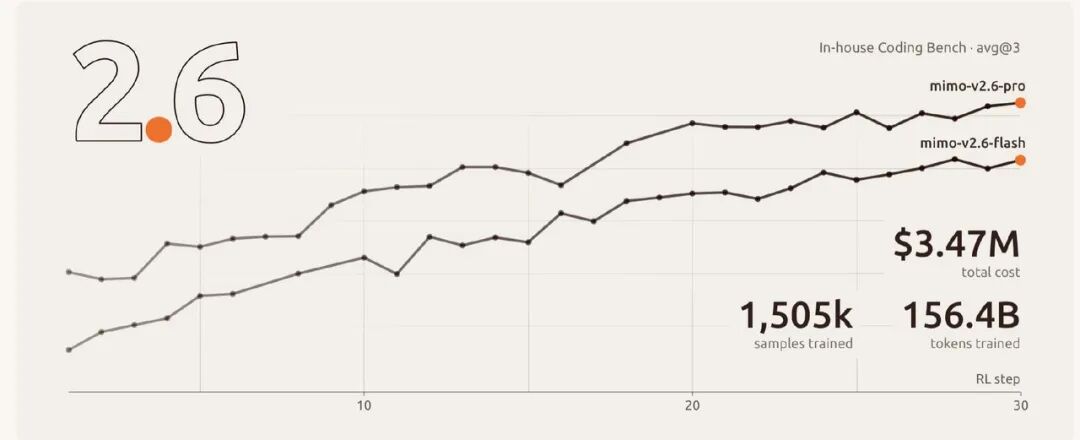
Xiaomi disclosed that MiMo-V2.6-Pro and MiMo-V2.6-Flash respectively completed 30 reinforcement learning steps in less than 6 days, and each model processed about 750,000 trajectories.
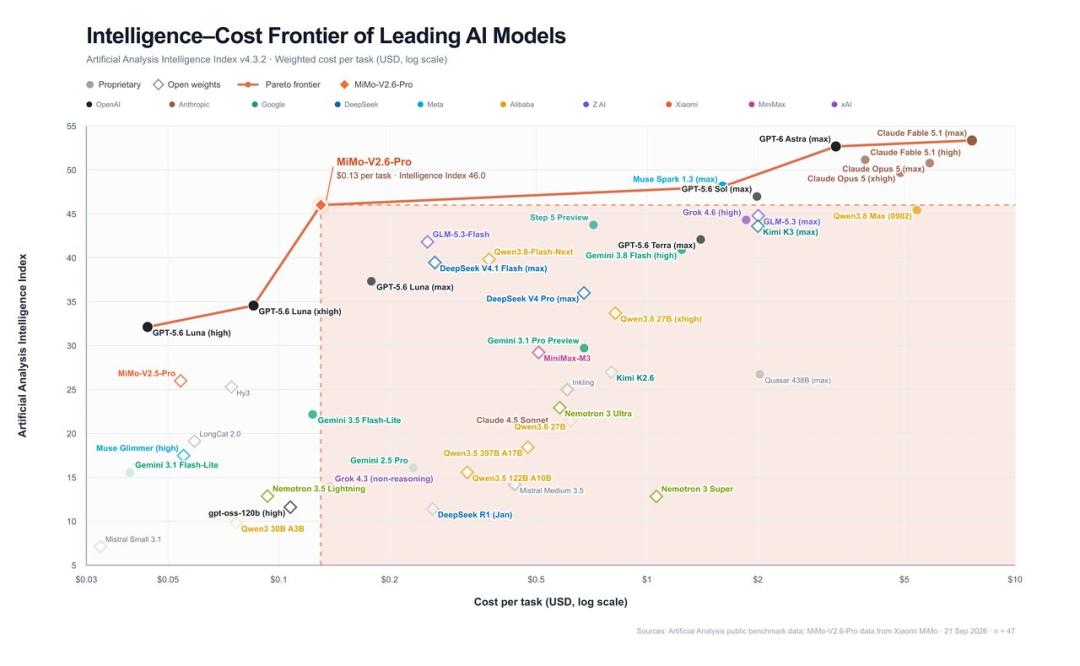
The training cost of Flash is about 850,000 USD, and that of Pro is about 2.62 million USD, totaling about 3.47 million USD.
Its single-step training batch contains 1568 prompts, each prompt generates 16 trajectories, a single step processes about 3.5 billion to 3.7 billion tokens, and the maximum training context reaches 1 million tokens.
Different from performing independent reinforcement learning for programming, vision or agents separately, Xiaomi mixes programming, general agent, visual and cybersecurity tasks in the same round of training, hoping that the strategies formed in different tasks can be transferred to each other.
In the reward session, the MiMo team did not only use the binary signal of "pass or fail", but introduced an intra-group comparison mechanism: the evaluator agent compares multiple trajectories generated by the same task horizontally, further distinguishes the quality of solutions that have completed the task, and distributes higher rewards to results with shorter paths, less token consumption or higher execution quality.
The direct purpose of this method is to solve a problem in long-term agent training: two trajectories may both pass the test, but they have obvious differences in execution efficiency, step rationality and stability, which cannot be reflected only by the final test result.
In order to control reward hacking, Xiaomi said it added environmental hardening, anomaly detection, adversarial evaluation and cross-checking between different verifiers during training, and froze the router of the MoE model to reduce the drift of expert selection strategies during large-scale reinforcement learning.
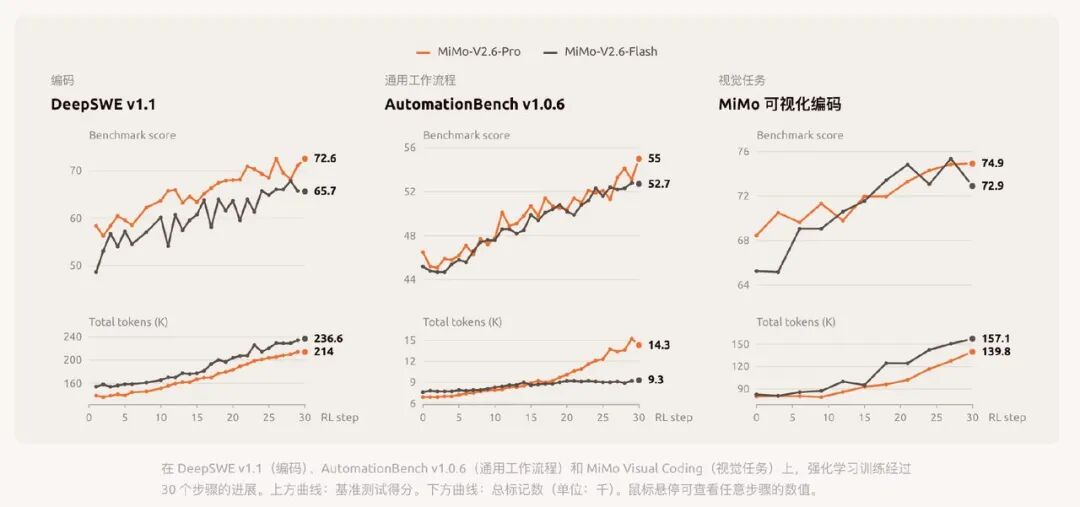
According to the officially announced training curve, after 30 steps of reinforcement learning, the average pass rates of Flash and Pro on training tasks increased by about 25% and 12% respectively.
On the long-term software engineering test DeepSWE v1.1 that was not directly used for training, the two models increased from 48.8 points and 58.4 points to 65.68 points and 72.57 points respectively.
Xiaomi therefore believes that the improvements brought by reinforcement learning can be partially transferred outside the training distribution.
Xiaomi also opened the technical report, training environment and reinforcement learning code. Compared with only releasing the final weights, this gives the outside world the opportunity to further inspect its task settings, reward design and training process, but whether the relevant results can be independently reproduced remains to be verified by developers and research institutions in the follow-up.
MiMo-V2.6 has improved so rapidly, how is it technically implemented?
According to the technical report, the performance of MiMo-V2.6 is not brought about by a single point of innovation, but the result of the combined effect of model architecture, pre-training, mid-training, reinforcement learning scale, reward design and training infrastructure.
The most critical change is that Xiaomi no longer only uses computing resources to increase pre-training data and model parameters, but invests a large amount of computing power in the interaction between the model and the real task environment, allowing the model to learn how to complete long-term tasks in repeated execution, verification and error correction.
In short, the path of MiMo-V2.6 can be summarized as: first use large-scale pre-training to build knowledge and multi-modal understanding capabilities, then expand the model's "exploration space" through agent-oriented mid-training, and finally generate trajectories on a large scale on verifiable complex tasks, using a more refined reward mechanism to screen out better solutions.
Layer 1: Mixed attention and sparse MoE balance scale and long context
MiMo-V2.6-Pro adopts a sparse Mixture-of-Experts architecture, with a total of 1.02 trillion parameters, activating about 42 billion parameters per inference.
Flash has a total of about 310 billion parameters, activating about 15 billion parameters. Each layer of the two models only activates 8 experts, which expands the model capacity while avoiding all parameters participating in each calculation.
The model backbone adopts a hybrid architecture with alternating "sliding window attention + global attention". Sliding window attention only processes nearby tokens, keeping the computational overhead at a low level; periodically inserted global attention is responsible for re-aggregating long-distance information.
This design addresses the practical contradiction in long-term agent tasks: the model needs to read code repositories, tool return results, historical operations and multi-turn context, but if each layer performs global attention on all tokens, the calculation and memory cost of 1 million token context will be very high