India's exports to China have surged by 40%. Is the increment driven by smartphones? Does Apple's promise still hold?
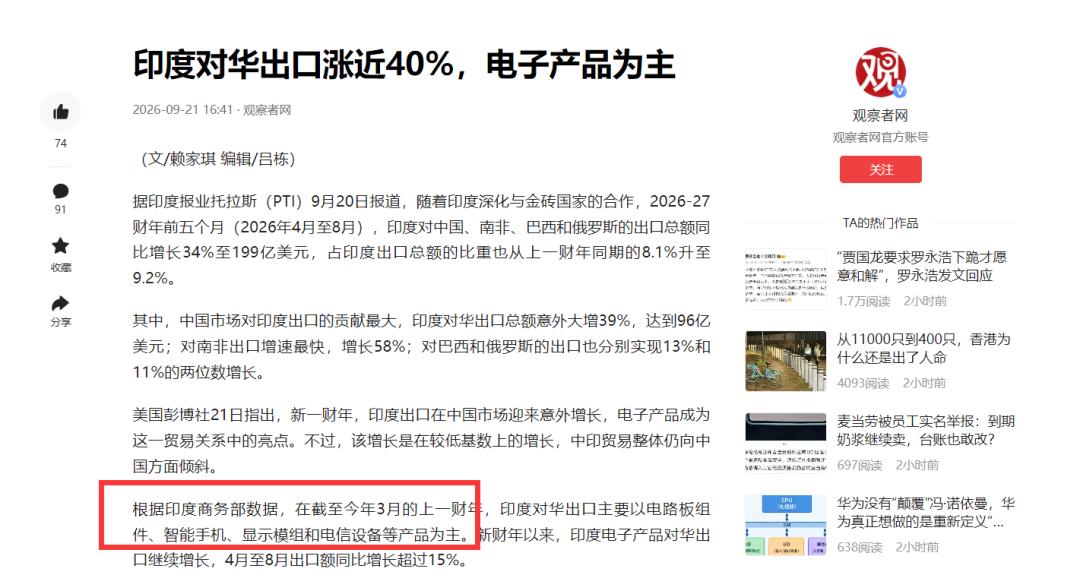
On September 20, Guancha.cn cited a report from Press Trust of India and released a set of data: in the first five months of the 2026 fiscal year, India's exports to China surged by 39%, reaching 9.6 billion US dollars.
According to data from the Ministry of Commerce of India, electronic products such as printed circuit board assemblies, smartphones, display modules and telecommunications equipment are important components driving the growth of India's exports to China.
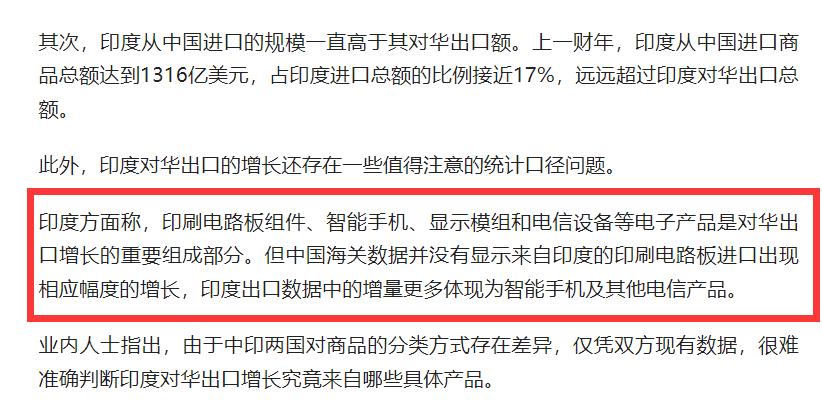
Interestingly, according to reports from Guancha.cn, data from China Customs does not show a corresponding increase in imports of printed circuit boards from India, the increment in India's export data is more reflected in smartphones and other telecommunications products.
If you think further along this line, local Indian mobile phone brands cannot be sold in China, and Chinese consumers will not buy Indian-made mobile phones at all. So what brands are the mobile phones India sells to China exactly?
The answer is almost only one — iPhone.
India-made iPhones have jumped from 6% to nearly 26%
In 2022, India-produced iPhones only accounted for 6% of the global total. By 2025, Apple assembled about 55 million iPhones in India, a year-on-year increase of 53%, accounting for about 20% of the global total.
In the first half of this year, this figure soared to 25%, and is expected to reach 26% for the whole year. In four years, it has more than quadrupled.
Moreover, this year marks the first time that Apple's top-tier Pro and Pro Max models have been supplied simultaneously by Indian factories from the initial launch, which are claimed to be mainly shipped to the US and European markets.
This brings up an unavoidable problem: As India manufactures more and more iPhones, its local market cannot absorb such a large volume, and there is also a ceiling in the European and American markets. The remaining production capacity will definitely find markets for export — according to Indian data, part of it may be flowing back to the Chinese market through various channels.
This explains why the mobile phone category data of India's exports to China has risen so sharply.
Chinese consumers do not prefer Indian-made iPhones, and Indian media are well aware of this
But the question is, can Chinese consumers accept Indian-made iPhones now? Back to the iPhone 15 era three years ago, Indian-made iPhones sparked a huge heated discussion on the Chinese Internet.
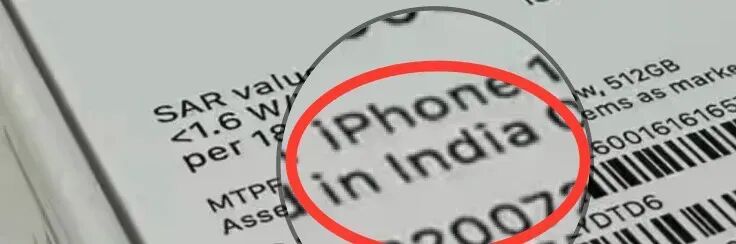
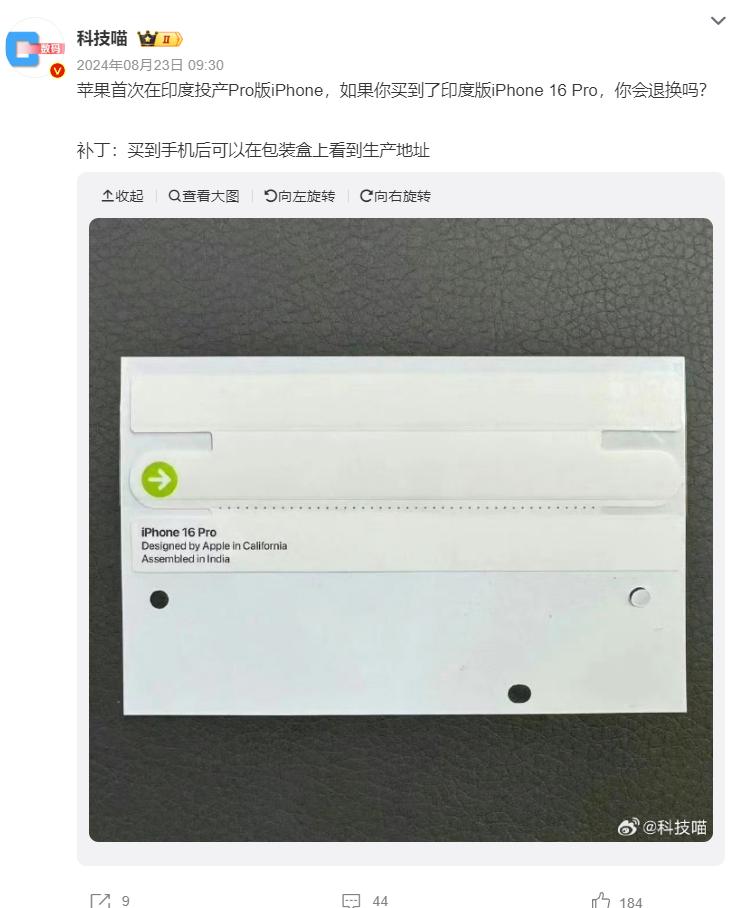
At that time, there was a rumor that "China-made iPhones are supplied to Europe and the United States, while India-made ones are exclusively for China", which instantly enraged consumers. Everyone frantically checked the phone packaging, model number and production label, for fear that they would spend more than 10,000 yuan to buy an Indian-made iPhone.
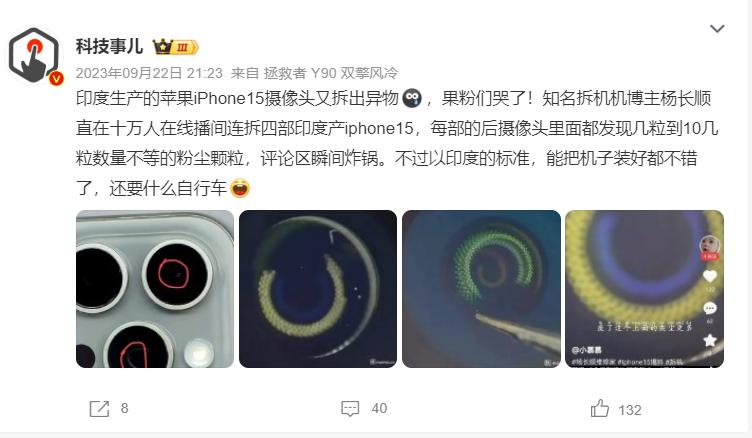
In addition, successive problems have been exposed on Indian-made iPhones: fingerprints on the motherboard, dust entering the camera, and gaps large enough to fit an A4 paper, with quality control far inferior to that of the Zhengzhou factory.
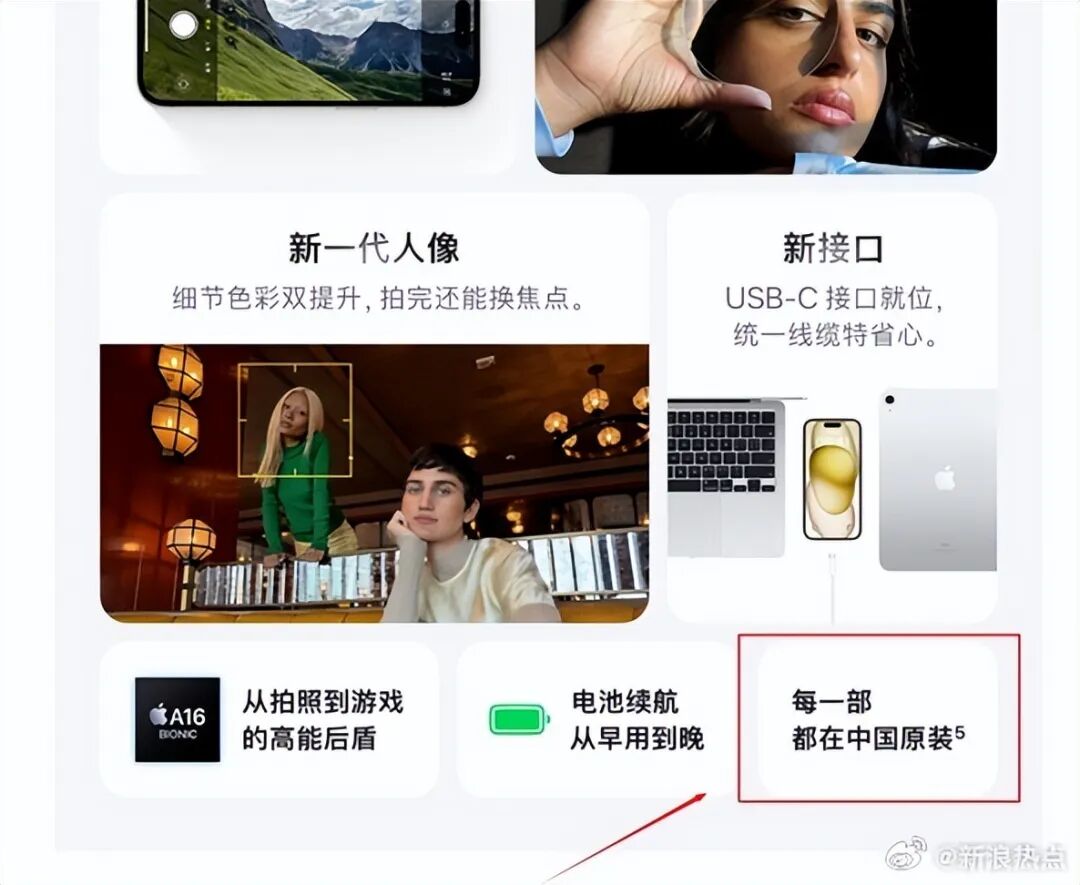
Having been repeatedly questioned, Apple specially published an article "Skill Convenience Store" on its official WeChat public account in November 2023, stating clearly that "all legally certified iPhone 15 series products sold in mainland China are assembled in China." This means that the products you buy through official channels are domestic versions, rest assured, they are not made in India.
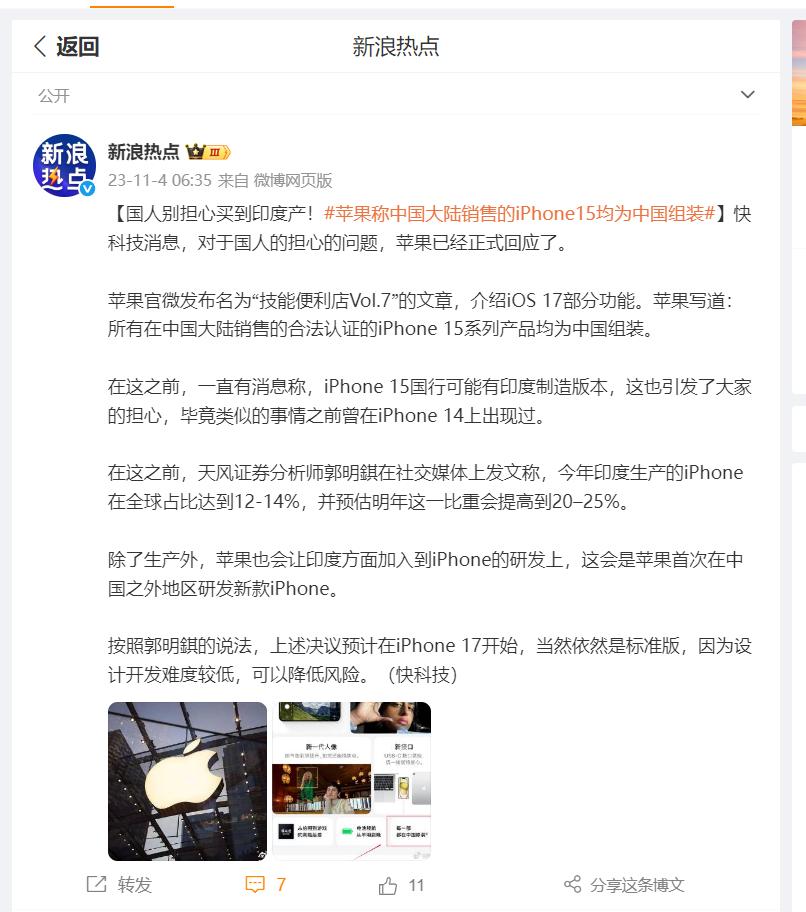
This statement reassured consumers back then. But looking back now, it refers to "legally certified, official channels" — these words leave a very large leeway.
Three years on, is this "reassurance" still valid?
This is where the current contradiction lies.
Three years ago, India's production capacity was only 6%, and Apple was confident to claim that all domestic iPhones were made in China; three years later, India's share has reached 26%, and the trend is continuing to rise year by year. The official domestic channels are still mostly dominated by China-made products for now, but the production capacity is shifting outwards.
This proportion will continue to rise, and no one can guarantee how long the statement "all iPhones sold in mainland China are assembled in China" can hold.
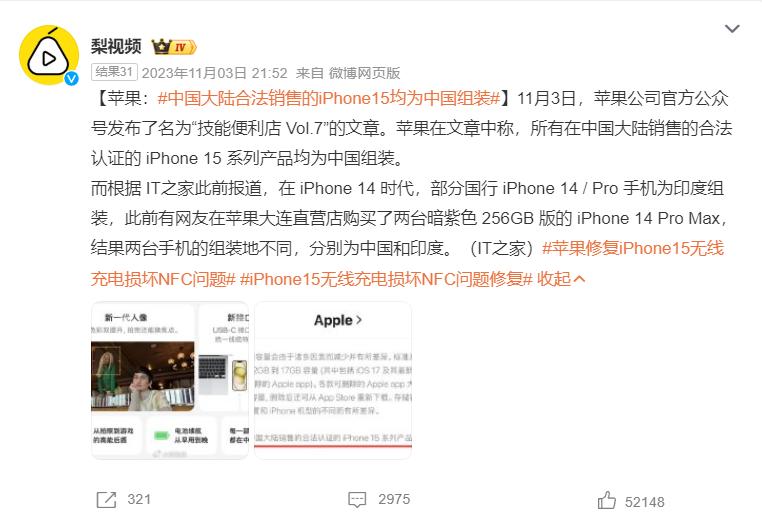
Chinese consumers do not like Indian-made iPhones, and Indian media are fully aware of this.
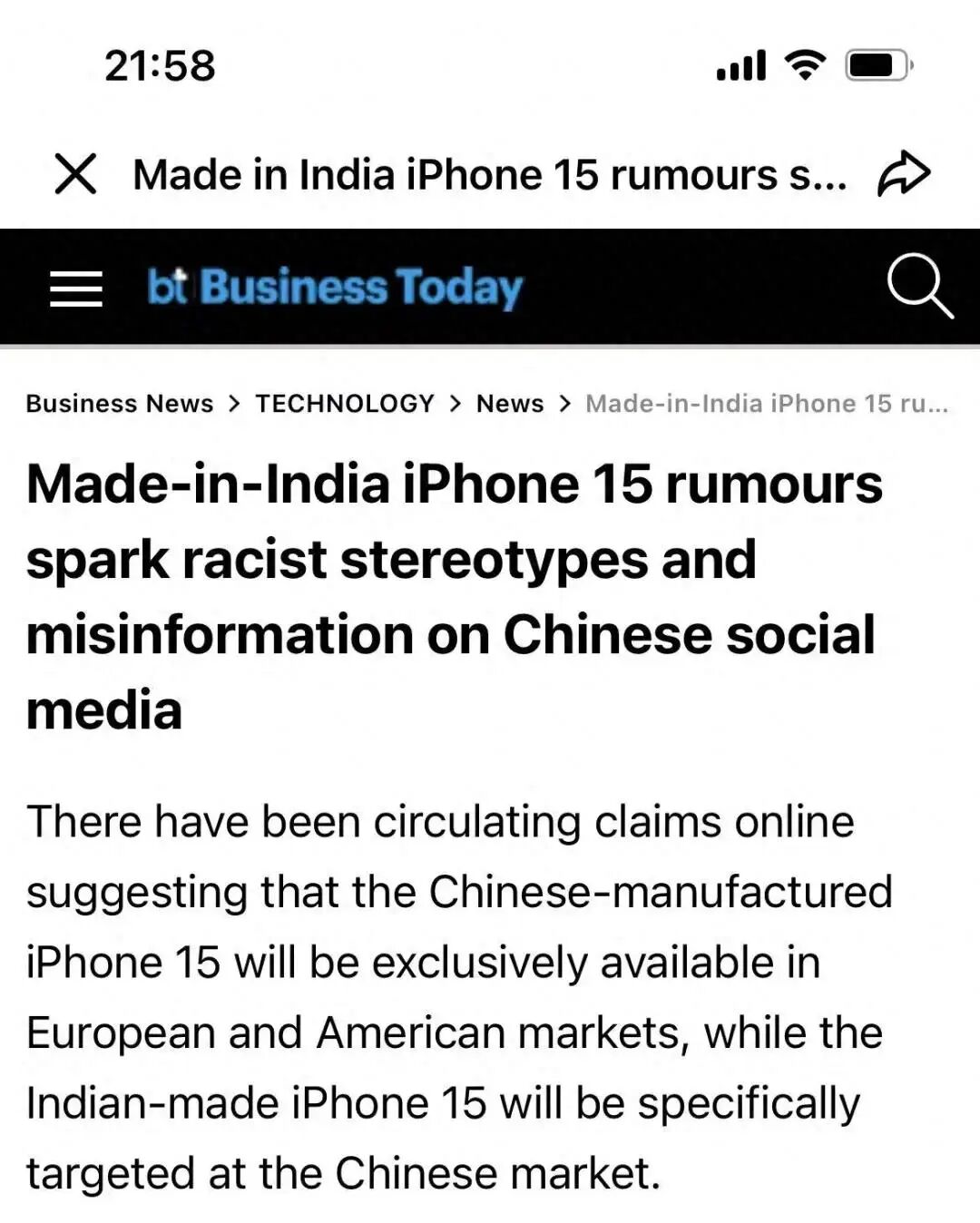
As early as the launch of iPhone 15 in 2023, Indian media Business Today published an in-depth report titled "Rumors of 'Made in India' iPhone 15 spark stereotypes and misinformation on Chinese social media".
This is the first time that Indian media has officially responded to the phenomenon of "Chinese consumers shunning Indian-made iPhones".
In March 2026, global tech media MacRumors released a report titled Apple Now Makes One in Four iPhones in India, confirming that more than 70% of US-version iPhones are produced in India.
After the news was released, a large number of netizens on overseas forums reposted the phenomenon that the Chinese market distinguishes the production origin of iPhones, and the topic was spread back to Indian social networks, triggering a large-scale debate again.
Extreme netizens on India's X platform believe that Chinese consumers have inherent prejudices. An Indian tech blogger said: "All iPhones follow exactly the same Apple manufacturing standards, the same components, and a unified global warranty. It is unreasonable to treat them differently just because the assembly location is different, which is nothing but a stereotype."
A highly upvoted answer on Quora wrote: "Consumers should not be misled by sporadic fault cases on the Internet."
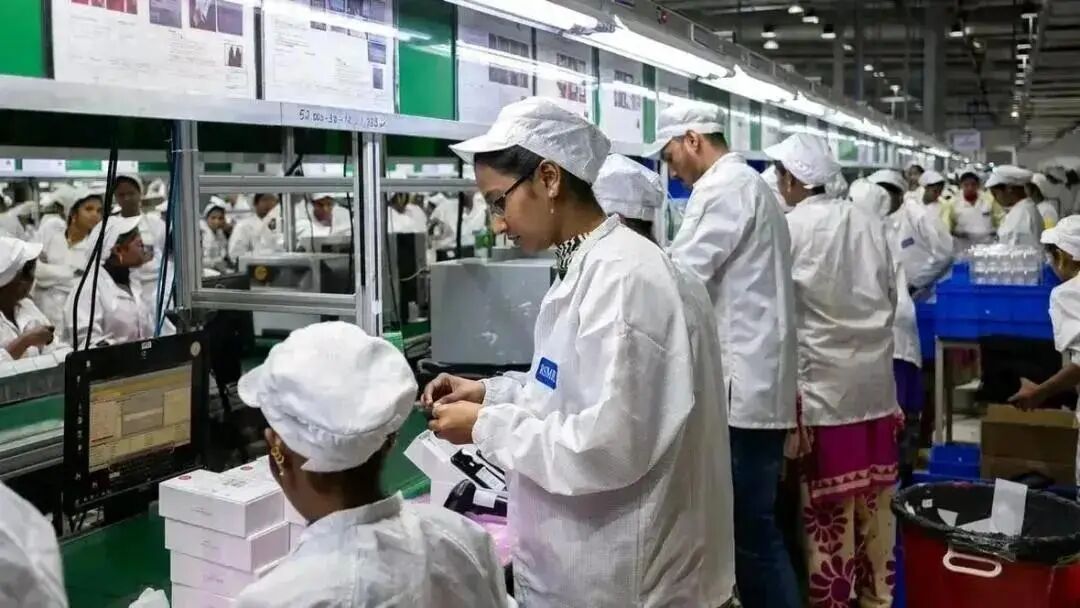
But at the same time, a message left by an electronic manufacturing engineer in Bangalore in the comment section of Indian tech media Tech2 received tens of thousands of likes: "We must face up to the reality that there is a gap between the current yield rate of Indian assembly lines, supply chain stability and those of China. Consumers who spend money on high-priced products have the right to avoid higher failure rates, and market choice has nothing to do with discrimination."
In other words, even Indian engineers have admitted that consumers have the right to avoid higher failure rates. Therefore, for consumers, being more careful when buying a mobile phone is not paranoia.
The most reliable way is to check the model number: go to "General - About This Device" in Settings, and the one whose model number starts with CH/A is the mainland China domestic version.
For those cheap "brand-new phones" and parallel imports of unknown origin, the production origin is hard to tell. This is not about blindly worshipping China, it's about spending money to know exactly what you get.
If Indian-made iPhones become prevalent in the Chinese market in the future, there will be two outcomes
However, as for the "smartphone" label in India's current export data, it remains to be further confirmed whether it refers to highly integrated core modules of mobile phones, or finished mobile phones as understood by consumers. But there are two more tangible changes behind this.
On one hand, the cake of China's OEM industry is indeed being divided. The share of Indian-made iPhones has jumped from 6% to 26%, and the extra 20% of production capacity originally belonged to orders of Zhengzhou Foxconn, Shenzhen and Luxshare Precision.
On the other hand, India's iPhone assembly cannot do without China's industry. The yield rate of Chinese factories has long been steadily maintained at 97% to 98%, while that of Indian factories is 85% to 88%, a gap of nearly 10 percentage points.
Apple's Chief Operating Officer Williams once said bluntly that almost all key components for Indian-made iPhones, including chips, sensors, display screens and cameras, still have to be shipped all the way from China.
India produces 55 million iPhones a year, and more than 40 million of them have to be exported; if the mobile phone category data in India's exports to China is true, then the entry of Indian-made iPhones into the Chinese market is not a future tense that can be covered by the statement "all domestic iPhones are made in China", but a present continuous tense that has already been recorded in the trade data.

If the quality control reputation of Indian-made iPhones cannot be established — once problems such as dust ingress, fingerprints and gaps are perceived by more people — Chinese consumers' impression of "India-made iPhones" will be further strengthened.
When more and more consumers are unwilling to take a chance on an "Indian-made iPhone" whose quality control depends on luck, this may be an opportunity for domestic mobile phones, and it depends on whether domestic mobile phones can seize it.
Three years ago, Apple assured that "all domestic iPhones are assembled in China", now when India's production capacity is getting higher and higher, does Apple still have the confidence to keep this promise?
When the share of Indian-made iPhones reaches 30% to 40% in the future, the probability of Chinese consumers buying Indian-made iPhones will also get higher and higher.
There may be two outcomes. First, consumers gradually get used to Indian-made iPhones, and can no longer perceive the experience gap between China-made iPhones and Indian-made iPhones.
In this case, Indian-made iPhones may further expand their sales in the Chinese market in the future, which will continuously squeeze the market share and orders of the Chinese mainland iPhone supply chain.
The second outcome is that the quality control reputation of Indian-made iPhones cannot be established, leading to a decline in iPhone sales in the Chinese market. Eventually, based on the downward trend of sales, Apple chooses to keep its promise and only sell China-assembled iPhones in the Chinese market. The decision of this outcome is in the hands of consumers.
Of course, on the other hand, it depends on the improvement of product capability and quality control yield of Indian-made iPhones. When Indian-made iPhones keep improving, climbing the curve, and eliminating the gap with China-made ones, and consumers can accept them, this will probably be the crisis that China's iPhone supply chain needs to deal with next.
This article is from the WeChat official account "Hot Micro Review" (ID: redianweiping), written by Wang Xixi, authorized to be released by 36Kr.