Its market value has shrunk by about 300 billion yuan, and no one can make sense of the final outcome this company is betting on.
Since the start of September, MiniMax has made frequent moves in overseas markets.
On September 16, among the AI learning programs launched by Singapore's SkillsFuture Singapore, three products of MiniMax, as the only selected domestic large model representative, are listed as optional services alongside ChatGPT Plus, Google AI Pro, and Microsoft 365 Personal. On September 3, HUMAIN, an AI company under Saudi Arabia's Public Investment Fund, launched Humain-M3 which is pre-trained with more than 1 trillion tokens of native Arabic corpus based on MiniMax M3, ranking first in average score across seven Arabic benchmark tests.
Driven by this, MiniMax's stock price rose for two consecutive days on September 17 and 18, with a sharp increase of nearly 19% at the close of the Hong Kong stock market on the 18th. As of the close on September 21, MiniMax's stock price stood at HK$298 per share.
Compared with its peak stock price of HK$1,330 per share, the outside world may be more concerned at present: When will M3.1 and M3 Pro be released?
At the earnings call on August 26, Yan Junjie, Founder and CEO of MiniMax, said: "With the continuous improvement of the two pipelines of the M series and H series, the model release cycle will be significantly shortened, and new products such as M3.1, M3 Pro and H3.1 can be expected in the future. Among them, the parameter scale of M3 Pro is expected to increase to about 3T, equipped with MSA 2.0 architecture, and the computing efficiency is expected to increase by about 3 times."
However, up to now, there has been no news about the launch of M3.1.
Meanwhile, the iteration pace of domestic large models has accelerated significantly in the second half of 2026 — Zhipu released GLM-5.3 on August 14, Kimi released K3 with parameters of 2.8 trillion on July 17, and DeepSeek V4 Pro also launched its official version on August 13.
Although MiniMax released the multimodal video model H3 on July 31, under the current evaluation system, the capability of text models attracts more attention. However, M3 was released hastily with insufficient preparation, and it was just sandwiched between GLM-5 and K3, two models with outstanding performance in fields such as Coding and Agent. In addition, the price positioning triggered strong backlash from developers, making it extremely awkward in the competitive landscape.
From the perspective of product iteration logic, using a better model to cover the previous mistake should have been the optimal solution, but the company's delay in releasing M3.1 and M3 Pro has also made the outside world question MiniMax's model capabilities.
At present, when it comes to Zhipu, the capital market thinks of Coding; when it comes to Kimi, it thinks of Agent clusters; when it comes to DeepSeek, it thinks of text focus and price advantages. These labels and partial leading advantages of model capabilities do give these companies a clear valuation anchor in the capital market, and also make users' perception of them clearer. However, MiniMax's multimodal strategy has not formed an absolute leading advantage in individual capabilities or prices at present, and the outside world feels that its positioning is always vague, so the valuation system is also fluctuating.
JPMorgan Chase once downgraded MiniMax's rating from "Overweight" to "Neutral" in June 2026, and sharply lowered its target price. The core reason is exactly that MiniMax's flagship model M3 lacks pricing power and its model capability is still in the catching-up stage. This means that next, MiniMax must come up with a sufficiently powerful model to prove that its route choice is not wrong.
In fact, the questions MiniMax needs to answer go far beyond the model itself.
01
From To C To To B
On August 26, MiniMax released its first interim results after listing.
The company's total revenue in the first half of the year was 117 million US dollars, a year-on-year increase of 283.1%, reaching 1.5 times the full-year revenue of 2025 in only half a year. Q2 revenue increased by 81.8% quarter-on-quarter; Token consumption in July has reached 20 times that in January; ARR (Annual Recurring Revenue) in August further increased to over 800 million US dollars. Gross profit was 20.81 million US dollars, a year-on-year increase of 464.8%, and gross margin increased from 12.1% to 17.9%, up 5.8% year on year.
But at the same time, there is another set of figures: the company's R&D expenditure in the first half of the year was 297 million US dollars, a year-on-year increase of 138.8%; the net loss for the period was 358 million US dollars, narrowing by 11% compared with 402.2 million US dollars in the same period of last year; but the adjusted net loss after excluding share-based payment, changes in fair value of financial liabilities and listing expenses was 293 million US dollars, expanding by 111.2% year on year. The adjusted net loss rate narrowed from about 455.9% to about 251.4%, which seems to have improved, but the main reason is that the revenue base has become larger, and the absolute amount of loss is still accelerating to expand.
What is more noteworthy than the profit and loss figures is the drastic change in revenue structure. In the first half of 2025, the revenue from MiniMax's AI-native products (Hailuo AI, Talkie/Starfield and other C-end products) accounted for about 70%, which was the absolute pillar of the company. In the first half of 2026, the revenue from the B-end open platform and enterprise services increased from 9.2 million US dollars in the same period of the previous year to 73.9 million US dollars, a year-on-year increase of 703.1%, and the proportion jumped from 30.3% to 63.4%, becoming the largest source of revenue; although the revenue of AI-native products increased by 100.9% year-on-year to 42.6 million US dollars, the proportion dropped to 36.6%. By August, the to B proportion in ARR had climbed to about 80%, leaving only about 20% for to C.
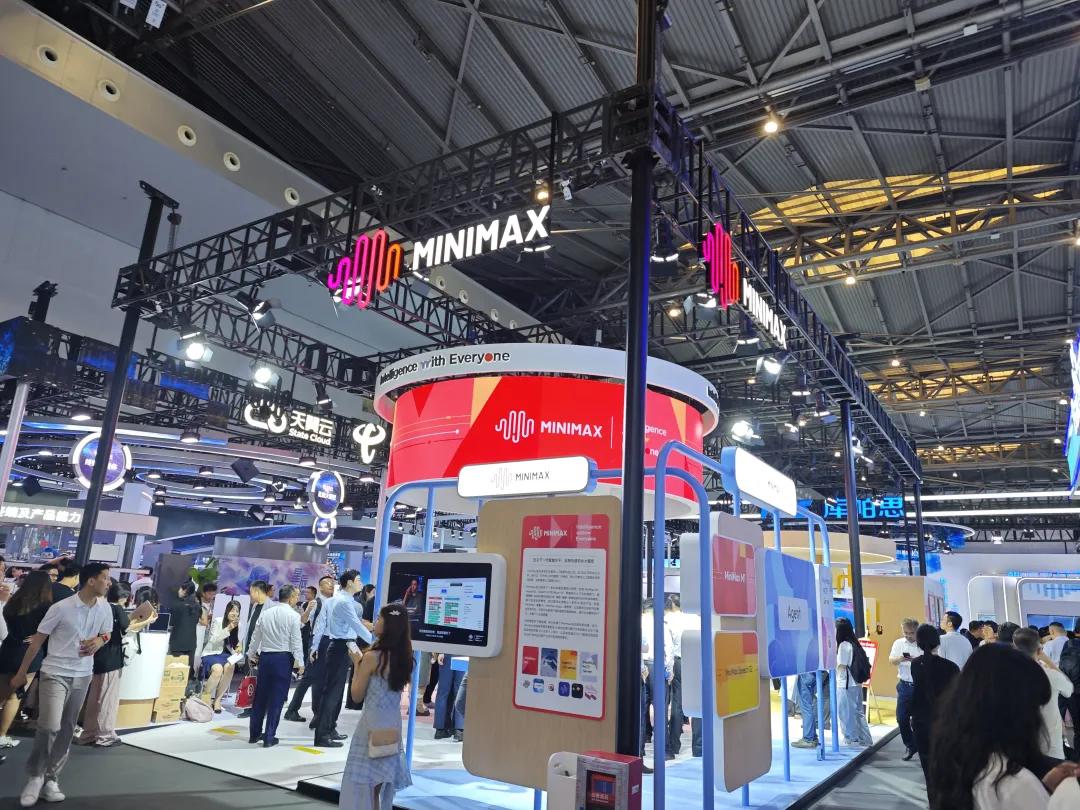
Photography:
In half a year, a company known to ordinary users for its C-end products has completely reversed its revenue structure.
However, this shift is not without omens. At least on the Coding track, the internal discussion at MiniMax started much earlier than the outside world imagined. On October 27, 2025, MiniMax officially open-sourced and launched MiniMax M2, which is claimed to be specially designed for Agent and code.
Yu Yang, an entrepreneur and former employee of MiniMax, told China Entrepreneur: "The company's judgment on Coding actually existed as early as when Claude first emerged in 2025. At that time, IO (Yan Junjie) had already shared it at the CD meeting." The CD meeting is an internal meeting held by MiniMax every Friday at noon, where Yan Junjie reports business development to employees, answers employees' questions, and shares his views on the cutting-edge development of AI.
Therefore, in Yu Yang's view, it was foreseeable long ago that MiniMax would focus on B-end in commercialization. "Because entering the Coding track means serving B-end customers."
At the MiniMax developer offline exchange event held in June 2026, Yan Junjie also mentioned that two years ago, he asked Liang Wenfeng whether to do AI Coding. He said that at that time, everyone's consensus was that there might be only 1 million to 2 million people in the whole of China who could write code, which did not seem to be a broad enough market, but now it has obviously changed. AI Coding does enable more ordinary people to have productivity.
However, early layout does not mean that cognitive leadership can be transformed into market advantages. MiniMax's model parameters and capabilities on the Coding track have not formed a sufficiently strong cognitive barrier in the developer community.
This cognitive lag was quickly reflected in the capital market. When the market perception of model capabilities failed to match its technical investment, the valuation logic began to shake. The unlocking pressure of the secondary market and valuation regression followed. Although more than 80% of Pre-IPO and cornerstone shareholders publicly stated that they would continue to hold, and the two major strategic shareholders Alibaba and miHoYo explicitly expressed their support, the company's stock price still fluctuated sharply, falling by more than 80% from the highest point.
After the release of MiniMax's financial report on August 26, the stock price rose only 3.83% the next day. After the live stream built on H3 Max was launched on August 31, MiniMax's stock price rose rapidly, rising nearly 20% at one point during the intraday trading, closing up 16.18%; the uptrend continued on September 1, with a cumulative increase of more than 20% in two trading days.
This also shows that the market still believes in the narrative of model capabilities. Yan Junjie also emphasized this point again at the earnings call. When sharing the company's positioning and strategy, he said: "The intelligent improvement driven by large language models has almost no end. From the practical application of Coding and Agent capabilities since the second half of last year, to the subsequent more autonomous and creative completion of long-term tasks, and then to the expected end-to-end delivery of reliable results in the future, we are continuously pursuing higher intelligence."
02
M3's "Fiasco" and H3's "Reversal"
On June 1, MiniMax released M3. The model has a total parameter scale of 428B, activated parameters of 23B, adopts a Mixture of Experts (MoE) architecture, and natively supports a million-level token context.
In the competitive landscape at that time, this parameter scale seemed rather awkward.
When M3 was released, many trillion-parameter models such as Qwen3-Max-Thinking, DeepSeek V4 Pro, and Kimi K2.6 had already been launched in China, while overseas, there were competing products such as GPT-5.5, Gemini 3.1 Pro, and Claude Opus 4.7. Trillion-level parameters are becoming the entry ticket for top players. Two months later, Kimi K3 was open-sourced with 2.8 trillion parameters, and Qwen-3.8 Max reached 2.4 trillion, further widening the gap.
Source: Visual China
On the eve of its release, M3 was highly expected, and the company internally hoped that the model capability would reach a new level. However, after its launch, many developers said after trying that the actual performance of M3 did not meet expectations. Some insiders also admitted that the launch of M3 was a bit "hasty", or "too urgent".
Alex, an individual developer, said that the main model he uses daily is Kimi K3, and he will try Zhipu GLM after the quota is used up, while MiniMax is a backup option. "MiniMax gives me the feeling that its capability is not that strong, but it works stably."
Alex explained his choice logic: he is not a software engineer and does not have strong identification ability. When asking AI to implement functions, he cannot understand most of the questions the model asks him. In this case, he wants to give the decision-making power to AI, let it decide how to do it, and then he verifies the results given by AI. "So I need a stronger model, not a stupid but fast model, because the latter will greatly increase the frequency of me checking the results." Therefore, he will give priority to Kimi or stronger SOTA models.
Since his daily work is to provide software for the industrial field, Chen Lijun, founder of Yita Industrial Intelligent Technology, has higher requirements for model capabilities and code accuracy, and the performance of M3 cannot meet his delivery requirements. He believes that the root cause of the problem lies in the parameter volume. He takes Qwen's model as an example: "3.7 Max and Plus have the same total parameters, but Plus is multimodal. The addition of multimodal parameters under the same total parameters leads to a sharp decline in Coding quality. Switching to 3.8 Max with trillion-level parameters, although it is a multimodal model, its capability is on par with or even higher than 3.7." In Chen Lijun's view, among models specially trained for Coding or models at the same parameter level, pure text models are generally stronger than multimodal models.
For Chen Lijun, the problem with M3 is insufficient parameters. He did the math: "What really consumes tokens is rework. I would rather add more tokens in the early stage of research, make each module pass at one time, and call each other later, which brings the highest benefit. If you ask AI to modify the results after they are generated, it may delete the previous content while modifying, which is very uncontrollable. This is a deep pit I have stepped into personally." In his view, the "cost-effectiveness" of the model does not hold in the daily workflow: The money saved by low prices may be doubled in rework.
However, M3 does not mean it is not easy to use. Developer Xiaofeng emphasized that the method is more important than the model itself. In his view, everyone uses different methods, and some people may not even use the built-in Skills, so the problem may not lie in the model. "You give the general direction to AI, and AI helps you implement it, but before execution, you need to use Plan to make a plan first, generate a to-do list, you check whether the content in it meets the requirements, and then let it do it based on the list." He also mentioned that deleting 80% of the prompts of Claude Code can also achieve the effect, the key lies in whether the requirement description is clear and structured. "Choose the right direction before execution, and do not rely entirely on AI."
Xiaofeng said that he uses MiniMax for Coding, image and picture recognition in daily life, for example, using DeepSeek to generate text, and then sending the text to MiniMax to generate videos or pictures.
This is also the state of MiniMax's model in the minds of many developers: as a multimodal execution tool, M3 is usable, but not irreplaceable.
What really makes users dissatisfied is M3's pricing scheme. On the day the model was released, MiniMax switched the long-used subscription-based Coding Plan to the new Token Plan billed by token, but this change was not notified to users in advance, and the explanation information on the official page was not clear. A large number of individual developers found that the rules had changed after logging in. Soon some people found that with the same intensity of use, the quota consumption speed was far faster than expected, and dissatisfaction quickly fermented. Some people rushed to the complaint platform to request a refund, some announced that they would no longer renew, and vented their emotions on social media.
Soon, MiniMax released an apology announcement, admitting that it did not fully communicate with users before the adjustment and improperly handled the weekly quota for old users, "it is our work that is not in place", and launched a set of combined compensation plans. But its market performance and public praise still cannot be completely recovered.
Many internal employees later described the state of a few months before the release of M3 to the media: "We put all our attention on the model's intelligence itself." Yan Junjie also admitted at the earnings call: "During the R&D process of M3, we also had practical deficiencies."
The turning point came on July 31, when MiniMax released the open-source multimodal model H3. In the Artificial Analysis video model list, H3 ranks first in the world in video editing capability, and its generation price of 0.8 yuan/second (2K resolution) is only one third of that of similar flagship video models.
After the release of H3, the public praise of MiniMax's model capabilities has also reversed to a certain extent, which can also be seen from the data. Yan Junjie said at the earnings meeting: "In the more