The 1-billion-yuan wind power project has been urgently suspended, leading wind power giants are collectively "heading into space", and Haili Wind Power has placed its bet on rocket propellant tanks.
Haili Wind Power has suspended its 10-billion-yuan wind power project to bet on transformation through rocket tank manufacturing.
An offshore wind power component supplier has halted the wind power equipment manufacturing project that it just expanded to 1 billion yuan, and allocated the same plot of land to rocket tank production instead.
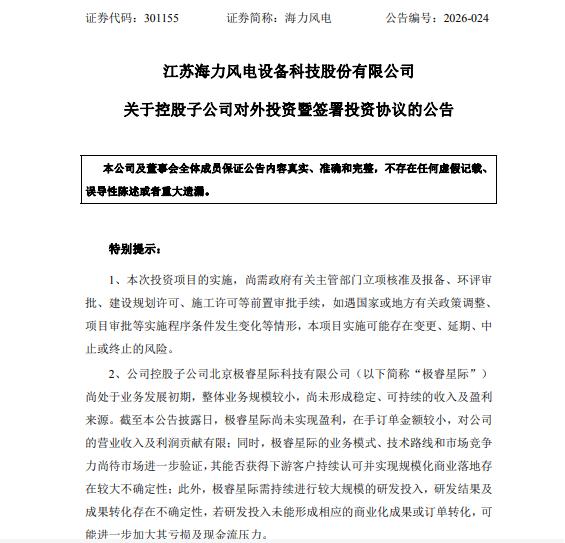
Foresee Energy noted that on the evening of September 18, Haili Wind Power released several announcements in a row, declaring the termination of the "Haili High-end Energy Equipment Manufacturing Project", and re-signed an investment agreement to use the original project plot for fuel tank production of its holding subsidiary Beijing Joray Interstellar Technology Co., Ltd.
This project had a total investment of no less than 500 million yuan when it was approved in March 2024, and the investment was doubled to 1 billion yuan in July the same year. Less than two years later, it has been officially suspended.
It is no longer news that leading wind power enterprises are collectively "moving to the aerospace sector". Goldwind holds shares in Landspace, Taisheng Wind Energy has renovated its Dongtai factory to build a tank production line, and Mingyang Smart Energy acquired Dehua Chip, a satellite power supply enterprise. However, Haili Wind Power's path is different from all of them, as it is facing the operational reality that its revenue has plummeted by 90% and its non-recurring profit and loss net profit has turned from positive to negative.
A more urgent question is: When a company with sharply shrinking main business puts its resources into a loss-making start-up subsidiary, is this a strategic transformation, or a passive gamble?
01
Performance cliff and project redirection take place on the same timeline
Haili Wind Power's performance curve drew a steep inverted V shape between 2025 and 2026.
In the first half of 2025, the company achieved a revenue of 2.03 billion yuan, a year-on-year increase of 461%, and a net profit attributable to shareholders of 205 million yuan, a year-on-year increase of 90.61%. The number of newly started offshore wind power projects rose significantly, and the product sales scale increased accordingly, making this report card look quite impressive.
The turning point came quickly. In the first half of 2026, the company's revenue was only 186 million yuan, down 90.85% year on year; its net profit attributable to shareholders was a loss of 93.4493 million yuan, with a year-on-year decline of 145.55%.
Foresee Energy found that the explanation given by the company in its semi-annual report is that the customers' offshore wind power projects are restricted by factors such as sea use approval and waterway coordination, and cannot start construction before the relevant procedures are completed, so the product delivery is postponed accordingly. On the other hand, the new installed capacity of domestic offshore wind power in the first half of the year was 840,000 kilowatts, a significant decline compared with the same period of the previous year.
Against this background, the logic of the "redirection" of the 1-billion-yuan project becomes clear. The original project covers 165 mu of land, with a new factory building of about 59,000 square meters, and was originally planned to purchase equipment such as gantry cranes, double-girder cranes, and laser cutting machines. Now this plot of land will be used to build a fuel tank production line, which will also purchase more than 300 sets of equipment including 5-axis laser cutting machines, friction stir welding machines, and CNC machining equipment, with a total investment of 1 billion yuan, implemented in two phases.
The company stated that there is no liability for breach of contract for terminating the original project, and it will not have a significant impact on the overall business development and financial status. At the moment when the main business revenue has plummeted by 90%, the degree of ease in this statement is worth pondering.
02
The technical logic is valid
But the transfer of manufacturing capabilities is only the starting point
The process transfer between wind power towers and rocket tanks is not empty talk. Both are large-scale pressure-bearing metal structural parts, and their technical logic does have similarities in key links such as material technology, structural mechanics, and precision welding.
The more direct driving force lies in gross profit margin.
The average gross profit margin of the tower industry is around 22%, while Haili Wind Power's own gross profit margin for wind power towers was only 10.94% in 2025. The average gross profit margin of the rocket tank industry is about 25% to 40%, the value of a single tank is between 2.5 million yuan and 5 million yuan, and a rocket usually uses 2 to 6 tanks.
But the gap in gross profit margin does not mean that the manufacturing difficulty is simply superimposed. Rocket tanks have substantial barriers compared with wind power equipment manufacturing in terms of cryogenic material application, extremely high-standard sealing technology, aerospace-grade non-destructive testing, and strict supply chain access system.
Taking the core welding process as an example, friction stir welding has become the mainstream process in aluminum alloy tank manufacturing, but the requirements for assembly accuracy, roundness control, and heat input stability for large-diameter tank circumferential welding are much higher than those of conventional welding.
It is understood that in March this year, Jiutian Xingge completed the automatic laser welding of the circumferential seam of the world's largest 10-meter-class stainless steel tank cylinder section, with a total circumferential seam length of 33.5 meters, and achieved successful one-time welding.
There is a gap that requires long-term investment to bridge between the large-scale mass production capability of equipment that wind power enterprises are good at, and the quality control system in the aerospace field.
03
The actual situation of a loss-making subsidiary
The main entity that Haili Wind Power bets on, Joray Interstellar, currently does not have a good operating performance.
It is reported that from January to May 2026, Joray Interstellar's revenue was only 1.3783 million yuan, with a net loss of 5.3801 million yuan, a significant expansion compared with the loss of 202,900 yuan for the whole year of 2025. By the end of May, the company's net assets dropped to 13.9073 million yuan, and the asset-liability ratio rose to about 77%.
The announcement frankly states that Joray Interstellar's current order amount is small, its contribution to Haili Wind Power's revenue and profit is limited, and its business model, technical route and market competitiveness remain to be verified.
The total investment of 1 billion yuan for the project will be completed through self-owned funds, bank loans or other debt financing methods. Haili Wind Power itself has already suffered losses in the first half of 2026, so its asset-liability ratio will further rise and interest expenses will increase.
From the perspective of industry supply and demand, the domestic rocket tank market capacity from 2025 to 2030 is about 11 billion to 18.3 billion yuan, with an average annual growth rate of more than 20%. However, among private players, Tianjin Yuefeng, Jiutian Xingge, and Lightyear Exploration have already put their production lines into operation, and the window period for large-diameter tank production capacity is narrowing.
The first phase of Haili Wind Power's new project has an investment of 612 million yuan, which is expected to start construction in October 2026, with a construction period of about one year. It will be put into production no earlier than the fourth quarter of 2027.
Whether there will be enough space left in the market for a new player starting from scratch by then is an open question.
Foresee Energy believes that Haili Wind Power's this redirection is essentially a race against time between the sharp shrinkage of its main business and the narrowing window period of emerging tracks. The company's announcements repeatedly mention the synergy advantage of "relying on the coastal base wharf and heavy lifting equipment to shorten the logistics chain", which shows that the management is not blindly following the trend, but trying to find the specific connection between wind power manufacturing experience and aerospace demand.
But from test samples to aerospace-grade reliability verification, and then to mass supply and continuous revenue, every step requires real money and time to verify.
1 billion yuan has already been invested. What comes next is not concepts, but actual orders.
This article is from the WeChat official account "Foresee Energy", written by WANG Mengjiao, authorized for release by 36Kr.