HardKr Exclusive Release | Tsinghua University PhD team has developed a brand new architecture for robot brains, and has completed tens of millions of yuan angel financing.
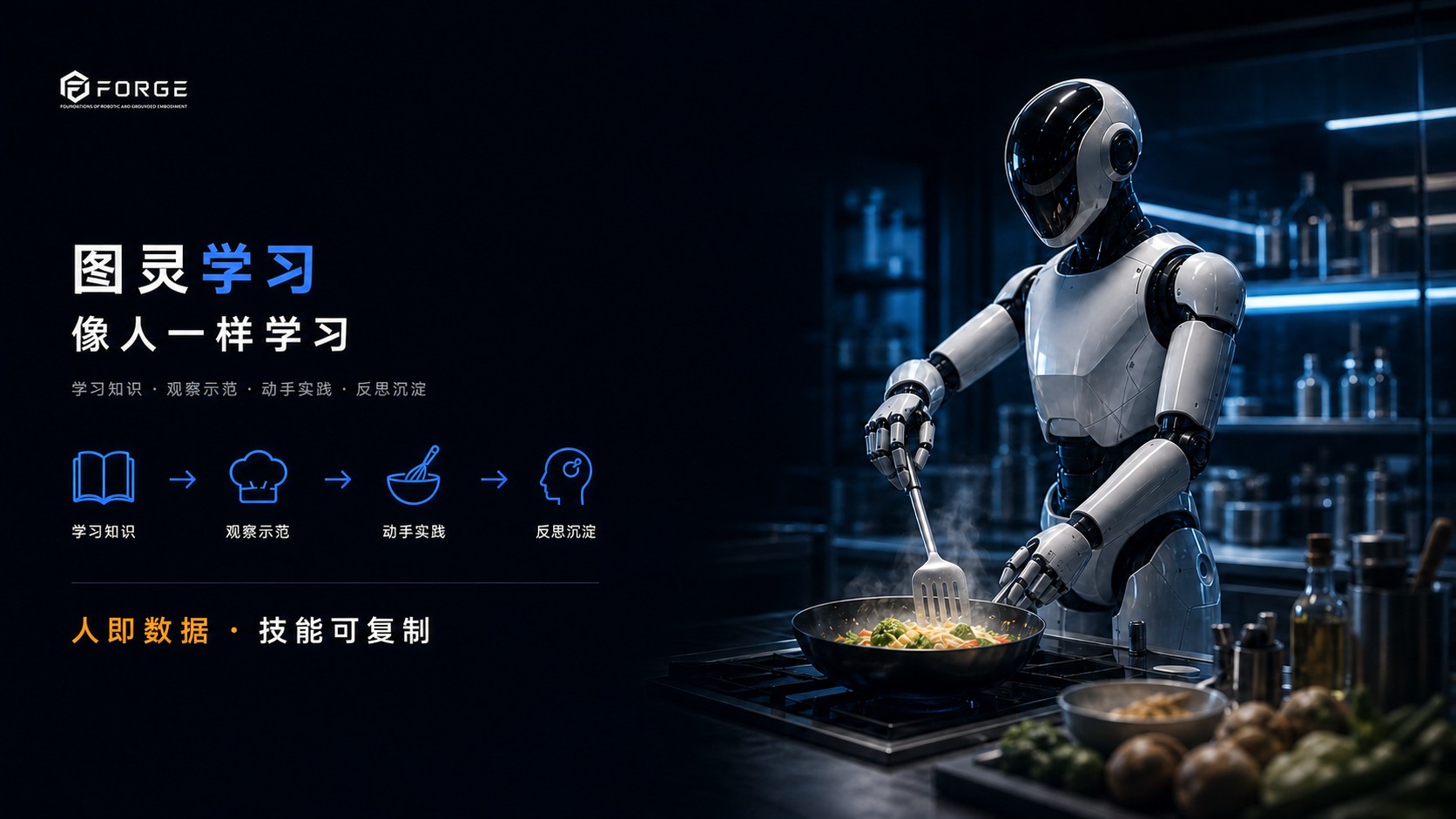
Image source: Fancy Technology
Hard Krypton learned that Fancy Technology, a developer of general embodied intelligence brains, recently completed a multi-million-yuan angel round of financing, with investors including TusStar Venture Capital and other institutional investors.
Founded in 2026, Fancy Technology is an R&D enterprise focused on general embodied intelligence brains. The team founder Wang Xinzhou graduated from the Department of Computer Science of Tsinghua University, and was deeply involved in the architectural design of Tencent Hunyuan 3D model and physical AI algorithm before starting his business.
It is reported that the funds from this round of financing will be mainly used for core technology R&D and expansion of the R&D team, accelerate the verification and commercial implementation of key technologies in typical scenarios, continuously build a "general skill operating system" that enables robots to learn sustainably and migrate across different bodies, so as to accumulate strength for building a general "robot brain".
Dr. Wang Xinzhou believes that the root cause of the weak generalization ability of current embodied robots still lies in the lack of human knowledge in the world model, while the embodied "brain" lacks physical common sense, that is, there is a separation between physical knowledge and semantic knowledge between the world model and the embodied model.
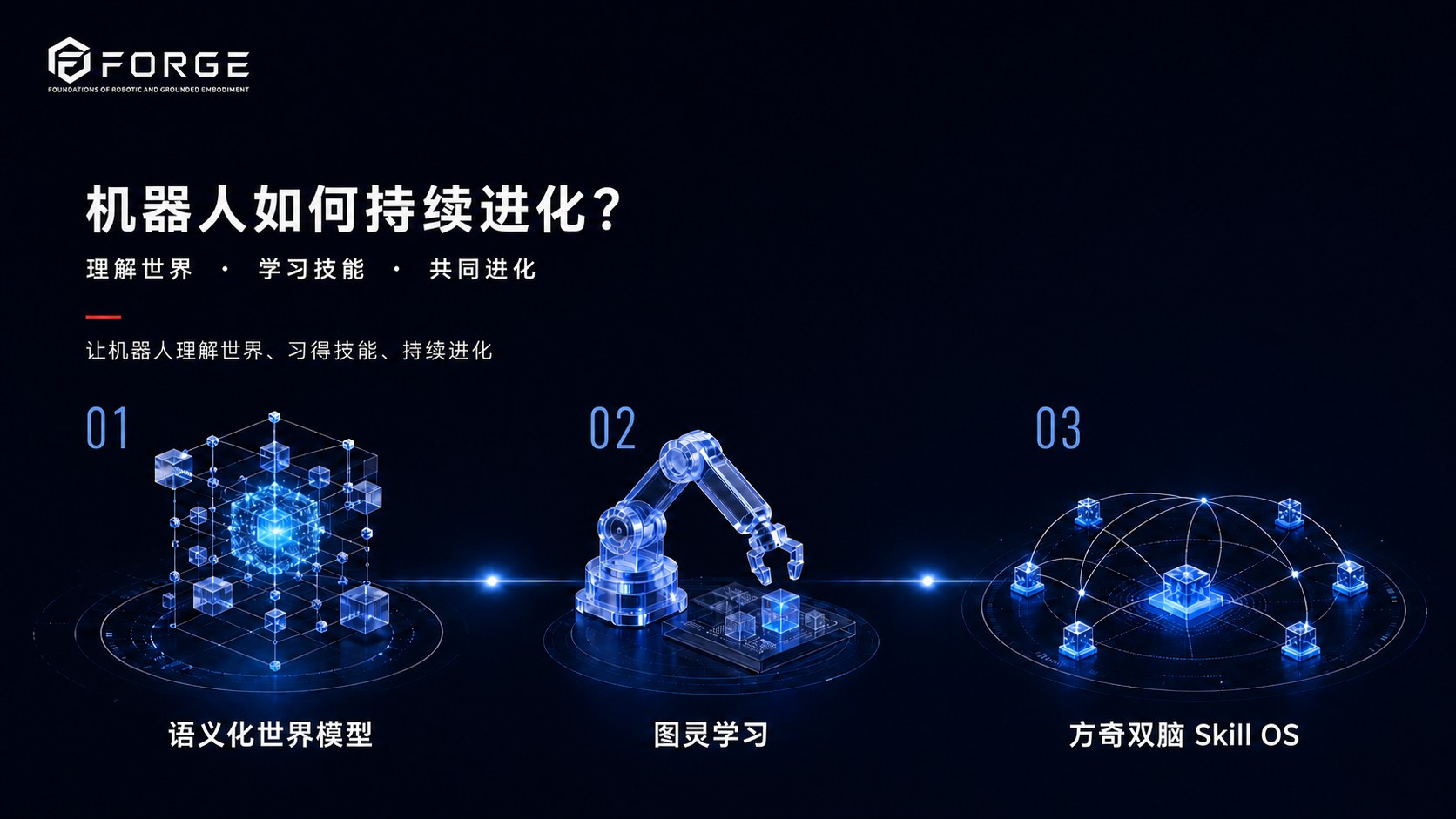
Image source: Fancy Technology
Based on this, Fancy Technology proposes a combined architecture of "semantic world model + Turing learning".
The semantic world model deeply couples the large embodied model with the world model, organizes vision, language and physical state into a unified 3D semantic space, enabling robots to understand the world, predict actions and make autonomous decisions just like humans.
The "Turing learning paradigm" is constructed through the link of curriculum learning, task learning, practical learning and reflective learning, breaking the dilemma of traditional remote operation learning robots that "only know what it is but not why it is", allowing robots to continuously learn from human data and real practice, and build a scalable and replicable learning paradigm.
The semantic world model and Turing learning together form the evolution flywheel of the embodied intelligent robot model, driving the continuous growth of the cloud-native embodied brain. On the one hand, it realizes the reuse of cross-body skills, and on the other hand, it enables learning and co-evolution among different robots.
Although the company was established only this year, Fancy Technology has made commercial progress, reaching strategic cooperation with UD Robots, Jiangsu Longhuan and other enterprises. It will take "3D cleaning" as the training ground to promote pilot implementation. At present, it has signed orders of nearly 10 million yuan, and has opened up the business model of selling complete machines and selling Skills.
The following is the exchange minutes between Hard Krypton and Wang Xinzhou, founder of Fancy Technology, the content has been edited
Hard Krypton: Many enterprises in the industry have started to go public and seek implementation. The industry has reached this stage, but Fancy Technology just enters the market and obtains financing now. What capabilities of Fancy Technology do investors value?
Wang Xinzhou: Embodied intelligence seems to be in an intermediate stage now, and investors' requirements for embodied intelligence are rising rapidly — it is difficult to raise money just by telling stories about the next 5-10 years. They want to see real machine indicators, pilot data, and verify whether the technology can run smoothly in real scenarios.
Our team comes from Tsinghua University and the Chinese Academy of Sciences, with solid technical foundation, but we pay more attention to whether the technology can truly solve the core problems of the industry: enabling robots to have the generalization ability across different bodies and scenarios, instead of relying on manual remote control teaching. This consensus is the basis for us to reach cooperation with investors.
Hard Krypton: Who are Fancy Technology's customers?
Wang Xinzhou: At present, we mainly target two types of customer groups. The first type is existing hardware manufacturers or hardware companies that do not have complete embodied capability development capabilities, and we output brains and skills for them. The second type is customers in vertical industries, such as Longhuan Property. At present, we focus on commercial service scenarios — such scenarios have higher requirements for the transferability of robot skills, which can just give full play to our advantage of "one brain for multiple forms".
We are positioned as a robot brain company. Instead of developing a separate brain for each specific robot, we turn the capabilities of the brain into one skill after another.
Hard Krypton: Now robots have various forms, how does Fancy Technology achieve "one brain for multiple forms"?
Wang Xinzhou: No matter it is humanoid, wheeled, or even a robotic arm, they have the greatest common divisor, which is the form of human beings.
We take human beings as the intermediary. No matter it is the robot of Unitree or that of Agibot, we convert all the actions of the robots into human actions, that is, actions centered on human beings, thus building a virtual reference robot platform.
Adapting the reference template to a specific robot requires relatively little effort. The development cycle of a robot is generally calculated in half a year, while this adaptation algorithm only takes about half a month.
In terms of technical architecture, we adopt the cloud-native "cloud super brain + end-side task intelligent agent" — the cloud is responsible for large-scale pre-training and skill precipitation, and the end-side is deployed in a lightweight way for execution, so as to realize "one brain for multiple forms".
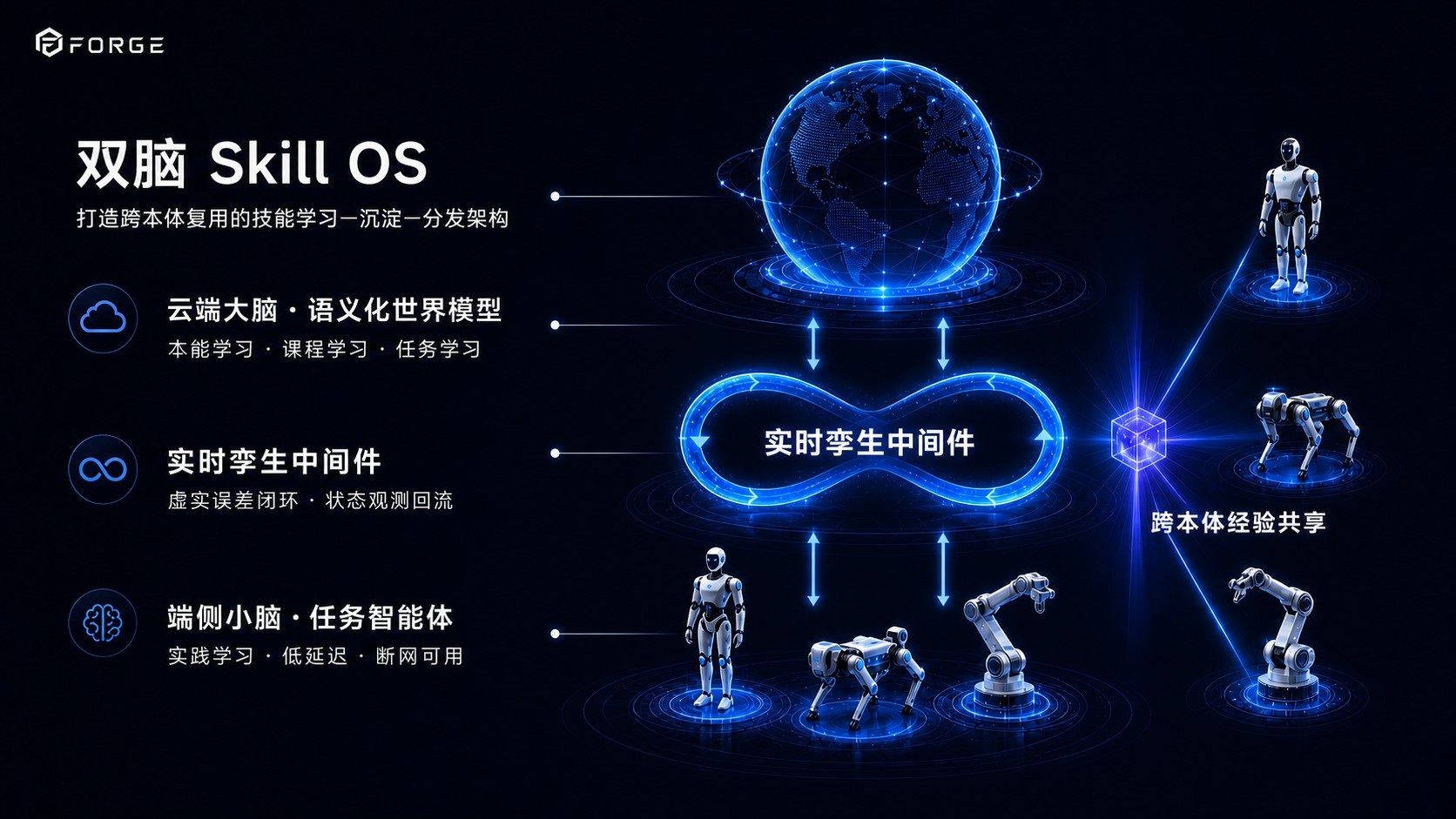
Image source: Fancy Technology
Hard Krypton: What is the most overrated thing in the industry now? And what is the most underrated one?
Wang Xinzhou: I think the most overrated thing may be the role of teleoperation data. In our opinion, to achieve real commercial implementation, no matter in terms of cost or time investment, it is definitely not a sustainable path, and it is impossible to cover all trajectories for teleoperation. For example, if the robot gripper is 5cm shorter, the utility of the data may be reduced by nearly 80% to 90%, but obviously hardware is iterating all the time.
The most underrated thing may be Agent intelligent orchestration (an artificial intelligence system that completes specific goals under limited supervision). Many people think that Agent is just an accessory of the multimodal large model, but tasks in the real world are all long sequences — when a robot works, it must complete a series of connected tasks. For tasks of this difficulty, it is difficult to achieve the goal only by relying on a single VLA or a single World Model, and a brain is needed for task orchestration.
Hard Krypton: What's the next step? What do you think of the future trend of the industry?
Wang Xinzhou: We plan to launch the available prototype for commercial services by the end of 2026, and promote large-scale deployment in 2027.
For the industry, my judgment is that the knockout round will start as early as 2027. The large-scale popularization of home humanoid robots still takes 3-5 years. Short-term commercial services and industrial scenarios are the best training grounds. The ultimate goal of robots is to learn like humans, think like humans, and be developed like computers.
Investor's Opinion:
Liu Bo, General Manager and Managing Partner of TusStar Venture Capital, said that the core of competition in embodied intelligence lies in whether we can get rid of the old path of "piling up massive real machine data" and find a low-cost, scalable general robot learning path. The semantic world model and Turing learning paradigm proposed by Fancy Technology bring new solutions to the industry, and we are optimistic that Fancy Technology has the opportunity to build the next-generation basic software platform for embodied intelligence.