From smart hardware to digital pet life forms, this company is building an AI-powered smart pet ecosystem | 36Kr Exclusive
Author | ZHANG Ziyi
Editor | YUAN Silai
36Kr Hard-Knowledge has learned that Moonback, a smart pet technology brand, has recently completed tens of millions of yuan in its first round of financing, with the investor being a listed AI company. This round of financing will be mainly used for AI algorithm R&D, and the construction of R&D and market teams.
The global pet economy continues to grow steadily.
Data from the American Pet Products Association (APPA) shows that the consumption of the U.S. pet industry reached 158 billion U.S. dollars in 2025, with a year-on-year increase of 3.7%, and is expected to further rise to 165 billion U.S. dollars in 2026; in 2025, about 95 million households in the United States owned at least one pet.
In the past, the main functions of smart pet hardware were still focused on automatic feeding, automatic cleaning, positioning and remote monitoring. With the development of AI and multimodal perception technology, smart pet hardware is expected to further evolve from "meeting daily needs" to "understanding pet status", and health management has also become a new direction for product exploration.
In the past year, the overseas business revenue of Moonback has reached nearly 100 million RMB, and the company has been continuously increasing its investment in AI to shift the product focus to the construction of a smart pet ecosystem.
Behind this shift is the discovery of pain points in pet-raising scenarios by Kevin, founder and CEO of Moonback.
"Pets are the only health scenario where the subject can never describe their own situation," said Kevin, founder of Moonback. "Combined with my many years of pet-raising experience, pet parents do not lack care, but have no way to know their pets' real status. A single drop in activity level may not be meaningful by itself, but if it is compared with the sleep, activity and behavior data of this pet over the past weeks and months, it is possible to spot signals that deserve attention in advance. The problem is that there is no place to integrate all these data right now."
Compared with the past practice of recording a single action with one device, Moonback hopes to simultaneously obtain data of pets' movement, heart rate, body temperature, sleep, breathing, excretion and behavior, and then analyze the combined long-term data with AI to monitor their health status.
Considering the different living habits of pet dogs and pet cats, Moonback has also designed different targeted products.
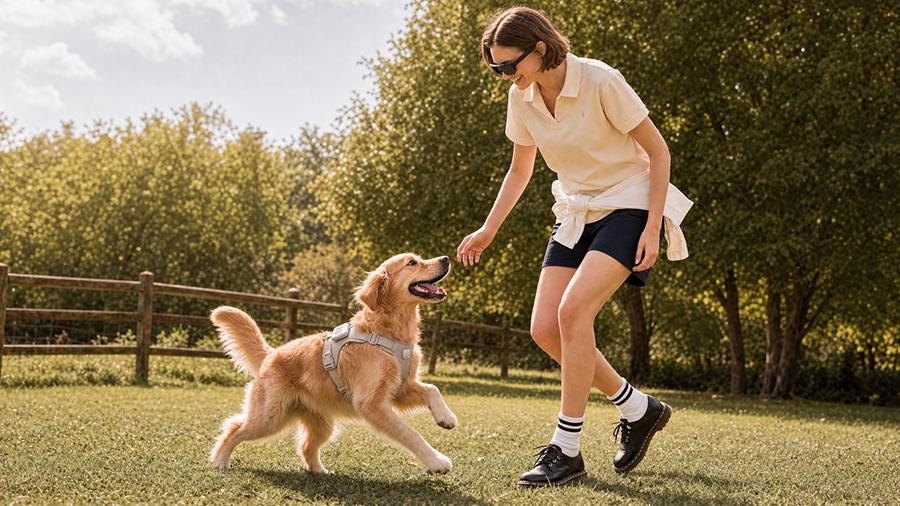
Smart Harness
For pet dogs, Moonback will launch a smart harness, which is equipped with GPS positioning and virtual electronic fence, as well as the function of monitoring physical parameters such as exercise volume, body temperature and heart rate, and provides users with health trend interpretation and risk alerts via AI Agent.
Compared with smart collars, harnesses are also a carrier that fits dogs' existing habits better.
Kevin told 36Kr that the team had considered collars before, but the whole weight would be concentrated on the dog's neck, leading to low comfort for long-term wearing. The current smart harness is more suitable for dogs to wear, with a battery life of 10 to 15 days.
The smart harness is mainly designed for outdoor scenarios. For indoor scenarios, Moonback has developed an AI sleep nest mat.
The sleep nest mat is equipped with sensing modules such as millimeter-wave radar, which can record indicators such as resting heart rate, respiratory rate, scratching behavior and sleep duration when the pet dog is sleeping. Moonback also pays attention to groups such as middle-aged and elderly dogs and short-snouted dogs, for which the early symptoms of heart and respiratory problems are not obvious, and the long nighttime sleep provides a relatively stable data collection scenario.
According to Moonback's plan, the smart harness and the sleep nest mat cover outdoor and indoor scenarios respectively, and the two types of data need to be further cross-analyzed.
"The health status of a pet cannot be judged by a single indicator or a one-time data change," Kevin said. "We also need to combine heart rate, sleep, as well as behavioral manifestations such as wandering and restlessness, and refer to long-term data trends to comprehensively analyze the changes in its status."
For the smart health detection products for pet cats, the data entry relies more on vision.
Pet cats live indoors for a long time, and their activity positions are more scattered. Moonback develops AI cameras to cover high-frequency scenarios such as eating, drinking, sleeping and excretion.
For example, near the litter box, the camera can record the color, shape and hardness of the cat's excrement when it defecates, and then compare it with long-term historical data; when placed in the eating and sleeping areas, it can record changes in diet and behavior.

AI Sleep Nest Mat
From smart harnesses, AI nest mats to cameras, what Moonback intends to do is not simply increase the number of hardware SKUs, but add more "dimensions" to observe pets.
Since the end of 2024, Moonback has accumulated hundreds of thousands of samples involving pet behavior, physiological data and vocalization, and has started to cooperate with pet hospitals and universities to supplement clinical data.
At the same time, Moonback is outputting health reports, anomaly alerts and pet-raising suggestions through AI Agent, and gradually forming a long-term digital file for each individual pet. Rather than continuing to expand the hardware categories, what Moonback hopes to verify is that the data continuously collected by multiple hardware devices can eventually be converted into more effective judgments of the pet's physical condition and emotional state.
CEO Dialogue
Hard-Kr: Many hardware companies are talking about AI right now. What problems do you think pets really need AI to solve?
Kevin: What Moonback aims to do is to help every furry kid express their health and emotions through hardware + AI, help pet parents better understand their furry kids, and provide a real community and platform that can solve pet-raising problems for both pet parents and their pets.
Human children can express their conditions and demands through crying, speaking and other ways, but pets cannot tell you their health and emotional problems. Especially when they enter the middle and old age, many diseases and emotional problems will gradually appear.
So we need to collect their physical and behavioral data through different devices. We cannot only look at a single data point, and all behaviors including wandering and restlessness at home should be taken into comprehensive consideration.
Hard-Kr: The data foundation of pet medical care is far less mature than that of human medical care. What do you think is the real threshold of this track?
Kevin: Technical capability is the foundation for entering this field, but what really forms long-term differentiation may be the accumulation of data and scenarios.
Moonback has been working on this for more than a year, and has now accumulated hundreds of thousands of pet-related data. Taking pet vocalization understanding as an example, AI cannot only know "it made a sound", but also need to know why it barked at this time and in this environment, and what happened before and after the bark. This means that pet AI does not only need larger models, but also a large amount of multimodal data from real life scenarios, as well as long-term data accumulation.