36Kr Exclusive | The domestic large aircraft manufacturing equipment supplier that has captured nearly 70% of China's aerospace assembly robot market share has secured tens of millions of yuan in financing.
Author | Qiao Yujie
Editor | Yuan Silai
This article is approximately 2800 words, with an estimated reading time of 8 minutes
36Kr learned that Feitai Intelligent Manufacturing Technology (Shaoxing) Co., Ltd. (hereinafter referred to as "Feitai"), an aerospace assembly robot company, has recently completed a financing of tens of millions of yuan, led by Haiyuan Capital and Zhejiang University Holdings, with participation from Zhongfu Venture Capital, Jinke Tongchuang, Nantong Jianghai Talent Angel Investment Fund, and angel investors.
Feitai focuses on the field of aerospace intelligent manufacturing. Through self-developed high-precision embodied intelligent robots and the overall delivery solution for intelligent assembly production lines, the company solves core pain points in aviation manufacturing such as low assembly accuracy of large structural parts, high reliance on manual labor, and data confidentiality. At present, it has occupied nearly 70% of the domestic market share of aerospace assembly robots.
Dr. Zhang Yilian, founder of Feitai, graduated from Shanghai Jiao Tong University. He previously served as the technical director of Shanghai Top Numerical Control Technology Co., Ltd., and has more than 15 years of experience in R&D and manufacturing of aerospace robots. The company's core founding team all comes from well-known universities such as Shanghai Jiao Tong University, Zhejiang University, and Shanghai University, with the technical team accounting for more than 60% of the total staff.
In terms of core products, Feitai is currently the world's only robotics company with full-process process capabilities for aerospace assembly. Its robot product line covers all key processes such as hole making, riveting, glue dispensing, grinding and inspection. Different from traditional expensive large-scale special equipment, Feitai adopts a miniaturized collaborative arm solution, which features small footprint and flexible movement. Its product performance is comparable to similar European and American products, while the price is about 1/8 to 1/10 of theirs. At present, Feitai has become a core supplier of manufacturing equipment for the first phase of C919 mass production.
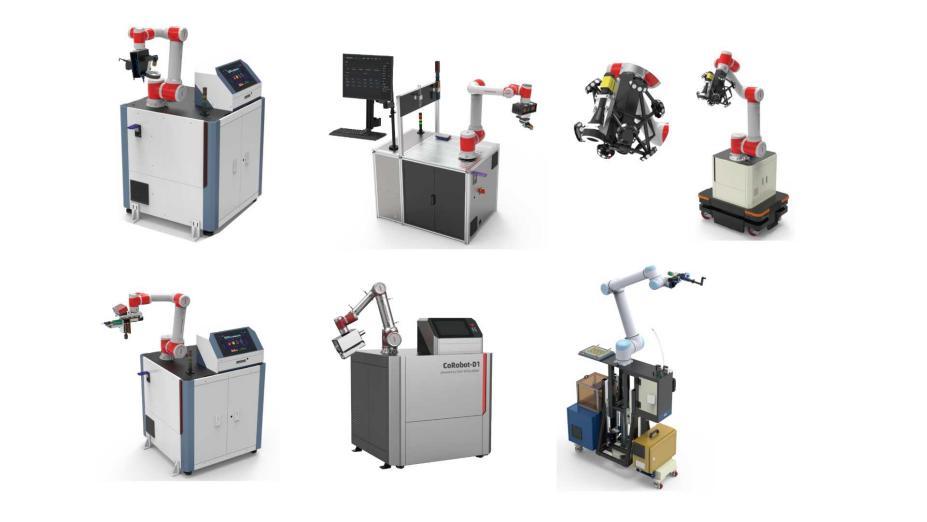
Image source / Enterprise
Supporting this hardware capability is the company's intelligent assembly production line "turnkey" project, which means that according to customers' part and process requirements, it plans the whole line implementation from stand-alone equipment, information system to logistics system in a coordinated manner. At present, the company has delivered a number of national key projects, with customers covering leading enterprises such as COMAC, AVIC, AECC, and CASIC.
Underpinning the implementation of the above products are Feitai's technical capabilities formed in precision control, machine vision, process simulation, production management, and lightweight embodied intelligence models.
Precision control is one of the core thresholds for aerospace assembly robots. According to Zhang Yilian, the accuracy of traditional industrial robots such as KUKA and ABB is generally 0.8 to 1 mm, while the accuracy requirement for some aerospace assembly processes is within 0.5 mm. To address this, Feitai independently develops underlying control algorithms, carries out high-precision transformation on the robot's rotating joints, and combines the robot deformation compensation algorithm to increase the body control accuracy to ±0.25 mm, which is in the world's first tier.
Aiming at the problem that aerospace thin-walled parts are prone to deformation during processing, Feitai has developed machine vision technology for aerospace manufacturing. The system can identify temporary reference pins through vision and dynamically adjust the processing trajectory to keep the hole position on the center line of the skeleton; at the same time, by identifying the product reference points, it calculates the relative coordinate relationship between the robot and the product, and compensates for the positioning error caused by AGV movement, so as to ensure the processing accuracy.
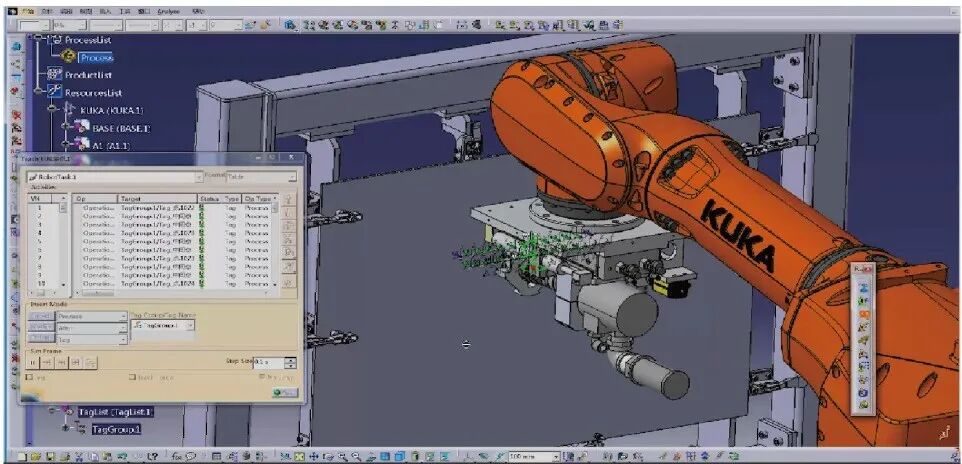
Image source / Enterprise
On the software side, the company has self-developed process simulation and human-computer interaction software and process database accumulated over many years, supporting AR/VR guidance and digital twin systems. In addition, the company's fully self-developed 4D production management and quality control system adds a time axis on the basis of 3D space, which can realize traceability of the production process and "rewind" retrieval, and combine machine learning technology to predict risks for massive quality data. According to the introduction, this system can greatly shorten the quality inspection process in the aerospace field, which currently accounts for about 40% of the total production process time.
At the same time, in order to further reduce the application cost of embodied intelligent robots in aerospace assembly scenarios, Feitai has developed the LHVA (Lightweight Hierarchical Vision-Action Model) lightweight model.
Zhang Yilian believes that the existing embodied robot VLA models usually require a large number of samples and high computing power, which are not fully applicable to high-value, low-fault-tolerance scenarios such as aerospace. On the one hand, existing models often need to be trained with visual images, language instructions and robot joint data at the same time, resulting in a large data scale; on the other hand, aerospace customers have high data confidentiality requirements, which require the use of domestic computing power hardware and operating systems, putting forward higher requirements for the computing power efficiency of the model.
Therefore, Feitai has developed a hierarchical lightweight model LHVA based on the characteristics of aerospace production lines. The model collects a small amount of point cloud data through line laser as feature samples, encodes the product contour features and tool pose information, greatly reducing the amount of training data; at the same time, it does not directly train the robot joint motion, but learns the processing trajectory for specific processes, and then executes it combined with classical kinematics algorithms, so as to balance model efficiency and motion accuracy.
This model supports customers to collect data on site for self-training. The "general robot + lightweight model" approach is expected to further reduce the cost of aerospace assembly equipment. According to the introduction, the company has already closed a deal for a "robot dog + robotic arm" order equipped with this model, which is the first embodied intelligent order in the aerospace assembly field.
In terms of market space, the global aerospace assembly robot market size exceeded 240 billion yuan in 2024, the domestic market size was about 62 billion yuan, and the CAGR of the Chinese market reached 17.9%, higher than the global average growth rate of 14.2%. With the continuous improvement of the automation rate requirements of the aviation industry, Feitai is expected to realize large-scale replication of manufacturing solutions through standardized robot products and production line capabilities. The company estimates that its order amount in 2026 will exceed 150 million yuan, and its revenue will exceed 100 million yuan.
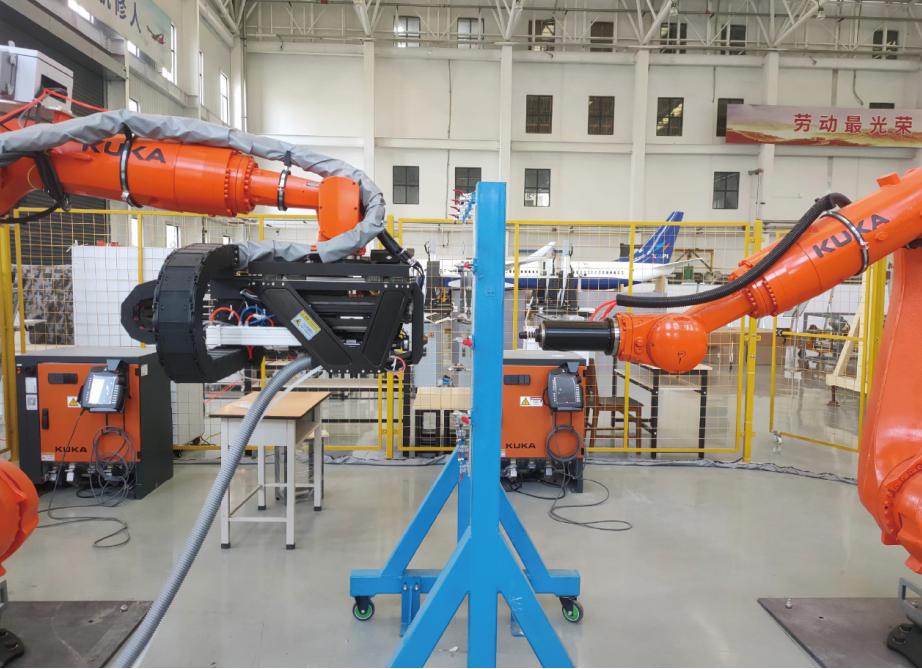
Image source / Enterprise
Apart from the aviation sector, Feitai has also started to deploy commercial aerospace manufacturing. Facing the growing manufacturing demand for rockets, satellites and other products, the company is exploring the standardized production of rocket and satellite components, and extending its capabilities in aerospace assembly robots and digital intelligent production line planning and construction to the commercial aerospace sector.
The following is an excerpt of the communication between 36Kr and Feitai founder Zhang Yilian:
36Kr: Structural parts in the aviation field are generally large. What is your consideration for the company's robot products to focus on "miniaturization"?
Zhang Yilian: In the past, large special machine tools were used for processing aircraft and rocket parts, and the equipment needed to match the product size, with a single unit costing tens of millions of yuan. Later, robots began to be used for replacement, but in order to cover large components, it was still necessary to add columns, lifting platforms and AGV moving chassis. The whole set of equipment could weigh more than ten tons, imported equipment cost 30 to 40 million yuan, and even the domesticated version cost more than 10 million yuan.
We are taking a different route now, developing miniaturized mobile robots. Our robot body weighs only 40 kg, the end effector weighs about 10 kg, covers an area of 1m × 1m, and the price is about one-tenth of the original large equipment. It has a longer arm span and higher load capacity than humans, can replace manual labor to complete assembly, and can also work collaboratively through multiple robots.
In the past, large equipment was inconvenient to move and expensive, so automation could usually only cover about 10% of the processes. What we are targeting is actually the market that used to be 90% completed by manual labor, and the demand in this part is very large. One miniaturized robot can replace two or three people. Calculated at the current equipment price, the investment cost can be recovered in about two years, which greatly improves the return on investment for manufacturers.
36Kr: Why do you want to further develop embodied intelligence models?
Zhang Yilian: The development of embodied models is related to our development path. The general equipment we are producing now may cost more than one million yuan per unit. In the future, we hope to use general robots equipped with our own lightweight models, so that customers can collect data and train by themselves. After the model is mounted on the general robot body, the equipment cost can be further reduced. At present, this model platform has been developed, and a set of "robot dog + robotic arm" embodied intelligent equipment has been sold, which is the first embodied intelligent order in the entire aviation field.
36Kr: What adaptive designs has the LHVA model made for aerospace assembly?
Zhang Yilian: Current VLA models generally train visual images, language instructions and robot joint data together, with a very large sample size. In addition, the errors generated by the robot body and the vision system will be continuously iterated, resulting in a final motion accuracy of only 30%-40%. This method cannot be directly applied to our industry. In addition, aerospace customers have data confidentiality requirements, can only use domestic computers and operating systems, cannot use NVIDIA GPUs, and have relatively limited computing power.
Therefore, we developed the hierarchical lightweight model LHVA, removing the language part and adopting hierarchical training. The training samples are also very small. We use line laser to collect a small amount of point cloud data, extract only several product contour features, plus 6 coordinate values of the tool pose, and one sample is only a few KB. For example, when manual gluing is performed, data can be collected and trained on site, and it can run on domestic hardware.
At the same time, we do not train the robot's joint data, but train the process trajectory. That is to say, for different product features, we learn what kind of gluing method to adopt, finally get the process path, and then execute it through the classical kinematics algorithm. This can not only reduce the data volume and computing power requirements for model training, but also ensure the accuracy and reliability of trajectory execution.