As AI enters the physical world, why did JD Logistics choose a "non-sexy" path?
In the 1990s, Denver International Airport once aimed to build a futuristic airport.
The most ambitious part of their plan was to completely eliminate manual handling of luggage: starting from the check-in counter, automated shuttles would travel at high speed along underground tracks to deliver luggage directly to the corresponding flights.
However, the future did not arrive as scheduled, and instead turned into a nightmare for the airport.
Luggage was sent to wrong destinations, shuttles jammed the tracks, and parcels were crushed and damaged. The opening of the airport was delayed by a full 16 months, and the airport paid more than 1 million US dollars in interest and maintenance fees every day for an idling facility.
Nearly 30 years later, the same story repeated at Tesla's Fremont Factory.
In 2018, the Tesla team designed a complex robot equipped with a vision system to place a soft fiberglass pad on top of the battery pack. But the robot often failed to grasp the pad or placed it in the wrong position, dragging down the entire production line. Elon Musk then raised a more fundamental question: is this pad even necessary? Comparative tests showed that installing or removing the pad made no difference to the in-vehicle noise level.
The two stories separated by nearly three decades share the same core: when the evolution of a single unit or single thread cannot match the pace of the entire system, even the most advanced technology will become a burden. The more capable machines are, the more efficient production will not necessarily be.
Today, similar fanaticism is repeating in the field of embodied intelligence. According to data from IT Juzi, in the first half of 2026, there were 322 financing events in China's embodied intelligence sector, with a total amount of about 935 billion yuan, 5 times that of the same period last year. However, most of the most eye-catching stories in the robotics industry take place in laboratories and demo scenes. In a strictly controlled stable environment, robots can fold clothes, cook, and work in factories, and their progress seems very rapid.
Few people have calculated this account: how big is the gap between the efficiency and reliability requirements of demo scenarios, household scenarios, and industrial-grade scenarios? When the task base increases from dozens of times to 550 million times a day, and when the environment changes from a booth with stable lighting to a warehouse with tens of millions of SKUs, countless irregularly shaped parcels, and people walking around at any time, how much persuasiveness do those carefully arranged demos retain?
How far is Physical AI from the "singularity" of real implementation?
Logistics: The Training Ground That Pulls Physical AI Back to Reality
At the 2026 World Robot Conference, parcel sorting and bin handling have almost become the most crowded exhibition tracks for embodied intelligence. More than a dozen humanoid robots sort express parcels in perfect unison, and many visitors joked that "there are too many robots, not enough express parcels to go around".
The bustle is real, but most of these scenarios are scattered, fragmented, and unconnected: a robot completes a perfect sorting action on the booth, which is just a drop in the bucket compared to the astronomical level of system complexity in the real-world logistics industry.
The real logistics environment poses high-density and high-intensity practical challenges to Physical AI.
Do you know how many express parcels are on the way in China every day? According to data from the State Post Bureau and CCTV Finance, in the first half of 2026, the average daily express business volume in China was about 550 million pieces, and during major promotion periods such as the 618 shopping festival, the maximum daily business volume could reach 777 million pieces. Behind the 550 million parcels are 550 million times of collection, transportation, sorting, and delivery. Under such high-frequency physical actions, the fault tolerance rate is compressed to the extreme.
At the same time, the complexity of the logistics industry far exceeds people's imagination.
Take JD Logistics, which integrates warehousing, supply chain and distribution, as an example. According to financial report data, as of June 2026, the total managed area of JD Logistics' warehousing network exceeded 36 million square meters, equivalent to about 5,000 standard football fields. More than 70,000 self-operated transport vehicles, 13 self-owned full cargo planes, more than 600,000 self-owned distribution operators, and over 19,000 distribution stations and outlets are operating across this network.
Meanwhile, the scenarios it covers are also extremely complex, including islands, villages, cities, and cross-border overseas markets. The problems to be solved in different situations are completely different, with a high degree of non-standardization. Hundreds of thousands of couriers need to rely on manpower and hard work to support this huge system, which is in urgent need of efficiency improvement brought by Physical AI.
The logistics industry did not start its automation transformation in this wave of Physical AI boom. As early as more than a decade ago, the logistics industry successively introduced conveyor lines, sorting machines, and handling robots, gradually completing 80% of the most easily standardized and most easily automated parts of the work.
The remaining 20% is the real "hard nut to crack".
For example, in links such as commodity picking and non-standard parcel stacking, the shape of items and operating environment are constantly changing. If a robotic arm grasps a parcel incorrectly, an unmanned vehicle hits an obstacle, or a robot picks up the wrong commodity, it will immediately affect the subsequent fulfillment links. Warehouses themselves rarely maintain an ideal state: there may be hundreds of thousands of SKUs in one warehouse, the placement posture of the same commodity is not fixed, cartons may deform, soft packages may slip, and temporarily added shelves and floor stacks will change the original moving routes. Order fluctuations further increase the operational difficulty: if robots are configured according to peak demand, a large number of devices may be idle in normal times; if the configuration only covers daily order volume, manual backup is needed for peak periods.
All these non-standard problems stack up one by one, forming black holes that stand in the way of Physical AI implementation, delaying the arrival of the singularity.
The industry is not standing still. A large number of embodied intelligence enterprises have flooded into the logistics industry as a clear proof. For example, Starway Dynamics announced that it has entered more than ten logistics centers of SF Express and China Post, targeting links such as parcel supply and sorting; Jiushi Intelligence cooperated with Cainiao to form an unmanned fleet, targeting the transportation link; Sainard's autonomous loading and unloading robot focuses on links such as autonomous unloading, code scanning, and palletizing.
Beyond all these players, JD Logistics also provides an excellent observation sample.
As we all know, due to its long-term direct operation of warehousing, distribution and supply chain, JD Logistics' labor, warehousing network and equipment are all directly included in its cost structure. This means that every 1 percentage point increase in efficiency in each turnover link can theoretically directly contribute to its profit statement, which is an internal ROI verification field with extremely strong driving force.
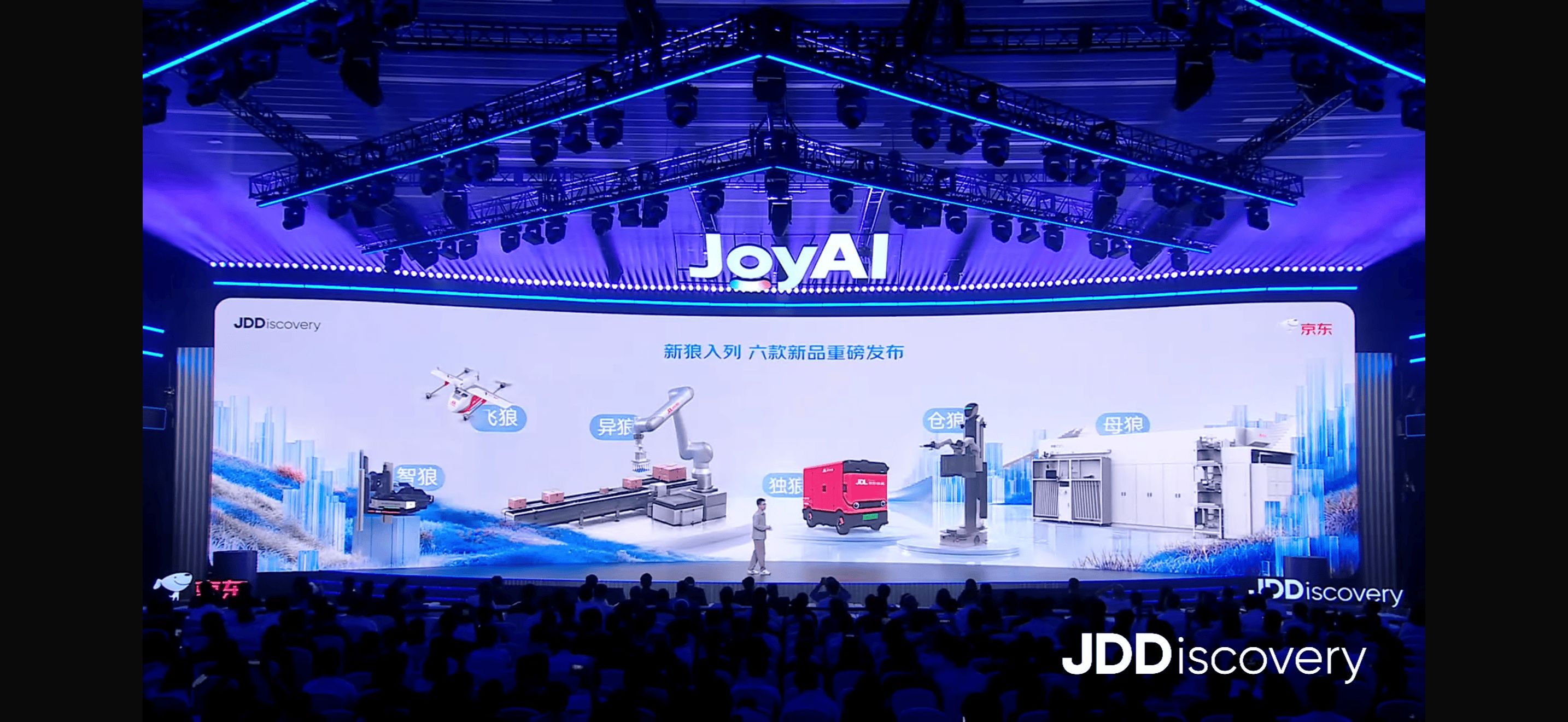
Not long ago, on September 9th, at the JDD JD Global Discovery Conference, JD Logistics exhibited its self-developed industrial-grade large model "Super Brain 3.0", and intensively released and upgraded a number of new products including Yilang, low-temperature version of Zhilang, Canglang, health version of Mulang, Dulang 6th Generation Plus, and Feilang L05, upgrading the entire "Wolf Clan" robot system to 9 categories and 11 robots, covering all storage, handling and sorting links in the entire logistics industry chain, which seems to be the perfect answer for Physical AI to enter the real world. But is that really the case?
To understand this entire system, we might as well start with the journey of a parcel.
The Journey of a Parcel
Imagine a scenario: you are browsing products in the JD APP, and even before you click pay, you just drag the product into the shopping cart, the entire JD Logistics system has already started operating.
"Super Brain 3.0" intervenes first: it predicts orders, analyzes inventory, plans routes, and then sends instructions to every device and every person distributed in warehouses, vehicles and distribution stations, just like the brain sending commands to the nervous system.
If we compare this "Super Brain + Wolf Clan" system to a human being, "Super Brain" is its brain, and the "Wolf Clan" robots are its torso and limbs. The brain is responsible for thinking, predicting orders, planning routes, and scheduling resources; the torso and limbs are responsible for execution, including picking, selecting, stacking, and transferring.
JD Logistics is one of the pioneers in the field of intelligent warehousing in China. As early as 2016, JD Logistics built the first batch of unmanned warehouses in the industry, and then gradually tested equipment such as "Dilang" AGV, "Tianlang" pallet robot, and "Nephew Wolf" sorting wall; in 2023, JD Logistics launched the "Zhilang" goods-to-person system, together with "Feilang" drones, forming the "Wolf Clan" robot legion.
From the underlying naming logic of the "Wolf Clan" robots, we can see that JD Logistics has emphasized not "individual combat" from the very beginning, but imitating the biological characteristics of wolves fighting in groups, so that robots form cluster collaboration in all links of the supply chain. Under the scheduling of "Super Brain", different robots undertake different links of warehousing, picking, handling and distribution, and the value generated by linkage collaboration is far greater than the sum of the work of each robot operating alone.
After "Super Brain 3.0" sends out the instructions, the torso and limbs respond immediately. Next, this product needs to be found, taken out, handled, sorted, transported, and finally delivered to the consumer.
The first step is to take the product out of the warehouse.
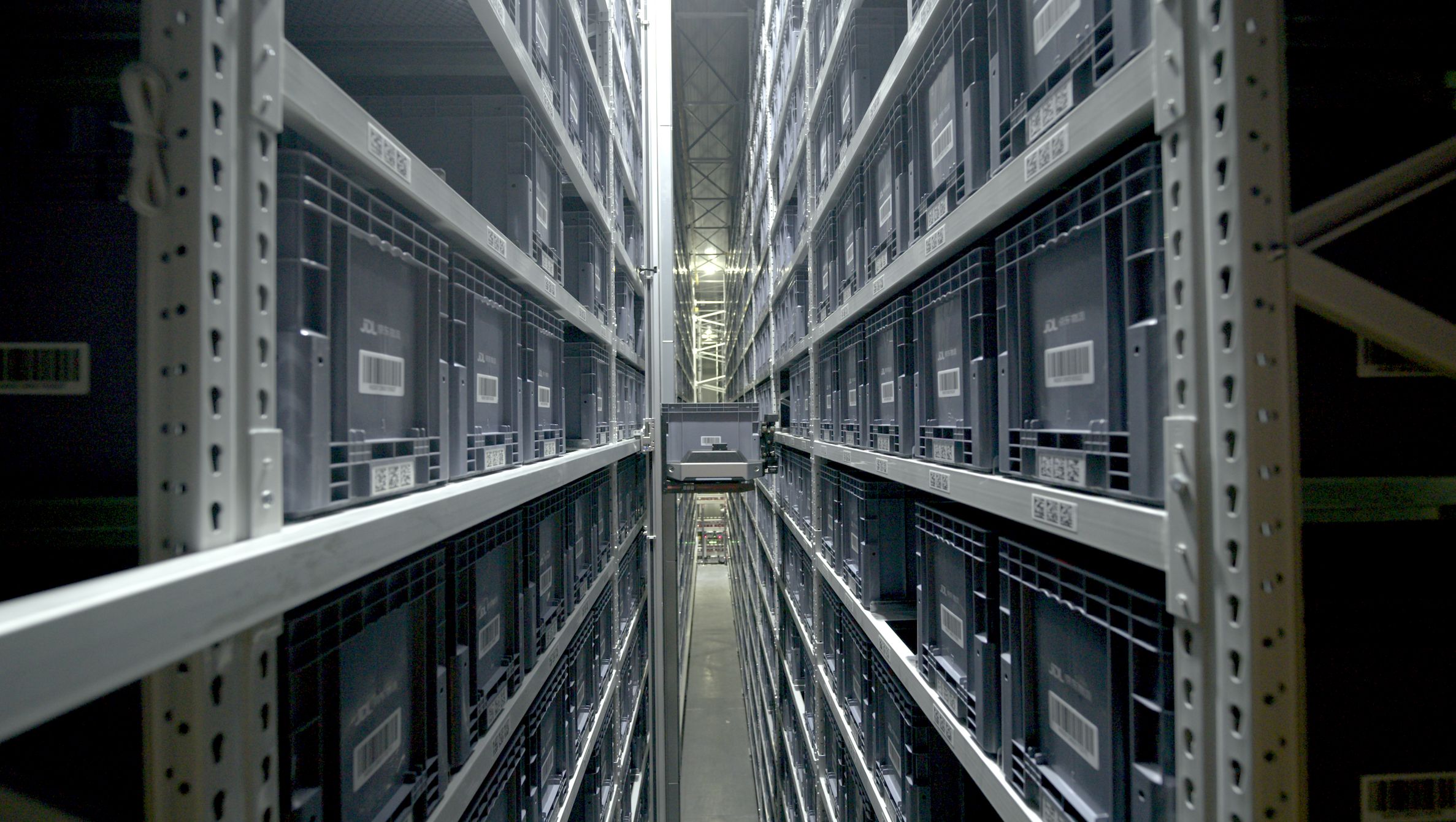
In the past, pickers had to walk 30,000 to 40,000 steps a day in the warehouse, running back and forth to find all the products of an order from different storage locations. The emergence of Zhilang has changed this. As the "relay runner" in the warehouse, the "Zhilang" robot lifts and lowers along the three-dimensional shelves to pick up bins, while the ground shuttles are responsible for handling. The two types of equipment are decoupled and perform their respective duties. Its biggest advantage is that it can make full use of a 12-meter clear height for storage, while most of the goods-to-person products in the industry can only use a clear height of 3 to 5 meters.
In terms of "cost accounting", JD Logistics' R&D team revealed to 36Kr that the team reversed the unit cost and R&D plan through order volume, rent, floor efficiency and labor efficiency, and compressed the payback period of "Zhilang" to two years. In the capital-intensive industry, a two-year payback period is almost astonishingly fast. The usual requirement for automation equipment in the logistics industry is three years, and JD Logistics has directly increased the speed by 1/3. According to data from JD Logistics, the Zhilang system currently supports nearly one million order fulfillments per day internally, and has been put into operation in overseas warehouses in the UK and Germany.
By the way, there is also a "freeze-resistant warrior" in the JD Zhilang family. At the JDD JD Global Discovery Conference on September 9, the new "low-temperature version of Zhilang" was unveiled, which is mainly targeted at cold chain scenarios. Cold storage warehouses are at minus 20 degrees Celsius all year round. Workers wear thick cotton-padded clothes to work inside, their efficiency is less than half of that in normal temperature warehouses, and the employee turnover rate remains high. The low-temperature version of Zhilang brings bin storage into cold storage: the materials are pre-shrunk and compensated, the power supply adopts a non-contact wireless solution, and workers pick goods in the refrigerated area with efficiency close to that of normal temperature warehouses, completely isolated from the cold operation area - people no longer need to enter the freezing warehouse.
But what if the products are stored in ordinary manual shelves, old warehouses, or leased warehouses? This is a larger stock market. The premise of traditional automation transformation is often to "transform the warehouse into a form that robots like", for example, stop production for 6 months, modify shelves, divide roadways, and move storage locations. The vast majority of small warehouses, old warehouses and aged warehouses cannot afford such costs, and the "cost accounting" is not worthwhile.
This is when "Canglang" enters the scene. Canglang is the "picker" in the roadway. It drives directly into the existing warehouse, identifies products in the narrow roadway, and stretches its arm to grasp them. Relying on its autonomous mapping capability, Canglang can quickly generate an environment map after driving into the warehouse; it can also take into account the inspection and inventory tasks, and automatically check the shelf products during the picking gap. There is no need to modify the shelves or require the warehouse to adapt to the robot. The robot drives directly into the manually operated warehouse, and independently picks goods in the narrow roadway. The deployment can be completed in 2 weeks, the product coverage rate of the entire warehouse exceeds 85%, the picking accuracy rate is 99.9%, and the comprehensive picking efficiency is 80 pieces per hour. Don't underestimate the data of 80 pieces. Although it is still not as good as the best human pickers, it gives the stock warehouses that were forgotten by automation in the past the qualification to participate in intelligent transformation for the first time.
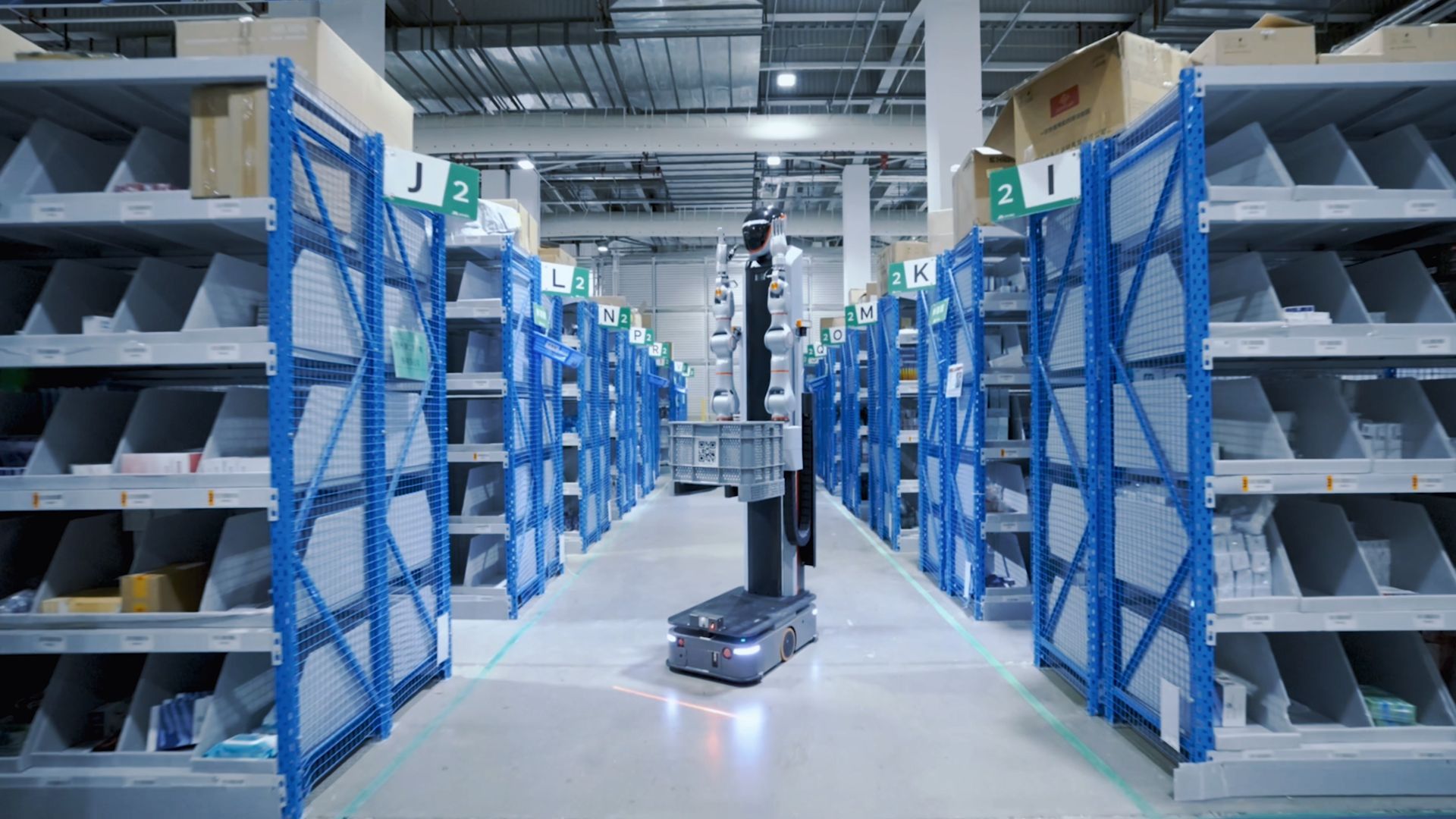
More importantly, cooperating with "Super Brain 3.0", "Canglang" can be compatible with the original manual operation. Robots deployed undertake tasks during off-peak periods, and when there is a production peak such as promotion events, the system uniformly plans the moving routes of people and machines at the upstream, so that the same SKU can be sorted by both machine and human, truly bringing Physical AI into the warehouse.
After the products are picked and packed, they need to be sorted according to their destinations. We now arrive at the sorting yard of "Yilang".
This is the hardest, most tiring, and most likely link where machines get "stuck" in the entire chain. In the sorting yard, a skilled stacker has to bend down thousands of times a day to move parcels of different shapes into cage carts. Traditional robotic arms are almost powerless against soft woven bags, bulging air column bags, and irregular special-shaped items, which is the "non-standard problem" that global automation companies cannot avoid.
At this point, "Yilang" takes over. Equipped with an industrial dexterous hand, Yilang is the coolest "stacker" on the entire assembly line. The R&D team told 36Kr that before starting work, Yilang can obtain the order time, outbound warehouse, and destination of this parcel from JD Logistics' internal "brain", and judge its size, material, and distribution destination in real time.
