Just now, Claude has become the sole access point! The super "full-stack office suite" is taking on Microsoft head-on.
As of today, Claude has officially completed its epic unification!
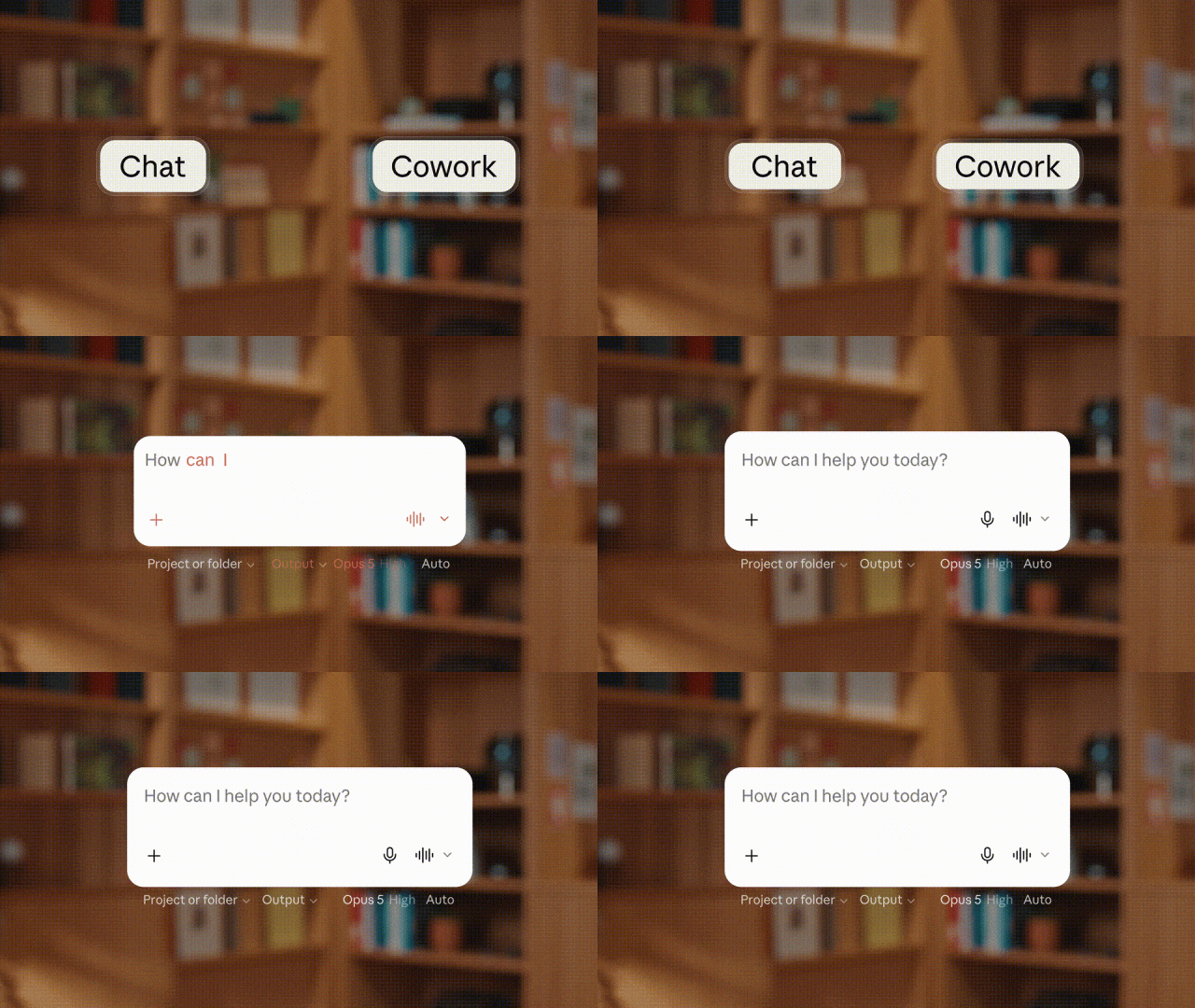
Anthropic just announced that Claude Cowork and Chat have been fully merged, leaving only one single unified "Claude" entry going forward.
From now on, no one will ever have to wonder whether a task should be sent to Chat or handed over to Cowork.
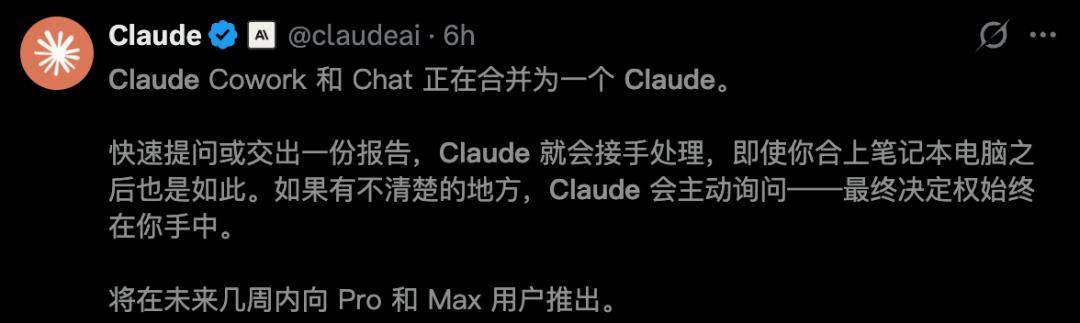
Throw it a tiny casual question, it handles it; hand it a heavyweight report that would take you hours to polish, pass it directly to it.
You only need to open the new version of Claude to access all the capabilities of Cowork, Design, Docs, and Slides.
Claude's full office suite has finally been fully integrated this time.
Most importantly, all your accumulated historical conversations, Skills and connectors are all preserved, nothing is lost at all.
After receiving a task, Claude will independently judge the complexity of the task and invoke the corresponding capabilities.
Close your laptop and leave, Claude can keep working on the task.



However, you will need to wait a little longer: the unified version of Claude will be rolled out to Pro and Max subscribers in the coming weeks.
The Ultimate Unification of Claude
The True All-In-One Office Suite Is Here
The most disruptive part of this evolution is that it completely breaks the traditional human-computer interaction model.
In the past, people got used to the pattern of "you ask one question, the AI gives one answer, you close your computer, all progress is cleared".
But this has brought a new gap: there are more and more separate entries --
You turn to Chat for Q&A, launch Cowork for complex tasks, switch to Design for visual creation, and open another tool to make presentations.
However, real work is never divided strictly according to product functions.
A business analysis report may require multiple operations at the same time: collecting information, analyzing data, writing documents, making presentation slides, designing visual elements, and making repeated revisions based on feedback. It naturally spans multiple AI capabilities.
Many users have reported that they are often troubled by having to judge which workspace a task belongs to!
Therefore, Anthropic decided to eliminate this choice entirely.
Now, no matter if you just throw out a vague small request casually, or directly hand over a full dozens-of-page complex business report to it, Claude can take over fully autonomously and keep advancing the task in the background even after you close your laptop and turn off the screen.
Word, PPT, Design Software
All Integrated Into Claude
Strictly speaking, Cowork has not disappeared.
All the capabilities it originally undertook have been integrated into the main Claude entry.
The past model was: Claude Chat is responsible for answering questions; Claude Cowork is responsible for executing complex tasks; Claude Design is responsible for visual creation.
Now, Claude uses one unified entry to let the AI independently judge the task requirements, whether it needs Chat, Cowork, Design, or documents, spreadsheets and PPT functions.
The fewer judgments left to humans, the higher the quality of the delivered outcomes.
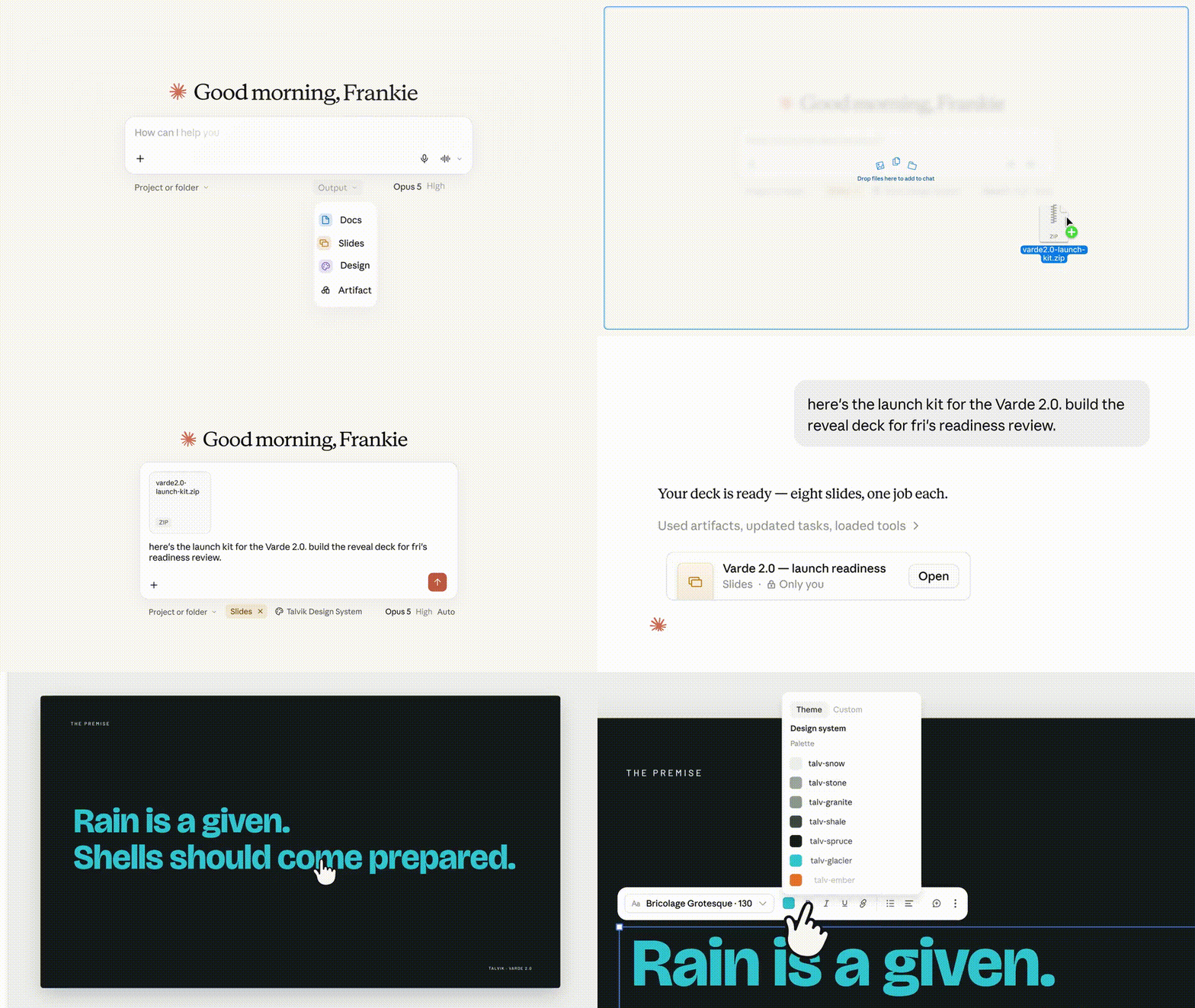
What's even more impressive is that Claude's conversation interface has now directly evolved into a one-stop native "creative factory".
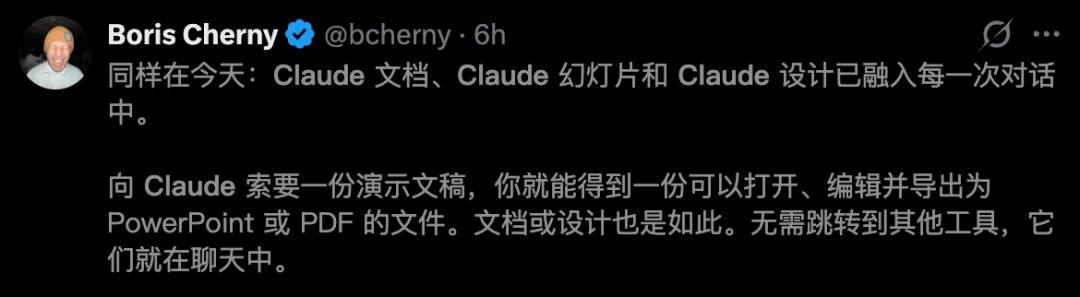
You don't need to jump between different software at all, you can complete typesetting, slide production and visual design directly in the chat box:
Claude Docs: Supports quick drafting of one-page proposals or full-length documents;
Claude Slides: Can convert the newly written document into well-structured presentation slides with one click;
Claude Design: Can seamlessly generate matching visual drafts and interface prototypes in the same workspace.
On the surface, this is Anthropic adding more office functions, but the deeper change is: Claude is starting to transform from an "answer window" to an "outcome workspace".
The previous traditional AI interaction model was: user asks a question -> AI outputs text -> user copies the text to other software.
Now, the interaction model of the brand new Claude has become: user puts forward a goal -> AI creates a document -> AI makes a presentation -> AI generates designs.
All content maintains the same consistent context.

The interaction granularity is even as precise as pixel level --
You can either modify a certain line of text in the document personally, or leave a comment on a certain page of the PPT for Claude to rewrite it, or directly select a certain design element with the mouse to drag and adjust it at will.
When everything is ready, you can directly present the slides from Claude, export the document in your commonly used format, or share all content through a single link.
This is actually a full Harness refactoring.
For example, before you go out now, you can ask Claude what progress has been made in the business pipeline last week, and then add: "Write it in our usual format, mark all delayed items, and organize the key points into five slides for the leadership meeting."
If there is anything unclear, Claude will take the initiative to ask you.
On your way to the office, you can check the progress on your mobile phone. The moment you sit down, the report document is ready, with comments from your colleagues included, and the PPT can be opened directly.
Moreover, since both are generated from the same conversation, the PPT content is completely consistent with the report.
In addition, you can set it to execute automatically every Monday, and Claude will write the report on its own without you reminding it!
OpenAI, Anthropic, Google
Competing For The Super Entry
This adjustment of Claude also reflects that AI giants are moving towards a similar direction.
OpenAI wants ChatGPT to become the unified entry, integrating Codex, so that chat, coding, research and Agent functions all revolve around ChatGPT.
Anthropic's path is even more obvious: to make Claude an AI assistant that can perform work tasks for a long time.
Google is trying to deeply embed Gemini into its existing ecosystem such as Gmail, Docs and Workspace.
The three companies have different routes, but similar goals: to compete for the new operating system entry in the AI era.
The large-scale integration of Doubao's resources in China may also follow a similar line of thinking.
Fewer Buttons, More Intelligence
In the past, software competition was about who had more functions, who provided more tools, and who had more entries.
But the AI era may be completely the opposite: the best product may show users the fewest options.
Why does this change happen? Because the complexity is absorbed by the AI.
Users only need to say: "Complete this goal."
The remaining questions: what tool to invoke? How to break down the task? When to ask the user for feedback? When to continue execution?
All of these can be handled by the AI on its own.
Most users only use the Chat function, wasting the powerful Agent capabilities of independent modules such as Cowork and Design.
The integration of Claude Cowork into Chat is not a simple product merger.
The signal it sends is: Agent is evolving from a special feature to the basic architecture of AI products.
The competition between AI assistants in the future is by no means only the competition of model capabilities, but also the competition of who can build a more powerful Harness, so that the same model can truly be embedded into human work processes.
References:
https://claude.com/blog/cowork-is-now-claude
This article is from WeChat official account "AI Era" (ID: AI_era), edited by Ma Ke, Taozi and Aeneas, published with authorization from 36Kr.