Most high-paying skills will lose their value within 10 years, just learn these four.
Shen Translation Bureau is a translation team under 36Kr, focusing on technology, business, workplace, life and other fields, with a focus on introducing new technologies, new perspectives and new trends from abroad.
Editor's Note: The code premium has dropped to zero, and the decent life earned by working has completely collapsed. When AI takes over all execution tasks, there are only two paths left in the future world: either eke out a living on relief, or build your own billion-dollar unicorn all by yourself. This article is translated and compiled.
"In the next 2 to 5 years, AI will replace 50% of white-collar jobs."
—— Dario Amodei, CEO of Anthropic
I am genuinely terrified.
I am forced to face up to exactly how powerful AI has evolved today.
I also know very well that many people have heard such arguments so many times that they are tired of them, and even start to selectively ignore and no longer pay attention to them.
But this time, the situation has changed completely.
Software engineers are outsourcing all their work to AI; ordinary people who know nothing about programming are starting tech startups worth millions of dollars from scratch; accountants are being replaced by AI in batches.
This raises a core question: "So what should we do?"
If AI can write any code, develop any software, solve any difficult math problem, and create any work of art, what else can we humans do?
If human society was originally built around work and the identity that work gives, what kind of drastic changes will this social structure undergo?
When humans have nothing to do, how can we find the meaning of life?
After all, the self-worth and sense of identity of the vast majority of people are deeply rooted in the jobs they do.
And this is exactly the core I want to discuss with you today.
Why today's AI is completely different from what it was three or four years ago (and why you must take it seriously, right now, immediately!).
The positions that are being replaced now (those white-collar professions that we once thought could never be replaced but are now the first to bear the brunt), and why the once high-paying skills are turning into nothing.
Next, I will analyze the six major dimensions that humans use to build the meaning of life.
Finally, we will sort out 4 core skills that can make you invincible in the future.
Let's get down to business.
Why AI Today Is Different
We first came into contact with AI around 2021 to 2022.
At that time, ChatGPT had just come out, and most people saw it as nothing more than a novel gimmick.
It would confidently talk nonsense, make mistakes frequently, and its overall performance was not very smart (at least ordinary users had no idea how to use it effectively).
But in the world of AI, four years is a lifetime away.
To really understand this, you have to see the amazing technological chasm we have crossed in the past few years.
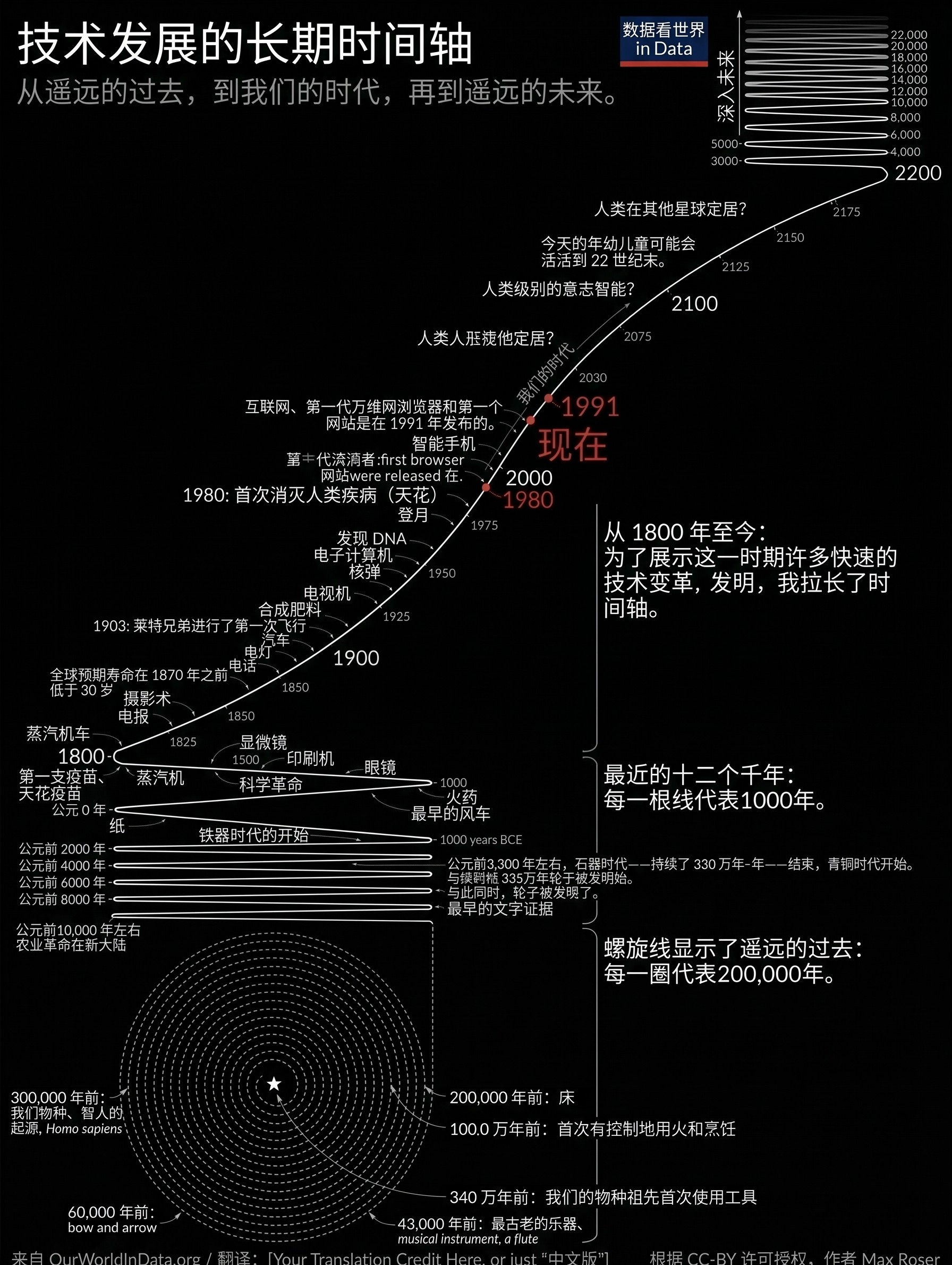
Data source: ourworldindata
2018: GPT-1 completes basic natural language tasks
2020: GPT-3 reaches high school level logical reasoning ability
2022: GPT-4 ranks in the top 10% of test takers in exams such as SAT, LSAT and physician licensing exams
2025: GPT-5 wins the gold medal at the International Mathematical Olympiad (IMO)
What is truly spine-chilling is what happened in February 2026. OpenAI, the creator of ChatGPT, released its new generation model ChatGPT 5.3 Codex, and made the following statement at the time of release:

Source: Official OpenAI Documentation
This is the first time in human history that we have witnessed an AI model achieving self-iterative development.
Jensen Huang, CEO of NVIDIA, predicted as early as 2024:
"The programming language of the future is the native language of human beings."
—— Jensen Huang, CEO of NVIDIA
If AI is already so smart, why bother learning to code? Isn't it possible to program directly in everyday English, Chinese, German, or any of your native languages?
With the current leap in intelligence of AI models, this vision has finally become a reality.
Nowadays, software engineers are handing over all their work to AI for processing. This is completely reasonable.
AI writes code faster than humans, makes fewer mistakes, remembers more system details than any engineer, and the marginal cost of generating code is almost zero.
This is exactly the huge change that the programming industry is going through now. We have witnessed the full explosion of "Vibe Coders" — a group of people who know nothing about underlying code or technical architecture, but as long as they have a product idea and describe it clearly to AI in plain language, AI can handle all the technical implementation.
The market size of the "Vibe Coding" industry has reached 3 billion US dollars, and experts predict that this figure will climb to 30 billion US dollars in the next 6 years.
As a pure skill, the premium of "typing code" has been completely shattered. What is now rapidly increasing in value is marketing ability — that is, how to bring products to a larger audience. Technology companies are drastically cutting R&D budgets and instead investing heavily in marketing and public relations. Because their growth bottleneck is no longer production capacity or technical implementation, but the competition for real users.
To be honest, I now rely entirely on AI even for writing papers: extracting core viewpoints, discovering insights I missed, and even generating the supporting code.
Even 80% of the content of my last long post was written by AI.
When I was running, an idea and a general outline popped into my head, I sent a few concise instructions to AI, and the first draft was done in two minutes. Then I only spent 30 minutes polishing it (purely because I have a perfectionist tendency).
"Will AI replace humans" is no longer a question, the only thing left undecided is how fast it will replace humans.
The Turbulence Brought by AI Is Not Unprecedented in History
"It won't be AI that eliminates you, but people who know how to make good use of AI."
—— Jensen Huang, CEO of NVIDIA
What is happening now is by no means a brand new thing that has never happened before, it is just another recurrence of the wheel of human history.
When the movable type printing press was invented, the copying monks in the monasteries — those masters who made a living copying books by hand to preserve documents — were the first to be eliminated by history. They had undergone years of rigorous skill training, and their profession had high social prestige at that time. However, once the printing press became popular, their skills depreciated instantly; the heavy work that used to take months to complete could be copied in seconds.
The same is true for the advent of harvesters, threshers and modern mechanical plows. They swept away the labor force in the fields with overwhelming force, and the farm work that used to require dozens of people to complete together can now be easily done by a few people.
When the Industrial Revolution came, the same script played out again: humans were ruthlessly replaced by tireless machines — these steel creatures never took leave, never asked for a raise, and never complained about overloading.
Today, this historical cycle has come to AI. The replacement of human labor by technology is unfolding in all directions.
Customer service and call center agents: AI chatbots process massive amounts of business at a marginal cost close to zero;
Data entry and administrative clerks: highly repetitive, with very low resistance to automation;
Paralegals and legal researchers: AI reviews contract documents and case law faster and at lower cost;
Junior analysts and financial specialists: pattern recognition and automated research report generation have always been AI's absolute strengths;
Radiologists and medical imaging diagnostic experts: in the accuracy of medical image reading, AI has been equal to or even surpassed human specialists;
Copywriters and content creators: generative AI is mass-producing high-quality images, texts and videos on an assembly line.
Technology has always replaced humans, and it always will. This is an inseparable part of human evolution. As long as there are trivial things we hate in the world, humans will inevitably find ways to outsource or automate them.
This is our nature: we are essentially problem solvers.
However, when I conducted in-depth research on this topic, I realized another point: human resilience is unbelievably strong beyond imagination.
It is true that half of white-collar jobs are facing reshuffling. But looking back at the past, we have always been able to find a way out in the crisis, and this time will be no exception.
If there is any inevitable rule, it is: technology will always empower only those who have a high degree of autonomy.
These people can set their own goals, break down problems independently, and never rely on the charity of others to get what they need.
AI will become the supreme leverage for these highly autonomous individuals, multiplying their productivity, helping them create freely, think deeply, and overcome interesting and creative challenges that were previously impossible to reach.
Purely technical execution work is receding at an accelerating pace.
Nowadays, blindly being a "single-skill specialist" has greatly diluted its value.
Where Will Human Society Go When Labor Loses Its Traditional Meaning
There is a huge logical loophole in the popular "AI endgame narrative" nowadays.
Let's quickly sort out this common narrative that is unfolding:
Humans invented technology;
Technology makes work easier;
Humans have more ample time to develop more advanced technology;
Eventually, humans created AI;
AI begins to take over the underlying administrative trivialities;
AI evolves smart enough to take over high-level cognitive work;
Humans are completely replaced by AI;
AI takes over all production labor, and all human beings are completely unemployed.
The whole narrative stops here.
As if "all humans lose their jobs" is the final ending.
However, if you look closely, you will find that this narrative is missing the follow-up at the most critical turning point.
What will happen after humans are completely replaced? How do we survive? How will the country and the economic system continue to operate?
After all, the foundation for the modern economy to grow like a snowball is that residents have purchasing power. If there are no jobs at all, where will the public get their income from?
My judgment is that the future society will inevitably divide into two camps:
Camp 1: Highly sovereign independent individuals, who independently set their own goals and create the vast majority of the wealth of the whole society;
Camp 2: The general public, whose livelihoods depend entirely on the Universal Basic Income (UBI) issued by the government.
However, the fatal point is that people in the second camp will completely lose their subjective initiative. They have no say in how to spend the rest of their lives, what kind of work to do, and what kind of pursuits to achieve, because they can no longer support themselves. Being in the second camp sounds like a paradise of getting something for nothing, until you suddenly realize that the UBI system will never really serve your core interests. Because this system is not supported by you, the payer behind it is the first camp (they contribute the vast majority of taxes).
When your entire life and destiny are completely in the hands of others, the other party has absolute dominion over you, and you have no choice but to obey.
If you don't set goals for yourself today, you will be forced to implant goals customized by others in the future, and believe in them deeply.
If you don't take the initiative to solve your own problems, you will become a tool that others assign to solve problems.
If you don't build your own life rhythm, the system will impose a fixed operating track on you.
If you don't know your own direction at all, someone will naturally step forward to order you around.
The real world always adheres to the cold law of efficiency.
This system will never leave a place for "useless people".
Once you decide that you are useless, others will not hesitate to step in and squeeze you into resources that are beneficial to them.
Six Stages of Life
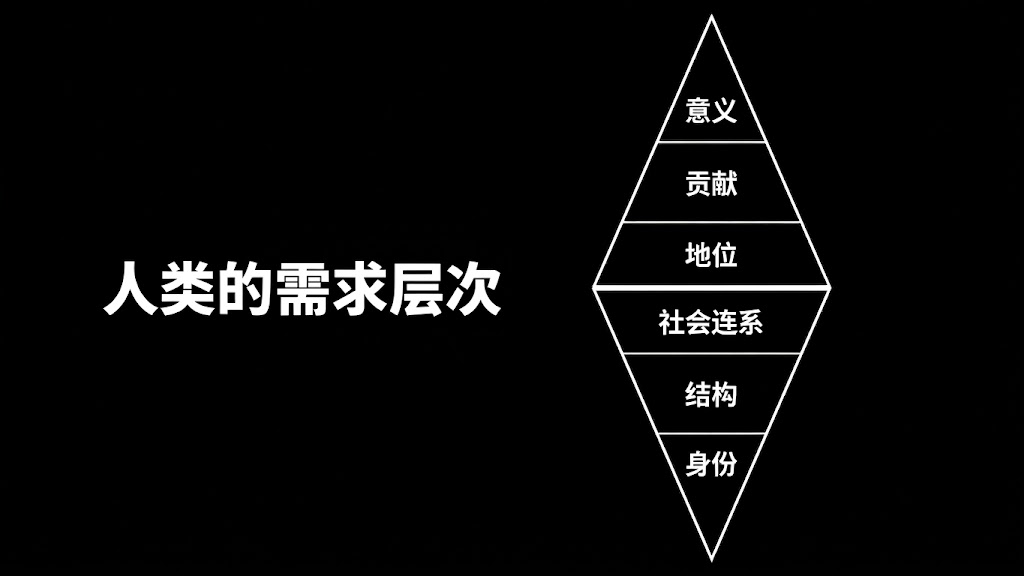
The traditional 9-to-5 work is not all bad.
For most people, going to work regularly is still the most stable and logical way to survive. It precisely supports the six dimensions that are indispensable for building a fulfilling life:
1) Identity
When you ask others "Who are you?" or "What do you do?", almost everyone's first reaction is to report their occupation to make a living:
Engineers, artists, doctors, lawyers, accountants.
Their self-identity is completely anchored in their profession. Work has become the core coordinate for you to look at yourself and for society to define you.
2) Life Order
Although it is a bit sad, work does give the public a regular work and rest structure: 9-to-5, five days a week, two days off, repeating for forty years. Everyone needs some kind of order. For most people, it is the above regular track; for a few people, their order may be to break the rules. In any case, life order can straighten out your thinking, daily life and vision, sort out the priorities of your schedule, and let you always have something to look forward to and something to do. However, the pain point is: the vast majority of people do