Candidates are poached midway and positions remain vacant for a long time: What do those top leading talents that AI pharmaceutical companies cannot poach look like?
Recently, a piece of news that a leading internet giant offered a daily salary of 5,000 yuan to a post-2000s algorithm intern and an annual salary of 3 million yuan after they graduate and become a full-time employee has left workers across all industries astounded. In an era where high hopes are placed on intelligent technology, it seems no myth created by AI is too far-fetched.
The competition for talent in the AI pharmaceutical sector is equally fierce. Last year, the human resources department of a multinational pharmaceutical company posted a recruitment notice for a Principal Scientist of Computational Protein Design, with a maximum annual salary of 256,500 US dollars. But ten months on, the position is still vacant, and the preferred candidate was poached by peers three times in a row. A senior headhunter said that against the backdrop of the AI boom, interdisciplinary talents are in short supply. The annual salary for director-level positions has reached nearly 1.5 million yuan, and the annual salary for heads of AI pharmaceutical R&D even exceeds 2 million yuan, yet the number of vacant positions still far outpaces the number of talents willing to switch jobs.
What kind of talents are the AI pharmaceutical industry struggling to recruit?
When talking about scarce talents in the AI era, people often first think of algorithm engineers. But in the AI pharmaceutical industry, talents who can screen out molecules designed by AI, send them to wet lab verification, and feed experimental results back to the model for iterative optimization are far more difficult to recruit than algorithm engineers. In AI pharmaceutical enterprises, these positions have different names, such as Computational Protein Design Scientist, AI Protein Engineering Scientist, or AI-enabled Structural Biologist. But they are all responsible for the same core task: bridging the last mile of AI pharmaceutical development.
In the past, drug discovery mainly relied on screening, identifying potential molecules that can bind to targets from existing molecular libraries. The disruptive nature of generative AI lies in turning the starting point of new drug development into de novo generation. As a result, the design cost is driven down to nearly zero, but the verification link has become the bottleneck. The number of molecules that can be tested in one wet lab run is far behind the output of the model. To distinguish truly potential molecules from statistically noisy molecules among tens of thousands of candidate molecules, human experience is required for judgment. Based on these judgments, designing experiments for verification and feeding the results back to the model to make the next round of design more accurate also requires human judgment. People who can make such judgments accurately and quickly must have a solid understanding of both AI and pharmaceutical R&D, the so-called interdisciplinary talents. The scarcity of such interdisciplinary talents is exactly the new bottleneck restricting the development of the AI pharmaceutical sector at present.
This type of demand was first written into job recruitment descriptions in 2025.
In early 2025, Moderna posted a recruitment for Principal Scientist of Computational Protein Design, with an annual salary ranging from 142,500 to 256,500 US dollars. Moderna has embedded AI into the protein design workflow, and the model generates a large number of candidates every day. However, the model cannot improve its performance on its own, and it needs to be fed back with real experimental data. The most critical requirement in the job description is very specific: work closely with the experimental team, interpret screening data, and drive the next round of design with experimental results. "This position requires two core tasks: translating the output of the model into experimental protocols, and then translating the experimental results into signals that the model can use," a senior pharmaceutical headhunter analyzed to VCBeat, "Pure algorithm engineers cannot do the second task, and pure experimental scientists cannot do the first." Moderna is not the only company stuck in this bottleneck, but it is one of the first companies to write this requirement into job descriptions.
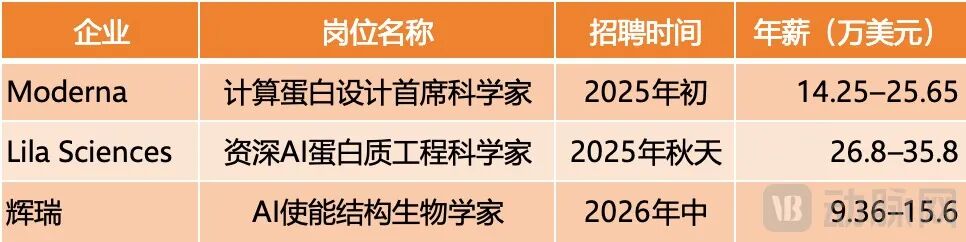
Data source of partial overseas relevant job recruitment information: VCBeat sorted according to official websites and public information
In the autumn of the same year, Lila Sciences, incubated by Flagship Pioneering, completed two consecutive rounds of financing totaling 350 million US dollars. Subsequently, Flagship Pioneering posted a recruitment for Senior AI Protein Engineering Scientist, with an annual salary ranging from 268,000 to 358,000 US dollars. The organization of Lila is flatter than that of large factories, and every new member joining the team needs to take full responsibility for their work independently, so the job description is written very straightforward: master both machine learning and biology, be able to promote a computational hypothesis all the way to wet lab verification to get results, and have proven successful cases verified by wet experiments. However, this recruitment posting was still on the website until September 2026.
In mid-2026, Pfizer also posted a similar position. It is recruiting an AI-enabled Structural Biologist, with an annual salary ranging from 93,600 to 156,000 US dollars, and the job level is one level lower than the previous two companies. But a word that rarely appeared in previous recruitment notices, "experimental triage", appeared in the job description.
The scale of Pfizer's pipeline determines that the number of candidates pushed to it by AI is massive, but experimental resources are always limited. Testing each molecule costs money and takes time, so someone needs to rely on their experience to make trade-offs: which molecules to test first and which to abandon first. "The so-called experimental triage is the implicit capability of traditional senior scientists," the aforementioned headhunter said, "Writing this requirement into AI job descriptions also shows how high the interdisciplinary requirements of such positions are."
Over more than a year, many enterprises have posted such job demands with high salaries, the job definitions have become more and more specific, but the number of talents who can meet the requirements has not increased. The reason is that there was no such position in the industry division of labor in the past few decades. The responsibility of medicinal chemists is to master synthesis, biologists need to understand experiments, while AI and large models are not within the scope of their experience and expertise. Algorithm engineers with internet backgrounds master models, but have no experience working in laboratories. "AI extracts the capability requirements of three types of people and combines them into one person," the aforementioned headhunter pointed out.
According to an estimate from an industry report, there are no more than 500 AI pharmaceutical practitioners in China who truly meet the requirements of such positions. Their salaries have doubled rapidly in the past few years. "A large part of this is panic premium, companies are raising prices mutually to compete for talents," the aforementioned headhunter said. There are no ready-made qualified talents in the market, and cultivating an interdisciplinary talent who can make independent judgments requires at least full participation in several project cycles from design to verification, and such project opportunities themselves are scarce.
"What the industry lacks is not algorithm talents, but talents who can run through the dry-wet closed loop," Ren Feng, Co-CEO of Insilico Medicine, once put forward such a judgment. The aforementioned headhunter predicts that the competition for AI pharmaceutical interdisciplinary talents will become more intense in the next 3 to 5 years, "The generative capability of AI is still growing, but the number of talents who can take over the output is limited, so the talent gap will not narrow."
It is not only a talent gap, but also an AI capability gap
In 2021, AlphaFold2 was released, and AI was able to read proteins for the first time. In the computer, by inputting an amino acid sequence, the large AI model can calculate the 3D structure in a few minutes. It took humans decades to achieve the same result with X-ray crystallography and cryo-electron microscopy, but AI only used a few days. This is a qualitative leap in life science experiments.
However, what the industry really needs is not just reading proteins. The essential difference between the two is that the answers of "reading" are already written in nature, and AI is just translating them, while "designing" needs to be created from nearly infinite possibilities. Proteins are made of amino acid chains. Theoretically, there are more than 20 choices for each position, and an ordinary protein usually consists of hundreds of amino acids.
"But essentially, AI protein design is a system, the core is not the generation module, but the evaluation module," pointed out by Zhang Xiaonan, founder of DeepSpin Technology.
To evaluate whether a candidate molecule is feasible, whether it can bind to the target, whether the binding is tight enough, whether it is stable, and whether it can be expressed by cells, two types of experiments are required: dry experiments and wet experiments. The so-called dry experiment refers to scoring with AI, which has a cost close to zero but low accuracy. Taking the prediction of ligand affinity of G protein-coupled receptors, a type of membrane protein, as an example, the current accuracy is only about 60%, far from being reliable. Conventional wet lab experiments in the laboratory are still the gold standard, with reliable results, but each molecule takes time, money, and manpower to promote one by one. More importantly, AI can generate thousands of candidate molecules a day, but the number of molecules that can be actually verified is extremely limited.
At present, the work of wet experiments itself is also quietly differentiating. The procedural work such as hands-on synthesis, reaction running, and data recording is gradually taken over by robots and automated experimental platforms. It is reported that one domestic robot laboratory can run about 800 reactions a day, which is equivalent to the workload of 150 to 200 chemists in one day. The AI and robot laboratory of Jingtai Technology has increased the success rate of chemical synthesis from 30%-40% to about 90%.
However, non-procedural work such as deciding what to test, how to test, how to interpret data, and how to feed results back to the model cannot be replaced by AI at present. Machines take over the execution work, while judgment and decision-making are left to humans. This is the underlying reason why the aforementioned AI pharmaceutical interdisciplinary talents are increasingly sought after: the speed gap between the generation end and the verification end has been further widened by AI, rather than narrowed.
AlphaFold3 released in 2024 has further improved the AI's evaluation capability, realizing atomic-level and multi-body interaction structure prediction. Theoretically, AI can complete the work of molecular evaluation, screen out a small number of potential molecules, and send them to wet experiments for further verification. But the current accuracy is far from enough to replace wet experiments.
Facing the huge talent gap, the iteration direction of large AI models has also become clear. In a sense, what determines the practical penetration capability of an AI pharmaceutical model is not the level of its design capability, but whether it can achieve a sufficiently high level in the evaluation link.
Capital is flowing into the verification link of AI pharmaceuticals. Adaptyv has increased its throughput 5 times a year, has more than 100 customers, and its revenue has increased nearly 10 times in the past 1.5 years. It secured 40 million US dollars in Series A financing in 2025, focusing on wet lab verification of AI candidate proteins. Only more than 30% of the thousands of molecules sent by Anthropic can finally bind to the target. Isomorphic Labs, spun off from DeepMind, is developing a closed-source evaluation model, and it won 2.1 billion US dollars in Series B financing in 2025, refreshing the industry's single financing record.
The next hidden reef for domestic AI pharmaceuticals?
In China, many pharmaceutical companies have also posted recruitment requirements for such interdisciplinary talents.
For example, AKBio is recruiting AI Structural Biology Algorithm Development Scientists, requiring candidates to develop antibody and protein structure prediction tools based on AI algorithms, and combine the tool output with wet experiment results to iterate the model. This is a typical demand for interdisciplinary talents who master both AI and pharmaceutical R&D. However, the job level that AKBio sets for this position is not very high, it is positioned as a technical backbone in the R&D field, and the reporting line is the head of the antibody R&D department. For another example, HuaDeep Biopharma posted a recruitment demand for AIDD Scientists, which also requires candidates to connect computational design with experiments. The job description clearly states that candidates need to jointly promote the construction of dry-wet experiment closed loop, be able to provide suggestions for computational prediction results and experimental protocols, and be able to verify and iterate designed molecules.
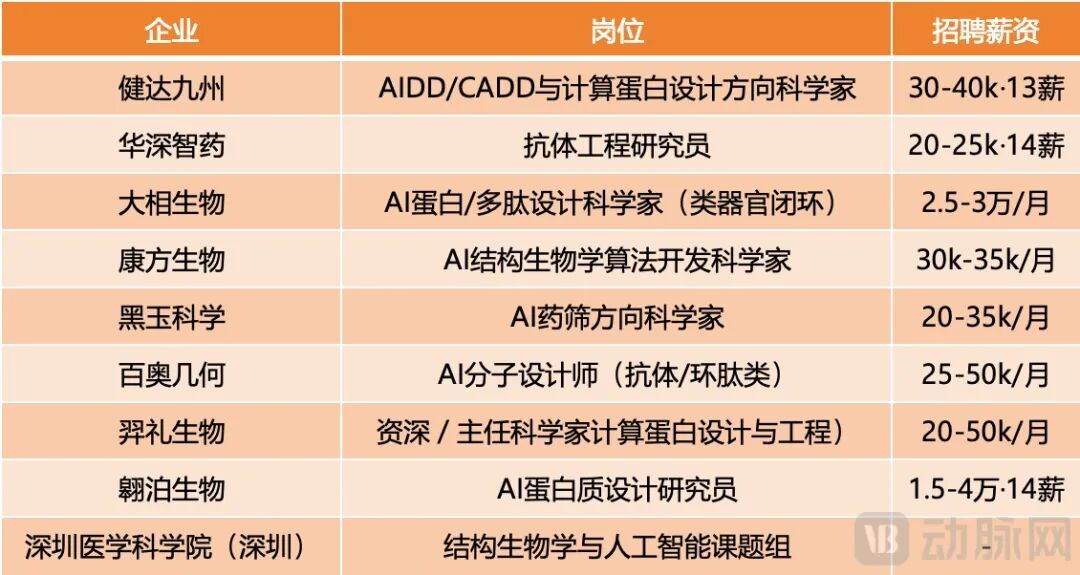
Data source of partial domestic relevant job recruitment information: VCBeat sorted according to Liepin, Boss Zhipin and public information
In addition, some enterprises have posted recruitment positions that do not directly mention the interdisciplinary background of AI and pharmaceuticals, but put forward requirements for interdisciplinary capabilities. For example, BioMap posted a recruitment demand for Chief Innovation AI Researcher on Liepin, with a monthly salary of 60,000 to 90,000 yuan and 16 annual salary payments. Although the position name is Chief Innovation Algorithm Researcher, its primary responsibility is to lead the cutting-edge technology innovation of AI and life sciences, and candidates who have published high-level papers in top interdisciplinary journals as the first author or corresponding author are preferred.
Most of these positions were posted in the first half of 2026, and are still open by late September, as suitable talents are hard to find.
In a sense, the peak of domestic interdisciplinary talent demand is far from coming. In the first half of 2026, multiple large-scale financings were completed in the AI4S field. Deep Potential's cumulative financing exceeded 1 billion yuan, and Starpharma, Zhiyuan Biotech, Deep Original Pharmaceutical and other enterprises successively obtained 100 million-yuan-level investments. After the funds are in place, platform companies are stepping up to expand their teams. Leading enterprises such as BioMap, Jingtai Technology, and MoleculeMind are all building deeper AI and pharmaceutical integration teams. With the superimposed demand, the market price of interdisciplinary talents will undoubtedly continue to rise.
More importantly, for a period of time, the gap of interdisciplinary talents may make the booming AI pharmaceutical industry face a real bottleneck in industrial penetration. In addition to the aforementioned great difficulty for enterprises to cultivate interdisciplinary talents internally, hiring existing talents with high salaries cannot fill the gap widely. On the one hand, the stock of returned overseas talents is limited, and overseas markets are also short of such talents, so the path of poaching existing talents is narrowing. A senior supervisor position of a A+H listed CDMO directly wrote "must be a returned overseas doctor" into the job requirements, which shows that enterprises are willing to pay the screening cost for this, but overseas markets are also competing for these talents. On the other hand, the scale of AI teams of multinational pharmaceutical companies in China is limited, and there is no talent stock pool precipitated from the 2018 to 2020 AI pharmaceutical boom like Moderna or Roche.
Against this background, domestic capital has also started to bet on the verification link of AI pharmaceuticals. In July 2026, Tianwu Technology completed several hundred million yuan in Series A++ financing, focusing on dry-wet closed-loop agents, feeding experimental data back into model iteration. Almost at the same time, Valhalla Technology completed multiple rounds of financing in three months, with a cumulative amount of nearly 50 million US dollars, and built its own high-throughput wet experiment platform. In August, DeepSpin Technology secured angel round financing, focusing on all-atom biological foundation models, to block molecules that are physically unfeasible at the design stage. The three enterprises have different entry points: Tianwu focuses on feeding experimental results back to the model, Valhalla focuses on raising wet experiment production capacity to industrial level, and DeepSpin focuses on filtering out physically unfeasible molecules at the AI design stage. The concentration of capital in the verification link shows that the industry has identified this hidden reef.
But the formation of the hidden reef is earlier than the identification of capital. Capital entered this field intensively in the second half of 2026, but the structural cause of the talent gap was planted much earlier. Three problems will not be solved automatically just by pouring money in: slow organizational transformation, the stock of returned overseas talents being exhausted, and the internal talent cultivation plan being split due to financial instinct. When the gap is transmitted to the pipeline progress, it will be too late to adjust the organization and supplement the talent pool.